
Singapore MVL: 12 Month Solvency Test for Foreign Founders
Published: 15 October 2026 · Reviewed by Ray Tay, Co-Founder & Managing Director, VIVOS PTE. LTD. (ACRA Filing Agent FA20240323 · MOM EA Licence 24S2425)
A members’ voluntary liquidation (MVL) closes a solvent Singapore company: directors sign a declaration of solvency, members pass a special resolution, and a liquidator settles creditors, distributes the surplus and dissolves the company. Strike-off applies only to dormant companies with no assets or liabilities. As of 2026, both routes sit under ACRA and the IRDA.
TL;DR:
- Directors must investigate the company’s finances before signing; the solvency declaration must be lodged before meeting notices and cover debts due within 12 months.
- After the resolution, file it with the Registrar within seven days, then publish notice in the Gazette and an English local daily within ten days.
- Liquidation does not suspend tax duties; GST registered companies must file returns and cancel registration within 30 days after business cessation.
- Prepare bank records, contracts, asset registers, creditor details, and tax correspondence before the meeting; the liquidator takes control after appointment.
- A false strike off declaration or unresolved objection can stall an application or prompt scrutiny, so confirm the company has no unresolved matters first.
Table of Contents
- What is a members’ voluntary liquidation?
- MVL vs strike-off: which should you use?
- How long does an MVL take?
- The step-by-step MVL process
- Filings, documents and the digital handover
- Timelines and statutory deadlines to track
- Tax and GST obligations during liquidation
- Liquidator duties and the handover checklist
- How we support foreign founders through MVL
- Why MVL is the defensible exit for cross-border founders
- Ready to close your Singapore entity the right way
- FAQ
- Sources
What is a members’ voluntary liquidation?
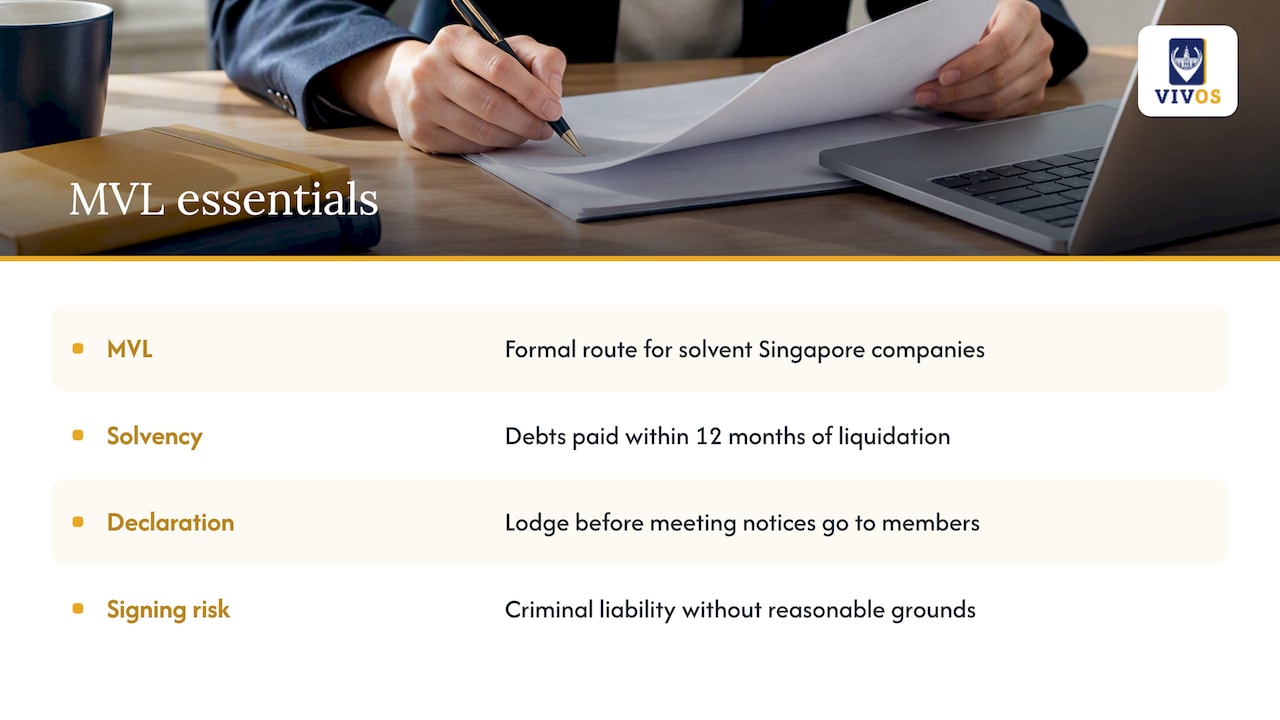
A members’ voluntary winding up is the formal route for a solvent Singapore company, one that can pay all its debts in full within 12 months after the liquidation starts. It is governed by the Insolvency, Restructuring and Dissolution Act, which provides the statutory framework for voluntary winding up.
The process begins with the declaration of solvency. Directors, or the majority where there are more than two, must make this declaration within five weeks before the winding-up resolution, and it has to be lodged before notices of that meeting go out to members or partners.
This declaration is not paperwork to rubber-stamp. Directors must genuinely investigate the company’s financial position before signing, because the law presumes a lack of reasonable grounds if the debts are not paid within the stated period, and directors who sign without that basis face criminal liability.
MVL vs strike-off: which should you use?
Foreign founders closing a Singapore entity often default to strike-off because it looks faster and carries no application fee. That assumption only holds when the company genuinely has nothing left to settle.
Strike-off may suit a company that owns no assets, owes nothing and has no pending legal or regulatory matters. MVL is generally more suitable when there is cash or property to distribute, a creditor to pay, or a claim that needs formal resolution.
- MVL gives shareholders a documented, legally defensible exit when assets or liabilities exist.
- Strike-off works only for a truly inactive company with a clean balance sheet.
- A false strike-off declaration, or an unresolved objection, can stall the application or trigger scrutiny.
| Factor | Members’ voluntary liquidation | Strike-off |
|---|---|---|
| Eligibility | Solvent company able to pay debts in full within 12 months | No assets, no liabilities, no pending proceedings |
| Cost | Liquidator fees and any applicable publishing costs | Application itself is free |
| Timeline | Governed by statutory filing windows and liquidator administration | May be more straightforward when the criteria are met, but objections can delay the application |
How long does an MVL take?
There is no single fixed duration because the liquidator’s administration period depends on how quickly assets are realized and creditors settled. The statutory deadlines, however, are fixed and worth planning around.
Directors’ solvency opinion must cover the 12 months following commencement of the winding up, and the declaration itself must be made within five weeks before the resolution is passed. Once members pass the special resolution, the clock runs fast: the resolution must be lodged with the Registrar within seven days, and notice published in the Gazette and at least one English local daily newspaper within ten days.
After that, the liquidator’s work and the final meeting determine when dissolution actually completes, which is why assembling clean records before the process starts can help the process run more smoothly.
The step-by-step MVL process
The sequence below follows the order ACRA and the Ministry of Law expect, and skipping ahead on any step risks a defective filing.
- Hold a directors’ meeting to investigate the company’s affairs and prepare a statement of affairs.
- Make and lodge the declaration of solvency via BizFile within the five-week window before the resolution, as set out by ACRA’s guidance.
- Call a general meeting where members pass the special resolution to wind up and appoint a liquidator.
- Lodge the resolution with ACRA within seven days, then publish notice in the Gazette and one English local daily within ten days.
- Hand administration to the liquidator, who collects assets, pays creditors, resolves tax and GST matters, and calls the final meeting.
- Apply for dissolution once the liquidator confirms all statutory obligations, including IRAS filings, are closed out.
We note that VIVOS is an ACRA-registered filing agent providing Singapore company incorporation for foreign founders, including nominee resident director, registered address, corporate secretary, strike-off and liquidation support, and we serve Malaysia, Hong Kong and the UAE as well.
Filings, documents and the digital handover
Every statutory step above maps to a specific BizFile lodgement, so directors should know what to prepare before the meeting clock starts.
- BizFile carries the declaration of solvency and, later, the winding-up resolution. The declaration filing requires a statement of affairs as a supporting upload.
- The Gazette and at least one English local daily newspaper notice must go out within ten days of the resolution.
- The liquidator can retrieve Notices of Assessment and Statements of Account through myTax Portal.
- A complete handover includes bank statements, contracts, asset registers, the creditor list, statutory registers and GST correspondence.
Pro Tip: Confirm the access and records the liquidator will need before administration begins.
Founders managing statutory registers from abroad should check which records are held by the corporate secretary and include them in the handover.
Timelines and statutory deadlines to track
Four deadlines anchor the entire process, and missing any one of them creates avoidable friction with ACRA or the Registrar.
The 12-month solvency horizon sets the test directors must satisfy before signing anything. The five-week window before the resolution is when that declaration has to be made and lodged. Once the resolution passes, the seven-day filing deadline with the Registrar and the ten-day publication deadline run in parallel, both counted from the resolution date rather than from each other.
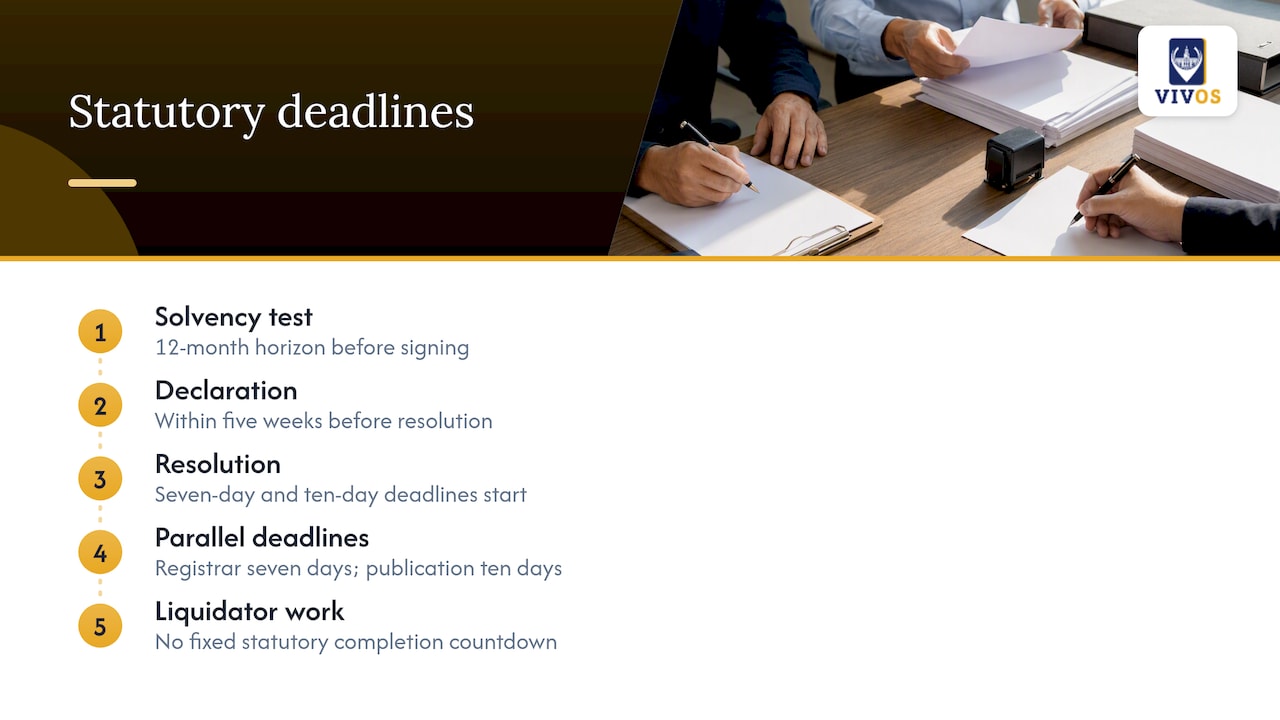
The liquidator’s final meeting, and the dissolution that follows it, have no fixed statutory countdown; their timing reflects how quickly assets, creditors and tax matters actually close out.
Tax and GST obligations during liquidation
IRAS treats liquidation as a distinct filing period, not an automatic exemption from compliance. The liquidator must file all outstanding financial statements and tax computations up to the liquidation date, along with a Declaration of Receipts and Payments covering the liquidation period itself, as described in IRAS guidance on companies under liquidation.
Liquidators can use the myTax Portal to retrieve Notices of Assessment and Statements of Account and check the company’s tax position.
For a GST-registered entity, the obligations run further: file returns up to the day before liquidation, have the liquidator file GST returns for the periods afterward, apply to cancel GST registration within 30 days of business cessation, and file the final GST F8 where required.
Liquidator duties and the handover checklist
Once appointed, the liquidator takes over execution entirely. Directors’ role shifts from decision-maker to record-provider, and the quality of that handover determines how smoothly the rest of the process runs.
The liquidator’s statutory duties cover taking custody of company assets, paying creditors in the correct order, investigating any outstanding claims, resolving tax and GST matters with IRAS, and calling the final meeting that leads to dissolution.
- Bank statements and reconciliations for all active accounts.
- Contracts, leases and any agreements still in effect.
- Asset registers, creditor details and outstanding tax or GST correspondence.
Pro Tip: Assembling these documents before the general meeting cuts both the liquidator’s time and the professional fees tied to that time.
How we support foreign founders through MVL
VIVOS is an ACRA-registered filing agent providing Singapore company incorporation for foreign founders, with nominee resident director, registered address, corporate secretary, strike-off and liquidation support, and the same model extends to Malaysia, Hong Kong and the UAE.
On the MVL side, we provide liquidation support.
“Foreign founders often assume winding up a Singapore entity is as simple as filing one form. An MVL protects the people behind the company, which is why the paperwork exists in the first place,” says Ray Tay, Managing Director of VIVOS.
Why MVL is the defensible exit for cross-border founders
MVL exists because a clean break matters more than a fast one. For a founder who no longer lives in Singapore, a documented liquidation closes the legal and tax trail in a way that strike-off cannot, especially when creditors, contracts or unresolved claims are still in the picture.
Reconcile the accounts and address disputes before signing the declaration of solvency, and prepare the handover for the liquidator.
— Ray
Ready to close your Singapore entity the right way

Winding up a company cleanly takes more than a form on BizFile. We are an ACRA-registered filing agent providing Singapore company incorporation for foreign founders, with nominee resident director, registered address, corporate secretary, strike-off and liquidation support, and we extend the same service model to Malaysia, Hong Kong and the UAE.
Where an MVL is the right route, we handle the pieces that usually cause delay:
- Providing liquidation support.
- Managing ongoing corporate secretarial obligations until the final meeting.
Get in touch through our pricing and services page for a quote tailored to your entity’s structure and timeline.
This article is general information, not a substitute for advice from a qualified financial advisor. Consult a qualified financial professional about your own circumstances before acting on anything here.
FAQ
Is an MVL mandatory for every solvent Singapore company closing down?
No. A solvent company with no assets, no liabilities and no pending matters can use strike-off instead, which carries no application fee from ACRA. MVL may be more suitable when there are assets to distribute or creditors and claims that need formal resolution.
Who signs the declaration of solvency?
The directors make the declaration, or the majority of them where the board has more than two members, and it must happen within five weeks before the winding-up resolution is passed, according to ACRA’s guidance. The declaration has to be lodged before meeting notices go out.
What happens if debts are not paid within the declared period?
The law presumes the directors lacked reasonable grounds for the declaration, which can expose them to criminal penalties under the Insolvency, Restructuring and Dissolution Act. This is why a genuine investigation of the company’s finances has to precede the signature, not follow it.
Can a foreign founder manage an MVL remotely?
A foreign founder can coordinate with a corporate secretary or filing agent on BizFile lodgements, the liquidator handover and IRAS correspondence. VIVOS is an ACRA-registered filing agent providing Singapore company incorporation for foreign founders, including liquidation support.
Sources
- About Liquidation or Winding Up
- Members’ or partners’ voluntary winding up: Declaration of solvency | Accounting and Corporate Regulatory Authority
Recommended
Most Popular
 2 January, 2025
Why Singapore Comes Into Action For Chinese Companies
 2 January, 2025
Malaysia’s Budget 2025: What The Dividend Tax Means For You
Recents Blogs


Singapore Compliance Calendar When You Also Run an Overseas Company (2026)

A Singapore company runs on its financial year end: ECI within 3 months, the ACRA annual return within 7 months for a non-listed company, and…

新加坡商业许可申请全攻略:ACRA 注册后该怎么做
了解新加坡商业许可如何按行业判定,注册后用 GoBusiness 查询牌照要求,并掌握餐饮、按摩、进出口审批及场地合规要点,避免申请受阻。