Singapore Due Diligence Checklist: 14 Points for Foreign Founders
Published: 20 September 2026
Buying into a Singapore company means checking five things before you sign anything: corporate standing, financial health, legal exposure, tax history, and employment liabilities. This due diligence checklist runs 14 items across those categories, built for foreign founders and investors acquiring a Singapore company. Every corporate record traces back to ACRA and every tax record to IRAS, as of 2026.
TL;DR:
Most buyers overlook the importance of inspecting original share certificates and legal documents, which can reveal discrepancies unseen in online ACRA extracts.
Thorough financial due diligence requires management accounts dated within 60 days of the deal and detailed receivables schedules, not just audited statements.
Legal and IP checks must include review of material contracts, ownership of IP, and pending or past litigation to uncover hidden risks and liabilities.
Verifying property ownership and zoning compliance through the Land Authority can prevent post-deal disputes that may nullify or alter the transaction value.
Employment and data protection checks, including CPF contributions, work passes, and PDPA compliance, are critical for foreign buyers to avoid inherited liabilities.
Vivos
Navigate Singapore Business Complexity
Vivos helps international entrepreneurs with incorporation, compliance, accounting, taxation, banking support, and corporate advisory in Singapore.
Corporate Checklist: What to Pull From ACRA and the Target’s Statutory Books
Corporate due diligence in Singapore starts with a paper trail, not a conversation. The target’s ACRA BizFile+ extract is the single most reliable document in the entire deal because it is a government record, not a management claim. From there, the checklist moves into the company’s own books, where discrepancies between what ACRA shows and what the constitution or minute book records are common enough to be routine.
Pull the ACRA BizFile+ extract and reconcile it against the target’s internal share register and directors list, line by line.
Inspect original share certificates, not scanned copies, and match serial numbers to the register.
Read the board minute books cover to cover for resolutions that were passed but never filed or disclosed to the buyer.
Review the constitution for share transfer restrictions, pre-emption rights, and drag-along or tag-along clauses that could complicate the transaction.
Confirm the Register of Registrable Controllers (RORC) matches the actual beneficial ownership chain, including any nominee arrangements.
Search for charges, pledges, and encumbrances registered against the shares or company assets on the ACRA record.
Identify all options, warrants, and convertible instruments outstanding, since these dilute the buyer’s eventual stake if exercised post-completion.
For the data room, a proper corporate due diligence questionnaire (DDQ) asks for certified true copies of the last three annual returns, the full minute book, all share certificates, and a signed RORC declaration, not just a company profile printout. A corporate records due diligence review at this stage catches issues that a surface-level ACRA search misses entirely, particularly around undisclosed charges or lapsed filings.
Pro Tip:Physical inspection of original share certificates and minute books can reveal discrepancies that online extracts never show. If ownership is material to the valuation, insist on seeing the originals, not photocopies.
Financial Checklist: Documents and Focused Checks Investors Must Run
Financial due diligence in Singapore hinges on getting real numbers, not adjusted ones the seller wants you to see. Audited statements tell you where the company has been; management accounts tell you where it actually stands today, which is often a different story.
Request audited financial statements for the past three to five years, plus the latest management accounts, ideally dated within 60 days of the term sheet.
Check receivables aging and flag any customer balances outstanding beyond 90 days, since these often get written off post-acquisition.
Assess customer concentration by revenue percentage. A single client above 20% of revenue is a red flag for deal pricing.
Identify off balance sheet liabilities, including guarantees, letters of credit, and related party loans that don’t appear on the face of the statements.
Confirm accounting policies align with SFRS or SFRS(I) and reconcile any earn-out calculations against the actual accounting standard used.
Normalize cash flow and working capital by stripping out one time items, owner drawings, and non-recurring expenses to see the real operating picture.
Practice guides for buying a business in Singapore consistently point to bank confirmations and detailed receivables schedules as the items sellers are slowest to hand over, which itself tells you something worth investigating.
Pro Tip:Ask for management accounts covering the stub period between the last audited year end and completion. A seller who stalls on this request is usually hiding a recent dip in performance.
Legal Checklist: Contracts, IP, Litigation, and License Audits
Legal due diligence is where deals quietly fall apart after signing, usually because a contract clause or license nobody flagged during negotiation. Singapore’s legal due diligence practice notes emphasize material contracts, IP, and employment matters as the three areas most likely to hide value destroying surprises.
Collect all material contracts above a defined value threshold and flag change of control or anti assignment clauses that could void the agreement on transfer.
Verify IP ownership and registrations with the relevant Singapore authorities, and trace the chain of title for any IP built by contractors rather than employees.
Trace software license chains, especially for SaaS businesses, since licenses issued to the founder personally rather than the company are a common and costly oversight.
Search for pending or threatened litigation and any regulatory investigations, both filed and informally flagged by counterparties.
Audit every statutory license the business holds for validity and transferability, including sector specific licenses from MAS, IMDA, or SFA where the business touches financial services, telecoms, or food.
A well drafted share purchase agreement allocates the risk for anything found late in this process, so review draft SPA warranties alongside the contract review, not after it.
Tax Checklist: IRAS Records, GST, Withholding Tax, and Transfer Pricing Risks
Tax due diligence uncovers liabilities that don’t show up anywhere else in the deal, because they belong to the government, not the company’s own books.
Obtain IRAS tax assessments and correspondence for the past several years, covering both corporate income tax and GST, since IRAS holds records of unpaid liabilities and open disputes that management accounts rarely disclose.
Confirm GST registration status and filing history, and check whether any GST audit flags or disputes remain unresolved.
Review withholding tax compliance on cross border payments and request transfer pricing documentation for any related party transactions, particularly for groups with regional operations.
Check exposure under the domestic top up tax framework tied to the OECD’s global minimum tax rules (GloBE), which affects multinational groups with Singapore entities from 2025 onward.
Singapore’s tax authority has tightened scrutiny of related party arrangements in recent years, and buyers who skip the transfer pricing review often inherit an assessment gap that surfaces only at the next filing cycle.
Statistic: IRAS treats correspondence going back three to five years as the standard lookback window for corporate tax review, which is why this checklist mirrors that same period for both requests and audits.
Employment Checklist: Contracts, CPF, Work Passes, and Key Person Exposure
Employment liabilities move with the company, not with the seller, which makes this section non-negotiable for foreign buyers.
Collect employment contracts for key staff, checking restraint of trade clauses and whether change of control triggers resignation or retention bonus rights.
Verify CPF contribution records for arrears, late payments, or disputes with the CPF Board, since unpaid contributions transfer directly to the new owner.
Confirm the validity of Employment Passes, S Passes, and work permits, and check whether these require fresh applications post-acquisition rather than simple transfer.
Identify key person dependency, particularly where a single technical founder or sales lead holds relationships the business cannot easily replace.
Cross border M&A guidance for Singapore flags CPF and Employment Act transfer issues as a recurring trap for foreign buyers who assume employment contracts simply carry over. They often don’t, and MOM’s Fair Consideration Framework compliance history is worth a separate check if the target employs a large foreign workforce.
PDPA / Data Protection Checks
Singapore’s Personal Data Protection Act (PDPA) applies to any company handling personal data, and it carries extraterritorial reach that catches foreign buyers off guard. The Personal Data Protection Commission (PDPC) enforces compliance, and a target’s data practices become the buyer’s problem the moment the deal closes.
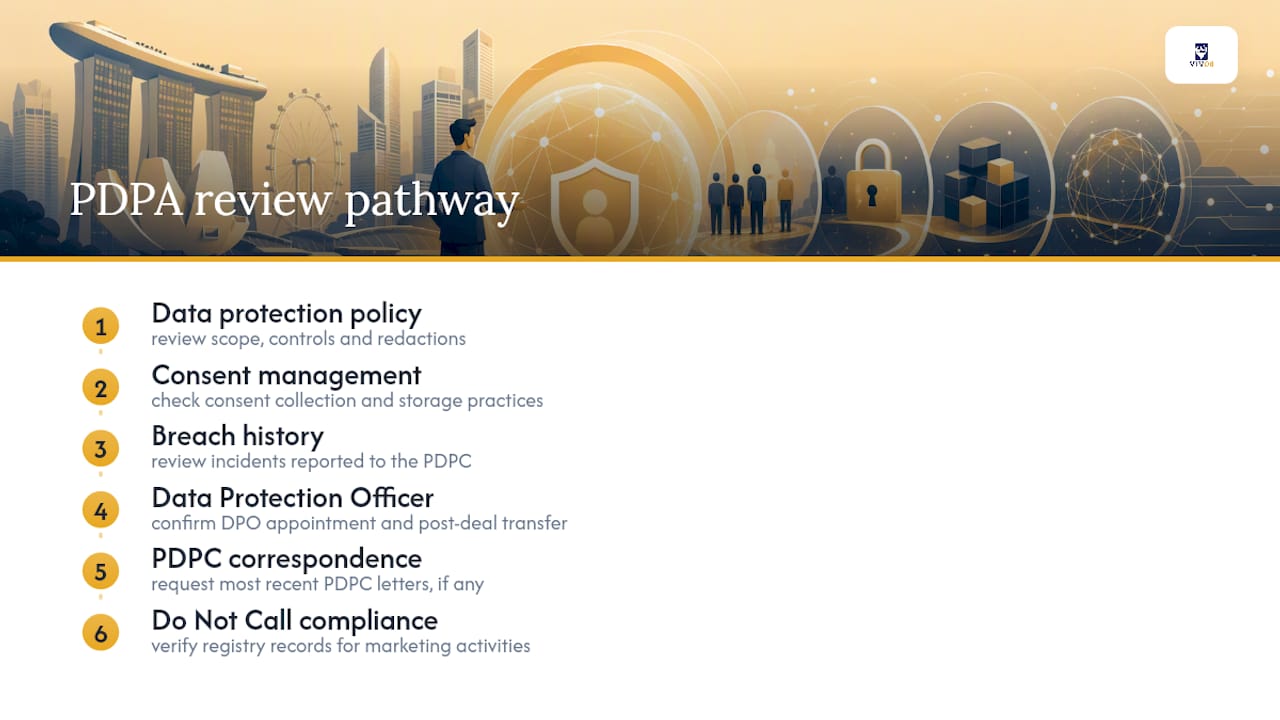
Review the target’s data protection policy, its consent management practices, and any breach history reported to the PDPC. Vendor disclosures in a data room are usually redacted for personal data specifically because sharing unredacted personal data creates PDPA obligations for the buyer before the deal even completes. Expect this redaction. It’s standard practice, not evasion.
Check whether the target has appointed a Data Protection Officer, as required under the PDPA, and whether that role transfers or needs replacing post-acquisition. If the business processes customer data at scale, such as an e-commerce platform or a fintech, request the PDPC’s most recent correspondence, if any, and any Do Not Call registry compliance records for marketing activities. A business that has never faced a PDPC inquiry isn’t automatically clean. It may simply never have been checked, which is a different risk profile entirely.
Legal Dispute and Litigation History Check Specific to Singapore Courts and Tribunals
Litigation history rarely shows up in a company’s marketing deck, and sellers have no obligation to volunteer it unless asked directly. This is one of the more overlooked steps in Singapore due diligence because it requires searching sources most buyers don’t know exist.
Search the State Courts and the Singapore High Court records for any civil suits naming the target company, its directors, or its major shareholders. Check the Employment Claims Tribunal for wage or wrongful dismissal disputes, which are common in smaller companies and often settled quietly without reaching a formal court filing. Review whether the company has faced any Singapore International Arbitration Centre (SIAC) proceedings, particularly relevant for businesses with cross border commercial contracts.
Regulatory investigations deserve a separate line item from civil litigation. A company under an active or recent inquiry from a sector regulator, such as the Monetary Authority of Singapore for financial services businesses, carries a different risk profile than one facing a straightforward commercial dispute. Ask directly whether any director has received a show cause letter or warning from a regulator in the past three years, and get that answer in writing as part of the seller’s disclosure schedule, not as a verbal assurance during negotiations.
Verification of Property Ownership and Land Titles via Singapore Land Authority (SLA)
Property matters more in Singapore due diligence than buyers from other markets expect, largely because so much commercial real estate involves leasehold rather than freehold arrangements. If the target owns or leases premises, the Singapore Land Authority (SLA) holds the authoritative title records that confirm what the seller actually claims to own.
Pull the SLA title search for any property listed as a company asset and confirm the registered proprietor matches the target entity, not a related party or a director personally. For leasehold arrangements, which cover most commercial and industrial space in Singapore, check the remaining lease tenure against the buyer’s intended holding period. A lease with 15 years remaining changes the economics of a deal very differently than one with 60.
Check for any caveats lodged against the property, which signal a pending dispute or a competing claim on title. If the business operates from industrial space, confirm the property’s approved use under URA zoning matches the actual business activity, since a mismatch can trigger enforcement action after closing. For manufacturing or logistics targets, this step alone has derailed deals where the seller’s actual operations exceeded what the zoning permitted.
Customer and Supplier Due Diligence Focusing on Singapore Market Relationships and Dependencies
A Singapore target’s customer and supplier base often tells you more about the real business than its financial statements do. Revenue concentration risk, covered under the financial checklist, is only half the picture. The other half is understanding whether relationships depend on the company itself or on personal ties that walk out the door with the founder.
Map the top ten customers and top ten suppliers by revenue and spend, and check contract terms for exclusivity, minimum volume commitments, or pricing locked to a departing owner’s personal relationship. For businesses serving government agencies or statutory boards, confirm whether contracts were awarded through open tender or through a relationship that may not survive a change of ownership. GeBIZ tender records offer a way to verify government contract history independently of what the seller claims.
Supplier dependency deserves equal scrutiny. A business reliant on a single Singapore based supplier for a critical input carries concentration risk that mirrors customer concentration, just less visible on the balance sheet. Ask for supplier contracts covering the past two years and check for price escalation clauses, minimum order requirements, or termination rights that a change of control might trigger.
Government Grants and Incentives the Target May Have Received or Qualify For
Singapore offers a wide set of grants and tax incentives that a target company may already be using, or may qualify for but never claimed. Either way, this affects deal value and post-acquisition planning.
Check whether the target has received support through schemes such as the Enterprise Development Grant (EDG) or Productivity Solutions Grant (PSG), both administered by Enterprise Singapore, and confirm whether any clawback provisions apply if ownership changes within a defined period. Some grants carry conditions tied to the original recipient’s shareholding structure, which a change of control can breach if nobody checks the fine print.
Review whether the target holds any tax incentive status, such as the Pioneer Certificate or Development and Expansion Incentive, since these typically require Singapore Economic Development Board approval and often carry conditions about headcount, investment commitments, or business activity that a new owner must continue meeting. Losing incentive status post-acquisition can materially change the deal’s projected returns, so this check belongs in the valuation model, not just the legal disclosure schedule.
Practitioner Perspective: What Buyers Skip Most
An exceptions-only report, flagging only material issues instead of documenting every finding, saves time and cost on straightforward deals. It works only when the DDQ is tight enough to catch what actually matters.
Licenses are the routine oversight. Buyers verify ownership and financials closely, then assume a license simply transfers with the company. It often doesn’t.
“The item buyers skip most is the license audit,” says Ray Tay, Managing Director of Vivos. “They assume a license transfers with the company. In Singapore, it rarely happens automatically.”
Bring in local counsel, a tax adviser, and a corporate secretary early, before the term sheet, not after.
— Ray
Who Handles This: Vivos for Foreign Founders Buying Into Singapore
Every item on this checklist assumes someone is actually pulling the ACRA extract, filing the RORC declaration, and keeping the statutory books current after closing. That’s the part foreign founders underestimate.
There are firms that handle nominee resident director, registered address, corporate secretary, and statutory records for foreign founders buying into or setting up a Singapore company. It’s the same practical support whether you’re incorporating fresh or stepping into an acquired entity that needs its compliance brought current. Some providers also cover Malaysia, Hong Kong, and UAE for founders structuring deals across more than one jurisdiction.
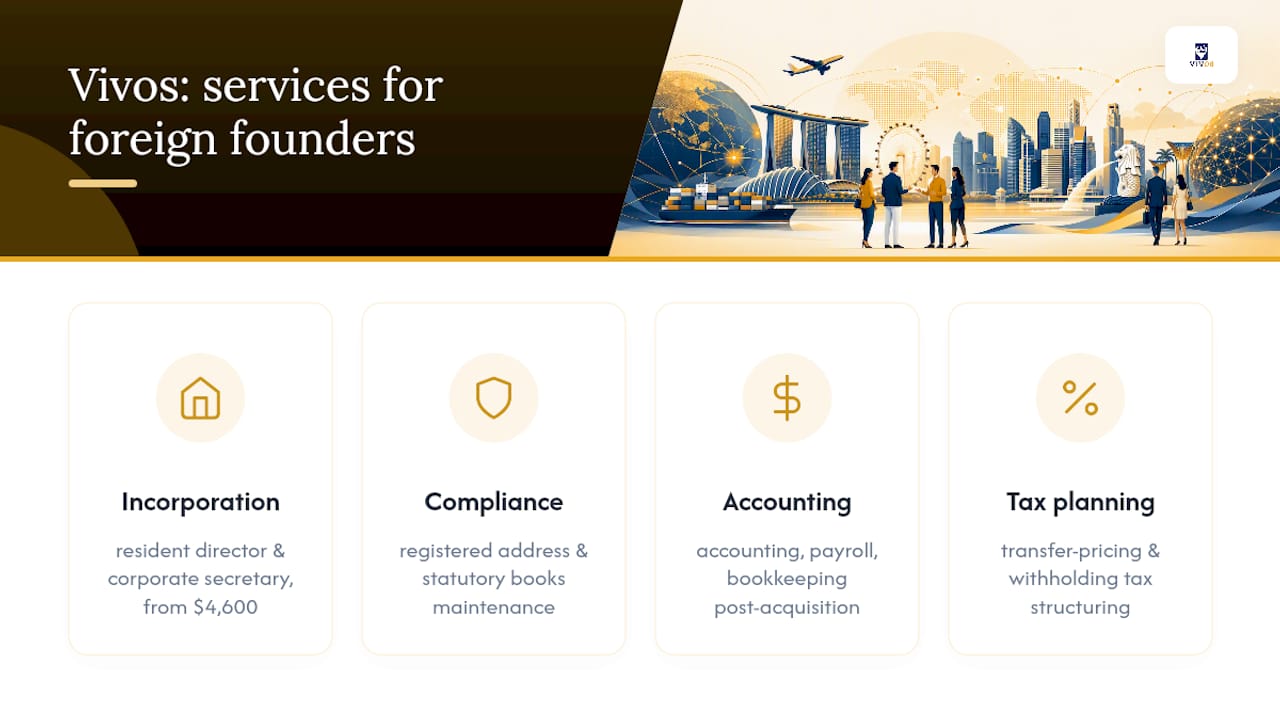
Post-acquisition, Vivos handles the accounting, payroll, and bookkeeping and compliance work this checklist assumes is already in place, plus tax planning and structuring for the transfer pricing and withholding tax exposures the tax checklist above flags. If the target needs a resident director or a corporate secretary appointed before completion, that’s a same setup Vivos runs for foreign-founder incorporation, starting from $4,600 one off.
Check current pricing and service scope on the Vivos pricing page or start with the incorporation service page to see what a resident director and corporate secretary setup involves before your deal closes.
This article is general information, not a substitute for advice from a qualified financial advisor. Consult a qualified financial professional about your own circumstances before acting on anything here.
What Should Be Included in a Due Diligence Checklist?
A complete due diligence checklist for a Singapore acquisition covers five categories: corporate records (ACRA filings, share register, RORC), financial statements, legal contracts and litigation history, tax filings with IRAS, and employment compliance including CPF and work passes. Each category needs its own document requests and specific verification steps, as outlined above.
What Is a CDD Checklist?
A CDD, or corporate due diligence checklist, focuses specifically on verifying a company’s legal and statutory standing, including its ACRA records, constitution, share register, and Register of Registrable Controllers. It’s the corporate component of the broader due diligence process and typically the first stage completed before financial and legal reviews proceed.
What Is a DDQ Questionnaire?
A due diligence questionnaire (DDQ) is the structured document request list a buyer sends to a seller, specifying exactly which corporate, financial, legal, tax, and employment records are needed for the data room. A tight, well scoped DDQ is what makes an exceptions only due diligence report workable without missing material risks.
What Are the Five Core Parts of Due Diligence?
The five core parts of due diligence for a Singapore company acquisition are corporate, financial, legal, tax, and employment review. Corporate confirms ownership and statutory compliance through ACRA, financial verifies the numbers through audited statements, legal checks contracts and litigation exposure, tax reviews IRAS filings and GST history, and employment confirms CPF compliance and work pass validity for the workforce being acquired.
Master the cap versus discount crossover. Calculate the $12.5M breakpoint from a $10M cap and 20% discount, model conversions, and avoid Singapore filing...
Which consulting niches need a licence in Singapore, PDPA obligations every consulting firm carries, and the SS 680:2021 standard that replaced TR 43:2015 for Enterprise…