
去印尼扩张为何要先设新加坡控股公司?直接持股最多损失37.6%(2026年算法)

Ray Tay
直接持有印尼公司:22%企业所得税+20%股息预提税=37.6%;通过持股≥25%的新加坡控股公司,协定税率10%,合计29.8%,且退出时印尼不征税。
Published: 17 August 2026 · Last reviewed: 30 September 2026 · Reviewed by Ray Tay, Co-Founder & Managing Director, VIVOS PTE. LTD. (ACRA Filing Agent FA20240323 · MOM EA Licence 24S2425)
By Ray Tay, Co-Founder & Managing Director at VIVOS Pte. Ltd. — ACRA Registered Filing Agent FA20240323 · MOM Employment Agency Licence 24S2425 · Last reviewed: 17 September 2026
The 13O incentive requires S$20 million AUM and 2 investment professionals; 13U requires S$50 million and 3 investment professionals, at least one non-family. Both exempt qualifying fund income from Singapore tax, require tiered local business spending (S$200k–1M), and commit 10% or S$10M of AUM to local investments.
| 13O | 13U | |
|---|---|---|
| Minimum AUM | S$20M | S$50M |
| Investment professionals | 2 (≥1 non-family) | 3 (≥1 non-family) |
| Local business spending | Tiered S$200k–1M by AUM | Tiered S$200k–1M by AUM |
| Capital deployment (local) | 10% of AUM or S$10M (lower) | Same |
| Typical setup-to-launch | ~4–6 months | ~4–6 months |
Watch on YouTube: Singapore family office rules just changed (2026) · 1 min 18 sec.
13O typically suits first-generation wealth consolidating a single family’s assets into one Singapore vehicle — the lower AUM and professional-headcount bar make it the more accessible route. 13U is built for institutional-scale families: the higher thresholds (S$50M AUM, 3 investment professionals with at least one non-family hire) reflect a more mature governance structure, and MAS treats 13U applicants closer to a licensed fund manager in terms of expected substance.
Both incentives run through MAS’s application process and require the fund vehicle, the local business spending, and the investment professionals to be in place before approval — this is structuring and compliance work best done before you apply, not after. Once operating, a family office can also anchor Employment Pass applications for family members working in it, and at S$200M+ AUM it connects directly to the Global Investor Programme as a route to Singapore PR.
Family offices sit alongside VIVOS’s core tax structuring and compliance services — see our tax page for the wider Singapore corporate and personal tax picture your family office will operate within.
Not by itself — but it anchors Employment Pass applications for family members working in it, and at S$200M+ AUM it can qualify under GIP Option C for permanent residency.
They’re incentive awards subject to ongoing conditions (AUM, spending, professionals) — breach the conditions and the exemption is at risk.
AUM is measured on the fund vehicle the incentive covers; structuring which assets sit inside is exactly the design work to do before applying.
Budget roughly S$150,000–S$500,000 in one-off setup costs (legal structuring, fund-vehicle incorporation, the MAS application, and first-year compliance), plus annual running costs commonly in the S$300,000–S$1.5 million+ range once headcount and local spending conditions are met. Many practitioners now quote 6–12 months end-to-end for a first-time applicant, so build in buffer beyond an optimistic best case.
Not automatically — the tax incentive and immigration status are separate applications. Families targeting residence through a family office generally look at the Global Investor Programme’s Option C, which requires a much larger S$200 million AUM family office with at least S$50 million deployed into approved Singapore investments, well above the 13O/13U entry thresholds. Smaller family offices more commonly pursue PR by first placing an owner or professional on an Employment Pass.
MAS re-tests AUM, local spending, and staffing at every financial year-end, not just at application. If designated investments fall below the applicable threshold at a year-end, the fund typically loses the tax exemption for that basis period; in cases of a genuine breach, MAS can withdraw the award and IRAS can retrospectively tax the previously exempted income. Large distributions or withdrawals close to financial year-end are a common trigger.
Yes — qualified family members can count toward the investment-professional headcount under both schemes, provided they meet the same conditions as any other hire: Singapore tax residency, a fixed monthly salary above the MAS floor, and a genuine, substantial investment role. However, both 13O and 13U require at least one non-family investment professional, so an all-family team does not qualify under either scheme. Non-citizen family members taking up these roles need an Employment Pass, assessed under MOM’s COMPASS framework.
It depends on scale and purpose. Singapore does not impose a general capital gains tax and generally exempts most foreign-sourced income and dividends received by individuals, so a passive high-net-worth investor can already achieve a low personal tax burden without any structure. A 13O/13U family office adds value less through incremental tax savings and more through consolidated governance, multi-generational succession planning, the ability to formally employ and sponsor passes for family members and professionals, and the credibility of a MAS-recognised structure.
Facts in this guide were checked against the Monetary Authority of Singapore’s (MAS) published FAQs on the Schemes for Single Family Offices and MAS’s media release on the revised Single Family Office framework taking effect 15 June 2026, MAS circulars governing the Section 13O and 13U qualifying conditions (investment-professional headcount, local business spending tiers, and the capital deployment requirement), Inland Revenue Authority of Singapore (IRAS) guidance on the tax exemption schemes for funds, Ministry of Manpower (MOM) Employment Pass and COMPASS framework guidance for the family-member and non-family staffing points, and the Singapore Economic Development Board’s (EDB) published criteria for the Global Investor Programme. Figures were cross-checked against current published analysis from Singapore-licensed corporate services and law firm practitioners. Last verified: 17 September 2026. Rules change periodically — always confirm current thresholds directly with MAS before relying on this guide for an application.
Choosing between Section 13O and 13U, structuring the fund vehicle, meeting the investment-professional headcount (including the non-family requirement), and lining up the right Employment Passes are easier to get right the first time than to fix after MAS has queried an application. VIVOS Pte. Ltd. is a Singapore-licensed corporate services and immigration firm — ACRA Registered Filing Agent FA20240323 and MOM Employment Agency Licence 24S2425 — handling incorporation, the 13O/13U application, and family and professional passes under one team.
Talk to a specialist: WhatsApp +65 9366 9399 or contact@vivos.com.sg — incorporation, passes and compliance handled by one licensed team.
Related: For families weighing Permanent Residence alongside the fund structure, our Global Investor Programme (GIP) 2026 guide covers the S$200M Option C family-office route and when 13O/13U plus an Employment Pass is the smarter sequence.
See also: our Employment Pass guide for family office principals and key staff, our Singapore trust structures guide for how families hold assets alongside a 13O/13U vehicle, and our glossary of Singapore immigration and family office terms.
 2 January, 2025
 2 January, 2025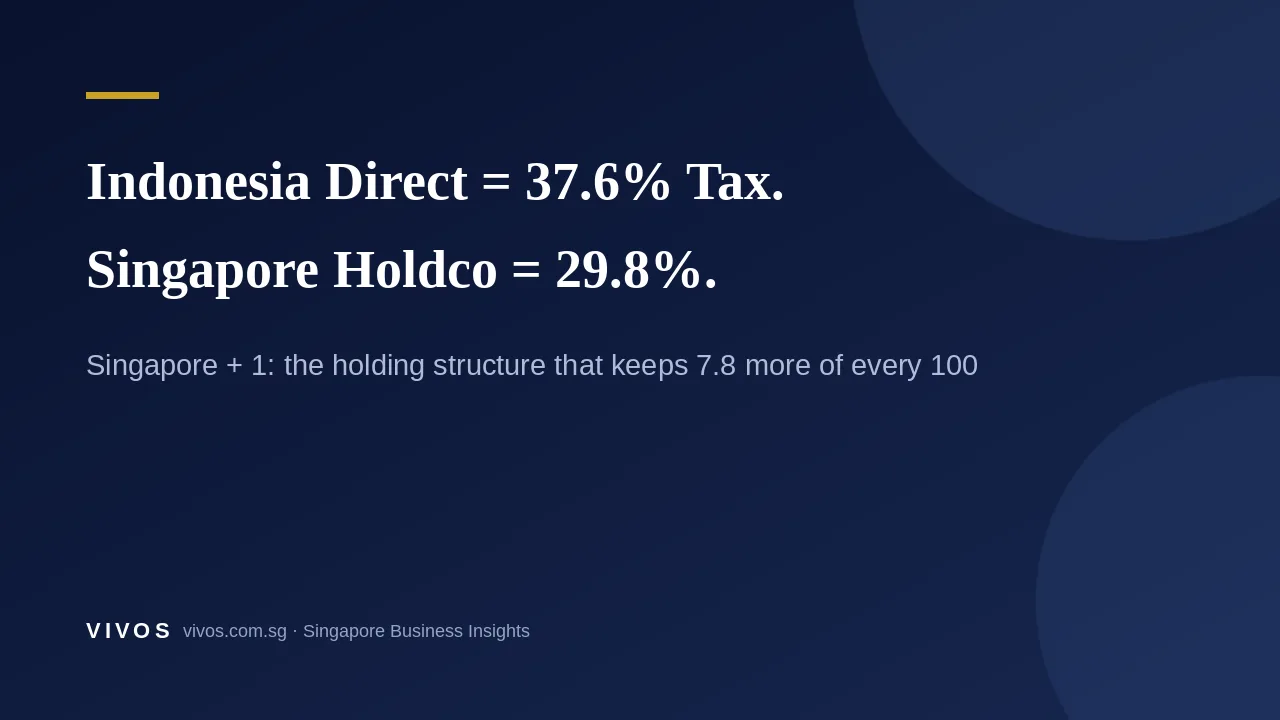
直接持有印尼公司:22%企业所得税+20%股息预提税=37.6%;通过持股≥25%的新加坡控股公司,协定税率10%,合计29.8%,且退出时印尼不征税。
Own an Indonesian company directly and up to 37.6% of profit is gone. A Singapore holding company (≥25%) cuts that to 29.8% and protects the…
VIVOS Group has opened its Dubai office in Business Bay, led by Partners Neelam Bhatia and Shafran Ally, for UAE company formation, licensing and visas.