

GST Registration & Filing Services in Singapore
Stay compliant, avoid penalties, and simplify your GST obligations with expert support for registration, computation, and filing.
Last updated:
Connect With Us Now


Expert GST Registration and Filing for Businesses in Singapore
What Is GST, and Which Businesses Must File It?
GST is a 9% consumption tax on most goods and services in Singapore, including imports. Businesses with annual taxable turnover above SGD 1 million must register for GST and file returns with IRAS. GST-registered businesses must charge GST on sales, submit timely filings, and comply with tax rules. Some supplies, like exports and international services, are zero-rated, while financial services and residential property sales are GST-exempt.
You must register if your taxable turnover is more than S$1 million at the end of a calendar year (apply between 1 and 30 January of the following year), or if you reasonably expect it to exceed S$1 million in the next 12 months (apply within 30 days). Taxable turnover includes zero-rated supplies such as exports, but not exempt supplies. Read our guide to GST registration in Singapore, or talk to us about where your business stands.
GST Registration and Filing Services We Offer – End-to-End GST Solutions
We support Singapore companies, including those owned and run by overseas founders, from the first question of whether you need to register through to regular returns and, when the time comes, deregistration. Every engagement starts with an evaluation of your registration requirement against IRAS’s turnover tests, so you register when the rules require it or when it makes commercial sense.
- Evaluation of your GST registration requirement based on revenue thresholds.
- Application for GST registration via myTax Portal.
- Guidance on schemes such as reverse charge or overseas vendor registration.

- Quarterly or monthly preparation and submission of GST returns.
- Accurate reporting of output and input tax.
- Claiming of GST on eligible business expenses and imports.
- Timely filing via myTax Portal to avoid penalties.

- Assistance in recovering GST paid on purchases before registration.
- Ensure documentation and eligibility requirements are met.

- Periodic health checks to validate your GST processes.
- Guidance in responding to IRAS queries or audits.
- Filing corrections and voluntary disclosures, where needed.
- Advisory on when and how to deregister from GST.
- Full support with final return preparation and closure procedures.


What Our Clients Are Saying
Mr Bok
Singapore
"Ivan and team is very responsive, and is able to give very all rounded advise surrounding my business expansion across the border. These guys are experts, no regrets taking a chance to speak with them on my banker's recommendation."

Mr C Zhao
Chengdu, China
"I got some information about Singapore from a friend, but to my surprise, what I'd been told wasn't entirely accurate — especially advice from so-called Singapore experts.
My worst nightmare was realizing, 2-3 years later, that I'd been following the wrong advice all along, unable to reach my goals and wasting valuable time.
VIVOS gave me the real picture and practical solutions to move my trading business to Singapore. These are long-term solutions that also ensure I stay compliant with Singapore's regulations."
Ms Widjaja
Jakarta, Indonesia
"I've dealt with many corporate service providers over the years in Singapore, always a hit and miss situation.
VIVOS is the only company that has been able to consistently provide a high level of service at a very reasonable price.
I'm looking to consolidate my companies under VIVOS once they are up for annual renewals.
"
Ms Wei
Shanghai, China
"I highly recommend VIVOS for anyone considering business incorp in Singapore. Their team demonstrated exceptional professionalism throughout the entire process, offering prompt service and tailored solutions that suited our specific needs. Their in-depth knowledge of business regulations and industry requirements was instrumental in ensuring a smooth and efficient setup."
Mr Seetoh
Kuala Lumpur, Malaysia
"For those seeking reliable and efficient corporate services in Singapore, I would strongly recommend VIVOS. Their team combines extensive expertise with a highly personalized approach, ensuring that every aspect of business setup and compliance is handled professionally and promptly. Their knowledge of regulatory and licensing matters is extensive, and they provide bespoke solutions for every client."
Mr Lee
Seoul, South Korea
"I have had the pleasure of working with VIVOS, and I can confidently recommend their services. Their professionalism and attention to detail are unparalleled. From business incorporation to ongoing compliance, they offer a seamless, fast, and highly knowledgeable service. Their team is always available to address any concerns, and they provide thoughtful, customized solutions that address each client's unique needs."
Ms Nguyen
Ho Chi Minh, Vietnam
"I wholeheartedly recommend VIVOS to anyone looking for expert corporate services. Their team brings a wealth of knowledge across industries and regulatory matters, providing quick, efficient, and bespoke solutions for every client. Their approach is thorough, with a strong focus on client satisfaction, making them a valuable partner in business development and compliance."
Mr Lim
Penang, Malaysia
"VIVOS has been an invaluable partner throughout our business incorp in Singapore. Their team is incredibly knowledgeable, responsive, and always available to provide guidance. They took the time to understand our needs and offered tailored solutions, ensuring every step of the process was smooth and efficient."
Mr Wongphat
Bangkok, Thailand
"I would highly recommend VIVOS to anyone needing expert corporate services in Singapore. Their professionalism and attention to detail are exceptional. They provided clear guidance on regulatory matters and compliance, making the process seamless and worry-free. VIVOS truly stands out for their bespoke approach to client needs."
Ms Koh
Singapore
"The team at VIVOS is exceptional. They offer prompt and reliable services with a deep understanding of both local and international business regulations. Their approach is client-focused, ensuring you’re never left in the dark, and they provide expert support every step of the way."
Mr Ng
Singapore
"Working with VIVOS has been a great experience. Their team’s professionalism, industry knowledge, and quick turnaround time were key factors in making our business setup in Singapore smooth and efficient. I have no hesitation in recommending them for anyone seeking top-tier corporate services."

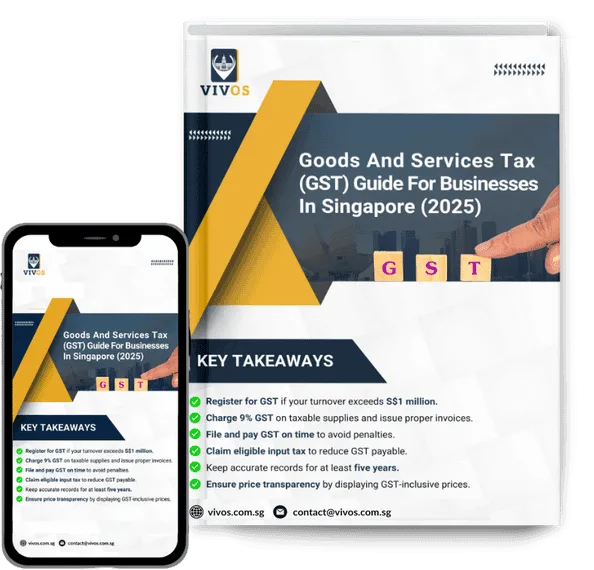
Goods & Services Tax (GST)
Thinking of charging GST in Singapore? Here’s a quick guide on when you must, when you should, and how to get it right.
Frequently Asked
Questions
-
What is GST registration, and when is it required in Singapore?
There are two compulsory tests. Under the retrospective test, you must register if your taxable turnover is more than S$1 million at the end of a calendar year, and you apply between 1 and 30 January of the following year. Under the prospective test, you must register if you reasonably expect your taxable turnover to exceed S$1 million in the next 12 months, and you apply within 30 days. Our guide to GST registration in Singapore walks through both tests.
-
Can I register for GST voluntarily if I’m below the threshold?
Yes. A business below the S$1 million threshold can apply to register voluntarily, subject to IRAS’s conditions. Once registered, you must stay registered for at least two years, so it is worth weighing the costs and benefits over that period before you apply.
-
How often do I need to file GST returns in Singapore?
Most businesses file GST returns quarterly, with accounting periods that follow the financial year-end. A business that expects to receive GST refunds regularly can apply to file monthly, subject to IRAS approval. Returns and any GST payable are due one month after the end of each accounting period.
-
What happens if I miss my GST filing deadline?
IRAS imposes a S$200 late submission penalty immediately, plus a further S$200 for each completed month the return stays outstanding, up to S$10,000 per return. If GST is not paid by the due date, a 5% late payment penalty also applies. Failing to file GST returns is also an offence.
-
Can I claim GST for expenses before I registered?
Yes, under IRAS’s conditions. Broadly, you can claim GST on goods you still hold on your registration date and on services bought within the six months before registration that were not used to make supplies before then, provided you hold valid tax invoices addressed to your business. Our team reviews your purchases and prepares the claim.
-
Do overseas sales count towards the S$1 million GST threshold?
Yes, in most cases. Taxable turnover includes zero-rated supplies, such as exports of goods and international services, so sales to overseas customers can still take you over S$1 million. Exempt supplies, such as financial services and residential property sales, are not counted. A review of your revenue mix shows which of your sales count towards the threshold.
-
What is the difference between GST Form F5 and Form F8?
Form F5 is the regular GST return you file for each accounting period. Form F8 is the final return IRAS issues after your GST registration is cancelled, covering the period up to your last day of registration. Both are due one month after the end of the period they cover.
-
Can VIVOS tell me whether my business needs to register for GST?
Yes. We evaluate your turnover and expected sales against the retrospective and prospective tests and the voluntary registration conditions, then tell you whether registration is compulsory, optional or not needed yet. If you go ahead, we submit the application through IRAS’s myTax Portal. Contact us to get started.
Contact To Your Growth Partner