



Best Corporate Cards in Singapore for SMEs: 2026 Guide

Discover the best corporate cards in Singapore for SMEs in 2026. Find the right card for travel, rewards, or startup needs today!
Any Singapore business whose taxable turnover exceeds S$1 million is required to register for Goods and Services Tax (GST) with the Inland Revenue Authority of Singapore (IRAS). That threshold applies under two legal tests: the retrospective view (turnover exceeded S$1 million in the past 12 months) and the prospective view (you reasonably expect turnover to exceed S$1 million in the next 12 months). Overseas suppliers and marketplace operators may also face registration obligations under the Overseas Vendor Registration (OVR) regime or reverse charge rules, even without a local presence.
Key facts at a glance:
Immediate next steps: compute your taxable turnover using the IRAS GST Registration Calculator on myTax Portal, gather supporting contracts and invoices, and apply via myTax Portal if you are liable.
Compulsory GST registration in Singapore applies when taxable turnover exceeds S$1 million under either the retrospective or prospective view, with a 30-day application window and significant penalties for late notification.
| Point | Details |
|---|---|
| Compulsory threshold | Taxable turnover above S$1 million triggers mandatory registration under retrospective or prospective rules. |
| Late registration risk | IRAS uncovers around 100 late registrants annually, with average combined GST and penalties of approximately S$100,000. |
| Voluntary registration commitment | Voluntary registration is binding for two years; complete the IRAS e-Learning course before applying. |
| Turnover computation | Include standard-rated and zero-rated supplies; exclude exempt supplies, out-of-scope supplies, and capital asset sales. |
| Vivos GST services | Vivos provides end-to-end GST registration, filing, and advisory support for Singapore businesses. |
Under the retrospective view, a business must register when its taxable turnover for the past 12 calendar months exceeds S$1 million. The 12-month period is assessed on a rolling basis at the end of each calendar month. If you breach the threshold at the end of December, you must apply by January 31, and your effective registration date will be March 1.
The prospective view applies when you have reasonable grounds to expect your taxable turnover to exceed S$1 million in the next 12 months, even if you have not yet crossed it historically. Under this test, you must apply within 30 days of the date you first formed that expectation, and IRAS will register you effective 31 days from that forecast date. Acceptable evidence includes signed contracts, purchase orders, and confirmed invoices. Note that transitional rules apply for liabilities arising on or after July 1, 2025, per the IRAS e-Learning Module 1.
Not every business above S$1 million must register. The following supplies are excluded from the taxable turnover computation entirely:
Beyond exclusions from the computation, a business may also qualify for a formal exemption from registration. If zero-rated supplies represent more than 90% of total taxable supplies and registration would put you in a net refund position, you may apply for exemption from GST registration even when turnover exceeds S$1 million.
Pro Tip: Keep a rolling 12-month turnover tracker updated monthly. Many businesses miss the retrospective trigger because they only review revenue annually.
Taxable turnover for GST registration purposes includes the value of standard-rated supplies (currently taxed at 9%) and zero-rated supplies (taxed at 0%). It does not include exempt supplies, out-of-scope supplies, or proceeds from selling capital assets used in the business.
Use the IRAS GST Registration Calculator on myTax Portal to run the computation with your actual revenue figures. It requires your Unique Entity Number (UEN) and monthly revenue data.
A Singapore-based software consultancy has the following 12-month revenue:
Taxable turnover = S$700,000 + S$350,000 = S$1,050,000. The business exceeds the threshold and must register. The residential rental and capital asset sale are excluded from the computation.
| Supply Type | Included in Taxable Turnover? |
|---|---|
| Standard-rated supplies (9% GST) | Yes |
| Zero-rated supplies (0% GST) | Yes |
| Exempt supplies | No |
| Out-of-scope supplies | No |
| Sale of capital assets | No |
| Disbursements | No |
Pro Tip: If your business has significant zero-rated exports, run the 90% zero-rated test before registering. You may qualify for an exemption and avoid the compliance burden entirely.
Businesses below the S$1 million threshold may register voluntarily if they make taxable supplies, intend to make taxable supplies, or procure services from overseas suppliers where input tax recovery would be beneficial. Voluntary registration is also available to businesses that make only out-of-scope supplies or import goods for business use.
If you have not yet started making taxable supplies at the time of voluntary registration, you must begin within two years (or an IRAS-approved longer period), or you risk deregistration.
Reasons voluntary registration may benefit your business:
Reasons to proceed with caution:
Pro Tip: Run a two-year financial model before applying voluntarily. Map your GST-registered supplier spend against your customer mix. If most of your customers are end consumers, voluntary registration often costs more in administration than it recovers in input tax.
The GST registration application is completed entirely online via myTax Portal using CorpPass authorization. Prepare all supporting documents in softcopy before starting, as the portal accepts attachments and saves drafts but does not auto-populate revenue data.
| Form | Purpose |
|---|---|
| GST F1 (myTax Portal e-service) | Standard local business registration |
| GST F2 | Exemption from GST registration |
| GST G1 | Group registration application |
| GST F11 / F12 | Divisional registration |
| OVR Form (FormSG) | Overseas Vendor Registration for foreign suppliers |
Processing time is typically four to six weeks from the date IRAS receives a complete application. The effective registration date follows the retrospective or prospective rules described above, not the date IRAS approves the application.
Once registered, a business must charge GST on all standard-rated supplies from the effective registration date. The current GST rate is 9%. Zero-rated supplies remain at 0% but must still be reported in GST returns.
Input tax is the GST you pay on business purchases and imports. You may claim it against output tax (GST collected from customers) in each GST return. Key conditions:
Pro Tip: Align your supplier invoice collection cycle with your GST filing period. Missing invoices at the time of filing means deferring input tax claims, which affects cash flow. A simple monthly invoice reconciliation prevents this.
The OVR regime applies to overseas suppliers of digital services and low-value goods (goods valued at S$400 or below) sold to consumers in Singapore. An overseas supplier must register under OVR if its global turnover exceeds S$1 million and its supplies to Singapore consumers exceed S$100,000 in a 12-month period. Marketplace operators facilitating such sales may also be required to register and account for GST in place of the underlying seller. Registration is completed via a separate FormSG process, not the standard myTax Portal F1 flow, per the IRAS GST registration overview.
Local businesses that import services (e.g., consulting, software subscriptions, cloud services) from overseas suppliers may be subject to reverse charge. Under reverse charge, the local business accounts for GST on the imported service as if it were the supplier. This applies to businesses that are not entitled to full input tax credit (e.g., those making exempt supplies). Businesses fully entitled to input tax credit are generally not required to account for reverse charge on imported services, though they must still assess their position.
Common questions:
A business may apply to deregister when:
Voluntary registrants cannot deregister within the two-year commitment period unless the business ceases trading entirely.
Deregistration is completed via myTax Portal. The business must submit evidence that turnover has fallen below the threshold or that trading has ceased (e.g., cessation notice, sale agreement, or ACRA deregistration documents). IRAS will confirm the effective deregistration date.
Late notification is treated seriously by IRAS. Consequences include:
IRAS identifies around 100 late registrants annually, with an average combined GST and penalties of approximately S$100,000 per business. Voluntary disclosure before IRAS detection typically results in more lenient treatment.
Pro Tip: Use accounting software with GST tagging (such as Xero or QuickBooks with Singapore GST configuration) from day one. Proper tax code mapping prevents the most common filing errors and makes audit preparation straightforward.
GST registration in Singapore is well-documented by IRAS, and the myTax Portal process is structured enough that many businesses can complete it without external help. The IRAS e-Learning module, the registration calculator, and the guide to completing the registration form together cover the standard application path clearly.
DIY registration is reasonable when the business has a straightforward supply profile (local sales only, no imports, no exempt supplies), clean financial records, and an accounting system already configured for GST. A sole proprietor selling goods locally, or a small company with a single revenue stream, typically has everything needed to self-register without professional assistance.
The calculus shifts when complexity enters the picture. Businesses with significant import activity, cross-border service procurement, or a mix of taxable and exempt supplies face a higher risk of misclassifying supplies or missing reverse charge obligations. Group registration, divisional registration, and OVR applications each involve additional forms and IRAS correspondence that benefit from structured advisory support. The highest-risk scenario is a business that suspects it may have crossed the S$1 million threshold in a prior period without registering. Backdated registration with a large GST liability and potential penalties is a situation where professional representation and voluntary disclosure management can materially reduce the financial outcome.
Practical signals that professional help is worth the cost:
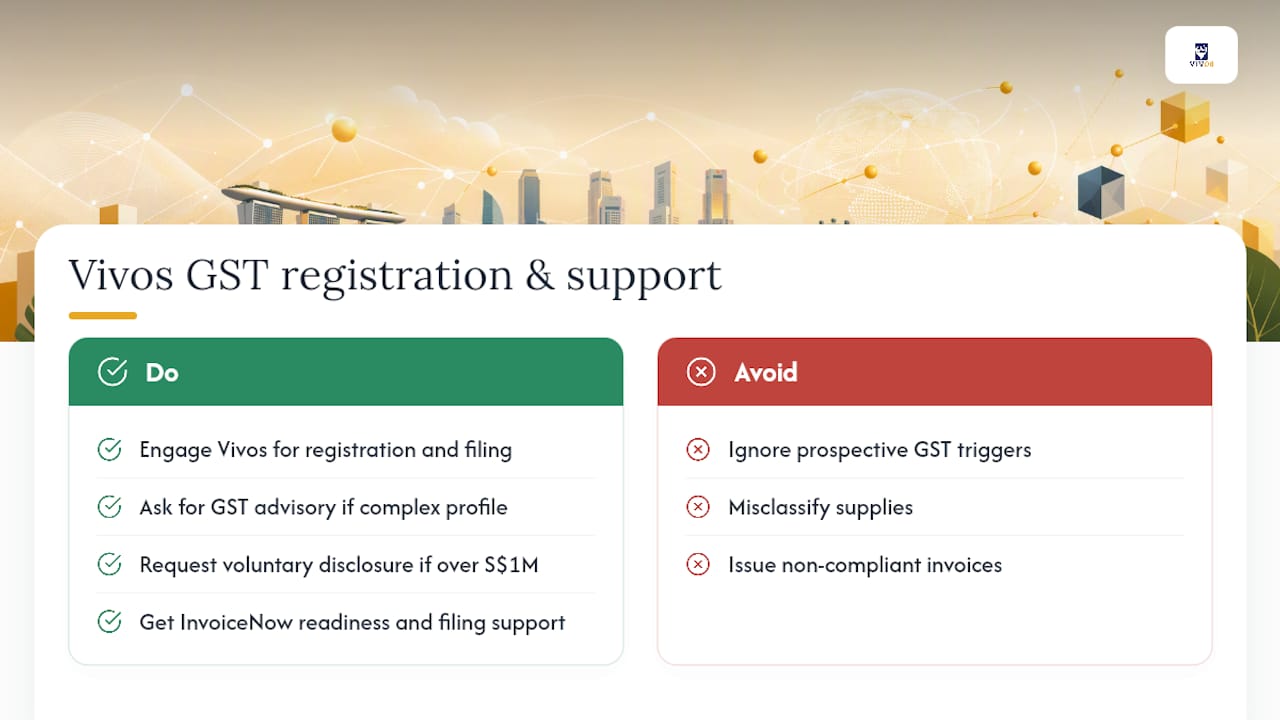
GST registration in Singapore carries real financial risk when handled incorrectly. Vivos offers GST registration and filing services that cover the full process: threshold assessment, application preparation, myTax Portal submission, e-Learning coordination, and GIRO setup. For businesses with more complex profiles, Vivos provides GST advisory services including voluntary registration cost-benefit analysis, InvoiceNow readiness planning, and ongoing filing support.
The practical advantage is reduced penalty exposure and a correctly configured accounting setup from the start. Businesses that engage Vivos avoid the most common errors: missed prospective triggers, incorrect supply classification, and non-compliant invoicing. For businesses already past the S$1 million threshold without having registered, Vivos manages voluntary disclosure and backdated registration to minimize financial impact. Contact Vivos to assess your GST registration position and get the application right the first time.
The following IRAS pages and tools are the primary references for GST registration in Singapore:
This article is general information, not a substitute for advice from a qualified financial advisor. Consult a qualified financial professional about your own circumstances before acting on anything here.
 2 January, 2025
 2 January, 2025
Discover the best corporate cards in Singapore for SMEs in 2026. Find the right card for travel, rewards, or startup needs today!

Discover how a Singapore holding company offers asset protection, tax benefits, and efficient ownership structuring for entrepreneurs.

Understand the estimated chargeable income Singapore for your company. Learn filing rules, exemptions, and key components to ensure compliance.