
Foreign Founders: Outsource Singapore Company Secretary Within 6 Months
Published: 3 September 2026 · Last reviewed: 30 September 2026 · Reviewed by Ray Tay, Co-Founder & Managing Director, VIVOS PTE. LTD. (ACRA Filing Agent FA20240323 · MOM EA Licence 24S2425)
Every company incorporated in Singapore must appoint a qualified, locally resident company secretary within six months of incorporation, and a sole director cannot fill that role simultaneously. This is a statutory obligation under the Companies Act 1967 and enforced by ACRA, and as of 2026, non-compliance carries real financial and operational consequences.
TL;DR:
- All Singapore companies must appoint a qualified resident secretary within six months of incorporation, with non-compliance risking fines and public record flags.
- The secretary must be “ordinarily resident” in Singapore, meaning they live there with a genuine address, and certain individuals like bankrupts are disqualified.
- The secretary handles statutory record-keeping, governance documentation, statutory filings, and share administration, making the role essential beyond basic paperwork.
- Quickly appointing a secretary and filing through BizFile+ is crucial if a vacancy occurs, especially when nearing compliance deadlines or during due diligence checks.
- Outsourcing to a compliant secretarial provider with a qualified individual streamlines filings, minimizes delays during account opening or licensing, and reduces risk during audits or funding rounds.
Table of Contents
- Does My Singapore Company Need a Company Secretary?
- Who Can Be a Company Secretary in Singapore?
- What Does a Company Secretary Do?
- Duties Table: What the Secretary Handles Routinely
- How to Appoint or Change a Company Secretary
- Outsourcing the Resident Secretary Requirement as a Foreign Founder
- VIVOS Perspective: Supporting Founders Through Secretary and Compliance Obligations
- How VIVOS Handles Your Company Secretary Requirements
- Sources
Does My Singapore Company Need a Company Secretary?
Yes. Every private limited company and every public company registered in Singapore must have a company secretary in place within six months of incorporation. There is no exemption for small companies, one-person startups, or holding entities. The requirement applies from the moment your company appears on ACRA’s register, regardless of whether you have started trading.
Public companies face a higher bar. ACRA expects a public company secretary to hold specific qualifications, such as membership in a recognized professional body, or to be a registered filing agent acting through a qualified individual. Private companies have more flexibility, which is discussed further below.
The six-month clock is not a soft guideline. ACRA can issue a fine of up to S$1,000 for leaving the secretary role vacant beyond that window, and the vacancy shows up clearly on your company’s public record through BizFile+. That visibility matters more than the fine itself. Banks, licensing authorities, and even prospective business partners routinely check a company’s compliance status before doing business with it, and an unfilled secretary position is one of the first red flags a due diligence check turns up.
A few practical scenarios trip up founders regularly:
- Newly incorporated companies often assume they can wait until revenue starts coming in. The clock runs from incorporation, not from your first sale.
- Dormant companies still need a secretary. Dormancy affects your tax and annual return obligations, not your obligation to maintain a company secretary.
- Companies switching secretaries mid-year must file the change promptly. A gap between resignation and replacement counts against the same six-month rule.
- Sole-director companies cannot simply have that director “double up” as secretary. Singapore law treats these as two distinct offices that cannot be held by the same person when there is only one director.
If your company has already gone several months without a secretary, the fix is straightforward but urgent: appoint one immediately and file through BizFile+ before ACRA flags the vacancy during a routine compliance sweep. Waiting rarely helps and often compounds the problem when annual return deadlines arrive with no secretary on record to certify the filing.
Watch on YouTube: How a Company Secretary Helps Prevent Financial Misconduct · 37 sec.
Who Can Be a Company Secretary in Singapore?
The Companies Act sets a residency test that trips up almost every foreign founder at some point. A company secretary must be a natural person whose principal or only place of residence is in Singapore, a standard commonly described as “ordinarily resident.” This is not a citizenship requirement, but it is a real-world presence requirement.
In practice, “ordinarily resident” is satisfied by:
- Singapore citizens
- Permanent residents
- Holders of an Employment Pass, EntrePass, or Dependant’s Pass who maintain a genuine local address and are actively present in Singapore
ACRA and the Companies Act look for practical evidence of residency, not just a stated intention. A registered local address, an active SingPass account, and a documented history of being physically present in Singapore all support a residency claim. A foreign national holding a pass but living abroad most of the year does not meet the bar, even with a Singapore-registered address on paper.
Certain individuals are barred outright from acting as company secretary, regardless of where they live:
- Undischarged bankrupts
- Individuals debarred by ACRA for prior compliance failures
- Anyone disqualified under a court order relating to company management
Directors carry a specific legal duty here too. The Companies Act requires directors to take reasonable steps to satisfy themselves that the person appointed has the requisite knowledge and experience to carry out the role. This is not a rubber-stamp appointment. A director who knowingly appoints an unqualified or disqualified secretary can face personal liability if things go wrong later.
Private companies enjoy considerably more flexibility than public companies. Any ordinarily resident individual with a working SingPass account can serve as secretary for a private company, provided the directors are satisfied with their competence. Public companies operate under a stricter regime: the secretary must generally be a qualified individual registered with ACRA, or the company must engage a registered filing agent that assigns a qualified individual to the account.
Pro Tip: Don’t assume a family member or friend with a Singapore address automatically qualifies. ACRA and the courts look at whether that person genuinely understands statutory registers, filing deadlines, and board procedure. An unqualified secretary who signs off on incorrect filings puts both the company and its directors at risk.
What Does a Company Secretary Do?
A company secretary’s job goes well beyond paperwork. The role carries statutory weight, fiduciary obligations, and a level of accountability that surprises many first-time directors who assume it is a purely administrative appointment.
Statutory registers and record-keeping
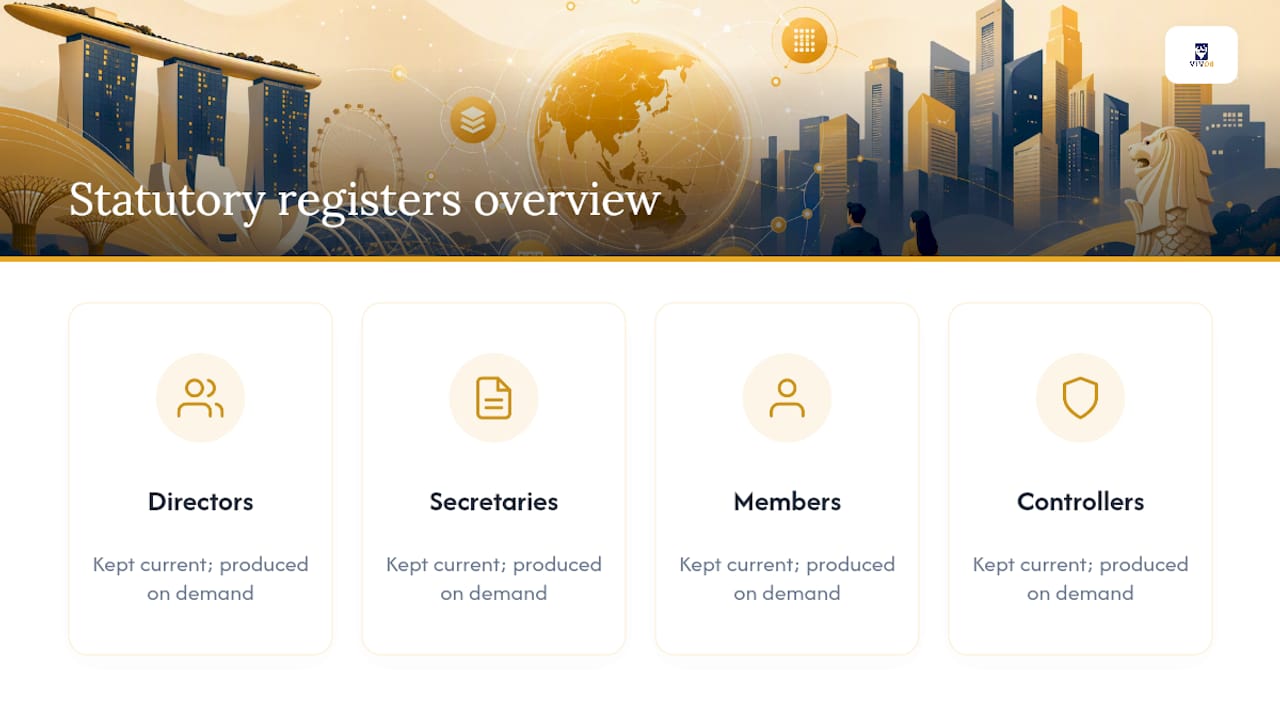
The secretary maintains the company’s statutory registers, which include the register of directors, register of secretaries, register of members (shareholders), and register of registrable controllers. These registers must stay current at all times and be produced on demand during an ACRA audit, a bank’s know-your-customer review, or a due diligence exercise ahead of an investment round.
Minutes, resolutions, and meeting administration
Every board meeting and shareholder meeting needs proper minutes, and every decision made outside a formal meeting needs a documented resolution. The secretary drafts, circulates, and files these records. This isn’t a bureaucratic nicety. Minutes and resolutions are the paper trail that proves your company followed proper governance when a bank, auditor, or court later asks how a particular decision was made.
AGM and EGM support
Private companies exempt from holding a physical Annual General Meeting still need someone coordinating the paperwork that replaces it. Companies that do hold an AGM rely on the secretary to schedule it, prepare the agenda, circulate notices within the statutory timeframe, and record what happened.
Filing officer changes and the Annual Return
Whenever a director, secretary, or shareholder changes, the secretary files the update through BizFile+. The Annual Return filing, which confirms your company’s registered details, financial statements, and officer information for the year, also falls under the secretary’s remit. Missing this deadline creates a compliance gap that compounds quickly, since ACRA tracks late filings against the company’s record.
Share transfers and share register administration
Any transfer, allotment, or transmission of shares needs to be reflected in the register of members and supported by proper transfer instruments. The secretary handles this administrative chain and ensures share certificates match what ACRA has on file.
Fiduciary duties and conflict disclosures
Beyond the mechanical tasks, the secretary owes the company duties of care and good faith. This includes flagging potential conflicts of interest among directors, advising on procedural compliance before decisions are finalized, and acting as a check against governance shortcuts that could expose the company or its directors to liability.
| Core Duty | What It Involves | Governance Impact |
|---|---|---|
| Statutory registers | Maintain registers of directors, secretaries, members, controllers | Required for audits, KYC checks, due diligence |
| Minutes and resolutions | Draft and file records of board and shareholder decisions | Legal proof of proper decision-making |
| ACRA filings | File officer changes, Annual Return, and other statutory updates | Keeps company record accurate and penalty-free |
| Share administration | Process transfers, allotments, update share register | Ensures ownership records match ACRA filings |
| AGM/EGM coordination | Schedule meetings, prepare notices and agendas | Meets statutory notice and reporting timelines |
Duties Table: What the Secretary Handles Routinely
The table above covers the strategic scope of the role. Day to day, the workload breaks down into recurring tasks with their own rhythm and paper trail.
| Task | Frequency | Records Required |
|---|---|---|
| Minutes and resolutions | Every board or shareholder decision | Signed minutes, written resolutions retained permanently |
| ACRA filings (officer changes) | As changes occur | Form 45B, board resolution, BizFile+ confirmation |
| Annual Return filing | Once per year | Financial statements, officer list, confirmed via BizFile+ |
| Statutory register updates | Continuous, whenever facts change | Register of directors, secretaries, members, controllers |
| Share transfers | As transactions occur | Transfer instruments, updated register of members |
| Company constitution custody | Ongoing | Current constitution and amendment history on file |
Each row represents a legal obligation with its own deadline pressure. Miss the Annual Return and your company’s compliance status flips to overdue on the public register within days. Let the register of members drift out of sync with actual share transactions, and you risk disputes over ownership that surface at the worst possible time, usually during a fundraising round or an exit.
How to Appoint or Change a Company Secretary
Appointing or replacing a secretary follows a defined procedural sequence. Skipping a step, or filing out of order, is the most common reason ACRA rejects a submission or flags a company for follow-up.
-
Pass a board resolution. The directors must formally approve the appointment (or the change) through a board resolution or written resolution. This document should name the incoming secretary and, where relevant, record the resignation or removal of the outgoing one.
-
Obtain signed consent using Form 45B. The appointed individual must sign Form 45B, confirming their consent to act and declaring they are not disqualified under the Companies Act. Keep the signed original, or a high-quality encrypted digital scan, in your statutory file.
-
File the appointment or cessation on BizFile+. Submit the change through BizFile+ within 14 days of the resolution date. This is the step ACRA uses to update the public register, and delays here are what typically generate compliance flags.
-
Update internal statutory registers. Reflect the change in your register of secretaries immediately after the BizFile+ filing confirms. Retain the board resolution, Form 45B, and BizFile+ transaction receipt together as a matched set.
-
Reconcile your records. Cross-check that the BizFile+ confirmation matches the resolution date and the Form 45B signature date. Banks and regulators commonly request these original documents during account opening or licensing reviews, and gaps between the paper trail and the online filing raise unnecessary questions.
A few pitfalls show up again and again. Founders sometimes file the BizFile+ change before the board resolution is actually signed, creating a document that contradicts the official timeline. Others let Form 45B sit unsigned for weeks while treating the BizFile+ submission as sufficient on its own, which leaves a gap in the statutory record that surfaces later during due diligence. If you’re changing your company name or making other structural changes around the same time, coordinate the secretary filing with those updates so your registers don’t fall out of sync across multiple simultaneous changes.
Outsourcing the Resident Secretary Requirement as a Foreign Founder
Foreign founders hit a wall almost immediately: you cannot appoint yourself as company secretary unless you are ordinarily resident in Singapore, and most first-time founders setting up remotely are not. This is precisely why outsourcing the role to a corporate secretarial firm has become the standard path for non-resident entrepreneurs incorporating in Singapore.
Two models dominate the market. Some providers assign a nominee resident secretary who acts purely in a compliance capacity, handling filings and registers without involvement in your operating decisions. Others operate as full corporate secretarial firms with a team supporting multiple clients under one Qualified Individual’s oversight.
That Qualified Individual designation matters more than most founders realize. Corporate service providers operating in Singapore fall under the CSP Act, which requires a designated Qualified Individual to take regulatory responsibility for the accuracy and timeliness of the firm’s filings. Before signing with any provider, verify:
- Whether a named Qualified Individual actually oversees your account, not just a generic support team
- What service level agreement covers filing turnaround and response times
- How the firm handles data security for your statutory documents and signed originals
- What continuity plan exists if your assigned secretary leaves the firm
An outsourced secretary does more than keep you compliant on paper. Banks conducting corporate account opening reviews almost always ask for confirmation of your company’s secretarial arrangements, and a properly staffed provider with clean, current filings can meaningfully shorten that process. The same applies to sector-specific licensing, where regulators expect to see a functioning compliance structure before granting approval.
Pro Tip: Ask a prospective secretarial provider how they handle officer changes when you add a co-founder or investor to your board later. A firm with slow, manual processes here will cost you time exactly when speed matters most, during a funding round or a bank’s urgent request for updated documents.
VIVOS Perspective: Supporting Founders Through Secretary and Compliance Obligations
VIVOS works with international entrepreneurs setting up in Singapore who need more than a checkbox secretarial filing. The firm provides Singapore company incorporation for foreign founders, including nominee resident director services, a registered address, corporate secretary appointment, and bank account opening support, all coordinated as part of a single setup process rather than handled piecemeal across separate vendors. VIVOS also incorporates companies in Malaysia, Hong Kong, and the UAE for founders building a presence across the region.
“Most foreign founders don’t realize how many downstream problems trace back to a poorly managed secretary appointment,” said Ray Tay, Managing Director of VIVOS. “A missed Annual Return or an outdated register of members doesn’t just risk a fine. It shows up during a bank’s due diligence and slows down exactly the moment a founder needs speed.”
That operational reality shapes how VIVOS structures its secretarial service. Clients get a resident company secretary who understands both the statutory registers and the practical documentation banks and regulators actually request, reducing the back-and-forth that typically delays corporate bank account approval. Filings through BizFile+, from officer changes to the Annual Return, get tracked against deadlines rather than handled reactively after a notice arrives.
For founders managing entities across Singapore, Malaysia, Hong Kong, and the UAE simultaneously, that consistency matters even more. A corporate secretarial services arrangement built around clear ownership of deadlines, rather than scattered responsibility across multiple contacts, tends to produce fewer surprises when regulators or banks come asking for updated records.
— Ray
How VIVOS Handles Your Company Secretary Requirements
Setting up a Singapore company from abroad means solving the resident secretary requirement before you can do almost anything else, including opening a corporate bank account. VIVOS provides Singapore company incorporation for foreign founders that bundles a nominee resident director, a registered address, a qualified corporate secretary, and bank account opening support into one coordinated setup, rather than leaving you to source each piece separately.

VIVOS also handles incorporation in Malaysia, Hong Kong, and the UAE, which matters if your plans extend beyond a single jurisdiction. Every secretarial engagement includes register maintenance, board resolution drafting, and BizFile+ filings managed against actual deadlines instead of after a compliance notice arrives.
If your company is approaching its six-month deadline, already past it, or you’re incorporating for the first time and need the resident secretary requirement solved from day one, VIVOS’s corporate secretarial team can review your situation and confirm exactly what’s needed. Start with a consultation on Singapore incorporation for foreign founders to get a clear scope and timeline before your next filing deadline arrives.
Sources
Readers who want to verify these requirements directly, or dig into the statutory language, can consult the primary sources ACRA and the Singapore government maintain:
- Step 4.3: Choosing company directors & other key officers | ACRA
- Companies Act 1967 – Singapore Statutes Online
- Singaporelegaladvice
- BizFile+
- Form
Recommended
- The Foreign Founder’s Guide to Incorporating a Company in Singapore (2026)
- Foreign Founders, Avoid Bank Delays When Renaming in Singapore
- Cost & Timeline to Incorporate a Company in Singapore (2026)
- How Can Foreigners Incorporate a Singapore Company in 2026?
Related guides
Related guides
Most Popular

 2 January, 2025
Why Singapore Comes Into Action For Chinese Companies
 2 January, 2025
Malaysia’s Budget 2025: What The Dividend Tax Means For You
Recents Blogs


Nominee Director Services in Singapore: 7 Providers Ranked on 6 Checks (2026)

Since 9 June 2025, a nominee director acting by way of business in Singapore must be arranged by an ACRA-registered corporate service provider.

Does Singapore Offer Citizenship by Investment? (2026)
Singapore has no citizenship by investment programme. Investors can get PR through the Global Investor Programme, then apply to ICA for citizenship after at least…