
新加坡海外收入汇回:2026年公司与个人的纳税规则与免税条件

Ray Tay
海外收入汇回新加坡何时需纳税?本文解析第10(25)条“汇入”定义、第13(8)条三项免税条件、外国税收抵免、第10L条及文件留存要求。
Published: 8 September 2026 · Last reviewed: 15 September 2026 · Reviewed by Ray Tay, Co-Founder & Managing Director, VIVOS PTE. LTD. (ACRA Filing Agent FA20240323 · MOM EA Licence 24S2425)
ACRA confirms these remain the core incorporation requirements as of 2026.
TL;DR:
- Engaging a nominee resident director and a registered address service are standard solutions for foreign founders to meet Singapore’s incorporation residency and location requirements.
- Most registrations are approved almost immediately after submitting the application and paying the S$300 fee, with larger or regulated cases taking up to 60 days.
- Appointing a company secretary within six months and maintaining statutory registers are crucial ongoing compliance obligations beyond initial registration.
- Setting up a bank account can take weeks and often requires in-person verification, so coordinating this step early saves time.
- Outsourcing incorporation and compliance tasks to a corporate service provider simplifies meeting statutory requirements and ensures adherence to deadlines.
A checklist beats a paragraph when you’re staring down five statutory boxes, a S$300 filing fee, and a deadline clock that starts the moment ACRA approves your name. Below is what each requirement actually demands and the practical route most foreign founders take to satisfy it.
| Requirement | Who can fulfill it | How foreign founders typically solve it |
|---|---|---|
| At least one shareholder | Any individual or corporate entity, local or foreign | Founders retain 100% ownership directly, no local shareholder needed |
| One director ordinarily resident in Singapore | Singapore citizen, permanent resident, or certain pass holders | Engage a nominee resident director through a corporate service provider |
| Qualified resident company secretary (within 6 months) | Locally resident individual meeting ACRA competency rules | Outsource to a corporate secretarial services provider from day one |
| Local registered office address | Any Singapore address open to the public at least three hours daily, per ACRA rules | Use a registered address service rather than a residential address |
| Minimum S$1 paid-up capital | Shareholders, in any currency convertible to Singapore dollars | Deposit S$1 or more; increase later via paid-up capital filings |
| Auditor (unless small company exempt) | Public accountant registered with ACRA | Appoint within three months, or confirm exemption eligibility with a secretarial provider |
Name reservation and BizFile+ incorporation filing involve government fees payable to ACRA.
The process moves fast once your documents are in order. Referral cases involving regulated activities can stretch the timeline, but a straightforward private limited company often clears within a day of submission.
Pro Tip: File your name reservation and prepare your bank account documentation in parallel. Banks often ask for the same position-holder details ACRA already collected, so having both ready cuts your total setup time by days, not weeks.
Yes to all three, and each role carries its own eligibility rules that trip up first-time foreign founders more than any other part of the process.
Incorporation is the easy part. What follows determines whether you stay in good standing with ACRA and the Inland Revenue Authority of Singapore.
Outsourcing your secretarial and bookkeeping functions removes most of the deadline-tracking burden, particularly for founders managing this remotely.
Government fees are fixed and low. Service provider fees vary, but they cover real statutory gaps foreign founders can’t fill themselves.
S$315 total in ACRA fees covers the entire government-side registration: S$15 for name reservation and S$300 for the BizFile+ incorporation filing, according to ACRA’s fee schedule.
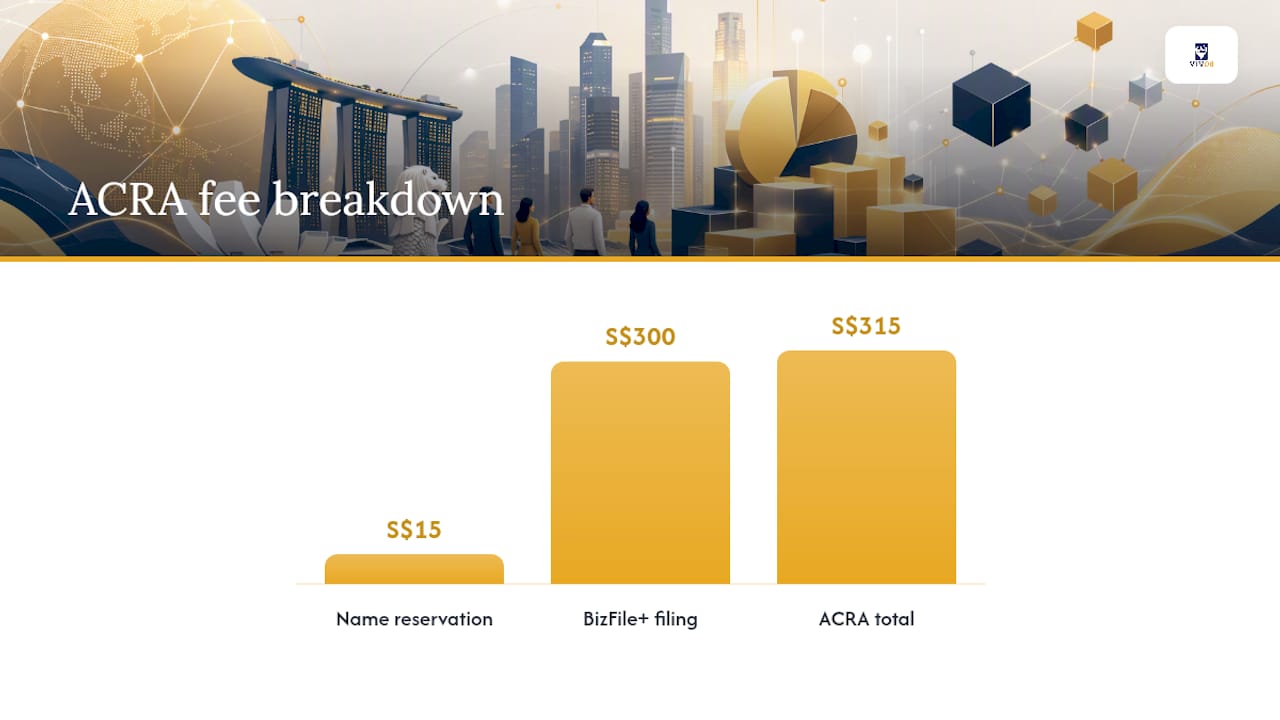
Processing speed depends on complexity. A standard private limited company application is often approved within the same day of payment. Applications referred to other government agencies, such as those involving regulated sectors like education, financial services, or media, can take several weeks for clearance. Beyond ACRA’s fees, expect ongoing charges for a nominee resident director, corporate secretary retainer, registered address service, and bank account facilitation, all of which are separate from the one-time government filing cost and typically billed as annual packages by corporate service providers.
Every requirement above becomes a phone call, not a project, when you have the right corporate service provider. A corporate service provider can offer Singapore company incorporation for foreign founders, covering the nominee resident director, registered address, corporate secretary, and bank account opening in one coordinated engagement, and may extend similar services across Malaysia, Hong Kong, and the UAE.
“Foreign founders don’t fail at incorporation because the rules are complicated. They fail because they try to solve five separate statutory requirements with five separate vendors, and something falls through the gap, usually the secretary deadline or the bank account,” says Ray Tay, Managing Director of VIVOS.
Founders expanding beyond Singapore benefit most from this pairing: the same team handling your Singapore incorporation can extend the resident director and secretarial setup to Malaysia, Hong Kong, or the UAE without restarting the relationship from scratch. That continuity, paired with bilingual English-Mandarin support, matters more to founders managing multiple Asian entities than any single feature on a service brochure.
Most guides on Singapore company requirements treat incorporation as a paperwork exercise: fill in five boxes, pay S$315, get your certificate. That framing undersells what actually determines whether a foreign founder succeeds here. The real bottleneck isn’t the BizFile+ form. It’s the six-month secretary deadline nobody tracks after the initial excitement wears off, and the bank account that takes longer than the incorporation itself.
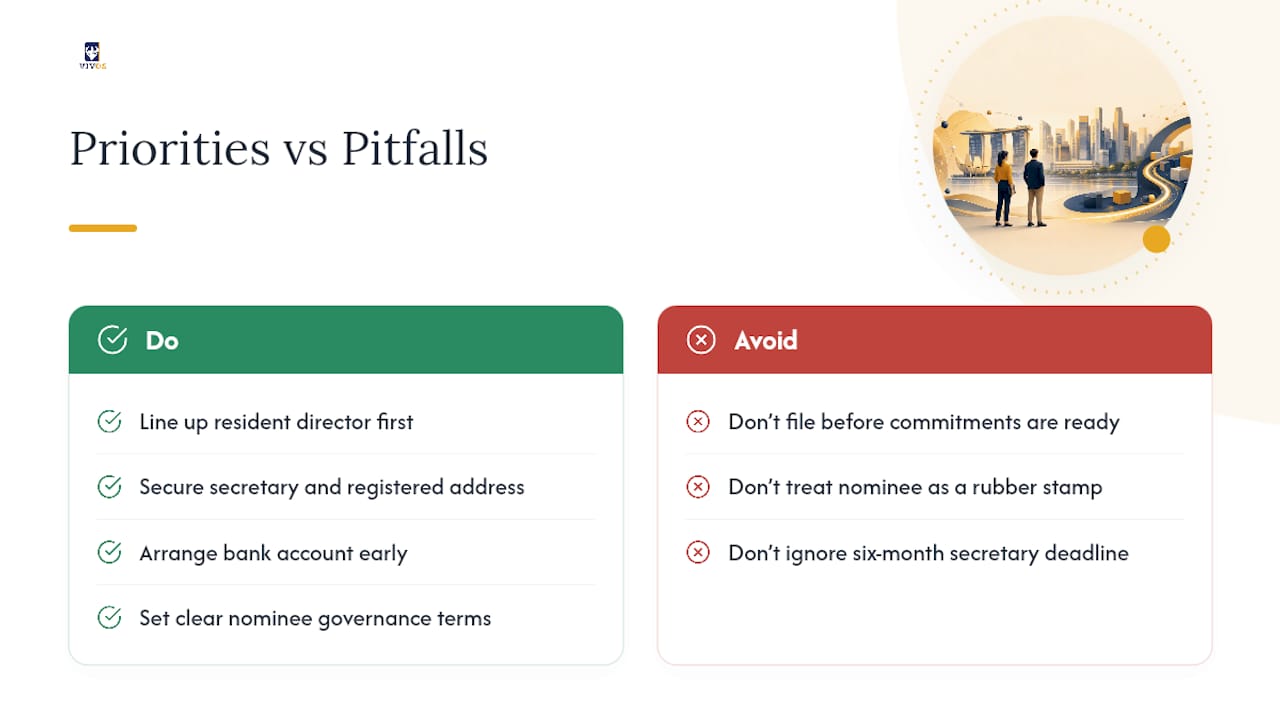
The conventional advice to “just hire a nominee director” also skips a genuine risk: that director carries legal liability under the Companies Act regardless of how the arrangement is marketed. Founders who treat the nominee relationship as a rubber stamp, rather than a governance partnership with clear terms, are the ones who end up with compliance gaps a year later.
What should you prioritize first? Not the incorporation filing. Line up your resident director, secretary, and registered address commitments before you reserve a name, so the six-month clock never becomes a fire drill.
— Ray
A corporate service provider may handle the parts of Singapore incorporation that trip up foreign founders most: the nominee resident director, the registered office address, the corporate secretary appointment, and the bank account opening, all coordinated under one engagement rather than scattered across separate vendors. Similar support may be available for founders expanding into Malaysia, Hong Kong, or the UAE.

If you’re weighing whether to handle name reservation and BizFile+ filing yourself or hand the entire process to a team that already knows where foreign founders get stuck, start with a straightforward conversation about your specific structure. Get started on your Singapore company incorporation and have your resident director, secretary, and registered address arranged before your name reservation even clears.

 2 January, 2025
 2 January, 2025
海外收入汇回新加坡何时需纳税?本文解析第10(25)条“汇入”定义、第13(8)条三项免税条件、外国税收抵免、第10L条及文件留存要求。
Employment Pass holders can bring their parents to Singapore on a Long-Term Visit Pass only if they earn a fixed monthly salary of at least…