
Avoid 4x Penalty: Transferring Shares in Singapore for Founders

Ray Tay
Practitioner checklist for founders transferring shares in Singapore: compute 0.2% stamp duty, meet the 14 or 30 day deadlines, secure board approval, and...
Published: 15 August 2026 · Last reviewed: 30 September 2026 · Reviewed by Ray Tay, Co-Founder & Managing Director, VIVOS PTE. LTD. (ACRA Filing Agent FA20240323 · MOM EA Licence 24S2425)
In Singapore, buyers typically prefer asset purchases when they need to control liability exposure, while sellers almost always favor share deals for a cleaner exit and more favorable tax treatment.
Before setting heads of terms, run two checks:
Pro Tip: If you want the operational continuity of a share deal but need liability protection, representations and warranties insurance (RWI) combined with targeted indemnities is the fastest mitigation tool available to buyers in Singapore.
In Singapore M&A, structure selection turns on three variables: liability exposure, stamp duty and GST costs, and the operational friction of transferring contracts and licenses.
| Point | Details |
|---|---|
| Liability drives structure | Buyers use asset deals to exclude legacy liabilities; share deals transfer all recorded and contingent liabilities automatically. |
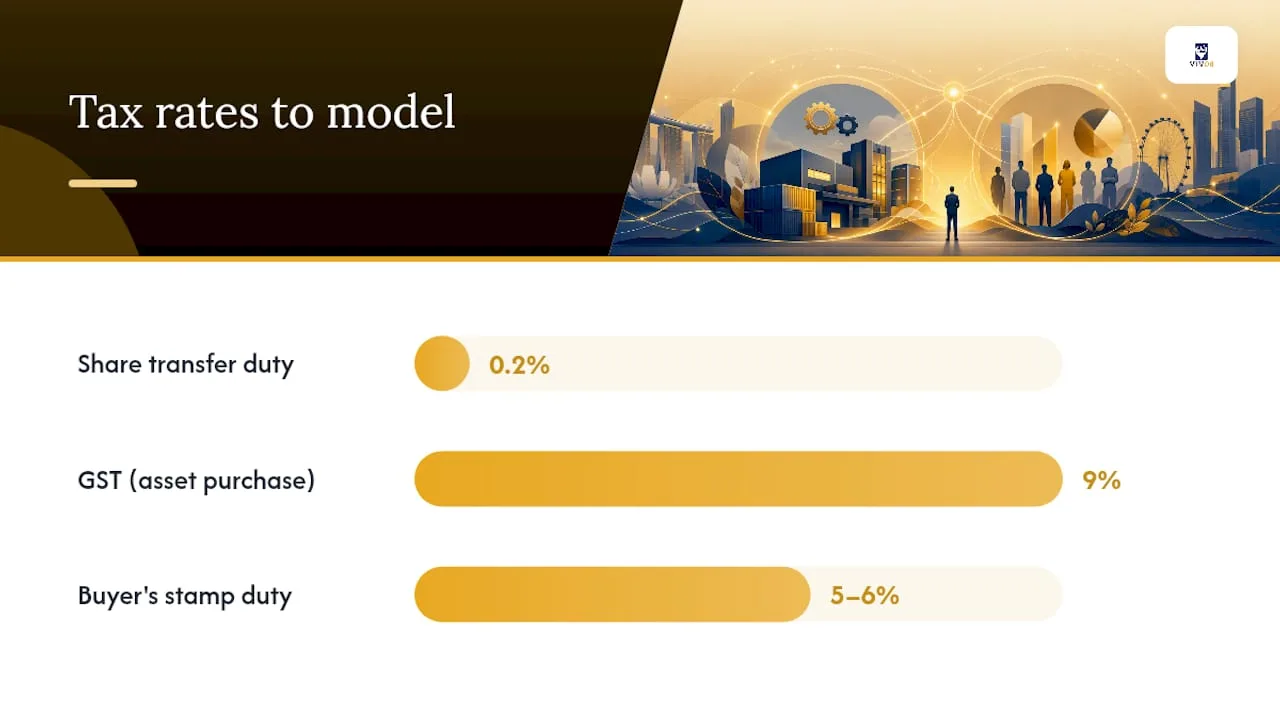
| Stamp duty and GST differ materially | Share transfers attract 0.2% duty; asset transfers attract 9% GST unless TOGC applies, plus BSD up to 5–6% on property. |
| Tax losses follow the entity | Carry-forward losses stay with the company and are preserved only in share purchases, subject to IRAS continuity tests under the Income Tax Act. |
| Consent friction is the hidden cost | Asset deals require individual novation or consent for each contract, lease, and license; non-transferable licenses often make a share deal the only viable option. |
| Vivos advisory | Vivos provides stamp duty and GST modeling, ACRA filings, and M&A advisory to support structure selection and post-deal compliance in Singapore. |
Practitioners describe the choice as a structural fork: buyers lean toward asset deals for liability protection and a stepped-up tax basis; sellers lean toward share deals for a clean exit and capital-treatment benefits. The table below maps the nine dimensions that matter most in Singapore transactions. ASEAN Briefing’s Singapore M&A guide and the Mondaq Singapore M&A Comparative Guide both confirm this framing.
| Dimension | Share Purchase | Asset Purchase |
|---|---|---|
| What transfers | Entire legal entity (shares in the company) | Specified assets and assumed liabilities only |
| Liability exposure | Buyer inherits all recorded and contingent liabilities | Buyer assumes only listed liabilities; legacy liabilities stay with seller |
| Stamp duty | 0.2% of higher of consideration or NAV | BSD up to 5% (non-residential) or 6% (residential) on immovable property; no duty on non-property assets |
| GST | Not applicable to share transfers | 9% GST on asset transfers unless structured as a TOGC |
| Tax losses / attributes | Carry-forward losses preserved (subject to IRAS continuity tests) | Losses remain with seller entity; buyer gets stepped-up asset basis |
| Third-party consents | Generally not required (unless change-of-control clauses apply) | Required for each contract, lease, and license assignment or novation |
| Employee transfer | Employees transfer automatically with the entity | New contracts typically required; Employment Act protections apply |
| Speed and continuity | Faster; contracts and licenses continue uninterrupted | Slower; consent and novation processes add weeks to months |
| Typical use case | Whole-business acquisition, preserving licenses, retaining tax losses | Carve-out, asset-line purchase, isolating legacy liabilities |
Quick decision triggers:
A share purchase transfers the entire legal entity. Contracts, licenses, employees, tax attributes, and liabilities all move with the company automatically, without individual assignments or third-party consents (unless specific change-of-control clauses trigger). That continuity is the structure’s primary commercial appeal, and it is also its primary risk.
The Practical Law Singapore practice note confirms that share purchases generally close faster and preserve contracts and licenses, making them the preferred route when operational continuity is the priority.
Share deal diligence must go deeper on historical risk because the buyer inherits everything:
Sellers prefer share deals because they exit the entity entirely. There is no asset-by-asset negotiation, no recapture of capital allowances, and no GST exposure on the sale proceeds.
Pro Tip: Buyers can tighten liability protection in share deals by combining targeted representations and warranties (tax, environmental, employment), an escrow sized to the identified risk quantum, and RWI to cover unknown exposures above the escrow floor. This structure lets buyers offer sellers a cleaner exit while retaining meaningful recourse.
For a detailed look at SPA drafting and key share-sale clauses, see Vivos’s Share Purchase Agreement Singapore guide.
An asset purchase lets buyers select exactly what they acquire and, critically, what liabilities they do not assume. The tradeoff is execution complexity: every asset category requires its own transfer mechanism, and most contracts and licenses need individual consent or novation.
Employees do not transfer automatically in an asset deal. The seller must terminate existing employment contracts, and the buyer issues new ones. Under the Employment Act, employees retain statutory entitlements (notice, leave, retrenchment benefits where applicable), and any dismissal must be handled carefully to avoid wrongful dismissal claims. MOM guidance should be reviewed for sector-specific obligations. In practice, buyers negotiate a period during which the seller retains staff on the payroll while the buyer completes onboarding.

Asset purchases create a fresh tax basis for each acquired asset, allowing the buyer to claim new capital allowances from the acquisition date. The purchase price allocation across asset categories determines how much of the cost is depreciable and over what period. Sellers face the reverse: recapture of previously claimed capital allowances (balancing charges) on assets sold above their tax written-down value.
GST at 9% (effective from January 1, 2024) applies to asset transfers unless the transaction qualifies as a Transfer of a Going Concern (TOGC). IRAS requires that the buyer is, or intends to be, GST-registered; that the assets transferred are necessary to carry on the same kind of business; and that the business (or part of it) is transferred as a going concern. Failing any condition, the full 9% GST applies to the asset consideration, creating a significant cash-flow cost for the buyer. Confirm TOGC eligibility with IRAS before signing.
Tax and stamp duty costs can shift deal economics materially. The figures below reflect current IRAS rates and statutory positions.
| Tax / Duty Item | Share Purchase | Asset Purchase |
|---|---|---|
| Share transfer stamp duty | 0.2% of higher of consideration or NAV | Not applicable |
| GST | Not applicable | 9% unless TOGC conditions met |
| Buyer’s Stamp Duty (property) | Not applicable (no property transfer) | Up to 5% non-residential / 6% residential on immovable property |
| ABSD | Not applicable | May apply depending on buyer profile and property type |
| Carry-forward tax losses | Preserved (IRAS continuity tests apply) | Remain with seller; not transferred |
| Stepped-up asset basis | Not available | Available; new capital allowances from acquisition date |
| Reconstruction / amalgamation relief | Available if IRAS conditions met | Available in limited circumstances |
IRAS applies the TOGC test strictly. The buyer must be GST-registered (or immediately become so), the transferred assets must be sufficient to operate the same business, and the transaction must not be a mere asset sale. Partial business transfers can qualify if the transferred portion is capable of independent operation. Confirm the position in writing with IRAS or through a GST ruling before closing.
Under the Income Tax Act, carry-forward tax losses and capital allowances generally remain with the company in a share purchase, subject to IRAS continuity tests (substantial continuity of shareholders and business). An asset purchase does not transfer these attributes; the seller retains them, and the buyer starts with a clean slate and a stepped-up basis. Where a target holds significant accumulated losses, a share deal may be the only way to preserve that tax value.
IRAS stamp duty relief for reconstructions and amalgamations is narrow. Eligibility requires that ownership and undertaking remain substantially the same, and certain scenarios require at least 90% reckonable share capital to remain with the same beneficial owners. Retention periods and dispersion rules also apply. Check the IRAS reconstruction and amalgamation relief page before assuming relief is available.
Interest on borrowings used to acquire income-producing assets in an asset deal is generally deductible against the income those assets generate. Interest on share acquisition financing is subject to stricter conditions and may be non-deductible. Buyers financing through debt should model this difference with their tax adviser before committing to structure. Vivos’s Singapore corporate income tax guide covers deductibility mechanics in detail.
Consent friction is where asset deals lose time and, occasionally, fall apart. Operational friction, not just price, often decides structure: if key contracts, licenses, or workforce cannot be assigned easily, a share purchase becomes pragmatic despite its liability risk.
Novation replaces the seller with the buyer as a party to the contract, requiring all three parties to sign. Assignment transfers the seller’s rights to the buyer but does not release the seller from obligations unless the counterparty agrees. Where counterparty consent is mandatory (most leases, regulated contracts), novation is the correct mechanism. Where consent is discretionary, assignment with notice may suffice.
Asset deals do not automatically transfer employees. The seller terminates, and the buyer rehires. Statutory protections under the Employment Act apply throughout: notice periods, accrued leave, and retrenchment benefit obligations (where applicable) must be honored by the seller. MOM guidance should be checked for sector-specific rules. Buyers should negotiate a transition services arrangement to retain key staff during the gap between termination and new contract commencement.
Pro Tip: Start landlord consent and regulator approval requests as early as possible, ideally concurrent with due diligence and before heads of terms are finalized. Use an escrow or deferred consideration mechanism to bridge the gap when one or two consents are still pending at the intended closing date. A short consent timeline checklist: (1) identify all consent-required contracts in week one of diligence; (2) issue consent request letters by the end of due diligence; (3) set a consent longstop date in the SPA; (4) agree on a price adjustment or walk-away right if a material consent is refused.
In a share purchase, the buyer inherits every recorded and contingent liability of the target company, including tax assessments not yet raised, pending litigation, and environmental obligations. In an asset purchase, the buyer assumes only the liabilities explicitly listed in the asset purchase agreement. That distinction is the single most important structural variable for buyers.
A robust disclosure schedule narrows the scope of rep breaches by disclosing known exceptions to the seller’s representations. For buyers, thorough diligence before the disclosure schedule is finalized reduces the risk of the seller disclosing away a material issue. For sellers, a comprehensive schedule limits post-closing indemnity exposure.
ACRA and IRAS records are the first line of diligence. Pull the target’s ACRA business profile, filed financial statements, and IRAS tax clearance position before negotiating indemnity sizing. Gaps between filed accounts and management accounts, or open IRAS queries, are the most common sources of post-closing disputes in Singapore share deals.
Vivos’s corporate records due diligence service covers the document requests and record review process for both share and asset transactions.
Decision rule: Assess liability first, then tax and stamp duty, then operational continuity. Structure follows risk, not preference.
Pro Tip: Consider a hybrid deal structure when the target operates multiple business lines: acquire the clean operating assets via asset purchase and leave legacy liabilities in the seller entity, while taking a share stake in a newly carved-out holding company for the ongoing business. Vivos typically stages post-closing transitions in these structures, handling ACRA filings, share register updates, and post-deal compliance in parallel with the buyer’s integration workstream.
Share deals generally close in weeks to a few months from signed heads of terms, assuming no regulatory approvals are required. Asset deals routinely take months longer because consent and novation processes run sequentially or in parallel with diligence, and any single refused consent can delay or restructure the deal.
Practical mitigation steps:
Singapore practitioners consistently report two recurring patterns in published guidance.
The first: buyers in regulated sectors (financial services, healthcare, education) almost always choose share deals because the target’s MAS or MOH license cannot be transferred. Acquiring the shares preserves the license without a fresh regulatory application. The Practical Law Singapore practice note confirms this directly, noting that share purchases preserve contracts and licenses while asset purchases require assignment or novation.
The second: buyers acquiring a business unit from a larger group, or acquiring a target with known legacy liabilities (litigation, tax disputes, environmental issues), consistently choose asset deals to isolate the clean operating assets. The consent friction is accepted as the cost of liability protection.
From ASEAN Briefing’s Singapore M&A analysis: “Share deals preserve continuity but carry liability risk; asset deals let buyers exclude liabilities but require individual transfers and may attract GST and property stamp duty.” This framing captures the core tradeoff that practitioners apply in virtually every Singapore M&A transaction. The full ASEAN Briefing guide covers stamp duty mechanics and deal structuring in detail.
A third pattern, less commonly discussed, is that where a target’s key contracts contain non-assignment clauses and the counterparties are unlikely to consent, a share deal becomes the only practical option regardless of the buyer’s liability preferences. Operational friction, not just price, often decides structure in these cases.
Choosing between a share deal and an asset deal is rarely a binary tax calculation. In practice, the decision turns on which risks the buyer can price and which risks it cannot. A buyer who can quantify the target’s tax exposure through diligence and price it into escrow and RWI coverage can often accept a share deal’s inherited liabilities in exchange for operational continuity. A buyer who cannot get comfortable with the liability profile, or who is acquiring a carve-out where the assets are clearly defined, will find the asset deal’s friction worth the protection.
The IRAS and ACRA checks are non-negotiable starting points, but the real work is mapping the consent landscape and the employment transition before heads of terms are signed. Committing to a structure in the LOI without that mapping creates renegotiation risk at the worst possible moment.
Readers can find additional Vivos resources and proof points on the M&A and fundraising advisory page.
Vivos provides M&A advisory, corporate secretarial, and tax modeling services specifically designed for buyers and sellers navigating the asset vs share purchase decision in Singapore. The team handles stamp duty and GST modeling (including TOGC eligibility assessments), ACRA share transfer filings, post-deal compliance, and governance support for board and shareholder approvals.
For buyers concerned about historic tax exposure, Vivos’s tax services cover GST structuring, corporate tax computation, and IRAS correspondence management. For post-deal filings and share register maintenance, the corporate secretarial services team handles ACRA submissions and ongoing compliance. To discuss your specific transaction and get a preliminary structure assessment, contact Vivos directly through the M&A advisory page.
The sources below are the primary legal and tax references cited in this article. Verify current rates and statutory language directly with each source before relying on them in a transaction.
Primary Singapore legal and tax sources:
- IRAS Stamp Duty — Reconstruction or Amalgamation Relief: Current relief conditions, ownership tests, and retention periods.
- IRAS Corporate Income Tax: Business expense deductibility and GST guidance.
- Income Tax Act (Singapore Statutes Online): Statutory framework for tax attributes, loss carry-forwards, and capital allowances.
- Employment Act (Singapore Statutes Online): Employee protections, notice obligations, and retrenchment provisions relevant to asset deal employee transitions.
- ACRA: Share transfer filings, register of members, and company compliance.
- MOM: Employment Act guidance and sector-specific labor requirements.
Practitioner resources:
- Practical Law — Comparing Asset and Share Purchases (Singapore): Practitioner checklist and mechanics comparison.
- ASEAN Briefing — Singapore M&A: Share vs Asset Deals and Stamp Duty: Jurisdictional overview of stamp duty and deal structuring.
- Mondaq — Singapore Mergers and Acquisitions Comparative Guide: Comprehensive practitioner guide covering stamp duty, GST, continuity, and financing.
This article is general information, not a substitute for advice from a qualified lawyer. Consult a qualified legal professional about your own circumstances before acting on anything here.
 2 January, 2025
 2 January, 2025
Practitioner checklist for founders transferring shares in Singapore: compute 0.2% stamp duty, meet the 14 or 30 day deadlines, secure board approval, and...
ACRA大多在付款后即批准注册(名称15新元+注册300新元,通常当天完成)。真正拖慢创始人的是未决定的事项:财年、股权、注册地址、银行KYC文件。
ACRA approves most Singapore incorporations soon after payment (S$15 name + S$300). A true client story on what really slows founders down — and the…