Capital Reduction in Singapore: 2026 Compliance Guide

Capital reduction in Singapore is the legal process by which a company lowers its paid-up share capital under the Companies Act 1967, Sections 78A through 78K. Two primary methods are available: the solvency-statement route (Sections 78B–78F) and the court-approved route (Sections 78G–78K). Both apply to private and public companies limited by shares, though the procedural requirements differ by company type and transaction structure.

Key procedural elements at a glance:

  • Solvency-statement route: Faster, no court involvement; directors make a solvency declaration before the special resolution.
  • Court-approved route: Requires a court order before the reduction takes effect; used when creditor risk is elevated.
  • Special resolution: Required under both methods; must be passed by at least 75% of shareholders.
  • Creditor objection window: Six weeks following the special resolution, mandatory under both routes.
  • ACRA filing: Capital reduction takes effect only once ACRA records the reduction information in the company register.
  • Solvency statement timing: Made within 20 days before the resolution for private companies; within 30 days for public companies.

Table of Contents

Why do Singapore companies reduce their share capital?

Companies pursue share capital reduction for a range of commercial and financial reasons, most of which relate to correcting a mismatch between the capital structure on paper and the actual financial position of the business.

Common motivations include:

  • Returning surplus capital to shareholders: When a company holds more paid-up capital than its operations require, reducing share capital and distributing the excess is a structured way to return value.
  • Canceling lost or unrepresented capital: Under Section 78A, a company may cancel paid-up capital that is no longer backed by available assets, cleaning up the balance sheet after losses.
  • Extinguishing unpaid capital liabilities: Reducing or eliminating the liability on shares where capital has not been called up simplifies the company’s obligations to shareholders.
  • Simplifying the balance sheet post-restructuring: After an asset sale, merger, or group reorganization, excess capital on the books can distort financial ratios and complicate reporting.
  • Facilitating capital restructuring: Adjusting the capital base can be a prerequisite for refinancing, dividend payments, or preparing the company for a new investment round.

The Singapore capital return process is not a shortcut. Each motivation must be weighed against the statutory requirements and creditor protections that apply, particularly where distributions of cash or assets are involved.
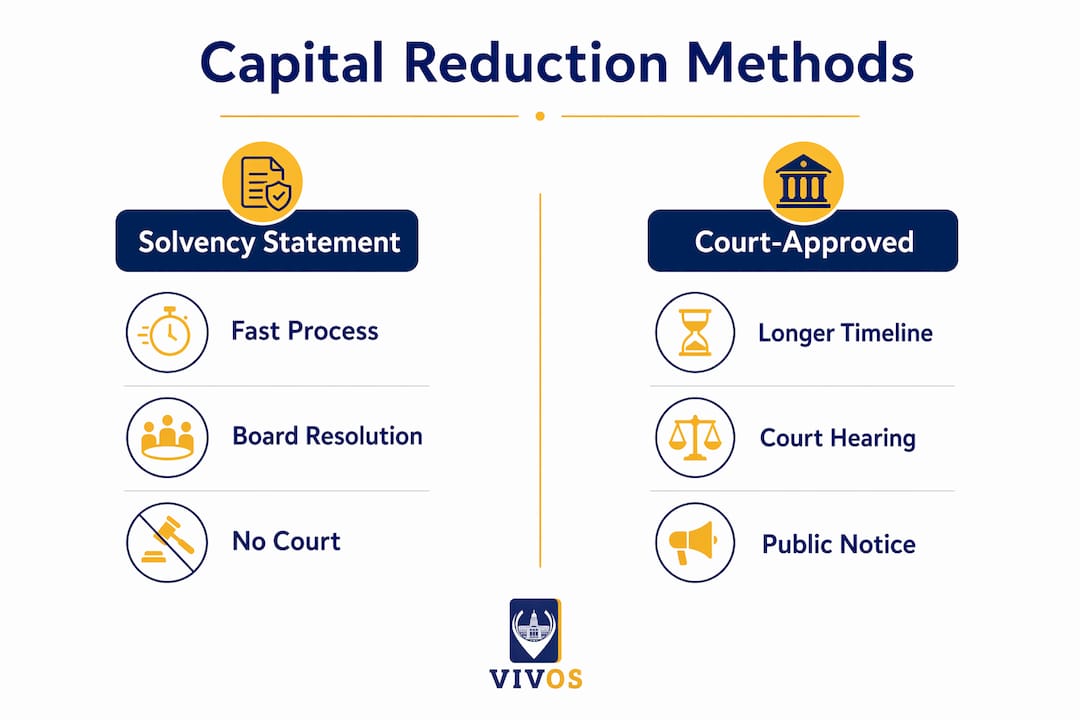

Infographic comparing capital reduction methods

How do the two capital reduction methods work, step by step?

Solvency-statement route (Sections 78B–78F)

This is the preferred path for most private companies. It avoids court involvement entirely, provided directors can honestly make the required solvency declaration.

  1. Board solvency declaration: All directors make a solvency statement confirming the company can pay its debts as they fall due within 12 months, and that the value of assets will not fall below liabilities after the reduction. For private companies, this statement must be made within 20 days before the special resolution date. For public companies, the window extends to 30 days.
  2. Pass the special resolution: Shareholders approve the reduction by a 75% majority. The solvency statement must be available for inspection by members at the meeting.
  3. Publish public notice: After the resolution, the company must publish a notice of the proposed reduction in a nationally circulated newspaper. The notice must accurately state the reduction details; inaccuracies can invalidate the entire process.
  4. Creditor inspection period: For six weeks from the resolution date, the solvency statement must be available at the company’s registered office for any creditor to inspect, free of charge.
  5. Wait out the creditor objection window: Creditors have six weeks to object to the reduction. If no valid objection is lodged, the company proceeds to filing.
  6. File with ACRA via BizFile+: The special resolution and solvency statement must be filed within 8 weeks of the resolution date, assuming no creditor objections. Capital reduction takes effect once ACRA records the information.

Statutory callout: The six-week creditor objection period is legally mandatory and cannot be shortened. Premature filing or a defective public notice can nullify the reduction entirely.

Court-approved route (Sections 78G–78K)

This route is available to all companies limited by shares as an alternative to the solvency-statement method. It is typically used when the reduction involves creditor risk that the solvency-statement route cannot adequately address.

  1. Pass the special resolution: Same 75% shareholder approval requirement applies.
  2. Apply to the court: The company applies for a court order confirming the reduction under Section 78I. The court has discretion to approve unconditionally or impose conditions.
  3. Court safeguards for creditors: Under Section 78H, if the reduction involves a diminution of liability or return of paid-up capital, creditors may appear and object. The court will not confirm the reduction if a creditor’s claim is unsecured and the reduction would prejudice that claim.
  4. Lodge court order with ACRA: Once the court issues its order, the company must lodge the court approval with ACRA within 90 days. The reduction does not take effect until ACRA records the information.

Common pitfalls across both routes:

  • Missing the 8-week filing deadline after the creditor objection window closes.
  • Publishing an incomplete or inaccurate newspaper notice.
  • Directors signing a solvency statement without adequate financial analysis.
  • Failing to make the solvency statement available for creditor inspection throughout the full six-week period.
  • Overlooking the requirement to notify tax authorities alongside the newspaper publication.

What rights do creditors have during a capital reduction?

Creditor protection is built into the statutory framework at multiple points. The six-week objection window is the central mechanism, but it operates alongside several other requirements.

  • Public notice obligation: The company must publish the notice of proposed reduction in a widely circulated newspaper. The notice must contain accurate reduction details; any material inaccuracy can void the process.
  • Solvency statement availability: Throughout the six-week period following the special resolution, the solvency statement must be available at the company’s registered office for creditor inspection at no charge.
  • Formal objection right: Any creditor may apply to the court to object to the reduction during the six-week window. The court has the power to cancel the reduction if it finds that a creditor’s claim is unsecured and would be prejudiced.
  • If objections arise: The company must address the objection through court proceedings. This may involve securing the creditor’s claim, obtaining a court dismissal of the objection, or abandoning the reduction and re-filing after resolving the dispute.
  • Tax authority notification: Companies must also notify the Inland Revenue Authority of Singapore (IRAS) as part of the publicity requirements, ensuring tax obligations tied to the capital structure are properly flagged.

Creditor protection compliance is not optional. Directors who fail to make the solvency statement available for inspection commit a statutory offense under the Companies Act, even if the resolution itself remains technically valid.


What are the ACRA filing and publication requirements?

Filing accuracy and timing determine whether the reduction actually takes effect. The process involves several distinct steps, each with its own deadline.

Publication requirements:

  • Notice of the proposed reduction must be published in a national newspaper after the special resolution is passed.
  • The notice must state the amount of capital being reduced, the number of shares canceled, and the resolution date.
  • Tax authorities must be notified alongside the newspaper publication.

Filing steps via BizFile+:

  1. File the special resolution with ACRA within 14 days of the resolution date.
  2. Lodge the solvency statement together with the resolution copy within 15 days of the resolution date (for public companies under Section 78C).
  3. Wait for the six-week creditor objection period to expire without a valid court application from any creditor.
  4. File the final capital reduction return via BizFile+ within 8 weeks of the resolution date, provided no objections have been lodged.
  5. ACRA records the reduction: Capital reduction takes effect at this point. ACRA updates the company’s share capital register accordingly.

For the court-approved route, the additional step is lodging the court order with ACRA within 90 days of the order date. The reduction does not take effect until ACRA records that information.

Key deadlines summary:

Milestone Deadline
File special resolution with ACRA Within 14 days of resolution date
Lodge solvency statement (public companies) Within 15 days of resolution date
Creditor objection window 6 weeks from resolution date
File final capital reduction return Within 8 weeks of resolution date
Lodge court order (court-approved route) Within 90 days of court order

How does capital reduction differ from a share buyback?

Both mechanisms reduce the amount of capital held by a company, but they operate under different statutory frameworks and serve different purposes.

  • Statutory basis: Capital reduction is governed by Sections 78A–78K of the Companies Act. Share buybacks are regulated separately under Sections 76B to 76G.
  • Shareholder binding: Capital reduction, once approved by special resolution, is binding on all shareholders. A share buyback is optional for individual shareholders; the company makes an offer and shareholders choose whether to participate.
  • Voting threshold: Capital reduction requires a 75% special resolution. Share buybacks typically require an ordinary resolution or a general mandate from shareholders.
  • Creditor protections: Capital reduction carries mandatory creditor notification and objection rights. Share buybacks do not trigger the same six-week creditor window.
  • Tax treatment: Capital reduction is generally not taxable in Singapore, though the distribution of assets may have tax consequences depending on the company’s financial structure. Share buyback proceeds may be treated differently depending on how the transaction is structured; consulting a tax professional and reviewing Singapore capital gains tax implications is advisable.
  • Strategic use: Share buybacks are often used to manage earnings per share, reward shareholders selectively, or absorb employee share option exercises. Capital reduction is more commonly used for structural balance sheet corrections or returning large surplus capital to all shareholders proportionally.

Understanding which mechanism fits the company’s situation requires analysis of the shareholding structure, financial position, and intended outcome. The two are not interchangeable.


How Vivos supports companies through the capital reduction process

Vivos provides end-to-end corporate secretarial services covering every stage of the capital reduction process, from initial structuring through to ACRA filing completion.

  • Route selection advisory: Vivos assesses the company’s financial position and shareholding structure to recommend the appropriate method, whether solvency-statement or court-approved.
  • Solvency statement preparation: The team assists directors in gathering the financial documentation required to support a valid solvency declaration, reducing the risk of a defective statement.
  • Special resolution drafting and filing: Vivos prepares and files the special resolution with ACRA within the required 14-day window.
  • Public notice compliance: Coordination of newspaper publication and tax authority notification to meet statutory publicity requirements.
  • Creditor objection monitoring: Vivos tracks the six-week objection period and advises on next steps if a creditor files a court application.
  • BizFile+ submissions: All final filings are submitted via BizFile+ within the 8-week deadline, with verification that ACRA has recorded the reduction.
  • Court-approved route support: Where court approval is required, Vivos coordinates with legal counsel and manages the lodgment of court orders within the 90-day window.

Pro Tip: Directors should not sign a solvency statement without a current set of management accounts. A statement made without adequate financial analysis exposes directors to personal liability under the Companies Act.

Vivos also supports post-reduction corporate governance and meeting management, including updating the company’s statutory registers and issuing revised share certificates where applicable.


How long does a capital reduction typically take in Singapore?

The timeline differs materially between the two routes.

Solvency-statement route: The minimum elapsed time from board resolution to completed ACRA filing is approximately 10–12 weeks. The six-week creditor objection window is the dominant constraint; it cannot be shortened, regardless of company size or transaction complexity. Add preparation time for the solvency statement, newspaper publication, and BizFile+ filing, and most straightforward transactions complete within 10–12 weeks from the initial board decision.

Overhead hands reviewing timeline documents

Court-approved route: Significantly longer. After passing the special resolution, the company must apply to the court and wait for a hearing date. Court timelines in Singapore vary, but companies should budget at least 3–6 months from the resolution date to ACRA recording, depending on whether creditors contest the application and how quickly the court schedules the matter.

Practical factors that extend timelines under either route include defective newspaper notices requiring republication, creditor objections requiring court resolution, and errors in BizFile+ submissions that require correction before ACRA will record the reduction. Engaging a corporate secretarial firm with direct BizFile+ experience reduces the risk of procedural delays.


What happens to company records and shareholder rights after a capital reduction?

Once ACRA records the reduction, the changes take effect immediately and are reflected across the company’s statutory records.

Updates to company records:

  • The company’s share capital register is adjusted to reflect the reduced capital amount and, where applicable, the reduced number of shares.
  • ACRA updates the company’s public profile on BizFile+ to show the new paid-up capital figure.
  • Where shares are canceled, the register of members is updated and affected shareholders receive revised documentation.

Effect on shareholder rights:

Under Section 78K of the Companies Act, a member’s liability in respect of any share is capped at the difference between the issue price of the share and the aggregate of the amount paid up plus the amount reduced. Shareholders cannot be called upon to contribute more than that difference, regardless of future company obligations.

Where the reduction involves a return of capital, shareholders receive the distribution as specified in the approved resolution. This is not a dividend; it is a return of capital, and the tax implications differ accordingly. Companies should confirm with IRAS whether any reporting obligations arise from the distribution, particularly where assets rather than cash are returned.

Post-reduction, the company’s financial accounting and reporting must reflect the adjusted equity position. Directors should also review whether any loan covenants, banking facilities, or contractual arrangements reference minimum capital thresholds, as a reduction may trigger review clauses or require lender consent.


Vivos handles your capital reduction from start to finish

Capital reduction is procedurally precise. One missed deadline or a defective newspaper notice can void the entire process, requiring the company to restart from the special resolution stage.

Vivos

Vivos offers a fully managed capital reduction service for Singapore companies, covering route selection, solvency statement support, resolution drafting, newspaper publication coordination, creditor objection monitoring, and all BizFile+ filings. Directors get a clear timeline, accurate documentation, and a team that has navigated ACRA’s requirements across multiple transaction types.

For companies weighing whether capital reduction or a share buyback better fits their situation, Vivos’s corporate advisory team provides a structured analysis before any resolution is passed, avoiding the cost of choosing the wrong mechanism.

Contact Vivos to discuss your company’s capital structure and get a clear plan for completing the reduction within statutory deadlines.


Key Takeaways

Capital reduction in Singapore requires strict adherence to the Companies Act 1967, with the solvency-statement route completing in approximately 10–12 weeks and the court-approved route taking 3–6 months or more.

Point Details
Two statutory routes Solvency-statement (Sections 78B–78F) and court-approved (Sections 78G–78K) are the only lawful methods.
Mandatory six-week window Creditors have six weeks after the special resolution to object; this period cannot be shortened.
ACRA filing deadline Final capital reduction return must be filed via BizFile+ within 8 weeks of the resolution date.
Solvency statement timing Directors must make the statement within 20 days before the resolution (private) or 30 days (public).
Vivos end-to-end support Vivos manages the full capital reduction process, from route selection through to ACRA recording.

Recents Blogs

Seed Funding in Singapore: A Practical 2026 Guide

Discover the essential guide to seed funding in Singapore for startups. Learn about key players and strategies to secure early-stage capital.

How to Register a Company in Singapore as a Foreigner — and Get Your Employment Pass or ONE Pass (2026)

Ray Tay

Quick answer: A foreigner can own 100% of a Singapore private limited company with S$1 paid-up capital, one Singapore-resident director (a nominee director qualifies), and…

Transfer Pricing in Singapore: 2026 Compliance Guide

Understand transfer pricing in Singapore for 2026 compliance. Learn key principles, the arm's length standard, and how IRAS enforces rules.

Wechat
Whatsapp