

在新加坡注册公司到底有多快?ACRA比客户的午餐还快(2026年真实案例)

Ray Tay
ACRA大多在付款后即批准注册(名称15新元+注册300新元,通常当天完成)。真正拖慢创始人的是未决定的事项:财年、股权、注册地址、银行KYC文件。
Published: 6 October 2026 · Reviewed by Ray Tay, Co-Founder & Managing Director, VIVOS PTE. LTD. (ACRA Filing Agent FA20240323 · MOM EA Licence 24S2425)
A share transfer in a Singapore private company needs a completed share transfer form and board approval, 0.2% stamp duty paid to IRAS on the higher of price or net asset value within 14 days (30 days if signed overseas), and a filing on BizFile+ to update ACRA’s electronic register, as of 2026.
TL;DR:
- Share transfers in Singapore require a signed transfer form, board approval, and compliance with pre-emption rights where applicable.
- Stamp duty of 0.2% applies on the higher of the transfer price or net asset value within 14 days of signing if in Singapore, or 30 days if signed overseas.
- The transfer is only complete once the transfer on BizFile+ is filed and ACRA’s register is updated, which is the effective legal point.
- Proper documentation includes the transfer form, board resolution, surrendered share certificate, and stamp duty working sheet, all kept for five years.
- Foreigners can buy shares freely, but the company must have a registered address and a locally resident director; remote signing requires advance planning.
A share transfer moves ownership from one shareholder to another without creating new shares, unlike an allotment, which issues fresh stock and changes the company’s total share capital. For foreign founders bringing in a co-founder or an early investor after incorporation, a transfer is usually the simpler route when the buyer takes over an existing stake rather than injecting fresh capital.
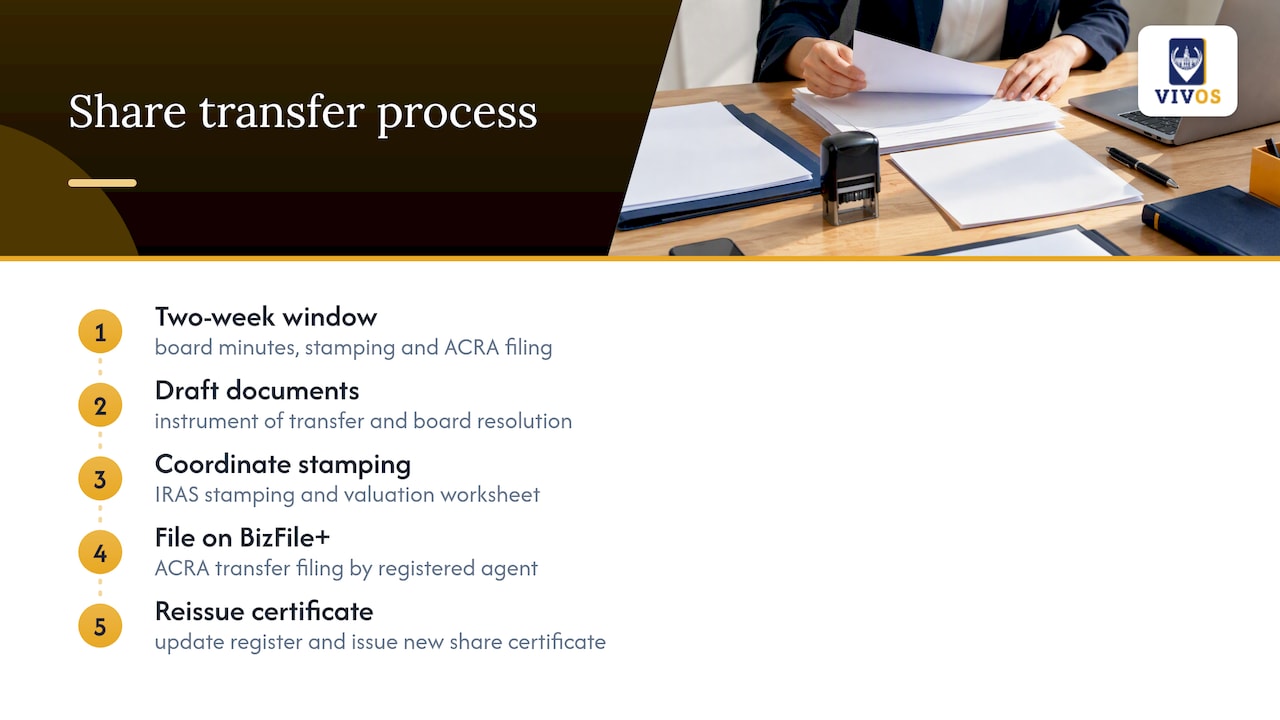
The sequence runs in a fixed order, and skipping a step creates problems later.
The transferor and transferee sign the instrument; the company secretary typically drafts the board resolution and coordinates stamping and filing. None of this is final until ACRA’s register is updated, so treat the filing date, not the signing date, as the real deadline.
Each document in a transfer has one clear owner and a deadline tied either to stamping or to filing.
| Document | Signatory | Deadline |
|---|---|---|
| Instrument of transfer / share transfer form | Transferor and transferee | Before stamping |
| Sale and purchase agreement (if used) | Transferor and transferee | Before instrument of transfer |
| Notice of transfer / waiver of pre-emption | Existing shareholders | Before board approval |
| Board resolution and minutes | Director(s) | At or before stamping |
| IRAS stamp duty working sheet | Prepared by transferee or appointed agent | Within 14 days of execution (30 if overseas) |
| Share certificate (surrendered and reissued) | Company secretary | After BizFile+ filing |
| BizFile+ transfer filing | Corppass-authorized officer or filing agent | Promptly after stamping |
Originals of the share certificate should be surrendered physically or securely retained; ACRA accepts electronic filing once the underlying documents are in order. A deed poll is needed only if a shareholder’s registered name has changed since incorporation. Keep signed copies of every document in the statutory register for at least five years, since IRAS and ACRA can both request them on audit.
Stamp duty on a Singapore private company share transfer is 0.2% of the purchase price or the net asset value of the shares, whichever is higher, under IRAS rules on buying or acquiring shares. Net asset value is calculated from the company’s latest accounts, provided those accounts are dated within 24 months of the transfer.
In practice, this means a transfer priced well below book value does not escape duty: IRAS will apply the higher NAV figure regardless of what the parties agreed to pay. The instrument of transfer, or the sale and purchase agreement where ACD applies, gets stamped through the myTax Portal. The clock starts at execution: 14 days for documents signed in Singapore, 30 days for documents executed overseas, according to IRAS guidance on stamp duty basics for shares. Missing the deadline brings a penalty of up to four times the duty owed, or a minimum of $25, whichever is greater.
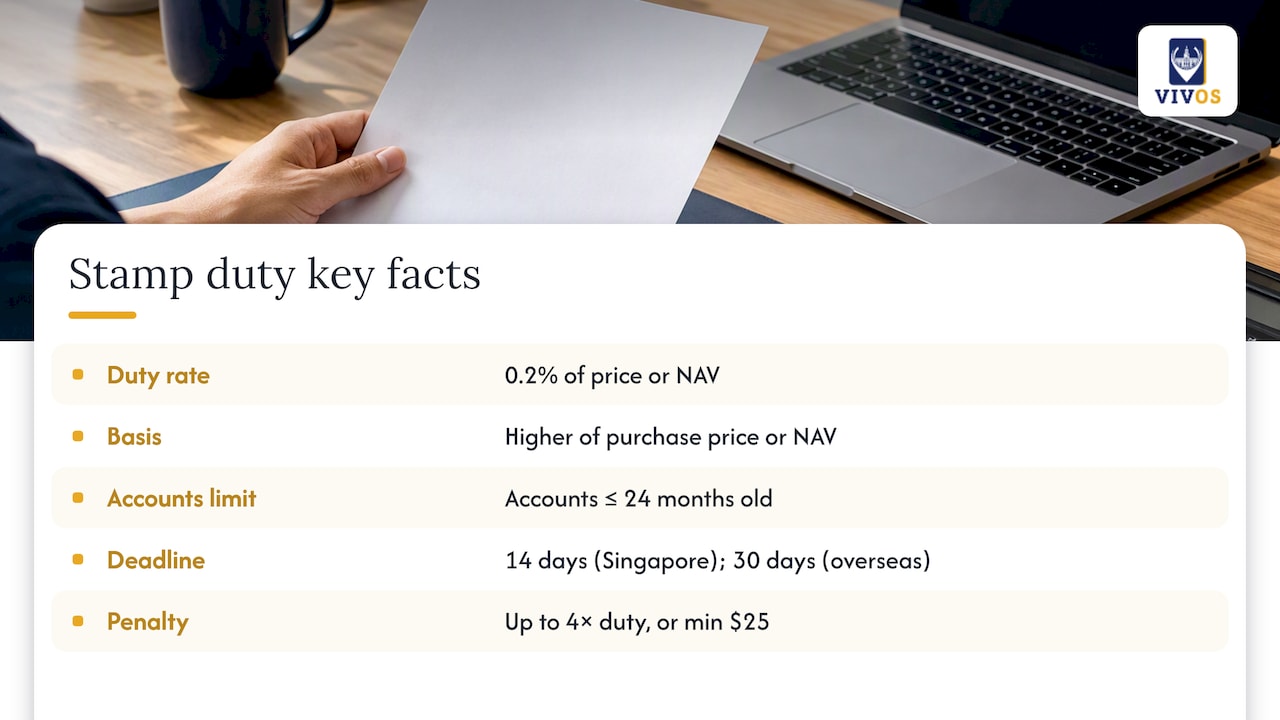
Transfers between associated entities may qualify for relief under IRAS’s remission rules, but the same 14- or 30-day timing rules still apply to the claim.
Directors approving a transfer must check the constitution first, not the transfer form. Pre-emption clauses typically require the company to offer shares to existing shareholders before an outsider buys in, and a shareholders’ agreement may add tag-along or drag-along mechanics on top of that. Skipping this check does not make the restriction disappear: a transfer that ignores a binding pre-emption right can be challenged later even after ACRA accepts the filing.
Directors have a duty to consider refusal or approval in good faith, and the reasoning belongs in the board minutes, not in an email thread. A properly minuted resolution is the company’s main protection if a disappointed shareholder later disputes the decision.
The recurring mistakes are predictable: ignoring pre-emption rights, accepting a verbal waiver instead of a written one, backdating an instrument to dodge a stamping deadline, and using a stale NAV figure that understates duty. Each is avoidable with a documented checklist before signing.
Filing happens through BizFile+, accessed with Corppass or through a registered filing agent’s profile. The sequence is fixed:
For a private company, the transfer has no legal effect until ACRA updates the electronic register of members, known as the EROM. Treat the 14-day window from stamping to filing as the working deadline, since the company secretary cannot issue a new share certificate until the register reflects the change. Common BizFile+ snags include Corppass authorization errors, missing shareholder-type fields, and confusion when the same two parties transfer shares more than once in a short period; ACRA’s own procedural guide covers each scenario directly.
Yes. Foreign individuals and entities can hold shares in a Singapore private company without restriction on nationality. The company itself still needs a registered Singapore address and at least one director ordinarily resident here, which is why many founders use a nominee resident director arrangement rather than relocating.
IRAS treats an electronic instrument executed outside Singapore as received here once it is retrieved or accessed in Singapore, or once the device holding it is brought into the country, which is what sets the 30-day stamping window rather than the signing date itself. Keeping access logs or noting when the signed document first reached a Singapore-based device gives a clear record if the timeline is ever questioned.
Foreign founders signing remotely should plan for Corppass or filing-agent authorization ahead of the stamping deadline, confirm who holds the myTax Portal login, and line up a corporate secretary to handle the BizFile+ filing on their behalf. Background on resident director requirements and nominee director arrangements is worth reviewing before the transfer date, not after.
Most disputes we see trace back to the same two gaps: a board resolution that was never properly minuted, and stamp duty paid late because nobody tracked the 14-day clock. Both are entirely avoidable with a basic checklist before signing.
We are an ACRA-registered filing agent providing Singapore company incorporation for foreign founders, including nominee resident director, registered address, and corporate secretary services that handle transfers and registers directly, alongside similar support in Malaysia, Hong Kong, and the UAE. For anything involving related-party valuations or cross-border signing, confirming the specifics with ACRA or IRAS directly, or with a qualified adviser, remains worthwhile before the deadline rather than after.
— Ray
A share transfer touches board minutes, stamp duty computation, and an ACRA filing all within the same two-week window, and getting one piece wrong usually means redoing the others. We handle this end to end as an ACRA-registered filing agent: drafting the instrument of transfer and board resolution, coordinating the IRAS stamping and valuation working sheet, filing the transfer on BizFile+, and issuing the reissued share certificate once the register is updated.

Our corporate secretarial services cover governance and share and capital management for exactly this kind of event, and we offer the same nominee resident director, registered address, and filing support for founders setting up in Malaysia, Hong Kong, and the UAE. If you are adding a co-founder or investor after incorporation, check our pricing page for corporate secretary and related service rates, or get in touch to have us run the transfer from signing to a reissued share certificate.
This article is general information, not a substitute for advice from a qualified lawyer. Consult a qualified legal professional about your own circumstances before acting on anything here.
Yes, a shareholder can transfer shares to another individual or entity using a completed instrument of transfer and board approval, subject to any pre-emption rights in the company’s constitution. The transfer is only legally effective once ACRA’s electronic register is updated through a BizFile+ filing.
A valid transfer needs a signed instrument of transfer, board approval recorded in minutes, and compliance with any constitutional restrictions such as pre-emption or consent clauses. Stamp duty of 0.2% on the higher of price or net asset value must then be paid to IRAS within 14 days, or 30 days if the document was executed overseas, before the filing with ACRA.
At minimum you need the instrument of transfer, a board resolution approving the transfer, the existing share certificate for surrender, and the IRAS stamp duty working sheet. A sale and purchase agreement is added when the transfer involves negotiated price terms rather than a straightforward internal move of existing shares.
Yes, provided the company’s constitution does not impose a blocking restriction such as an unwaived pre-emption right. Once board approval, stamping, and the BizFile+ filing are complete, the new owner is reflected in ACRA’s electronic register of members and holds full shareholder rights from that point.

 2 January, 2025
 2 January, 2025
ACRA大多在付款后即批准注册(名称15新元+注册300新元,通常当天完成)。真正拖慢创始人的是未决定的事项:财年、股权、注册地址、银行KYC文件。
ACRA approves most Singapore incorporations soon after payment (S$15 name + S$300). A true client story on what really slows founders down — and the…

了解新加坡公司注册费用:官方 315 新元起、首年第三方费用可明显上升,逐项报价与合规建议帮您控预算并加速开户,含处理时效与开户风险说明。