


Audit Exemption Singapore: 2026 Guide for Directors

Learn about audit exemption in Singapore. Discover how your private company can qualify and the criteria to watch for in 2026.
A share purchase agreement (SPA) is the contract that sets the commercial and legal terms for the sale of shares in a Singapore company. It governs price, conditions, warranties, and closing mechanics. The SPA itself does not transfer legal title — a separate share transfer form must be executed, stamped with IRAS, and registered with ACRA before ownership formally changes hands.
This guide gives you:
A Singapore SPA is a binding commercial contract between a seller and a buyer that records the agreed terms for transferring shares. It sets the price, payment mechanics, conditions precedent, and the risk allocation between parties. The legal transfer of title happens separately, through a stamped share transfer instrument and ACRA registration.
Choosing between a share sale and an asset sale is the single most important structural decision for any Singapore transaction. Each carries different risk, tax, and operational implications.

| Factor | Share sale | Asset sale |
|---|---|---|
| What transfers | The entire legal entity, including all liabilities | Selected assets only; liabilities generally stay with seller |
| Continuity of contracts | Contracts, licenses, and relationships transfer automatically | Each contract typically requires third-party consent to assign |
| Historical liabilities | Buyer inherits all pre-closing liabilities | Buyer avoids most historical liabilities |
| Stamp duty | Assessed on higher of consideration or net asset value | Assessed on individual asset categories |
| Operational complexity | Lower — business continues uninterrupted | Higher — reassigning contracts, permits, and employees |
| Typical preference | Sellers prefer; preserves entity and tax attributes | Buyers often prefer to limit inherited risk |
A share sale is usually appropriate when:
An asset sale tends to suit buyers who want to cherry-pick profitable assets and leave behind contingent liabilities, pending litigation, or legacy tax exposures.
A well-drafted Singapore SPA covers the following provisions. Each clause directly affects deal economics and the allocation of risk between buyer and seller.
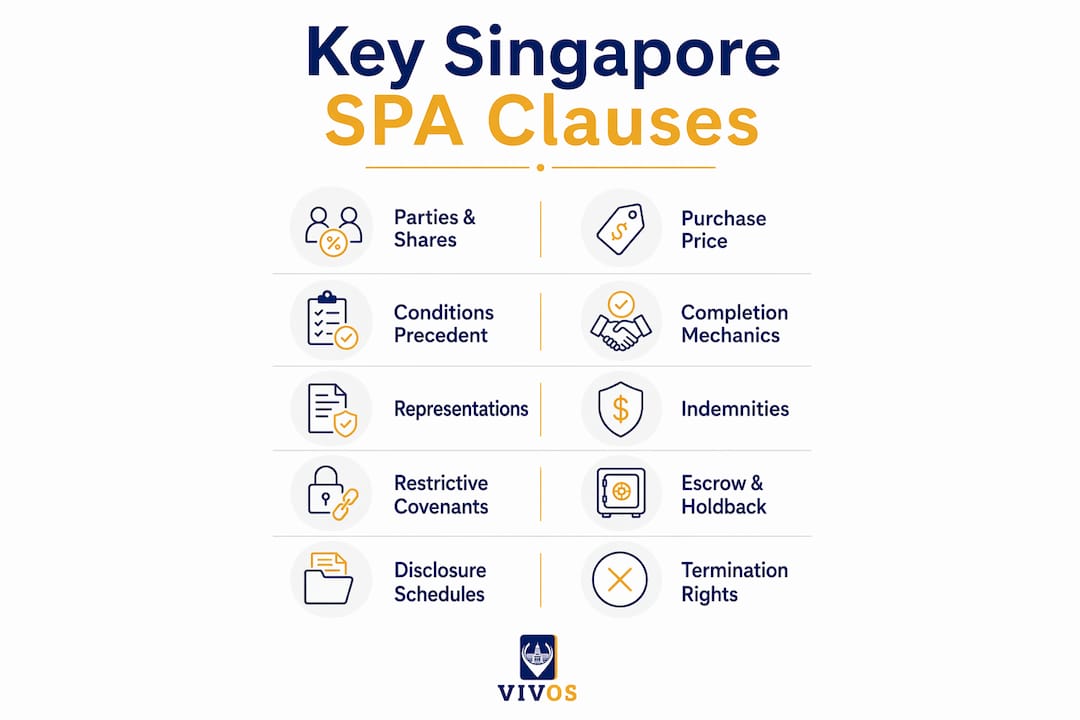
Identify each party precisely: full legal name, registered address, and UEN. Specify the class, number, and par value of shares being sold, and confirm the seller’s ownership is free of encumbrances.
State the total consideration in SGD (or agreed currency), the payment method (bank transfer, escrow, deferred payment), and any price adjustment mechanism. A typical price adjustment clause reads:

List every condition that must be satisfied before completion: board and shareholder approvals, regulatory clearances (MAS, CCCS), third-party consents, and any financing conditions. Include a long-stop date and specify what happens if conditions are not met, including any break fees.
Define the date, time, and location of completion. List every document to be exchanged: signed share transfer forms, board resolutions, share certificates, resignation letters, and statutory books. Specify the order of steps at the completion meeting.
Warranties cover the seller’s statements about the company’s financial position, ownership, contracts, tax, IP, employment, and regulatory compliance. Buyers push for broad warranties; sellers limit them through disclosure schedules and materiality qualifiers.
Specific indemnities cover known risks identified during due diligence — tax exposures, pending litigation, or environmental liabilities. General indemnities cover warranty breaches. Both are subject to caps, baskets, and survival periods.
Non-compete and non-solicitation obligations on the seller must be reasonable in scope, geography, and duration to be enforceable under Singapore’s common-law restraint of trade principles. Overly broad covenants risk being struck down entirely.
Escrow arrangements are common in Singapore practice for indemnity claims. A typical escrow release trigger: “The Escrow Amount shall be released to the Seller after a defined period following the Completion Date, less any amounts subject to a Pending Claim Notice.”
The seller discloses known facts that qualify the warranties. Proper disclosure protects the seller from warranty claims on disclosed matters. Buyers must insist on granular, specific disclosures rather than blanket references to documents.
Specify which warranties survive completion and for how long (typically a survival period of several months for general warranties, longer for tax and title). Define termination rights and consequences if the SPA is terminated before completion.
Pro Tip: Cap and basket drafting directly affects deal price. A seller’s liability cap set at 100% of the purchase price with a 1% basket (de minimis threshold) is a common Singapore market position, but buyers in complex deals frequently negotiate caps down to a low percentage for general warranties, with carve-outs for fraud and title warranties that are uncapped.
Missing a statutory step can make a transfer unenforceable or trigger unexpected tax and registration problems. Work through this checklist before signing.
The SPA must account for ACRA’s statutory steps: lodging the share transfer form, updating the register of members, and filing any director changes via BizFile+. Statutory timeframes apply — transfers must be registered promptly after stamping.
IRAS assesses stamp duty on the higher of the stated consideration or the net asset value of the shares being transferred. This can create unexpected stamp duty liabilities where the company’s net asset value exceeds the agreed price — a common issue in distressed or discounted sales.
Pro Tip: Run the IRAS net asset value check and the constitution pre-emption review simultaneously, not sequentially. Both can block or delay completion, and identifying them early gives you time to structure around them — for example, by obtaining pre-emption waivers from existing shareholders before signing.
Common payment structures in Singapore SPAs:
For cross-border transactions, banking and funds-flow planning should be confirmed before signing, as international wire transfers and currency controls can affect completion timing.
The typical flow runs:
Signing and completion can occur simultaneously for simple transactions. For complex deals with regulatory conditions, the gap between signing and completion can run 2–12 weeks or longer.
Representations and warranties are the primary mechanism for risk allocation in a Singapore SPA. They determine what the buyer can recover post-closing if the company turns out to be different from what was represented.
Specific indemnities cover identified risks — a pending tax audit, an unresolved supplier dispute, or a known environmental issue. They operate dollar-for-dollar, outside the warranty cap. General indemnities cover warranty breaches and are subject to:
Pro Tip: Disclosure schedules are your most powerful drafting tool. A seller who discloses a known issue specifically and in writing loses the warranty claim on that issue — but a buyer who accepts a vague, bundled disclosure loses the ability to claim on everything it covers. Insist on item-by-item, document-specific disclosures. Map each due diligence finding to a specific schedule entry.
Cross-border parties typically designate SIAC with a Singapore seat; domestic-only deals often accept Singapore courts for cost and familiarity reasons.
| Factor | SIAC arbitration | Singapore courts |
|---|---|---|
| Confidentiality | Yes — proceedings and awards are private | No — court proceedings are generally public |
| International enforceability | Yes — New York Convention (172 member states) | Limited to bilateral treaty recognition |
| Cost | Higher upfront (filing fees, arbitrator fees) | Lower for straightforward disputes |
| Speed | Expedited procedure available for claims under SGD 6 million | Depends on court docket |
| Finality | Award is final; limited grounds for challenge | Full appeal rights to Court of Appeal |
| Interim relief | Courts can grant interim relief in support of arbitration | Courts grant interim relief directly |
| Best for | Cross-border, complex, or high-value transactions | Domestic, lower-value, or straightforward disputes |
A well-drafted clause should specify:
For cross-border investors, SIAC arbitration provides enforceability across 172 jurisdictions under the New York Convention — a material advantage when the seller or buyer is based outside Singapore.
Completion is not the end of the transaction. The following steps must be completed within statutory windows.
Corporate secretarial providers such as Vivos typically manage steps 2–8, coordinating with lawyers on stamping and ACRA filings. For foreign founders, the ACRA registration process and BizFile+ lodgement requirements are handled as part of a full secretarial mandate.
A Singapore SPA template (Word or PDF) gives you a court-ready starting structure. Download the template, customize the warranties and schedules to your transaction, and have local counsel review before signing.
Seller IP warranty:
“The Company owns or has valid licenses to all intellectual property used in the conduct of its business as currently conducted, and no third party has asserted any claim of infringement or misappropriation against the Company in the 36 months preceding the date of this Agreement.”
Completion mechanics excerpt:
“At Completion, the Seller shall deliver to the Buyer: (i) duly executed share transfer forms in respect of the Sale Shares; (ii) the original share certificates representing the Sale Shares; (iii) board resolutions approving the transfer and registration of the Sale Shares in the name of the Buyer; and (iv) the statutory books and corporate records of the Company.”
Escrow release trigger:
“The Escrow Agent shall release the Escrow Amount to the Seller on the date falling 18 months after the Completion Date, less any amounts subject to a Pending Claim Notice delivered by the Buyer prior to such date.”
Templates are useful starting points but carry enforceability and compliance risks if used without review. Always confirm the template against the company’s constitution for transfer restrictions, obtain an IRAS stamp duty estimate, and verify sector-specific approval requirements with local counsel. For cross-border transactions where SPA annexures require translation, a certified translation service ensures documents are accepted by regulators and counterparties.
A buyer who completes a share transfer without first offering shares to existing shareholders (as required by the constitution) risks the transfer being void or challenged. Vivos conducts a pre-signing constitution review on every transaction to identify and resolve pre-emption obligations before the SPA is signed.
Where the company’s net asset value exceeds the agreed sale price, IRAS will assess stamp duty on the higher figure. This is a frequent surprise in distressed sales or where goodwill is not reflected in the balance sheet. Vivos prepares an early stamp duty estimate to prevent budget overruns at completion.
Generic warranties with no corresponding disclosure schedules leave both parties exposed. The seller cannot rely on disclosure to defeat a claim, and the buyer cannot quantify its recovery. Vivos coordinates with transaction lawyers to map due diligence findings to specific schedule entries.
Parties sometimes insert a SIAC clause in a purely domestic transaction, adding cost without benefit, or omit the seat of arbitration entirely, creating jurisdictional uncertainty. Vivos flags mismatched dispute clauses during document review.
Missing a required document at the completion meeting — a board resolution, a director’s resignation letter, or a stamped transfer form — can delay or abort completion. Vivos manages a completion checklist and coordinates all parties to confirm document readiness before the completion date.
Pro Tip: During the interim period between signing and completion, the seller must operate the company in the ordinary course of business. Document every material decision made in that window — board minutes, management accounts, and correspondence — so there is no ambiguity about whether a warranty breach occurred before or after signing.
For director-related actions during completion, including resignations and new appointments, Vivos handles the director change process and ACRA filings as part of its secretarial mandate.
| Phase | Simple deal | Mid-market deal | Complex deal |
|---|---|---|---|
| Due diligence | 1–2 weeks | 2–4 weeks | 4–8 weeks |
| SPA negotiation and signing | 1–2 weeks | 2–3 weeks | 3–6 weeks |
| Conditions precedent / regulatory approvals | — | 2–6 weeks | 6–12+ weeks |
| Completion and post-completion filings | 1 week | 1–2 weeks | 2–4 weeks |
| Total | 3–7 weeks | 7–15 weeks | 15–30+ weeks |
Regulatory approvals (MAS, CCCS) are the most common source of timeline extension. Build contingency into the long-stop date accordingly.
For IRAS-related queries and stamp duty disputes, Vivos provides tax advisory support as part of its transaction services.
A Singapore SPA sets the commercial terms for a share sale but does not itself transfer legal title — a stamped share transfer form and ACRA registration are required to complete the legal transfer.
| Point | Details |
|---|---|
| SPA does not transfer title | Execute, stamp, and register a separate share transfer form with ACRA after signing the SPA. |
| IRAS stamp duty risk | Stamp duty is assessed on the higher of consideration or net asset value — get an early estimate to avoid budget surprises. |
| Pre-emption rights | Check the company constitution for pre-emption obligations before signing; missing this step can void the transfer. |
| Disclosure schedule quality | Map every due diligence finding to a specific schedule entry; vague disclosures leave both parties exposed post-closing. |
| Vivos transaction support | Vivos coordinates secretarial, tax, banking, and ACRA filings across the full transaction lifecycle in Singapore. |
The pattern Vivos sees repeatedly is not that parties lack a template — it is that they use one without checking it against the company’s constitution, the IRAS stamp duty position, and the regulatory approval requirements specific to their sector. A generic SPA that ignores a pre-emption clause in the constitution, or that sets a purchase price without accounting for net asset value, creates problems that are expensive to unwind after signing.
The other consistent gap is disclosure discipline. Sellers who treat the disclosure schedule as a formality — attaching a data room index rather than specific, document-level disclosures — find themselves exposed to warranty claims they believed were covered. Buyers who accept bundled disclosures lose the ability to claim on everything those disclosures touch. Neither outcome is necessary with proper drafting.
The practical fix is straightforward: run the constitution review, the IRAS valuation check, and the disclosure mapping in parallel with due diligence, not after the SPA is already negotiated. That sequencing alone eliminates the majority of post-signing disputes Vivos encounters in transaction support work.
Drafting a Singapore SPA correctly requires more than a template. It requires a coordinated team covering corporate secretarial, tax advisory, banking, and ACRA compliance — all moving in parallel to meet your completion date.
Vivos delivers exactly that. For Singapore share sale transactions, Vivos handles corporate secretarial services including ACRA BizFile+ filings, share register updates, and share certificate issuance. The team coordinates stamp duty estimation and IRAS compliance, escrow and banking arrangements, completion checklists, and post-completion corporate record updates. For buyers and sellers who need full transaction advisory, Vivos provides M&A and fundraising advisory services covering deal structuring, due diligence coordination, and SPA review.
Book a consultation with Vivos to request a template review or get a fixed-scope quote for your transaction. Contact the team via vivos.com.sg/singapore/corporate-secretary-services.
 2 January, 2025
 2 January, 2025
Learn about audit exemption in Singapore. Discover how your private company can qualify and the criteria to watch for in 2026.

Learn how to set up a Pte Ltd in Singapore effortlessly. Follow our 2026 guide for streamlined registration and quick approval today!

Learn about capital reduction in Singapore in 2026. Understand the methods, requirements, and benefits for your company. Get compliant today!