
Avoid 4x Penalty: Transferring Shares in Singapore for Founders

Ray Tay
Practitioner checklist for founders transferring shares in Singapore: compute 0.2% stamp duty, meet the 14 or 30 day deadlines, secure board approval, and...
Published: 31 July 2026 · Last reviewed: 30 September 2026 · Reviewed by Ray Tay, Co-Founder & Managing Director, VIVOS PTE. LTD. (ACRA Filing Agent FA20240323 · MOM EA Licence 24S2425)
For most Singapore founders targeting growth, equity investment, or eventual exit, a Private Limited Company (Pte Ltd) is the stronger choice. For small professional partnerships or freelancer collaborations prioritizing flexible profit-sharing and lower compliance overhead, a Limited Liability Partnership (LLP) is the more practical fit.
Three factors drive that verdict:
Quick decision checklist:
Vivos supports founders through both incorporation paths, from structure selection through ACRA registration, banking introductions, and ongoing compliance.
The table below covers the nine dimensions founders weigh most when choosing between the two structures in Singapore.
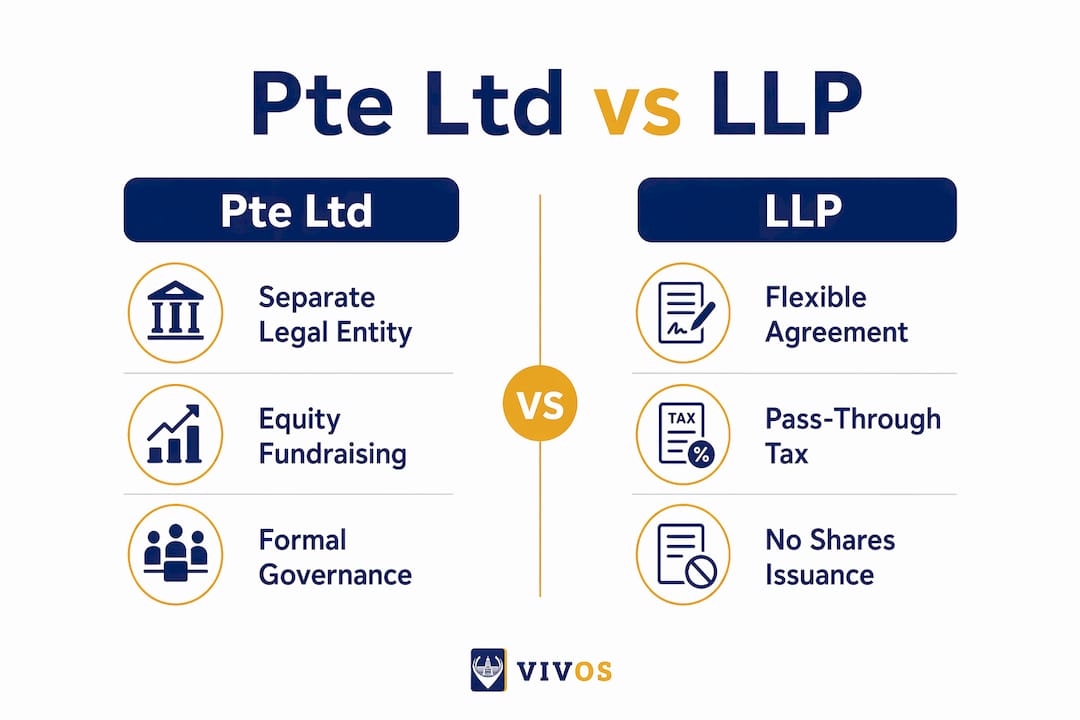
| Dimension | Pte Ltd | LLP |
|---|---|---|
| Legal status | Separate legal entity; owned by shareholders | Separate legal entity; owned by partners |
| Liability / personal risk | Shareholders’ liability limited to paid-up capital; personal assets protected | Partners protected from business debts; liable for own wrongful acts |
| Ownership & control | Shareholders own shares; directors manage; board decisions required | Partners own membership interests; governed by LLP agreement; no board required |
| Directors / partners required | At least 1 shareholder, at least 1 resident director | At least 2 partners; at least 1 local manager |
| Taxation | Corporate tax on company profits; dividends paid from after-tax profits | Pass-through: each partner taxed individually on their profit share |
| Setup & ongoing costs | Higher: ACRA registration fee, corporate secretary, accounting, potential audit | Lower: ACRA registration fee, annual declaration, partner tax filings |
| Compliance & reporting | Annual return to ACRA; corporate tax filing with IRAS; statutory registers | Annual declaration to ACRA; individual income tax returns for each partner |
| Ability to raise capital | Can issue shares; suitable for VC, angel, and equity fundraising | Cannot issue shares; limited to partner contributions and debt financing |
| Continuity / transferability | Perpetual succession; shares transferable; unaffected by director changes | Dissolves or restructures on partner exit unless LLP agreement provides otherwise |
| Conversion / exit options | Can be wound up, sold, or listed; M&A-ready | Can convert to Pte Ltd; winding up requires partner consent and debt clearance |
A Pte Ltd is a company incorporated under the Companies Act, recognized by ACRA as a legal entity entirely separate from its owners. Shareholders hold equity in the form of shares; directors manage day-to-day operations. The company can enter contracts, own property, sue, and be sued in its own name.
Formation essentials under ACRA:
ACRA recognizes two common sub-types relevant to most founders. An Exempt Private Company (EPC) has no more than 20 shareholders, none of whom are corporations, and qualifies for audit exemption if it meets the small company criteria. A Private Company Limited by Shares can have up to 50 shareholders and is the standard structure for most incorporated businesses in Singapore.
Shareholders’ personal liability is capped at their paid-up capital. If the company owes SGD 500,000 to a creditor, a shareholder who invested SGD 10,000 risks only that SGD 10,000, not personal savings or property. The exception: personal guarantees signed to secure bank loans or leases pierce that protection.
Common use cases for Pte Ltd:
Ongoing obligations include filing annual returns with ACRA, submitting corporate tax returns to IRAS, maintaining statutory registers, and holding annual general meetings (or passing written resolutions in lieu). These are manageable with a competent corporate secretary and accounting firm, but they do represent recurring cost and calendar discipline.
An LLP is a business structure that blends partnership flexibility with the liability protection of a company. Like a Pte Ltd, it is a separate legal entity under ACRA, meaning the LLP itself can own assets, enter contracts, and incur debts. Unlike a general partnership, partners are not personally liable for the business debts of the LLP or for the wrongful acts of other partners.
Formation essentials under ACRA:
An LLP agreement governs profit-sharing, decision-making, partner admission and exit, and dispute resolution. ACRA does not prescribe a standard form, so partners draft the agreement to fit their specific arrangement. Without a written agreement, default rules under the Limited Liability Partnerships Act apply, which may not reflect the partners’ actual intentions.
Tax treatment: LLP profits are taxed in each partner’s hands rather than at the entity level. Each partner reports their share of LLP income on their individual income tax return with IRAS. This pass-through structure can be advantageous when partners’ personal tax rates are lower than the corporate rate, but it removes access to corporate-level startup tax exemptions.
Typical LLP users:
One practical limitation: an LLP cannot issue shares. That single constraint rules it out for any business planning to bring in equity investors, offer employee stock options, or pursue a conventional venture capital raise.
Both structures protect personal assets from general business debts, but the protection has limits in both cases. In a Pte Ltd, a shareholder who also signs a personal guarantee on a bank loan or office lease is personally exposed on that specific obligation. In an LLP, a partner remains personally liable for their own negligence or wrongful acts, even if other partners are shielded. Creditors of an LLP can pursue the LLP’s assets; they cannot pursue individual partners’ personal assets for debts the LLP incurred through normal operations.
A Pte Ltd separates ownership (shareholders) from management (directors), though in small companies the same person often holds both roles. Shares are transferable, subject to any restrictions in the constitution, making ownership changes relatively clean. An LLP has no shares. Ownership interests are defined in the LLP agreement, and transferring a partner’s interest typically requires the consent of all other partners, which can slow exits or restructuring.

A Pte Ltd requires formal governance: board resolutions, director meetings, annual general meetings (or written resolutions), and statutory registers maintained by a corporate secretary. An LLP operates under its partnership agreement with no board requirement. Decisions can be made informally among partners, which reduces administrative overhead but also reduces the audit trail that sophisticated investors or acquirers expect to see.
Pro Tip: Draft your LLP agreement to include a conversion clause from the outset. If the business outgrows the LLP structure, a pre-agreed conversion pathway saves significant legal cost and partner negotiation time later.
The equity issuance capability of a Pte Ltd is its single most decisive advantage for growth-oriented businesses. Venture capital funds, angel investors, and government co-investment schemes (such as those administered through Enterprise Singapore) are structured around equity. A Pte Ltd can issue ordinary shares, preference shares, and convertible instruments. It can also implement employee stock option plans (ESOPs) to attract and retain talent. An LLP offers none of these mechanisms. Fundraising is limited to what partners contribute directly or what the LLP can borrow.
A Pte Ltd has perpetual succession. The death or departure of a director or shareholder does not dissolve the company. Shares pass to heirs or are bought out according to the constitution. An LLP’s continuity depends heavily on what the LLP agreement says. Without clear provisions, a partner’s death or exit can trigger dissolution proceedings. For founders thinking about business continuity planning or eventual sale, the Pte Ltd structure is considerably cleaner.
A Pte Ltd pays corporate income tax on its chargeable profits. IRAS administers corporate tax in Singapore, and founders should verify the current headline rate and applicable reliefs directly with IRAS, as rates and schemes are subject to legislative change. New companies may qualify for the Startup Tax Exemption scheme, which provides partial tax exemption on the first SGD 200,000 of chargeable income for the first three years of assessment, subject to qualifying conditions. This exemption applies to companies, not LLPs.
Directors who are also employees draw salaries, which are deductible business expenses for the company. Dividends paid to shareholders from after-tax profits are tax-exempt in the hands of shareholders under Singapore’s one-tier tax system.
LLP profits are not taxed at the entity level. Each partner reports their share of profits as personal income and pays individual income tax at their applicable rate. IRAS publishes guidance for self-employed individuals and partnerships that covers LLP filing obligations. Partners file their share of LLP income in their personal income tax returns, typically due by April 15 each year for paper filing or April 18 for e-filing.
Filing differences at a glance:
The choice between corporate tax and pass-through taxation is not always straightforward. A founder drawing a high salary from a Pte Ltd may face a combined corporate-plus-personal tax burden that differs from what they would pay as an LLP partner. Vivos’s tax advisory services can model both scenarios against a founder’s specific income and profit projections before incorporation.
ACRA charges registration fees for both entity types; founders should confirm current fee schedules on the ACRA fee schedule page before budgeting. Professional formation agents typically charge additional fees for name reservation, document preparation, and filing. Using a formation service like Vivos covers ACRA lodgement, constitution drafting, and first-year corporate secretarial setup in a single engagement.
Annual compliance for a Pte Ltd includes:
Annual compliance for an LLP is lighter:
Vivos’s corporate secretarial services cover the full annual compliance cycle, including ACRA filings, resolution drafting, and IRAS coordination.
The right structure depends on the business model, growth ambitions, and the founder’s risk and compliance tolerance. The following profiles map common Singapore scenarios to the recommended entity.
A Pte Ltd holds IP as a corporate asset, clearly separated from the personal estates of its shareholders. Licensing, assignment, and valuation for fundraising purposes are all more straightforward. In an LLP, IP is owned by the entity, but the absence of shares complicates IP valuation for investor due diligence. If IP is a core asset, the Pte Ltd structure provides a cleaner framework for protection, licensing, and eventual monetization.

Certain regulated industries in Singapore, including financial services, legal practice, and healthcare, have sector-specific rules on permissible business structures. Always verify with the relevant licensing authority (MAS for financial services, the Law Society for legal practice) before selecting an entity type.
Yes, but there is no single-step statutory conversion mechanism in Singapore. The practical pathway involves winding up the LLP and incorporating a new Pte Ltd, then transferring assets, contracts, and employees to the new entity. A procedural conversion guide outlines the key steps and highlights early actions founders must take.
Key considerations before converting:
Vivos’s corporate advisory team assists with conversion planning, including legal review coordination, ACRA filings, and banking introductions for the new entity.
Typical timeline: 3–7 business days for standard applications.
Typical timeline: 2–5 business days for standard applications.
For foreign founders: Additional steps include confirming residency status, appointing a local resident director for a Pte Ltd, and potentially applying for an Employment Pass before or after incorporation. Vivos’s foreign founder incorporation guide covers these steps in detail.
Pro Tip: Prepare all identity documents, proof of address, and the draft constitution or LLP agreement before starting the BizFile+ application. Incomplete submissions are the most common cause of processing delays.
Vivos provides end-to-end corporate services for founders choosing between Pte Ltd and LLP structures in Singapore. The team handles the full incorporation workflow, ongoing compliance, and post-incorporation support so founders can focus on building the business rather than managing regulatory paperwork.
Services relevant to the Pte Ltd vs LLP decision:
Founders who engage Vivos at the structure-selection stage avoid the cost of reorganizing later. The most common and expensive mistake Vivos sees is a founder who incorporates an LLP for simplicity, then discovers 18 months later that their lead investor requires a Pte Ltd before signing a term sheet.
For most Singapore founders, the choice between Pte Ltd and LLP comes down to one question: do you plan to raise equity capital now or in the next three years? If yes, the Pte Ltd is the only viable structure.
| Point | Details |
|---|---|
| Pte Ltd for equity fundraising | Only a Pte Ltd can issue shares; LLPs cannot accommodate VC, angel, or equity investment. |
| LLP for flexible partnerships | LLP suits small professional practices and freelancer collaborations that prioritize flexible profit-sharing over external capital. |
| Tax treatment differs | Pte Ltd pays corporate tax on profits; LLP partners pay personal income tax on their individual profit share. |
| Compliance costs are higher for Pte Ltd | Pte Ltd requires a corporate secretary, annual ACRA return, and IRAS corporate tax filing; LLP obligations are lighter. |
| Vivos covers both paths | Vivos handles incorporation, secretarial, banking, and tax filing for both Pte Ltd and LLP structures in Singapore. |
Most founders treat the Pte Ltd vs LLP decision as a compliance formality. It is not. The structure you choose on day one shapes your fundraising options, your tax position, your ability to bring in partners or exit cleanly, and how much you pay in professional fees every year for the life of the business.
The founders who get this wrong are rarely uninformed. They are usually in a hurry. They pick an LLP because it is simpler to register and cheaper to maintain, without modeling what happens when a strategic investor asks for a capitalization table. Or they incorporate a Pte Ltd without understanding that the corporate secretarial and accounting obligations start immediately, not when the business becomes profitable.
The LLP is genuinely the right answer for a subset of Singapore businesses: professional partnerships, small consultancies, and collaborations where the partners know each other well, have no intention of raising external capital, and want governance that reflects how they actually work rather than how a company act requires them to work. The LLP agreement is the critical document in that scenario, and many founders draft it too loosely or not at all.
For everyone else, the Pte Ltd’s fundraising flexibility, perpetual succession, and cleaner IP ownership structure justify the additional compliance cost. The gap between the two in annual professional fees is real but manageable, particularly when weighed against the cost of restructuring 18 months later.
Choose deliberately. The structure is not just a legal formality. It is the foundation every future decision about capital, talent, and exit will be built on.
Choosing between a Pte Ltd and an LLP is the first decision. Executing the incorporation correctly, opening a bank account, and staying compliant from day one is where most founders lose time and money working without support.
Vivos handles the full incorporation process in Singapore, from ACRA name reservation and document preparation through banking introductions and first-year compliance. Foreign founders get Employment Pass guidance and local director support built into the same engagement. Whether you are registering a Pte Ltd for a growth-stage startup or an LLP for a professional partnership, Vivos’s team navigates the regulatory requirements so you do not have to.
Start your Singapore incorporation with Vivos, or review the full range of corporate services available for Singapore-based entities.
The following official and reputable sources were used in preparing this article. Founders should verify current fees, rates, and filing deadlines directly with the relevant authority, as rules are subject to change.
 2 January, 2025
 2 January, 2025
Practitioner checklist for founders transferring shares in Singapore: compute 0.2% stamp duty, meet the 14 or 30 day deadlines, secure board approval, and...
ACRA大多在付款后即批准注册(名称15新元+注册300新元,通常当天完成)。真正拖慢创始人的是未决定的事项:财年、股权、注册地址、银行KYC文件。
ACRA approves most Singapore incorporations soon after payment (S$15 name + S$300). A true client story on what really slows founders down — and the…