Annual Tax Reporting in Indonesia: Navigating Coretax and New Compliance Rules

Editor's note (August 2026): Update for the 2026 filing season: amid the Coretax transition, Indonesia's Directorate General of Taxes relaxed the annual return deadlines – individual returns from 31 March to 30 April 2026 (Decree KEP-55/PJ/2026) and corporate returns from 30 April to 31 May 2026 (Decree KEP-71/PJ/2026), with no late-filing sanctions within the relaxation window. This supersedes the end-of-April corporate deadline referenced below. Coretax remains mandatory for all 2026 filings, and the DJP has acknowledged the system is still being refined.

Annual Tax Reporting in Indonesia Navigating Coretax and New Compliance Rules
January marks the beginning of the new financial year and is also an important time for companies operating in or planning to enter the Indonesian market. This period is essential for the preparation of Annual Tax Reporting.

As Indonesia strengthens tax governance and digital enforcement, corporate taxpayers are expected to approach annual reporting as a strategic compliance checkpoint.

This applies equally to established Indonesian subsidiaries and newly incorporated foreign-owned companies (PT PMA).

This applies to all companies in Indonesia, both local (PT) and foreign companies (PT PMA). Companies that have just been established and are not yet fully operational are also required to do an annual report.

Understanding Annual Corporate Tax Reporting in Indonesia

Annual corporate tax reporting in Indonesia refers to the obligation for companies to submit their Annual Corporate Income Tax Return (SPT Tahunan Badan) to the Directorate General of Taxes (DGT).

Based on official guidance from the Directorate General of Taxes Indonesia, corporate taxpayers are required to:

While the statutory deadline for Annual Tax Reporting is the end of April, companies typically begin preparation in January. An early start is to ensure proper alignment of all required documentation, including accounting records, withholding tax   forms, and VAT positions.

Key Focus Areas for the Current Tax Year

Currently, Indonesia has not made any major changes to corporate tax rates, but has increased the intensity of law enforcement.

Tax authorities are focusing more on data consistency and transparency rather than introducing new rules. Key areas under closer review include:

Foreign-owned companies frequently encounter disparities between their global reporting standards and Indonesia’s specific local tax requirements in these areas.

As a result, tax reports need to be revised to comply with DGT regulations. If not revised, the administrative risk of non-compliance or miscalculation is the imposition of late payment penalties or interest on underpayments.

This is why it is important to have a tax consultant who understands the latest tax regulations.

Strategic Implications of Coretax for Corporate Taxpayers

Indonesia’s tax authority is undergoing a major digital transformation through Coretax as a centralised tax administration system designed to modernise compliance monitoring. According to the DGT, Coretax aims to:
The core impact of the Coretax system on corporate taxpayers is a shift in how tax compliance risks are identified, not to add new filing obligations. This has significant strategic implications.
Annual Tax Reporting is therefore no longer an isolated task. It is part of a broader compliance ecosystem where data accuracy and internal alignment matter.

The New Compliance Landscape Under PER-11/PJ/2025

Indonesia’s tax authority has introduced PER-11/PJ/2025. A new tax regulation will reshape the corporate compliance landscape by serving as an operational framework that aligns tax administration procedures with the digital tax transformation agenda.
PER-11/PJ/2025 strengthens the validation, monitoring, and enforcement of tax data, particularly for corporate taxpayers. The Directorate General of Taxes places a stronger emphasis on:

The combination of PER-11/PJ/2025 regulations with Coretax means that compliance is no longer evaluated separately for each submission, but through continuous data integration and cross-comparison.

Annual tax reporting for companies is a process of verifying all taxation activities carried out throughout the year. Discrepancies between VAT reports, tax withholding reports, financial reports, and annual tax reports are now easier to detect under the new framework.
This evolving compliance landscape makes it essential for companies to move away from reactive, deadline-driven tax filings and adopt a more integrated, governance-oriented approach to Annual Tax Reporting.

Common Obstacles for Foreign-Owned Companies

Foreign-owned entities (PT PMA) often face additional complexity during Annual Tax Reporting due to cross-border structures and the involvement of regional HQs. Common problems include:
Many of these risks only become apparent at the end of the year and are more common in newly established foreign companies. So, making early review and structured preparation essential.

Managing Compliance in a Transparent Tax Environment

Annual Tax Reporting in Indonesia has evolved into a strategic compliance milestone through the implementation of Coretax. Companies must treat annual filings as a governance exercise rather than an administrative obligation.
Singapore-based companies operating in or considering entry into Indonesia must prioritise this critical moment to reassess their tax readiness, data consistency, and internal control systems.

VIVOS, together with Business Hub Asia, supports businesses across the full lifecycle of Indonesian tax compliance, from pre-entry structuring to annual reporting and ongoing regulatory alignment.

Through a coordinated Singapore–Indonesia approach, companies can navigate Annual Tax Reporting with confidence and clarity while positioning themselves for sustainable growth.
Ivan-McAdam-OConnell

Prepare tax reports in Indonesia from experienced consultants

Ensure your company complies with Indonesian tax regulations by starting the compliance process with VIVOS.

Frequently
Asked Questions

  • Annual Tax Reporting refers to the mandatory submission of the Annual Corporate Income Tax Return (SPT Tahunan Badan), summarising a company’s taxable income, tax payable, and fiscal reconciliation for the year.

    The statutory deadline is 30 April following the end of the fiscal year. However, preparation should begin in January to avoid last-minute risks.

Recents Blogs

新加坡公司红利分配:合规流程与税务要点全解析

Ray Tay

了解新加坡公司如何依法分配股息,掌握可分配利润、董事偿付能力审查、决议留档及税务处理要点,避免违规责任,厘清现金、股票与资产派息差异。

Singapore MVL: 12 Month Solvency Test for Foreign Founders

Ray Tay

Learn how foreign founders can close a solvent Singapore company through an MVL, meet ACRA and IRAS filing deadlines, and complete a clean handover.
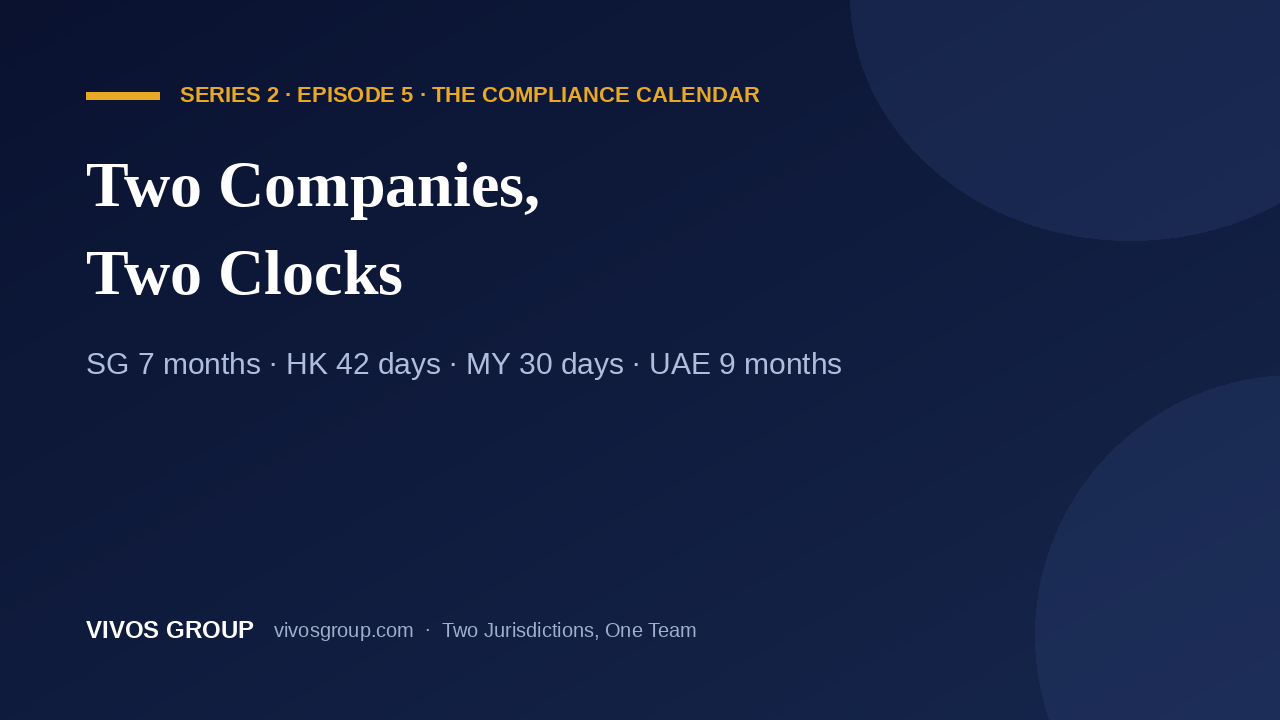
Singapore Compliance Calendar When You Also Run an Overseas Company (2026)

Ray Tay

A Singapore company runs on its financial year end: ECI within 3 months, the ACRA annual return within 7 months for a non-listed company, and…


VIVOS WeChat contact
Whatsapp
Licensed Singapore Corporate Service Provider (ACRA FA20240323, MOM EA 24S2425) · Rated 5.0 on G2