

Does Singapore Offer Citizenship by Investment? (2026)

Ray Tay
Singapore has no citizenship by investment programme. Investors can get PR through the Global Investor Programme, then apply to ICA for citizenship after at least…
Published: 15 July 2026 · Last reviewed: 30 September 2026 · Reviewed by Ray Tay, Co-Founder & Managing Director, VIVOS PTE. LTD. (ACRA Filing Agent FA20240323 · MOM EA Licence 24S2425)
Annual return filing is the mandatory statutory submission every Singapore company must make to the Accounting and Corporate Regulatory Authority (ACRA) under Section 197 of the Companies Act 1967. This filing updates public records on your company’s directors, shareholders, registered address, financial year end, and solvency status. It is separate from the tax return submission you make to the Inland Revenue Authority of Singapore (IRAS). Missing the deadline triggers penalties starting at S$300, and the obligation applies to every incorporated company regardless of size or activity level.
Preparation determines whether your submission goes through cleanly or gets rejected. Gathering the right documents before you log into BizFile+ saves significant time.
The annual return updates public records covering directors, shareholders, registered office, financial year end, solvency, and financial statements where required. Collect the following before you start:
| Company type | Financial statement format | AGM required |
|---|---|---|
| Listed company | Full XBRL via BizFinx | Yes |
| Non-listed company (non-small) | Full or simplified XBRL via BizFinx | Yes |
| Small company (exempt) | PDF attachment or no upload | No (written resolution) |
| Dormant company | No upload required | No |
Dormant companies are exempt from uploading financial statements but must still declare dormancy status accurately. Skipping this declaration is a common error that triggers enforcement action.
The standard filing fee is S$60, payable by credit card, debit card, or eNETS through BizFile+. Confirm your payment method is ready before you begin.
Pro Tip: Preparing financial statements in XBRL using BizFinx is the most time-consuming step. Start this at least two weeks before your filing deadline to allow time for corrections.
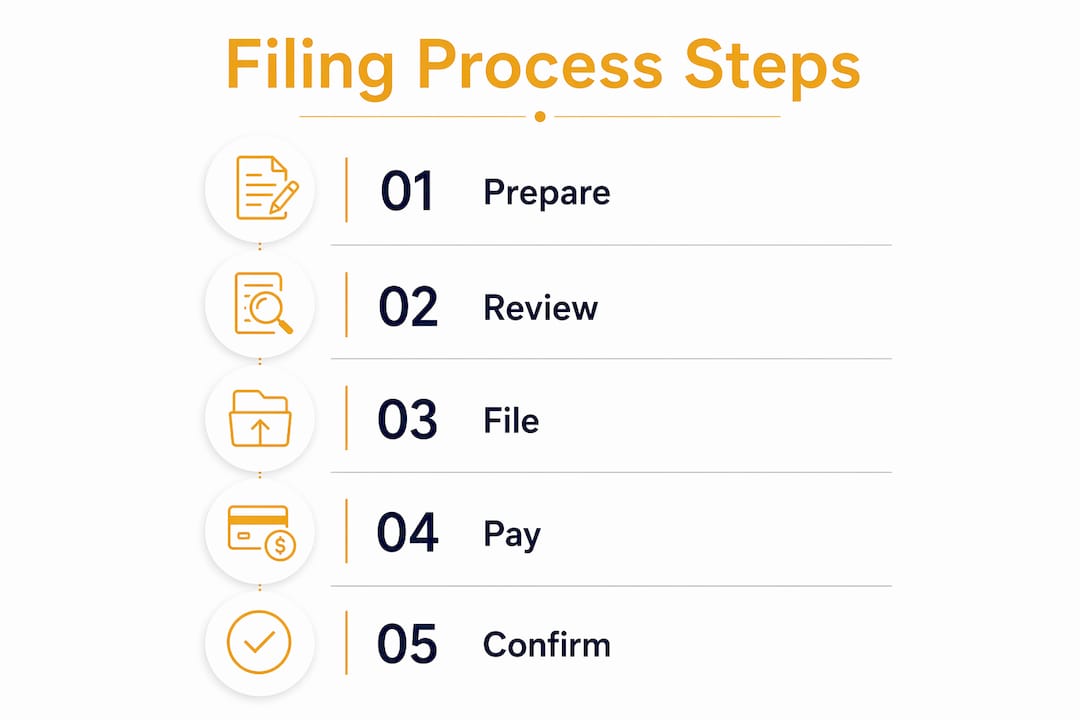

Electronic filing on BizFile+ typically takes 1–2 hours once all preparation is complete. The steps below reflect the current process for 2026 submissions.
Log in to BizFile+ (estimated time: 2 minutes). Use your SingPass credentials if you are a local director. International directors or authorized representatives use CorpPass. Ensure your CorpPass access is active before the filing date.
Select your company entity (estimated time: 3 minutes). Search by UEN or company name. Confirm the registered company name and UEN match your records exactly.
Verify and update company particulars (estimated time: 10 minutes). Review the registered address, financial year end, and company type. Correct any outdated information at this stage.
Set financial year end and declare solvency (estimated time: 5 minutes). Confirm the financial year end date. Declare whether the company is solvent, meaning it can pay its debts as they fall due. Dormant companies must also declare their dormancy status here.
Enter AGM or written resolution date (estimated time: 5 minutes). Input the date your AGM was held or the date written resolutions were passed in lieu of an AGM.
Upload financial statements (estimated time: 30–60 minutes). For companies required to file in XBRL, upload the completed BizFinx file. Small companies exempt from XBRL attach a PDF. Accurate XBRL preparation is critical here. Incorrect formats result in rejection and potential late penalties.
Complete director, auditor, and shareholder disclosures (estimated time: 10 minutes). Confirm all officer details are current. Add or remove directors and shareholders as needed to reflect the company’s actual position.
Pay the filing fee (estimated time: 5 minutes). The fee is S$60. Complete payment by credit card, debit card, or eNETS. The system generates a payment receipt immediately.
Submit and save confirmation (estimated time: 2 minutes). Review the summary screen before final submission. Save or print the ACRA acknowledgment for your records.
Pro Tip: Log in to BizFile+ at least 48 hours before your deadline. System maintenance windows occasionally restrict access, and a last-minute login leaves no buffer for technical issues.
Common submission errors to avoid:
Deadlines for the ACRA annual return depend on your company type and financial year end. Missing them carries direct financial consequences for both the company and its directors.
Deadlines vary with company type and financial year end. Planning your AGM and financial statement preparation well before the deadline prevents last-minute pressure.
Late filing penalties escalate quickly. Penalties rise from S$300 to S$600 if the filing is delayed beyond three months after the deadline. Timely filing protects business credibility and avoids enforcement risks.
Companies that need more time can apply for a 60-day extension of time (EOT) by paying a S$200 fee. Extensions must be approved before the original deadline passes. An EOT helps when AGM preparation or financial statement finalization runs late, but it is not a substitute for planning.
ACRA provides filing reminders and notifications to registered company contacts. Activating these alerts is a basic but effective step to avoid missing deadlines.
Common mistakes include confusing the annual return with the tax return, submitting wrong formats for financial statements, and missing AGM dates. Each error carries real consequences, from rejection to late penalties.
Confusing annual return with tax filing: The annual return goes to ACRA and updates company records. The tax return submission goes to IRAS and covers corporate income tax. These are two separate obligations with different deadlines and portals.
Wrong financial statement format: Submitting a PDF when XBRL is required, or using an outdated BizFinx template, causes immediate rejection. Verify the required format for your company type before preparing statements.
Incorrect solvency or dormancy declaration: Even companies exempt from preparing full financial statements must carefully declare dormancy and solvency to maintain accurate compliance records. An incorrect declaration creates a false public record and exposes directors to liability.
Incomplete officer or shareholder data: Missing identification numbers, incorrect nationalities, or shareholding figures that do not add up to 100% all trigger system errors. Cross-check all data against your company’s register before submission.
Late or missing AGM dates: Holding the AGM after the statutory deadline invalidates the timeline for filing. Plan the AGM at least six weeks before the filing deadline to allow time for financial statement preparation.
Assigning a specific person, whether an internal officer or an external corporate secretary, to own the filing process reduces errors significantly. Professional corporate secretarial services provide structured checklists, deadline tracking, and format verification that most internal teams lack.
Pro Tip: Run a dry-run review of all company particulars in BizFile+ at least one month before your deadline. Errors in officer data often require supporting documents to correct, and that process takes time.
Annual return filing is a mandatory ACRA obligation that every Singapore company must complete annually, with penalties starting at S$300 for late submissions.
| Point | Details |
|---|---|
| Statutory obligation | Every Singapore company must file with ACRA under Section 197 of the Companies Act 1967. |
| Filing fee | The standard fee is S$60, payable through BizFile+ by card or eNETS. |
| Penalty structure | Late penalties are S$300 within 3 months and S$600 after 3 months past the deadline. |
| Extension option | A 60-day extension costs S$200 and must be applied for before the original deadline. |
| Preparation is critical | XBRL preparation via BizFinx is the most time-consuming step; start at least two weeks early. |
Most filing problems are not caused by ignorance of the rules. They are caused by poor process design. A director who knows the deadline exists but has no calendar reminder, no assigned owner, and no checklist will still miss it. I have seen this pattern repeatedly with international entrepreneurs who are managing multiple entities across jurisdictions.
The single most effective habit is treating the annual return as a governance event, not an administrative chore. That means scheduling the AGM, financial statement preparation, and BizFile+ submission as three separate calendar items with buffer time between each. When all three collapse into one frantic week, errors multiply.
XBRL preparation deserves more respect than most companies give it. The BizFinx tool is not difficult once you know it, but the first time takes longer than expected. Companies that prepare their XBRL in-house without prior experience routinely produce files that fail validation. A rejected file resets your timeline and, if you are close to the deadline, pushes you into penalty territory.
The other mistake I see often is assuming that dormant companies have nothing to file. They do. The declaration of dormancy and solvency is still required, and ACRA’s records still need to reflect the current status. Skipping this because the company is “inactive” is a misunderstanding of the obligation.
My honest recommendation: if you are running a Singapore company as an international entrepreneur without a dedicated compliance officer, engage a professional corporate secretary. The cost is modest relative to the penalty exposure and the time saved. Filing accuracy also protects your directors from personal liability, which is a risk most founders underestimate until it becomes real.
— Ray
Annual return filing carries real consequences when it goes wrong. VIVOS provides corporate secretarial services specifically designed to handle the full filing cycle for Singapore companies, from financial statement preparation and XBRL formatting to BizFile+ submission and deadline management.

VIVOS manages AGM scheduling, solvency declarations, officer data verification, and extension applications where needed. International entrepreneurs benefit from a team that understands both ACRA requirements and the practical challenges of managing compliance across borders. Avoiding a S$600 late penalty starts with having the right support in place before the deadline arrives. Contact VIVOS to discuss how corporate secretarial support fits your company’s compliance calendar.
The standard ACRA annual return filing fee is S$60, payable through BizFile+ by credit card, debit card, or eNETS.
The annual return is filed with ACRA and updates company records including directors, shareholders, and solvency status. The tax return is filed separately with IRAS and covers corporate income tax obligations.
Late filing penalties start at S$300 if filed within 3 months after the deadline and increase to S$600 if filed more than 3 months late. Repeated non-compliance can lead to director disqualification proceedings.
Yes. Companies may apply for a single 60-day extension of time by paying a S$200 fee. The application must be submitted and approved before the original filing deadline passes.
Yes. Dormant companies are exempt from uploading financial statements but must still file an annual return and accurately declare their dormancy and solvency status with ACRA.
Article generated by BabyLoveGrowth

 2 January, 2025
 2 January, 2025
Singapore has no citizenship by investment programme. Investors can get PR through the Global Investor Programme, then apply to ICA for citizenship after at least…

2026年新加坡私人公司股份转让完整流程:章程核查、转让文书、IRAS印花税计算、ACRA申报与控制人名册更新,并附各环节时限总表。