
去印尼扩张为何要先设新加坡控股公司?直接持股最多损失37.6%(2026年算法)

Ray Tay
直接持有印尼公司:22%企业所得税+20%股息预提税=37.6%;通过持股≥25%的新加坡控股公司,协定税率10%,合计29.8%,且退出时印尼不征税。
Published: 1 October 2026 · Reviewed by Ray Tay, Co-Founder & Managing Director, VIVOS PTE. LTD. (ACRA Filing Agent FA20240323 · MOM EA Licence 24S2425)
A founder who owns an Indonesian company directly loses up to 37.6% of every dollar of profit before it reaches them — 22% Indonesian corporate income tax, then 20% withholding on the dividend — and can pay 5% of the gross sale price on exit, profit or not. Through a Singapore holding company that owns at least 25%, the Singapore–Indonesia tax treaty (in force since 1 January 2022) cuts dividend withholding to 10%, for 29.8% all-in; Singapore exempts that dividend on receipt; and on most share sales the treaty gives the taxing right to Singapore, which has no capital gains tax. Since 31 December 2025 (PMK 112/2025), the treaty rate needs a 365-day holding period and genuine Singapore substance.
Watch on YouTube: Singapore Holding Company for Indonesia: Avoid a 37.6% Tax Leak (2026). Full transcript below.
“Singapore + 1” — a Singapore base plus an operating company in one neighbouring market — is the most common expansion model we see among founders in Southeast Asia, and Indonesia is the most common “+1”. The operating plan usually gets months of attention. The ownership line above the Indonesian company often gets none, and it decides how much of the profit the founder actually keeps. This guide works through the three structures side by side, with every rate dated and sourced.
When a foreign founder personally holds the shares of an Indonesian PT (perseroan terbatas, a limited liability company; a foreign-owned one is usually called a PT PMA), profit is taxed twice before it reaches them. First, the company pays Indonesian corporate income tax at a flat 22% (PwC Worldwide Tax Summaries — Indonesia, reviewed 11 June 2026). Second, when the remaining 78 is paid out as a dividend to a non-resident shareholder, Indonesia withholds 20% under Article 26 of its income tax law, unless a tax treaty reduces the rate (DFDL, Singapore–Indonesia Tax Treaty Guide, updated 24 August 2026).
That is 22 + (20% × 78) = 37.6 of every 100 of profit, leaving the founder 62.4. On exit the picture is worse: without treaty relief, a non-resident selling unlisted Indonesian shares faces a final tax of 5% of the gross transaction value — payable whether or not the sale made a profit (DFDL, updated 24 August 2026).
The Singapore–Indonesia double tax agreement (the 2020 treaty, effective from 1 January 2022) caps Indonesian withholding on dividends paid to a Singapore resident: 10% where the recipient is a company holding at least 25% of the Indonesian company’s capital, and 15% in all other cases, including individuals (Article 10; IRAS list of DTAs; DFDL, updated 24 August 2026). The table shows what each structure leaves in the founder’s hands.
| Structure | Indonesian CIT | Dividend withholding | Total tax leak | Founder keeps (of 100) | Tax on exit (share sale) |
|---|---|---|---|---|---|
| Founder owns the PT directly, no treaty relief | 22.0 (22%) | 15.6 (20% of 78) | 37.6% | 62.4 | 5% of gross sale price |
| Founder owns directly, as a Singapore-resident individual (treaty 15%) | 22.0 (22%) | 11.7 (15% of 78) | 33.7% | 66.3 | Treaty Art. 13: Singapore taxing right on most share sales |
| Singapore holding company owns ≥25% (treaty 10%) | 22.0 (22%) | 7.8 (10% of 78) | 29.8% | 70.2 | Treaty Art. 13 + no Singapore capital gains tax |
Sources: Indonesian CIT — PwC WWTS (reviewed 11 Jun 2026); dividend and exit rates, Articles 10 and 13, PMK 112/2025 — DFDL (24 Aug 2026); Singapore exemption — IRAS. Arithmetic by VIVOS. Worked on 100 of pre-tax profit, fully distributed; treaty rates require the PMK 112/2025 conditions below.
Moving from direct ownership to a Singapore holding company adds 7.8 to every 100 of profit the founder keeps — 70.2 instead of 62.4, a 12.5% increase in distributable cash — before the exit advantage is counted.
Singapore exempts foreign-sourced dividends received by a Singapore tax-resident company under section 13(8) of the Income Tax Act, provided three conditions are met: the dividend was subject to tax in the source country, the headline corporate tax rate there is at least 15%, and the Comptroller is satisfied the exemption benefits the company (IRAS, Companies Receiving Foreign Income). Indonesia’s 22% headline rate clears the 15% test, so the 70.2 arrives in Singapore without a further Singapore layer. Singapore also has no withholding tax on dividends it pays onward to shareholders.
Article 13 of the Singapore–Indonesia treaty generally allows gains from selling shares to be taxed only in the seller’s country of residence. For a Singapore holding company that means Singapore has the taxing right on most sales of Indonesian shares — and Singapore does not tax capital gains. Budget 2025 made the section 13W safe harbour permanent from 1 January 2026: gains on disposing of ordinary shares are not taxed where the seller has held at least 20% for at least 24 months (Budget 2025 summaries, ACCA and BDO).
Two carve-outs matter. Shares in a land-rich company — one deriving more than 50% of its value from Indonesian immovable property — can still be taxed in Indonesia, and shares listed on the Indonesia Stock Exchange follow separate rules (DFDL, updated 24 August 2026). For a trading, services or technology business, the treaty route typically removes the 5%-of-gross exit charge altogether.
PMK 112/2025 — Indonesian Minister of Finance Regulation No. 112 of 2025 on applying tax treaties — took effect at the end of 2025 and tightened every step of claiming treaty relief (DFDL; RSM Indonesia). To claim the 10% dividend rate, the Singapore company must be the beneficial owner of the dividend, have real economic substance, have held the shares for at least 365 days including the dividend date, pass a unified principal purpose test, and provide a valid Certificate of Domicile (DGT form) before the payment is made. The 365-day rule also applies to sellers claiming treaty protection on shares in land-rich companies.
A holding company is not a magic wrapper. It does not deliver the treaty rate where the Singapore company is a letterbox with no people, board decisions or commercial reason to exist; where it owns less than 25% (the rate is 15%, not 10%); where the shares have been held for less than 365 days when a dividend is paid; where the Indonesian company is land-rich; or where the Indonesian company is small enough that its effective corporate rate is lower than 22% — companies with turnover up to IDR 50 billion get a 50% rate discount on part of their income (PwC, reviewed 11 June 2026), which changes the maths. Each of those cases needs its own calculation.
Order matters, because restructuring an existing Indonesian shareholding later can itself be a taxable share transfer. A clean sequence is: incorporate the Singapore company first and give it genuine substance — resident directors who actually decide, a bank account, accounts and a business purpose; then establish the Indonesian PT PMA with the Singapore company as the at-least-25% shareholder from day one; obtain the Indonesian tax registration and prepare the DGT form; and plan the first dividend for after the 365-day holding date. Keep board minutes in Singapore that show where decisions are made.
Indonesia withholds 20% on dividends paid to a non-resident shareholder without treaty relief, on top of the 22% corporate income tax already paid by the company. On 100 of profit that is 22 + 15.6 = 37.6 in total, leaving 62.4 (PwC, reviewed 11 June 2026; DFDL, 24 August 2026).
10% where the recipient is a Singapore company owning at least 25% of the Indonesian company’s capital, and 15% in all other cases, including individuals (Article 10 of the treaty effective 1 January 2022). Since 31 December 2025, PMK 112/2025 adds a 365-day holding period, a beneficial-ownership and substance test, and a valid DGT form before payment.
Usually not. Under section 13(8) of Singapore’s Income Tax Act, foreign-sourced dividends received by a Singapore tax-resident company are exempt if they were taxed in the source country, the source country’s headline corporate rate is at least 15% (Indonesia’s is 22%), and the Comptroller is satisfied the exemption benefits the company (IRAS).
For most shares, Article 13 of the treaty gives Singapore the taxing right, and Singapore does not tax capital gains; the section 13W safe harbour (at least 20% held for at least 24 months) is permanent from 1 January 2026. Exceptions are shares in land-rich Indonesian companies and IDX-listed shares. Without treaty relief, Indonesia taxes 5% of the gross sale price of unlisted shares.
To claim a treaty dividend rate that depends on a shareholding threshold, such as the 10% rate for a Singapore company owning at least 25%, the shares must have been held for at least 365 days, including the dividend date. The same holding period applies to sellers claiming treaty protection on shares in land-rich companies (DFDL; RSM Indonesia).
No. PMK 112/2025 requires the Singapore company to be the beneficial owner with genuine economic substance and to pass a principal purpose test. A shell with no staff, no local decision-making and no commercial purpose will be denied the 10% rate, and the 20% domestic rate will apply.
Own an Indonesian company directly, and up to thirty-seven point six percent of every dollar of profit is gone before it reaches you. Own it through a Singapore holding company, and that falls to twenty-nine point eight. I’m Ray Tay, co-founder of VIVOS — here’s the math.
The costly structure: you personally hold the shares of an Indonesian P-T. Indonesia taxes the profit at twenty-two percent, then withholds twenty percent on your dividend. Thirty-seven point six percent in total — you keep sixty-two cents on the dollar.
And when you sell, Indonesia can take five percent of the gross sale price — profit or not.
The better structure: a Singapore holding company owns at least twenty-five percent. Under the Singapore–Indonesia tax treaty, in force since twenty twenty-two, withholding drops to ten percent — twenty-nine point eight all-in — and Singapore exempts that dividend on receipt.
On most share sales, the treaty gives the taxing right to Singapore, which has no capital gains tax. Two conditions: since the end of twenty twenty-five, the shares must be held for three hundred sixty-five days, and the Singapore company needs real substance. A letterbox fails.
VIVOS sets up Singapore holding companies with that substance built in. Book a free consultation at vivos dot com dot sg.
This video is presented by an AI-generated avatar and voice of Ray Tay, co-founder of VIVOS. The content was written and fact-checked by VIVOS PTE. LTD.; rates verified 22–25 September 2026. General information only, not tax advice.
VIVOS PTE. LTD. incorporates Singapore holding companies and runs their corporate secretarial, accounting and tax compliance, with the substance the treaty now requires built in from day one. Book a free consultation at vivos.com.sg/contact-us or message us on WhatsApp at +65 9366 9399. Related reading: corporate income tax in Indonesia · annual tax reporting in Indonesia (Coretax) · foreign-sourced income in Singapore · capital gains in Singapore · where to incorporate in 2026 · hiring in Indonesia before you incorporate (EOR).
General information only, not tax or legal advice. Treaty relief depends on beneficial ownership, substance, holding period and a valid DGT form; your position depends on your facts. VIVOS PTE. LTD. — ACRA Registered Filing Agent FA20240323 · MOM EA Licence 24S2425.
 2 January, 2025
 2 January, 2025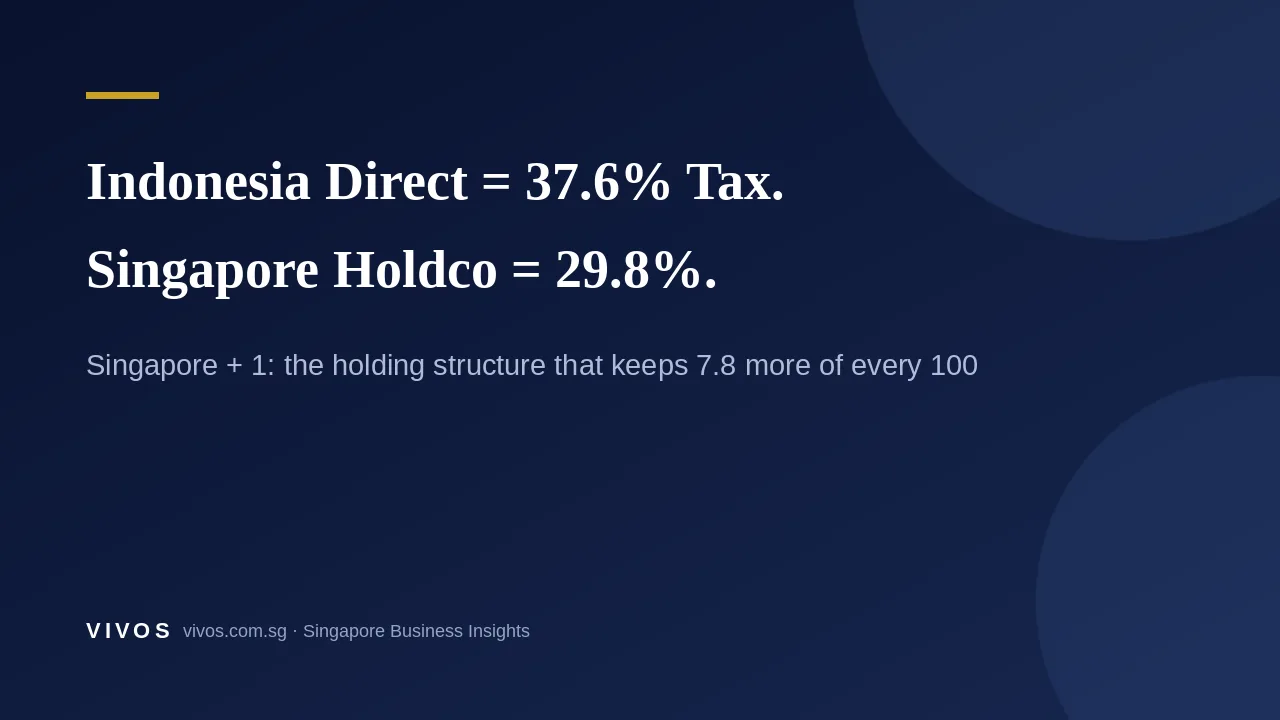
直接持有印尼公司:22%企业所得税+20%股息预提税=37.6%;通过持股≥25%的新加坡控股公司,协定税率10%,合计29.8%,且退出时印尼不征税。
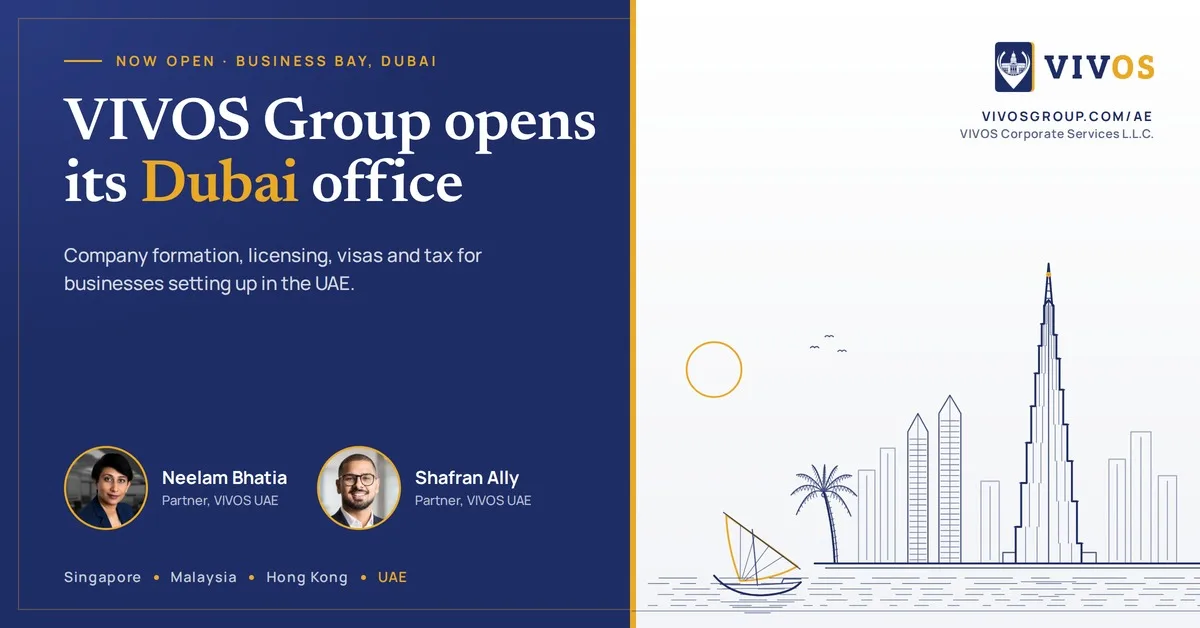
VIVOS Group has opened its Dubai office in Business Bay, led by Partners Neelam Bhatia and Shafran Ally, for UAE company formation, licensing and visas.

Practical 2026 explainer for foreign founders: pass the S$10 million two of three test, prepare accounts ready for XBRL, and file with ACRA using VIVOS.