E-Invoicing in Singapore: What GST Businesses Must Know
Update, 5 November 2026: GST InvoiceNow Singapore: Existing Businesses, 1 Apr 2028 to 2031 (2027 Rule Changes, Episode 8)
Existing GST-registered businesses in Singapore must transmit invoice data to IRAS through InvoiceNow in four phases, set by total annual supplies in 2025: S$200,000 or less from 1 April 2028, up to S$1 million from 1 April 2029, up to S$4 million from 1 April 2030, above S$4 million from 1 April 2031. Grants of S$1,000 and S$5,000 are open.
What some pages still say: "All GST-registered businesses must use InvoiceNow by April 2031, and a grant of up to S$5,000 for early adopters will be announced."
What IRAS and IMDA say: existing businesses are phased in by total annual supplies in 2025, smallest first, from 1 April 2028 to 1 April 2031. Fixed grants of S$1,000 (supplies up to S$4 million) and S$5,000 (above S$4 million, own system, done by 31 March 2028) opened on 1 July 2026, conditions apply (IRAS, GST InvoiceNow Requirement; IMDA, InvoiceNow Grants).
Yes. If your business is GST-registered in Singapore, InvoiceNow submission to IRAS becomes mandatory on a phased schedule. New voluntary GST registrants have been covered since 1 November 2025 (newly incorporated companies) and 1 April 2026 (all voluntary applicants). Existing GST-registered businesses follow in four phases set by total annual supplies in 2025, smallest first: S$200,000 or less from 1 April 2028, up to S$1 million from 1 April 2029, up to S$4 million from 1 April 2030 and above S$4 million from 1 April 2031. The requirement is not optional and not industry-specific, and being small is not an exemption.
Three things to do this week:
Check your implementation date in the notice IRAS sent you or with the implementation date calculator on the IRAS GST InvoiceNow Requirement page.
Confirm whether your accounting software is InvoiceNow-ready or whether you need an Access Point Provider.
Get Corppass access sorted now. Peppol ID registration depends on it.
Pro Tip:Don’t wait for your implementation date to arrive before testing. IRAS and IMDA both recommend onboarding early, and the S$5,000 transition grant for larger businesses only covers projects completed by 31 March 2028.
Key Takeaways
InvoiceNow compliance for GST-registered businesses in Singapore hinges on identifying your implementation date early and testing your invoice data transmission before that date arrives.
Point
Details
Mandate is phased, not optional
Voluntary registrants since 1 Nov 2025 and 1 Apr 2026. Existing businesses from 1 Apr 2028 (S$200,000 or less) to 1 Apr 2031 (above S$4 million), smallest first, based on total annual supplies in 2025.
Submission timing follows the “earlier of” rule
Invoice data must reach IRAS by the date you file the relevant GST return or its filing due date, whichever is earlier.
Packages and grants reduce cost
Free-of-Charge packages run to 31 Mar 2031 (current list to 31 Mar 2027). Transition grants of S$1,000 and S$5,000 have been open since 1 Jul 2026.
Onboarding follows four fixed steps
Ready your solution or Access Point, get your Peppol ID, connect via API, then activate and test.
VIVOS supports the compliance side
VIVOS ties GST advisory and accounting integration into InvoiceNow onboarding so deadlines don’t slip.
What Is E-Invoicing in Singapore and Why It’s Different
InvoiceNow is Singapore’s nationwide e-invoicing network, built on the international Peppol standard, and it works nothing like emailing a PDF invoice. A PDF still requires someone on the receiving end to open it and key the data into their accounting system by hand. InvoiceNow transmits structured invoice data directly between systems, no rekeying, no attachment, no manual entry.
The practical payoff is real. IMDA’s own research puts the processing savings at roughly S$8 per invoice once a business shifts from paper or PDF workflows to structured e-invoicing, with rectification costs for paper invoices being significantly higher.
Beyond cost, InvoiceNow gives every business a Peppol ID tied to its UEN. That single, persistent digital identity means:
Faster payment cycles, since invoices arrive ready to process rather than ready to retype.
Fewer disputes, because structured data reduces field errors and mismatched totals.
Easier integration between invoicing and payment rails, since your UEN already anchors both.
Who Must Comply With Singapore’s E-Invoicing Mandate and When
The GST InvoiceNow Requirement rolls out in stages tied to total annual supplies, not industry or company age. Smaller GST-registered businesses go first, by design; the largest get the most runway.
The phased schedule runs as follows:
November 1, 2025: Newly incorporated companies that register for GST voluntarily.
April 1, 2026: New voluntary GST registrants generally, regardless of incorporation date.
1 April 2028: Existing GST-registered businesses with total annual supplies of S$200,000 or less, plus new compulsory GST registrants applying on or after 1 April 2028.
1 April 2029: Existing businesses with total annual supplies of S$1 million or less.
1 April 2030: Existing businesses with total annual supplies of S$4 million or less.
1 April 2031: Existing businesses with total annual supplies above S$4 million.
Total annual supplies means the Box 4 figure (which includes exempt supplies) across your GST accounting periods ending in calendar year 2025, scaled to 365 days if those periods are shorter. Nil returns count as S$0, so a business that filed only nil returns starts on 1 April 2028. Source: IRAS, checked 20 October 2026.
Not every transaction line needs the same treatment, but the scope is broad and not limited to business customers. In scope: invoice data on standard-rated, zero-rated and exempt supplies (including sales to individual consumers), plus standard-rated and zero-rated purchases. Excluded Transactions include deemed supplies, reverse charge supplies, import permits, exempt financial services and exempt digital payment tokens (IRAS e-Tax Guide, para 7.3).
Exemptions exist but are narrow: overseas entities (such as Overseas Vendors registered under the OVR regime) and businesses registered wholly because of the reverse charge regime. Being small, low volume or making only zero-rated or exempt supplies is not grounds for exemption. Confirm your exact date through the IRAS notice or calculator, since misreading the schedule is one of the more common early mistakes finance teams make.
How to Get Started With InvoiceNow in Singapore
Onboarding follows four steps, and they’re the same four steps IRAS and GoBusiness outline for every GST-registered business:
Confirm your solution is InvoiceNow-enabled, or engage an IMDA-accredited Access Point Provider if your current accounting system isn’t Peppol-ready.
Obtain your Peppol ID. It’s derived from your UEN and issued through your provider, not directly by IMDA.
Connect your solution to IRAS via API so invoice data transmits automatically alongside your GST filings.
Activate and test the submission feature before your implementation date, using sample invoices and end-to-end sends with a real trading partner.
Pro Tip:Search the SG Peppol Directory before you commit to a provider. It shows you which trading partners are already reachable on the network, which tells you how much friction you’ll actually face at go-live.
Have your Corppass authorization ready before requesting Peppol ID registration. Accredited providers are expected to complete business user registration within three working days of that authorization, but delays on your end push that clock back.
What Invoice Data You Must Submit and When It’s Due
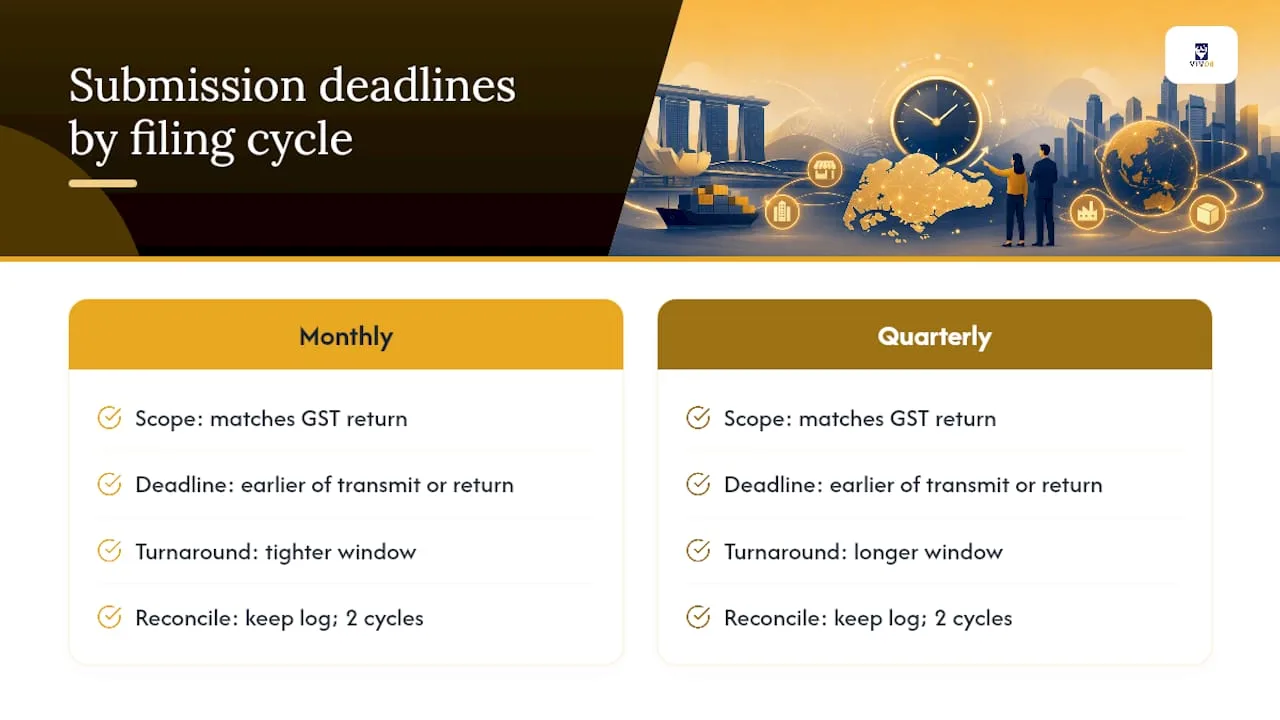
The scope mirrors your GST return. If a transaction shows up on your return, it generally needs to be transmitted through InvoiceNow. That includes standard-rated, zero-rated and exempt supplies and standard-rated and zero-rated purchases, but not Excluded Transactions such as deemed supplies and reverse charge supplies.
The deadline rule is the part most finance teams get wrong: you must submit invoice data to IRAS by the earlier of the date you file the relevant GST return and that return’s filing due date. It’s not one fixed calendar date across the board. It’s tied to your own filing cycle, so a business filing monthly faces a tighter turnaround than one filing quarterly.
Keep a transmission log and reconcile it against your filed GST returns for at least the first two reporting cycles after onboarding. IRAS guidance flags this reconciliation step specifically because early mismatches between what’s transmitted and what’s declared are a common audit trigger.
Free-of-Charge Solution Packages and Government Support
Cost shouldn’t be the reason you delay onboarding. IMDA and IRAS jointly publish Free-of-Charge solution packages specifically for GST-registered businesses, and the support runs longer than most finance teams expect.
The current list of FOC packages runs to 31 March 2027; the list for 1 April 2027 to 31 March 2031 is still to be published.
FOC packages remain available to GST-registered businesses until 31 March 2031.
Eligibility and package details are published as downloadable PDFs on IMDA and IRAS pages, updated as new providers get accredited.
Don’t treat these dates as fixed forever. Provider lists change as accreditation status shifts, so confirm the current window directly on IMDA’s site before you budget procurement around a package that may have already been superseded.
Two GST InvoiceNow Transition Grants have also been open since 1 July 2026, subject to IMDA conditions:
Ssuperseded.
,000
for businesses with total annual supplies up to S$4 million that subscribe to an accredited InvoiceNow-Ready Solution (or connect their own system through an accredited Access Point), activate GST InvoiceNow and submit invoice data. Claims run until 31 March 2030 or until funds are fully claimed. Free-of-Charge packages do not qualify, and businesses that voluntarily register for GST on or after 1 April 2026 are not eligible.
S$5,000 for businesses with total annual supplies above S$4 million that integrate their own ERP system through an accredited Access Point, with the project completed by 31 March 2028.
Claims are made with the claim forms on IMDA’s InvoiceNow Grants page (checked 20 October 2026).
Choosing Between an Access Point Provider and an InvoiceNow-Ready Solution
You have two routes onto the network. Route A: use accounting software that’s already InvoiceNow-ready, meaning it connects to Peppol natively. Route B: keep your existing system and connect through an IMDA-accredited Access Point Provider that handles the Peppol transmission layer on your behalf.
Neither route is inherently better. Route A tends to suit smaller businesses already using cloud accounting software. Route B often fits businesses with legacy or custom systems that aren’t worth replacing just for e-invoicing.
Whichever route you pick, ask your provider these questions before signing anything:
Does the platform support direct API connectivity to IRAS for GST submission?
Is the invoice format compliant with SG PINT, Singapore’s Peppol invoice standard?
What’s the service level agreement for Peppol ID registration turnaround?
Is there a real testing environment, not just a production go-live?
Pro Tip:Treat “no dedicated testing environment” as a hard red flag. So is a provider who can’t clearly explain their IMDA accreditation status. Both usually mean you’ll be debugging in production.
Implementation Checklist and Mistakes to Avoid
Run through this before your implementation date:
Confirm your implementation date with the IRAS notice or calculator.
Map every invoice field to the SG PINT format with your provider.
Run end-to-end test transmissions with at least one real trading partner.
Enable the IRAS GST submission feature and verify it’s actually firing.
Notify major trading partners of your new Peppol ID and onboarding date.
Reconcile transmitted invoice data against filed GST returns for the first two cycles.
The mistakes that cause the most rework are almost always avoidable. A mismatched UEN or Peppol ID silently breaks transmission. Untested field mappings surface as reconciliation errors weeks later, not immediately. And teams that forget to update purchase order templates and contracts often end up chasing suppliers for corrected details after go-live.
Pro Tip:Schedule a recurring monthly test transmission even after go-live, and automate exception reporting so a failed send doesn’t sit unnoticed until GST filing week.
What We See Most Often With InvoiceNow Onboarding
Most compliance delays come down to sequencing, not complexity. Businesses that treat Peppol ID registration, API testing, and supplier outreach as parallel tasks rather than a strict sequence tend to hit deadlines without the last-minute scramble.
Where businesses most often need outside help is Peppol ID setup, API testing against IRAS, and coordinating supplier communication before go-live.
Get Help Preparing for GST InvoiceNow Compliance
Reading the IRAS timeline is one thing. Mapping your specific transaction types to SG PINT fields, coordinating with an Access Point Provider, and reconciling your first two GST cycles against transmitted invoice data is where finance teams actually lose time.
VIVOS supports GST-registered businesses through exactly this kind of implementation work, tying GST advisory directly into your accounting setup so InvoiceNow onboarding doesn’t sit as a separate IT project bolted onto your existing filing process. That includes confirming your implementation date, checking your invoice data scope against your GST return, and coordinating with your Access Point Provider or software vendor on testing.
Ongoing compliance support matters too, once InvoiceNow is live, corporate secretarial services keep your broader statutory obligations aligned with the same operational calendar. If you want a structured review of where your business stands against its IRAS deadline, request a GST compliance consultation with VIVOS before your implementation date arrives.
Frequently Asked Questions
Is e-invoicing mandatory for all GST-registered businesses in Singapore?
Yes, apart from narrow exclusions such as overseas entities and reverse-charge-only registrants. It is phased: voluntary registrants since 1 November 2025 and 1 April 2026, then existing businesses by total annual supplies in 2025, smallest first: S$200,000 or less from 1 April 2028, up to S$1 million from 1 April 2029, up to S$4 million from 1 April 2030 and above S$4 million from 1 April 2031.
What’s the difference between InvoiceNow and just emailing a PDF invoice?
InvoiceNow transmits structured invoice data directly between systems using the Peppol network. A PDF still needs someone to manually key the data into their accounting software on the receiving end.
How do I get a Peppol ID in Singapore?
Your Peppol ID is derived from your UEN and issued through an IMDA-accredited provider or Access Point, not directly by IMDA. You’ll need Corppass authorization ready before requesting registration.
Are there free options for smaller GST-registered businesses?
Yes. Free-of-Charge solution packages are available until 31 March 2031 (current list to 31 March 2027). Businesses with total annual supplies up to S$4 million can also claim a fixed S$1,000 GST InvoiceNow Transition Grant, open since 1 July 2026, when they use a paid accredited solution; larger businesses can claim S$5,000 for own-system projects completed by 31 March 2028.
What happens if I miss my InvoiceNow deadline?
Missing your implementation date puts you out of compliance with the GST InvoiceNow Requirement. IRAS says enforcement will be calibrated for genuine mistakes in the early phases, but action may be taken against non-compliant businesses, and voluntary GST registrations can be refused or revoked. Confirm your exact date early and test well before it arrives.
This article is general information, not a substitute for advice from a qualified financial advisor. Consult a qualified financial professional about your own circumstances before acting on anything here.
Existing GST-registered businesses in Singapore must transmit invoice data to IRAS through InvoiceNow in four phases, set by total annual supplies in 2025: S$200,000 or…
MOM's updated COMPASS C1 salary benchmarks apply to new Employment Pass applications from 1 January 2027 and to renewals of passes expiring from 1 July…