
COMPASS C1 Salary Benchmarks 2027: Singapore Employment Pass Dates

VIVOS Editorial Team
MOM's updated COMPASS C1 salary benchmarks apply to new Employment Pass applications from 1 January 2027 and to renewals of passes expiring from 1 July…
Published: 13 November 2026 · Reviewed by Ray Tay, Co-Founder & Director, VIVOS PTE. LTD. (ACRA Filing Agent FA20240323 · MOM EA Licence 24S2425)
Written by the VIVOS team (MOM Employment Agency Licence 24S2425) and reviewed by Ray Tay. Figures checked against ACRA, MOM, IRAS and ICA on 4 November 2026.
The pass is usually an Employment Pass, an EntrePass for venture-backed or innovative startups, or a ONE Pass if you already earn at a very senior level. Permanent residence is a separate, later step. Most problems come from doing these steps out of order. The sequence below is the one we use with international founders at VIVOS.
| Step | Who does it | Typical time | Official source |
|---|---|---|---|
| 1. Reserve the name and incorporate a private limited company, with a locally resident director appointed | Registered corporate service provider (CSP), filing with ACRA | 1 to 3 business days once documents and KYC are complete (VIVOS figure). ACRA approves most registrations soon after payment; complex ones can take up to 15 working days. | ACRA |
| 2. Advertise the role on MyCareersFuture, unless exempt | Your company | At least 14 consecutive days. Companies with fewer than 10 employees are exempt. | MOM |
| 3. Apply for your work pass (EP, EntrePass or ONE Pass) | Your company, or an appointed employment agent | EP: online applications are processed or given an update within 10 business days | MOM |
| 4. Open the corporate bank account | You and the bank | Varies by bank and by how clear your business profile is | Your chosen bank |
| 5. Apply for Dependant’s Passes or Long-Term Visit Passes for family | Your company, as sponsor | Check MOM’s current processing times | MOM |
| 6. Move, collect your pass and register your address | You | Plan around the pass approval date | MOM |
| 7. Apply for permanent residence (optional, later) | You, as an EP holder | ICA generally processes within 6 months once all documents are in | ICA |
You do not need to be in Singapore to incorporate. ACRA requires foreigners to engage a corporate service provider to reserve a name and register the company. The CSP verifies your identity and source of funds (KYC), prepares the constitution and files on Bizfile.
ACRA charges S$15 for the name application and S$300 for registration, S$315 in total. The minimum is one issued share, so a company can technically start with S$1 of share capital, though that is rarely the right number for a founder who will sponsor their own pass.
The one requirement that catches most overseas founders is the director rule. ACRA requires at least one director who meets its local residency rules at the point of registration. ACRA’s list of who counts as locally resident is short: Singapore citizens, Singapore permanent residents, and valid holders of an Employment Pass, Personalised Employment Pass or ONE Pass. An EntrePass is not on that list, and neither is a Dependant’s Pass.
Since you do not yet hold any of these, the usual solution is a nominee director who sits on the board until you receive your own pass. Once your Employment Pass or ONE Pass is issued, you become locally resident yourself and the nominee can step down, provided the company still has at least one locally resident director at all times. If your route is the EntrePass, plan for the resident director arrangement to continue.
For the full incorporation checklist, documents and structuring points for overseas shareholders, see our guide for international investors and founders.
Your own company will be the sponsor, so the pass you apply for depends on your salary, your business model and your track record.
The Employment Pass is the route most founders use. It has two stages:
A new company has no local workforce to point to, which matters under the diversity and local employment criteria. MOM gives firms with fewer than 25 PMETs 10 points by default on each of those two criteria, so for a new company the outcome tends to turn on salary and qualifications.
The salary must be one the company can actually pay. Stating S$9,000 a month for a company with S$1 of capital and no revenue invites the obvious question.
The EntrePass is for founders of venture-backed or innovative technology businesses. MOM requires that you have started, or intend to start, an ACRA-registered private limited company in which you hold at least 30%, and that you meet at least one innovation criterion:
If the company is more than 12 months old when you apply, MOM assesses it under the renewal criteria. A consulting or trading business without one of these markers is generally an EP case.
The Overseas Networks & Expertise Pass is for people who earned a fixed monthly salary of at least S$30,000 with one employer for the 12 consecutive months before applying, or who will earn that with an established Singapore company, or who have outstanding achievements in sports, arts and culture, or academia and research. Its advantage for founders is flexibility: holders can start, operate and work for several companies at the same time, and it is valid for up to five years. Renewal can be met by running a Singapore company that employs at least five locals each earning at least the prevailing EP minimum qualifying salary. From 28 January 2027, MOM adds an AI and Tech track for candidates with founder, C-suite or technical experience at qualifying technology companies.
MOM does not publish a separate rulebook for self-sponsored founders, but in practice the officer is asking one question: is this a real Singapore business that needs this person here? What helps:
Banks run their own KYC on the company, its directors and its ultimate owners. An approved pass makes this smoother, because the bank sees a director living in Singapore and a business with a defined purpose. Some banks open accounts for directors still overseas; others want to meet you. We cover the options and documents in our guide to opening a Singapore bank account remotely.
In practice, the bank account and the pass application often run in parallel. Capitalise the company once the account is open, so the paid-up capital in your pass story is real money in a Singapore account.
Family passes are sponsored by the same company that sponsors you. For EP holders, MOM requires a fixed monthly salary of at least S$6,000 to sponsor a Dependant’s Pass for a legally married spouse and unmarried children under 21. Other family members may qualify for a Long-Term Visit Pass, including a common-law spouse and unmarried stepchildren under 21. Parents qualify for a Long-Term Visit Pass only if you earn a fixed monthly salary of at least S$12,000.
Note the gap: an EP at S$5,600 meets the work pass floor but not the S$6,000 family threshold. If your family is moving with you, set your salary with this in mind. EntrePass and ONE Pass holders have separate family requirements on MOM’s site. If your spouse plans to work, read whether a Dependant’s Pass holder can work in Singapore.
Do not commit to a long lease until the pass is approved. A serviced apartment for the first month or two, then a standard lease once the pass, bank account and school places are settled, works for most founders. Start international school enquiries early. Our family guide to relocating to Singapore covers housing, schools and settling in.
Your company and you are taxed separately. As a general rule, a foreigner who is physically present or employed in Singapore for 183 days or more in a calendar year is treated as a tax resident for the following year of assessment. Residents are taxed at progressive rates with personal reliefs; non-residents are taxed differently. IRAS also has concessions for stays that span two or three calendar years, with conditions, and some do not apply to company directors, so confirm your own position with IRAS. Check your home country’s exit rules and any tax treaty before you set your move date.
EP holders can apply to ICA for permanent residence, and ICA says it generally processes applications within six months once all documents are submitted. Approval is discretionary and there is no published scorecard, so treat PR as a possible later step, not part of the relocation plan. Founders with substantial capital to invest may also look at the Global Investor Programme, which is administered by EDB and grants PR to eligible investors. A growing Singapore business with local employees strengthens either route.
VIVOS is an ACRA Registered Filing Agent (FA20240323) and a MOM-licensed employment agency (EA Licence 24S2425). We incorporate the company, provide the nominee director until your pass is issued, file the Employment Pass, EntrePass or ONE Pass and the family passes, and keep the company compliant after you arrive. Speak to the team on +65 8827 7870 (WhatsApp) or contact@vivos.com.sg, at 14B Stanley Street, Singapore 068733. This article is general information, not legal or tax advice.
Yes. The constraint is the locally resident director, not the shareholding.
No. A registered corporate service provider can incorporate the company while you are overseas.
Yes. The company applies as your employer. In practice MOM also looks closely at whether the company has real substance and can pay the stated salary.
No. ACRA’s list of locally resident persons covers citizens, permanent residents, and Employment Pass, Personalised Employment Pass and ONE Pass holders. EntrePass holders still need a locally resident director on the board.
Once you hold a valid Employment Pass or ONE Pass, or another director who meets ACRA’s residency rules joins, the nominee can resign, as long as the company is never left without a locally resident director.
Not on the Dependant’s Pass alone. Since 1 May 2021 a Dependant’s Pass holder needs an Employment Pass, S Pass or DP-Work Permit applied for by an employer, or a Letter of Consent to run their own business.
Last reviewed: 4 November 2026 by Ray Tay.

 2 January, 2025
 2 January, 2025
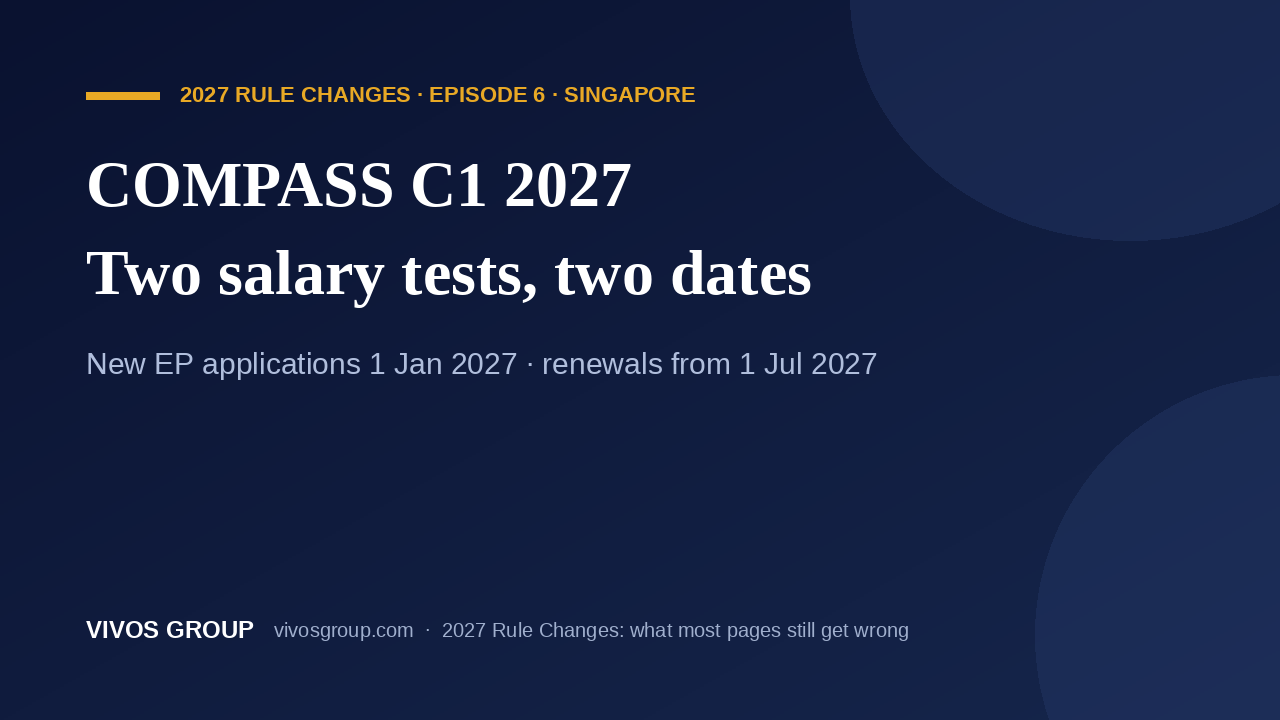
MOM's updated COMPASS C1 salary benchmarks apply to new Employment Pass applications from 1 January 2027 and to renewals of passes expiring from 1 July…
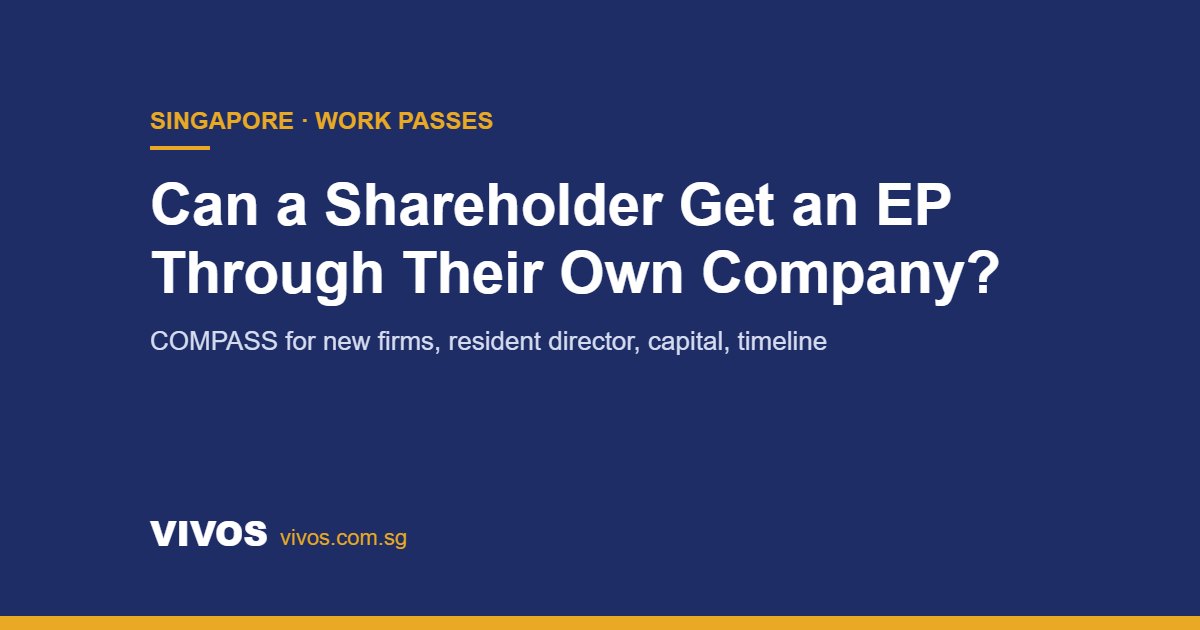
Yes, a shareholder can get an Employment Pass through their own new Singapore company. Here is what MOM checks when the company has no track…
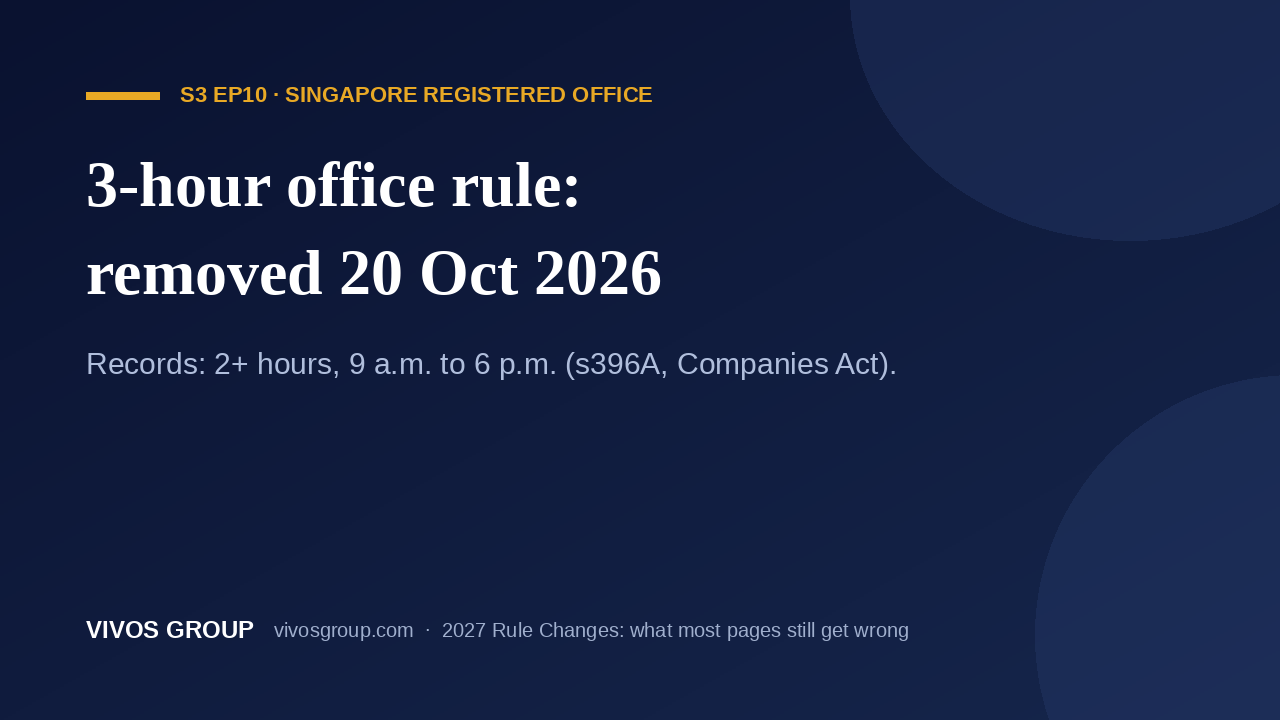
Singapore registered office opening hours: since 20 October 2026, a Singapore registered office no longer has to be open to the public three hours each…