
新加坡虚拟地址合规指南:创业者必须知道的规定

Ray Tay
在新加坡使用虚拟地址,须登记境内实体地址、避开邮政信箱,并在变更后14天内申报。掌握2026年文件查阅新规、选址核验与违规风险,创业合规少走弯路。
Published: 23 August 2026 · Last reviewed: 30 September 2026 · Reviewed by Ray Tay, Co-Founder & Managing Director, VIVOS PTE. LTD. (ACRA Filing Agent FA20240323 · MOM EA Licence 24S2425)
How much corporate tax does a new Singapore company actually pay in 2026? Far less than the 17% headline rate — a qualifying new company with S$200,000 of chargeable income pays roughly S$6,400 in Year of Assessment 2026, an effective rate near 3%.
That gap between 17% and about 3% comes from two reliefs running at the same time: the Start-Up Tax Exemption for your first three Years of Assessment, and the enhanced Corporate Income Tax rebate announced in Budget 2026. The numbers below are the ones stated in the video on this page.
Figures verified against IRAS at https://www.iras.gov.sg on 1 September 2026. This page is general information, not tax advice — a company’s actual tax position depends on its own facts, its financial year end and its activities. Updated 17 September 2026 with the video below.
Video 4 of 4 in the Foreign Founder: Singapore series from VIVOS PTE. LTD. — start with the resident director rule, then what incorporation really costs a foreigner and how to open a business bank account as a non-resident. If you are weighing a nominee director, read that one too — the arrangement affects the shareholding tests on this page. Presented by an AI-generated avatar and voice of Ray Tay, co-founder of VIVOS; written and fact-checked by VIVOS PTE. LTD.
Singapore’s Start-Up Tax Exemption (SUTE) cuts corporate tax for new companies by exempting 75% of the first S$100,000 of chargeable income and 50% of the next S$100,000, for each of your first three consecutive Years of Assessment (YAs), according to IRAS. As of YA 2026, qualifying companies must be incorporated and tax resident in Singapore, with no more than 20 shareholders. Eligibility starts the moment you incorporate, which is why getting your Singapore company incorporation structured correctly from day one matters.
The Start-Up Tax Exemption cuts tax on a Singapore company’s first S$200,000 of chargeable income by up to S$21,250, but only for founders who get their shareholding and residency documentation right from incorporation onward.
| Point | Details |
|---|---|
| Exact relief amounts | 75% exemption on the first S$100,000 and 50% on the next S$100,000 of chargeable income, for each of the first three YAs. |
| Maximum tax saving | A capped amount saved at the threshold chargeable income or above, since the exemption has a fixed ceiling. |
| Shareholder test | No more than 20 shareholders, with all individuals or at least one individual holding 10% or more of shares. |
| Dormant years still count | A loss-making or dormant YA still counts toward your three consecutive years, with no exemption claimed that year. |
| Claim method | No separate application; SUTE is claimed via ECI and Form C-S, Form C-S (Lite), or Form C by November 30. |
| VIVOS role | VIVOS structures shareholding at Singapore company incorporation and manages the secretarial and Form C filing work that keeps SUTE intact. |
Without any relief, a company earning S$100,000 in taxable profit would owe S$17,000. SUTE changes that math substantially for your first three YAs.
The exemption doesn’t touch the tax rate. It reduces the income subject to tax. On the next S$100,000, half (S$50,000) is exempt.
Here’s how that plays out at three common income levels, based on the exemption mechanics IRAS publishes and the arithmetic PwC’s Singapore tax summary confirms:
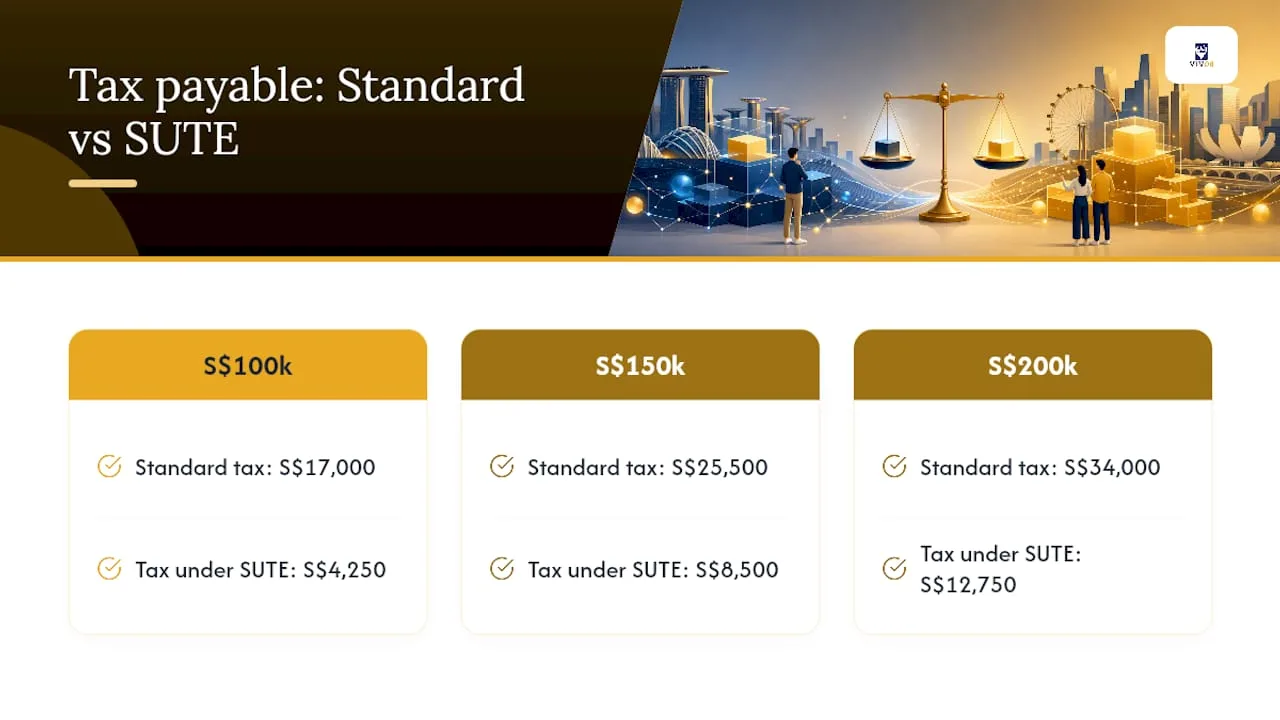
At S$200,000 in chargeable income, S$125,000 is exempt from tax entirely (S$75,000 plus S$50,000), which is exactly the combined exemption ceiling under SUTE.
A statistic worth sitting with: a company reporting S$200,000 in chargeable income pays S$12,750 in tax under SUTE before the YA 2026 rebate, instead of S$34,000. After the enhanced 50% Corporate Income Tax rebate for YA 2026 (capped at S$40,000) is applied to that S$12,750, the bill drops to roughly S$6,400 — an effective rate near 3%. That’s a significant reduction in tax payable, purely from qualifying for a scheme that requires no separate application.
What happens if your company posts a loss, or breaks even, during one of those three years? The YA still counts toward your three-year window. IRAS doesn’t pause the clock for a dormant or loss-making year. There’s simply no exemption to claim that year, since there’s no chargeable income to exempt. This catches out founders who assume a quiet first year buys them extra runway on the exemption. It doesn’t.
Not every new company automatically gets SUTE. IRAS applies specific tests, and missing one disqualifies your company for that YA even if you meet every other condition.
To qualify, your company must meet all of the following, per IRAS’s own guidance:
Tax residency is where a surprising number of founders trip up. IRAS determines residency by where the company’s control and management is exercised, not where it’s registered. That generally means where board meetings are actually held and where strategic decisions get made. A Singapore-incorporated company run entirely by directors dialing in from overseas, with no board presence here, risks failing the residency test.
Keep records that prove management happens in Singapore: board meeting minutes, director attendance, and evidence of where key decisions were signed off. Retain these for at least five years, since IRAS can review prior YAs during an audit.

Pro Tip: *Decide your shareholding structure before you incorporate, not after.
There’s no separate application form for SUTE. You claim it directly through your annual corporate tax filing, which means the exemption depends entirely on getting your Estimated Chargeable Income and Form C-S right.
Common filing errors include claiming SUTE in a fourth or later YA (it only applies to the first three), miscalculating the exempt amount when chargeable income exceeds S$200,000, and submitting Form C-S when the company’s income actually requires Form C. Since there’s no separate SUTE application to fall back on, an incorrect filing can mean losing the exemption for that YA entirely.
SUTE only applies to your first three consecutive YAs. From YA 4 onward, your company shifts to the partial tax exemption scheme, which exempts 75% of the first S$10,000 of chargeable income and 50% of the next S$190,000, a smaller benefit than SUTE but still meaningful.
The CIT rebate for YA 2026 is calculated on tax payable after SUTE or partial exemption has already been applied, so it stacks on top rather than replacing either scheme. For a company with S$75,000 of taxable income after SUTE (S$12,750 of tax at 17%), the 50% rebate cuts that bill to roughly S$6,400. Because rebate rates and caps can change in future Budget announcements, check the Ministry of Finance’s corporate tax page for the confirmed figure for later Years of Assessment.
Most SUTE claim failures come down to governance gaps, not tax miscalculation. IRAS reviews shareholding and residency evidence, and founders who treat compliance as an afterthought often discover the gap only when it’s too late to fix.
The recurring mistakes:
Keep a standing file of board minutes, your shareholder register, and records of major strategic decisions made in Singapore, retained for at least five years.
Structuring your shareholding correctly at incorporation, and keeping proper board and shareholder records from year one, is what actually protects your Start-Up Tax Exemption. Founders often treat this as paperwork. IRAS treats it as evidence.
That’s the view from Ray Tay, co-founder of VIVOS, on why governance discipline matters as much as the tax arithmetic itself.
If your shareholding structure is complicated, if you’re unsure whether your board meetings meet the residency bar, or if you’re approaching Form C-S filing without a tax preparer, that’s the point to bring in corporate secretarial and tax filing support rather than guessing.

Most guides on SUTE treat it as a formula: plug in your chargeable income, apply the percentages, done. That undersells what actually determines whether a company keeps the exemption across all three YAs.
The real risk isn’t the math. It’s governance drift. Founders incorporate with a clean shareholder structure, then add an investor, bring in a co-founder, or shift board meetings overseas as the team scales, without checking whether any of that still satisfies the 20-shareholder or residency tests. IRAS doesn’t send a warning before disqualifying a YA.
What the reader should prioritize first isn’t the tax calculation. It’s locking in a shareholding structure and a documented, Singapore-based board process before the first YA even starts. Fix that early, and the exemption arithmetic takes care of itself for three years. Get it wrong, and no amount of correct ECI filing recovers a disqualified YA. Founders approaching the end of their three-year window should also start modeling their YA 4 tax position under the partial exemption now, not after the SUTE benefit disappears.
Getting SUTE right starts before you file anything. It starts with how your company is incorporated. VIVOS handles Singapore company incorporation with shareholding structures built to meet the 20-shareholder and 10% individual tests from day one, so you’re not restructuring later to fix an eligibility problem.
Beyond incorporation, VIVOS provides the ongoing pieces that keep SUTE intact for all three YAs: corporate secretarial services that maintain your shareholder register and board minutes, and corporate tax computation and Form C filing support that gets your ECI and annual return submitted correctly and on time. For founders setting up a company specifically to claim SUTE from YA 1, VIVOS structures the shareholding and governance framework at incorporation, then carries that documentation through each year’s filing. If you’re incorporating a new Singapore company or reviewing whether your current structure still qualifies, start with VIVOS’s incorporation service to get the shareholding right before your first YA closes.
What corporate tax will your new Singapore company actually pay in 2026? Far less than the 17% headline — for many new companies, closer to 3%. I’m Ray Tay, co-founder of VIVOS. Here are the real numbers, straight from IRAS.
First, the Start-Up Tax Exemption. For your first three years of assessment, 75% of your first one hundred thousand dollars of chargeable income is exempt — and 50% of the next one hundred thousand.
Then Budget 2026 added more: an enhanced 50% corporate income tax rebate for Year of Assessment 2026, capped at forty thousand dollars.
Put together: a new company earning two hundred thousand dollars pays roughly six thousand four hundred — an effective rate near 3%. And Singapore has no capital gains tax, and dividends aren’t taxed again in your hands.
The conditions: incorporated and tax-resident in Singapore, no more than twenty shareholders, with at least one individual holding ten percent — and investment-holding and property-development companies don’t qualify.
VIVOS handles incorporation, accounting and every IRAS filing, so you actually capture these exemptions. Book a free consultation at vivos.com.sg.
This video is presented by an AI-generated avatar and voice of Ray Tay, co-founder of VIVOS. The content was written and fact-checked by VIVOS PTE. LTD.
It is a rebate of 50% of the corporate income tax payable for Year of Assessment 2026, capped at S$40,000, announced in Budget 2026. It is applied after the Start-Up Tax Exemption has already reduced the income being taxed, so it stacks on top of the exemption rather than replacing it. Figures were verified against IRAS at https://www.iras.gov.sg on 1 September 2026.
Because two reliefs run at the same time: the Start-Up Tax Exemption removes up to S$125,000 of chargeable income from tax in each of the first three Years of Assessment, and the YA 2026 rebate then halves the tax that is left. On S$200,000 of chargeable income that takes the bill to roughly S$6,400, an effective rate near 3%. The 17% figure is the statutory rate charged on what remains after relief, not what a qualifying new company ends up paying across its whole profit.
No. Singapore has no capital gains tax, so a gain on selling shares or other assets is not charged to income tax in the ordinary case. Gains that are in substance trading profits can be treated as income instead, so how each transaction is characterised matters.
No. Singapore runs a one-tier corporate tax system, so dividends paid by a Singapore resident company are not taxed a second time when they reach the shareholder. Tax is settled at company level, and what the company distributes afterwards is received without further Singapore tax on the dividend itself.
A Year of Assessment, or YA, is the year in which IRAS assesses the income your company earned in the preceding financial year. The Start-Up Tax Exemption is expressed in Years of Assessment rather than calendar years, which is why “the first three YAs” is the phrase that decides how long the relief lasts. Your company’s financial year end determines which YA a given set of accounts falls into.
No. The roughly 3% figure comes from one worked example: S$200,000 of chargeable income in a company that meets every Start-Up Tax Exemption condition and qualifies for the YA 2026 rebate. A company with different profits, a different Year of Assessment, or an excluded activity such as investment holding or property development will land somewhere else entirely. This page is general information and not tax advice, and a company’s actual position depends on its own facts.
It’s automatic once you meet the qualifying conditions. There’s no separate SUTE application form. You claim it by filing your ECI and completing the relevant sections of Form C-S, Form C-S (Lite), or Form C during your annual tax filing.
Yes. SUTE has no requirement about who owns the shares — a wholly foreign-owned company qualifies as long as it is incorporated and tax resident in Singapore, has no more than 20 shareholders, and either has all-individual shareholders or at least one individual holding 10% or more. Foreign branches and foreign companies operating in Singapore without local incorporation don’t qualify, regardless of their tax residency status here — the exemption is tied to Singapore incorporation, not to where the shareholders are from.
From YA 4 onward, your company moves from SUTE to Singapore’s partial tax exemption scheme instead: 75% of the first S$10,000 of chargeable income is exempt, plus 50% of the next S$190,000. It’s a smaller benefit than SUTE, but it still meaningfully reduces tax compared with paying the full 17% on all chargeable income.
No. IRAS specifically excludes companies whose principal activity is investment holding, along with those principally engaged in property development, regardless of whether the other shareholder and residency conditions are met.
 2 January, 2025
 2 January, 2025
在新加坡使用虚拟地址,须登记境内实体地址、避开邮政信箱,并在变更后14天内申报。掌握2026年文件查阅新规、选址核验与违规风险,创业合规少走弯路。

Remote founders can establish Singapore tax residency by documenting where board decisions happen, collecting minutes and CPF records, and applying for a COR.