
新加坡商业许可申请全攻略:ACRA 注册后该怎么做

Ray Tay
了解新加坡商业许可如何按行业判定,注册后用 GoBusiness 查询牌照要求,并掌握餐饮、按摩、进出口审批及场地合规要点,避免申请受阻。
Published: 28 August 2026 · Last reviewed: 30 September 2026 · Reviewed by Ray Tay, Co-Founder & Managing Director, VIVOS PTE. LTD. (ACRA Filing Agent FA20240323 · MOM EA Licence 24S2425)
Dividends paid by a Singapore tax-resident company are tax-free in the hands of shareholders. That’s the position IRAS confirms, as of 2026.
TL;DR:
- Dividends are generally tax-free in Singapore for shareholders due to the one-tier system, but distributions from co-operatives, partnerships, or disguised income are exceptions.
- Non-resident shareholders receive dividends gross, with no withholding tax, but they may owe taxes in their home countries; Singapore does not tax foreign-sourced dividends unless specific conditions are met.
- To qualify for foreign dividend exemptions, the income must have been taxed abroad at at least 15%, and proper documentation like tax certificates and source-country accounts is essential.
- Proper documentation, including solvency tests, board resolutions, and dividend vouchers, is critical for compliance; missing paperwork can trigger audits and threaten tax-exempt status.
- REIT distributions differ from ordinary dividends, often being tax-transparent for individuals but potentially subject to withholding for corporate or non-qualifying investors, requiring careful analysis.
Generally, no. Singapore’s one-tier corporate tax system means the tax paid at company level is final. Once a company settles its corporate tax bill on its profits, whatever it distributes to shareholders as dividends passes through tax-free. There’s no second layer of tax at the shareholder level, which is a deliberate design choice meant to avoid double taxation on the same pool of profit.
That said, “generally tax-exempt” isn’t the same as “always exempt.” A handful of situations fall outside the shelter:
Non-cash dividends (in specie distributions of shares or assets) and dividends connected to share buybacks generally follow the same one-tier logic, provided they’re paid out of already-taxed profits. If you’re unsure whether a specific payout qualifies, IRAS’s dividends page is the reference point, and taxable dividends, where they exist, get declared under “Other income” on your tax return.
No withholding tax applies. Singapore does not require companies to withhold tax on dividends paid to non-resident shareholders, whether those shareholders are individuals or corporate entities based overseas. This is a deliberate policy stance, not an oversight, and it makes Singapore a genuinely clean jurisdiction to hold shares in.
A few practical points follow from that:
Singapore’s side of the transaction is settled the moment the dividend is paid. What happens next is between you and your home tax authority.
Foreign dividends received by Singapore companies or resident individuals can qualify for exemption under Section 13(8) (companies) or Section 13(7A) (individuals), but the exemption isn’t automatic. Three conditions generally need to be satisfied:
IRAS’s guidance for companies receiving foreign income sets out these conditions in detail, and the documentation burden sits with the recipient, not IRAS.
The evidence you’ll want on file includes foreign tax paid certificates, the paying company’s audited accounts, and a clear paper trail showing the headline tax rate in the source country.
Pro Tip: Centralize your foreign tax certificates and source-country accounts the moment a foreign dividend lands. IRAS will ask for this evidence if your FSIE claim is ever reviewed, and reconstructing it two years later is far harder than filing it away now.
Whether it’s an interim or a final dividend, the process is the same in substance. Skipping steps here is exactly what turns a routine payout into an audit problem later.
Most documentation failures practitioners see aren’t about the dividend amount at all. They’re missing solvency test paperwork or absent board minutes, gaps that surface only when a bank, auditor, or IRAS asks for them. VIVOS’s Singapore company incorporation and accounting services build these records into the compliance workflow from the start.
Directors juggling how to take money out of their own company face a real trade-off. Fees and dividends are taxed differently, treated differently by CPF, and hit the company’s books in opposite ways.
| Factor | Director’s Fees | Dividends |
|---|---|---|
| Tax to recipient | Taxable as personal income | Generally tax-exempt under the one-tier system |
| CPF contributions | Applicable where the director is also an employee | Not applicable |
| Deductible to company | Yes, reduces taxable profit | No, paid from after-tax profit |
| Payroll compliance | Requires payroll processing and CPF filings | No payroll obligation |
| Reporting | Declared on the individual’s tax return | Declared as “Other income” only if taxable |
Here’s a simplified illustration. Say a company has $100,000 in pre-distribution profit. Paying it out entirely as director’s fees means the company deducts the full amount, but the director then pays personal income tax on it and, if CPF-eligible, contributes accordingly. Distributing the same $100,000 as dividends means the company first pays corporate tax at 17% (roughly $17,000), leaving $83,000 to distribute, but that $83,000 reaches the shareholder tax-free. Which route wins depends on the individual’s marginal tax rate and CPF status, which is exactly why this decision deserves a proper calculation rather than a guess.
Founders often treat dividends like an informal top-up to their pay, without the board resolution or solvency test behind it. That habit creates two problems at once: the company has no defensible paper trail if IRAS asks questions, and the shareholder loses the clean tax-exempt status the payout was supposed to have.
That’s the pattern Ray Tay, Managing Director of VIVOS, flags most often when reviewing client structures. The documentation gaps that raise audit flags tend to repeat themselves:
VIVOS’s corporate secretarial and accounting teams build these records into every distribution from the outset, rather than reconstructing them after the fact.
REIT distributions don’t follow the same clean one-tier logic that applies to ordinary company dividends, and that catches a lot of retail investors off guard. Singapore REITs typically qualify for tax transparency treatment: the REIT itself pays little or no tax on the income it distributes, provided it distributes at least 90% of its taxable income to unit holders.

Because that income was never taxed at the REIT level, the exemption story is different depending on who’s receiving it. Individual investors, whether resident or non-resident, generally receive REIT distributions tax-free, since Singapore has structured REIT taxation to push the tax obligation away from individual retail unit holders entirely. Corporate unit holders and non-qualifying investors, however, often face a different withholding treatment on their share of REIT income, precisely because that income skipped the corporate tax step that ordinary dividends already went through.
This distinction matters most for investors comparing a REIT holding against an ordinary blue-chip dividend stock. The headline yield might look similar, but the tax mechanics sitting underneath it are not. If you hold REITs through a corporate entity rather than in your own name, it’s worth checking the specific distribution components (some REIT payouts include capital, not just income) because the tax treatment can vary line by line. This is exactly the kind of nuance that trips up otherwise sophisticated investors who assume “REIT” and “dividend” are interchangeable for tax purposes. They aren’t.
Singapore doesn’t withhold tax on dividends paid out, so a DTA’s role here works mostly in the other direction: it protects Singapore residents receiving dividends from overseas.
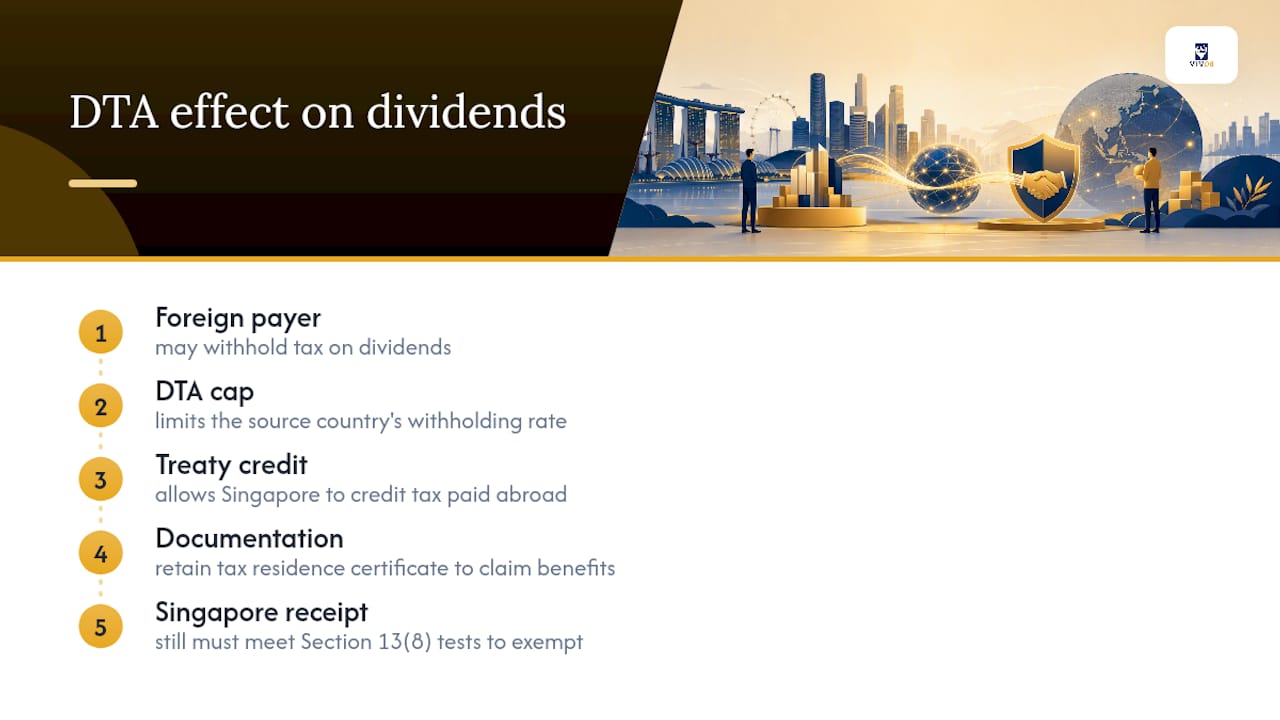
When a Singapore company or individual receives a dividend from a country that does impose withholding tax, a double taxation agreement between Singapore and that country typically caps the rate the source country can withhold, and it often provides a mechanism for Singapore to grant tax credit for tax already paid abroad.
For a Singapore-incorporated holding company receiving dividends from a subsidiary abroad, the practical sequence looks like this: check whether a DTA exists with the subsidiary’s country, confirm the reduced withholding rate that applies (versus the domestic rate the source country would otherwise charge), and retain the certificate of tax residence needed to claim treaty benefits at source. Missing that residence certificate is a common, entirely avoidable reason companies overpay foreign withholding tax on dividends they were entitled to receive at a reduced rate.
This is also where the Section 13(8) foreign dividend exemption and DTA relief interact. A dividend that’s already benefited from a reduced DTA withholding rate abroad still needs to separately satisfy the subject-to-tax and headline rate tests to be exempt once it reaches Singapore.
The biggest lever most shareholders overlook isn’t a clever structure. It’s sequencing: deciding deliberately between director’s fees, dividends, or a blend of both, based on where you sit for the year, not defaulting to whatever’s easiest to process.
For active directors, a modest salary sufficient to trigger CPF contributions (useful for retirement savings and, for some, housing eligibility) paired with dividends for the balance often beats an all-fees or all-dividends approach. The salary portion is deductible to the company and builds CPF savings; the dividend portion arrives tax-free rather than being taxed again at the marginal personal rate.
For holding structures with foreign subsidiaries, timing dividend receipts to align with when the Section 13(8) subject-to-tax and headline rate tests are clearly satisfied avoids a costly dispute later. Some companies also time dividend declarations around financial year-end to match distributable profit calculations cleanly, rather than declaring ad hoc payouts that complicate the solvency test.
For investors holding a mix of ordinary shares and REIT units, separating the two in your own tracking (given their different tax treatments, as covered above) makes year-end reporting considerably simpler and reduces the chance of misclassifying REIT income as an ordinary tax-exempt dividend.
None of these strategies require aggressive tax positions. They require discipline about documentation and timing, which is precisely where most shareholders fall short, not because the rules are unclear, but because the paperwork gets treated as an afterthought.
Singapore’s one-tier system itself hasn’t changed since it replaced the old imputation system years ago, and IRAS’s 2026 guidance continues to confirm the same core structure: tax once at the corporate level, exempt at the shareholder level, no withholding tax on outbound dividends.
Where the practical landscape has shifted is around foreign-sourced income scrutiny. IRAS and tax authorities globally have tightened expectations around substance and documentation for foreign income exemption claims, meaning companies claiming Section 13(8) relief on foreign dividends should expect closer review of the subject-to-tax and headline rate evidence they submit. This isn’t a change to the rate or the exemption itself, but it is a change to how rigorously the underlying paperwork gets checked.
REIT taxation rules have also seen incremental adjustments to distribution requirements and qualifying conditions over recent years, which is why REIT-holding investors should treat REIT tax treatment as something to reverify periodically rather than assume it’s fixed.
The practical implication for shareholders and directors is straightforward: the exemptions that make Singapore dividends attractive are still firmly in place, but the documentation bar to actually claim them, particularly for foreign-sourced income, keeps rising. Treating record-keeping as optional is a riskier bet than it used to be.
Before your next distribution, confirm your company genuinely qualifies for one-tier treatment, and keep every dividend voucher and board resolution on file, not just in someone’s memory. If foreign dividends are involved, retain the foreign tax proofs now, not when IRAS asks. Complex or cross-border structures are exactly where a second opinion from VIVOS pays for itself. Document the solvency test every time. It’s the cheapest insurance a director can buy.
— Ray
Getting a dividend distribution right on paper, not just in principle, is where most companies stumble, and it’s exactly where VIVOS steps in. VIVOS handles Singapore company incorporation with the governance structure built in from day one, so board resolutions and solvency test documentation aren’t an afterthought bolted on years later.

For companies already up and running, VIVOS’s accounting and financial reporting services keep dividend vouchers, ledgers, and foreign tax records organized and audit-ready, and the corporate secretarial team prepares the board minutes and resolutions each distribution actually requires. If your dividend income crosses borders, the cross-border tax service can help assess whether your Section 13(8) documentation will hold up. None of this replaces IRAS’s own guidance, but it does mean your next payout gets declared correctly the first time. Reach out to VIVOS to review your current dividend process before your next distribution date.
 2 January, 2025
 2 January, 2025
了解新加坡商业许可如何按行业判定,注册后用 GoBusiness 查询牌照要求,并掌握餐饮、按摩、进出口审批及场地合规要点,避免申请受阻。

Learn how Singapore taxes nonresident employees, when the 60 day exemption applies, and how employers meet IR21, IR8A, and departure filing deadlines.