


How to Set Up a Pte Ltd in Singapore: 2026 Guide

Learn how to set up a Pte Ltd in Singapore effortlessly. Follow our 2026 guide for streamlined registration and quick approval today!
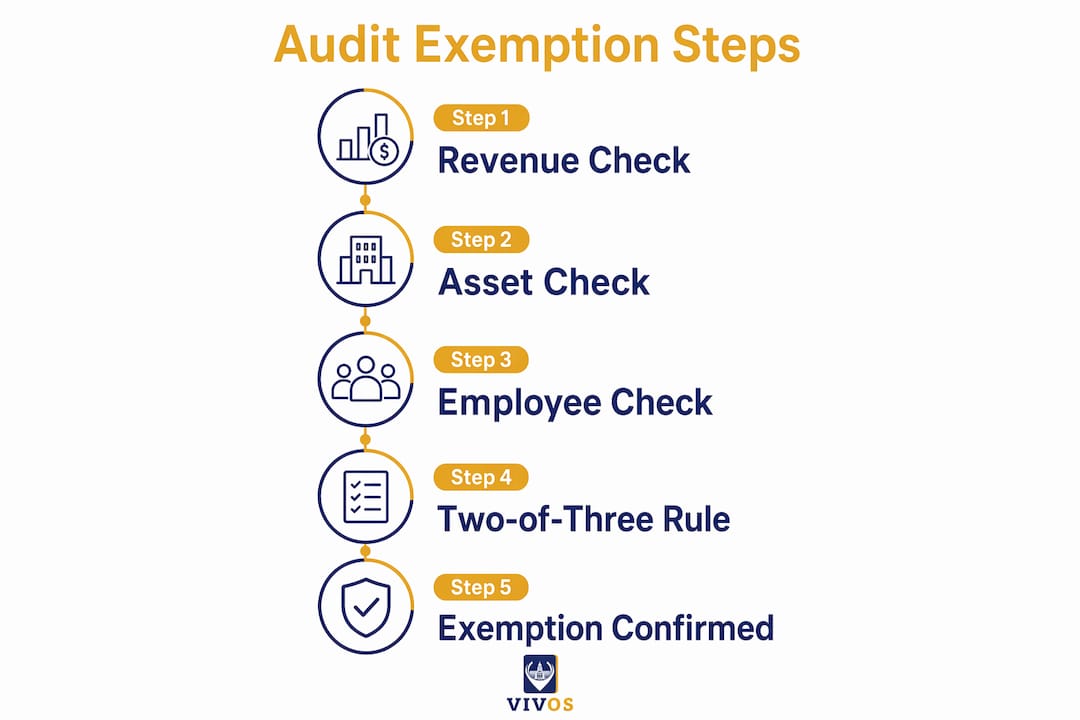
A private company in Singapore qualifies for audit exemption when it meets at least two of three quantitative criteria across the immediate past two consecutive financial years. The three thresholds, set under Section 205C of the Companies Act, are:
The small company test: meet at least two of three.
Total annual revenue ≤ S$10 million | Total assets ≤ S$10 million | 50 or fewer employees at year end.
Dormant companies have a separate exemption route and do not need to satisfy the two-of-three test. Companies that are part of a group face an additional consolidated test: the group as a whole must also pass two of three on a consolidated basis. ACRA announced a review of this framework in 2026, so directors should monitor for potential threshold changes.
The first gate is entity type. Only a private company qualifies. A public company, a company limited by guarantee, or a company whose shares are listed on a regulated market cannot rely on this exemption, regardless of size.
Once the private-company gate is cleared, the two-of-three quantitative test applies:
A company must satisfy at least two of these three criteria for each of the immediate past two consecutive financial years. Meeting them in only one year is not enough.
Worked example. A private company closes FY2023 with S$8 million in revenue, S$12 million in total assets, and 30 employees. It passes revenue and employees (two of three). In FY2024, revenue rises to S$9 million, assets fall to S$9 million, and headcount stays at 30. It passes all three. Having met two-of-three in both consecutive years, the company is audit-exempt for FY2025.

A newly incorporated company has no two-year history. Under the rules, a company in its first financial year applies the criteria to that year alone. In its second financial year, it applies the criteria to the first and second years. Only from the third financial year onward does the standard two-consecutive-year look-back fully apply.
Having corporate shareholders does not automatically disqualify a company from exemption. The small-company test is purely quantitative. Ownership structure is irrelevant unless the company forms part of a group, in which case the group-level consolidated test also applies (see the next section).
| Scenario | Effect | Recovery |
|---|---|---|
| Fails two-of-three in one year | Exemption lost for the following year | Must pass two-of-three in two consecutive years to regain |
| Fails two-of-three in two consecutive years | Audit required for those years | Two consecutive passing years needed to re-qualify |
| Ceases to be a private company | Exemption lost immediately | Must revert to private status and rebuild two-year record |
Growth-spike example. A company passes the test in FY2022 and FY2023. In FY2024, a large contract pushes revenue to S$13 million (fails revenue criterion) while assets hit S$11 million (fails assets criterion) and headcount stays at 40. It now fails two of three. An audit is required for FY2024. If the company returns below thresholds in FY2025 and FY2026, it regains exemption from FY2027 onward.
Key points to note:
A Singapore subsidiary within a larger group faces a two-layer test. The subsidiary must first qualify as a small company on its own. Then, the entire group must also meet at least two of three criteria on a consolidated basis for the immediate past two consecutive financial years.

The consolidated figures come from the holding company’s consolidated financial statements. If no consolidated statements exist, the group test cannot be satisfied by aggregating individual accounts.
Comparison: company-level vs. group-level test
| Test | Figures used | Who must pass |
|---|---|---|
| Company-level (small company) | Subsidiary’s own financial statements | The Singapore company alone |
| Group-level (small group) | Holding company’s consolidated statements | The entire group, including all subsidiaries |
Why this catches foreign-owned subsidiaries. A small Singapore subsidiary of a large multinational will almost certainly fail the group test. The consolidated group revenue and assets of a multinational far exceed S$10 million. Even if the Singapore entity itself is tiny, it cannot claim exemption because the group fails two of three on a consolidated basis.
Key implications:
Exemption is not a one-time determination. Directors must reassess eligibility at the close of every financial year before relying on the exemption for that year.
Even when unaudited, financial statements must be prepared under Singapore Financial Reporting Standards (SFRS) or SFRS for Small Entities, as applicable. Sloppy bookkeeping does not reduce the standard; it simply makes the assessment harder to defend.
Pro Tip: Set a calendar reminder 60 days before your financial year end to run a preliminary check on all three metrics. If you are borderline on any criterion, you still have time to consult your corporate service provider before the year closes.
Annual systematic tracking of the three metrics is the single most practical safeguard against an unexpected audit requirement after a growth spike.
Audit exemption is an ACRA statutory position only. It removes the obligation to appoint a public accountant to audit the financial statements. It does not remove any other compliance obligation.
Audit exemption does not mean no filing and no scrutiny. IRAS may still query figures in an unaudited set of accounts, and ACRA retains the authority to require a company to produce its accounting records for inspection. An audit-exempt company that files incomplete or non-compliant financial statements faces the same penalties as any other company.
Third-party demands add another layer. Banks routinely require audited or reviewed financial statements as a condition of credit facilities. Investors conducting due diligence before a funding round will typically request audited accounts. During M&A, acquirers expect financial statements that can withstand scrutiny. Exemption saves cost in normal years; it does not prepare a company for these events without additional work.
Pro Tip: Keep exemption workpapers for at least five years. If ACRA or a stakeholder queries the basis of exemption, a clean paper trail resolves the issue quickly. Missing records shift the burden of proof onto the directors.
Practical filing guidance for directors covers XBRL format requirements and the specific annual return fields relevant to audit-exempt companies.
Qualifying for exemption and choosing to remain unaudited are two separate decisions. Several circumstances make commissioning a voluntary audit the more prudent choice:
Maintaining high-quality bookkeeping even while audit-exempt reduces the cost and friction of a future audit significantly. A company that has kept clean, SFRS-compliant records can be audited quickly; one that has relied on exemption as a reason to maintain minimal records faces a costly catch-up exercise.
Vivos supports directors through corporate secretarial services, financial accounting and reporting, XBRL filing, and tax dispute resolution and audit support. For companies on the borderline between exempt and non-exempt, a pre-year-end assessment with Vivos identifies the risk before the financial year closes.
Pro Tip: If your company is borderline on any one of the three criteria, run a pre-year-end projection with your corporate service provider. Adjusting timing of asset disposals or year-end headcount within legitimate operational decisions can preserve exemption status for another year.
A private company in Singapore is audit-exempt only when it meets at least two of the three S$10 million / 50-employee thresholds for each of the immediate past two consecutive financial years, and the group test is also satisfied where applicable.
| Point | Details |
|---|---|
| Two-of-three rule | Meet at least two of: revenue ≤ S$10M, total assets ≤ S$10M, employees ≤ 50. |
| Two-year look-back | Both the current and immediately preceding financial year must satisfy the test. |
| Group consolidation trap | A Singapore subsidiary of a large group likely fails the consolidated group test even if it is small on its own. |
| Exemption ≠ no filing | Unaudited financial statements, annual returns, XBRL submissions, and IRAS tax filings remain mandatory. |
| Vivos support | Vivos provides corporate secretarial, accounting, XBRL filing, and audit support services to help directors document and maintain exemption status. |
Directors sometimes treat audit exemption as permission to run lighter books. That is a costly misreading of the rule.
The exemption removes one specific obligation: the appointment of a public accountant to audit the financial statements. Every other standard remains. SFRS compliance, ACRA filing deadlines, IRAS tax obligations, and the expectation that records can withstand scrutiny from a bank, investor, or regulator — none of those change.
The companies that benefit most from exemption are those that already maintain clean, well-documented accounts. They save the audit fee without sacrificing the quality that future fundraising or M&A will demand. The companies that misuse exemption as a reason to cut corners on bookkeeping tend to face a painful and expensive remediation when they eventually need audited financials.
ACRA’s 2026 review of the audit exemption framework may adjust thresholds or scope. Directors who track the three metrics annually are positioned to adapt quickly if the rules change. Those who have not been monitoring are exposed.
The practical counsel: accept the exemption when you qualify, invest the savings in better accounting infrastructure, and reassess every year. That is the approach that keeps compliance costs low and fundraising readiness high.
Qualifying for audit exemption reduces direct compliance costs. Staying qualified, filing correctly, and being ready for the moments when audited accounts are suddenly required — that is where most directors need support.
Vivos provides the full range of services that audit-exempt companies need: corporate secretarial services covering annual return filing, XBRL submission, and board documentation; financial accounting and reporting to SFRS standards; corporate tax computation and filing with IRAS; and audit support for companies that choose to commission a voluntary audit or face a statutory requirement. For directors planning fundraising or M&A, Vivos’s financial accounting and reporting services prepare accounts to a standard that satisfies investor and lender due diligence. Contact Vivos to confirm your exemption status, document your eligibility, and keep your filings on track.
Directors should verify current rules directly from primary sources. The following are the definitive references:
This article provides general information on Singapore’s audit exemption framework and does not constitute legal or professional advice. Directors should confirm current rules with ACRA, the Companies Act, or a qualified corporate service provider for their specific situation.
 2 January, 2025
 2 January, 2025
Learn how to set up a Pte Ltd in Singapore effortlessly. Follow our 2026 guide for streamlined registration and quick approval today!
Learn about capital reduction in Singapore in 2026. Understand the methods, requirements, and benefits for your company. Get compliant today!

Discover the essential guide to seed funding in Singapore for startups. Learn about key players and strategies to secure early-stage capital.