
在新加坡注册公司到底有多快?ACRA比客户的午餐还快(2026年真实案例)

Ray Tay
ACRA大多在付款后即批准注册(名称15新元+注册300新元,通常当天完成)。真正拖慢创始人的是未决定的事项:财年、股权、注册地址、银行KYC文件。
Published: 8 August 2026 · Last reviewed: 30 September 2026 · Reviewed by Ray Tay, Co-Founder & Managing Director, VIVOS PTE. LTD. (ACRA Filing Agent FA20240323 · MOM EA Licence 24S2425)
For most entrepreneurs seeking asset protection, centralized ownership, and tax-efficient group structuring, a Singapore holding company is a practical and well-supported choice. Singapore imposes no capital gains tax, operates a single-tier dividend system, and maintains a headline corporate tax rate capped at a competitive level — conditions that make it one of the most favorable holding jurisdictions in Asia. If your goals include consolidating subsidiaries, centralizing investment income, or preparing for institutional fundraising, the structure fits.
Immediate next steps:
A holding company is a legal entity that owns shares in one or more subsidiary companies or holds assets such as property, intellectual property, or financial instruments, without itself conducting active trading operations. POEMS describes the structure plainly: the holding company controls its subsidiaries through equity ownership, while the subsidiaries carry out the actual business activities.
In Singapore, the term covers several distinct vehicles, each with different regulatory and tax profiles.
IRAS defines an IHC as a company whose principal activity is holding investments — shares, properties, or other assets — to derive non-trade income such as dividends, interest, and rental income. The IHC is the most common structure for founders consolidating group ownership or holding passive assets.
The critical distinction IRAS draws is between an IHC and an investment dealing company. An IHC holds investments for long-term income. A dealing company buys and sells investments as its primary business, generating trade income. That classification difference directly affects how income is taxed and which expenses are deductible.
An FHC arises when a holding company sits above one or more regulated financial institutions — banks, insurers, or capital markets licensees. MAS applies additional oversight to these structures, including capital adequacy expectations, governance requirements, and in some cases formal licensing. Most entrepreneurs building operating groups do not encounter FHC treatment unless financial services entities are part of the group.
The VCC is a corporate structure introduced specifically for investment funds. It allows multiple sub-funds under a single legal entity, each with segregated assets and liabilities. Fund managers and institutional investors use VCCs as holding vehicles when they need capital flexibility and the ability to issue and redeem shares at net asset value. A VCC is not the right structure for a standard operating group holding company, but it is worth considering if the goal is to hold a portfolio of funds or attract institutional capital under a regulated fund framework.
A trust is not a corporate entity but can serve as a holding vehicle, particularly for estate planning, family wealth, or situations where confidentiality of beneficial ownership is a priority. Trusts in Singapore are governed by the Trustees Act and typically require a licensed trust company as trustee for regulated purposes.
| Type | Best for | Regulatory trigger |
|---|---|---|
| Investment Holding Company (IHC) | Passive asset holding, group ownership centralization | IRAS income classification rules |
| Financial Holding Company (FHC) | Groups containing regulated financial institutions | MAS oversight and licensing |
| Variable Capital Company (VCC) | Fund structures, institutional capital raising | MAS authorization under VCC Act |
| Trust | Estate planning, family wealth, beneficial ownership | Trustees Act; MAS for licensed trustees |
Singapore’s tax framework offers three core advantages for holding structures: no capital gains tax, a single-tier dividend system, and a corporate tax rate capped at 17%. Together, these mean that gains on the disposal of subsidiary shares are generally not taxable, dividends received from subsidiaries are not taxed again when distributed to shareholders, and retained income within the holding company is taxed at a rate of 17%.
Singapore’s absence of capital gains tax is a structural feature of the tax system, not an exemption that requires an application. Gains from the sale of shares or property are not subject to income tax, provided the holding company is not in the business of trading those assets — which brings the IHC classification back into focus.
IRAS guidance on IHCs separates income into two categories: income directly attributable to specific investments (direct income) and general overhead expenses not tied to a specific investment (non-direct expenses). Direct expenses — such as interest on a loan taken to acquire a specific property — are deductible against the income from that investment. Non-direct expenses, such as general administrative costs, are subject to a stricter test.
As a working rule, non-direct expenses that exceed a small fraction of gross investment income attract IRAS scrutiny and may be disallowed. This is not a statutory bright-line rule, but it reflects the practical standard IRAS applies when reviewing IHC filings. The IRAS worked examples PDF illustrates how income classification and expense allocation work in practice, with numerical examples that practitioners use to justify their apportionment methodology during audits.
The basic tax computation format for an IHC published by IRAS sets out exactly how investment income and deductible expenses should be presented in the tax return. If the IHC also provides routine support services to related parties, a separate computation format applies — IRAS expects an explicit apportionment of income and expenses, and publishes a dedicated format for that scenario.
Foreign-sourced dividends received by a Singapore holding company may qualify for tax exemption under Section 13(8) of the Income Tax Act, subject to three conditions: the headline tax rate in the source country is at least 15%, the dividend has been subject to tax in the source country, and the Comptroller of Income Tax is satisfied that the exemption is beneficial. Where these conditions are not met, the dividend is taxable at the standard corporate rate, with a credit available for foreign withholding tax paid.
Statistic callout: IRAS requires IHCs to file Estimated Chargeable Income (ECI) within a few months of the financial year end — a deadline frequently missed by newly incorporated entities that have not yet engaged a tax adviser.
Pro Tip: Document every expense allocation methodology before the first tax filing. IRAS expects a consistent, defensible basis for splitting non-direct expenses across investment income streams. Getting specialist sign-off on the methodology at setup is significantly cheaper than defending a disallowance during an audit.
Simple passive holding does not trigger MAS oversight. A Singapore holding company that owns shares in operating subsidiaries and collects dividends is not a regulated entity and does not require a MAS license. The regulatory picture changes when the group’s activities cross into financial services.
MAS becomes relevant in the following circumstances:
When MAS determines that a holding company qualifies as an FHC, additional obligations apply. These typically include:
MAS also operates a Securities Industry Council that publishes sector-specific guidance affecting group structures where securities activities are central to the business. Founders building groups that include fund management, brokerage, or financial advisory subsidiaries should review MAS guidance directly and engage a regulatory adviser before finalizing the holding structure.
Regulatory note: If any subsidiary in your group holds or intends to apply for a capital markets services license, engage a MAS-qualified regulatory adviser before incorporating the holding company. The structure of the holding entity can affect the licensing timeline and capital requirements of the regulated subsidiary.
The right structure depends on three variables: the nature of the group’s activities, the regulatory profile of its subsidiaries, and the capital-raising strategy.
For most founders building an operating group — a Singapore parent holding shares in one or more trading subsidiaries — the standard private limited company structured as an IHC is the correct choice. It is simple, well-understood by IRAS, and carries no regulatory overhead beyond standard corporate compliance.
Decision checklist:
| Structure | Primary use | Capital flexibility | Regulatory overhead |
|---|---|---|---|
| Private limited company (IHC) | Operating group, passive asset holding | Fixed share capital | Low — ACRA/IRAS only |
| Financial holding vehicle | Groups with regulated financial subsidiaries | Fixed share capital | High — MAS oversight |
| Fund vehicle (VCC) | Fund management, institutional capital | Variable — issue/redeem at NAV | Medium — MAS authorization |
| Trust | Estate planning, family wealth | Not applicable | Medium — Trustees Act |
Choosing between a standard private company and a VCC for fund-style holdings comes down to investor expectations and regulatory requirements. Institutional investors increasingly prefer the VCC for its segregated sub-fund structure and the ability to redeem shares without a court order. For a founder simply holding equity in two or three operating companies, the added complexity of a VCC is unnecessary.
Incorporating a Singapore holding company through ACRA’s BizFile portal takes as little as one to three business days once all documents are in order. The process follows a fixed sequence.
For foreign investors incorporating in Singapore, the nominee director requirement is the most common practical hurdle. A licensed corporate service provider can supply a nominee director, though the nominee’s role, liability, and removal terms should be documented in a nominee agreement.
| Document | Who provides it | Notes |
|---|---|---|
| Passport copy (all directors and shareholders) | Individual | Certified copy if not in Singapore |
| Proof of residential address (all directors and shareholders) | Individual | Utility bill or bank statement, dated within 3 months |
| Corporate shareholder documents | Corporate entity | Certificate of incorporation, M&A, register of directors |
| Draft company constitution | Adviser or founder | Standard template acceptable for most IHCs |
| Nominee director agreement | Corporate service provider | Required if no resident director available |
| Share subscription form | Founder/shareholder | Confirms paid-up capital |
Bank account opening typically takes two to six weeks after incorporation, depending on the bank and the complexity of the KYC review. Preparing a clear corporate structure chart, a business plan, and source-of-funds documentation before approaching the bank shortens the process materially. The BizFile entity details extract is a standard document banks request during KYC — having it ready on day one avoids delays. A practical guide to opening a Singapore company bank account covers the KYC preparation steps in detail.
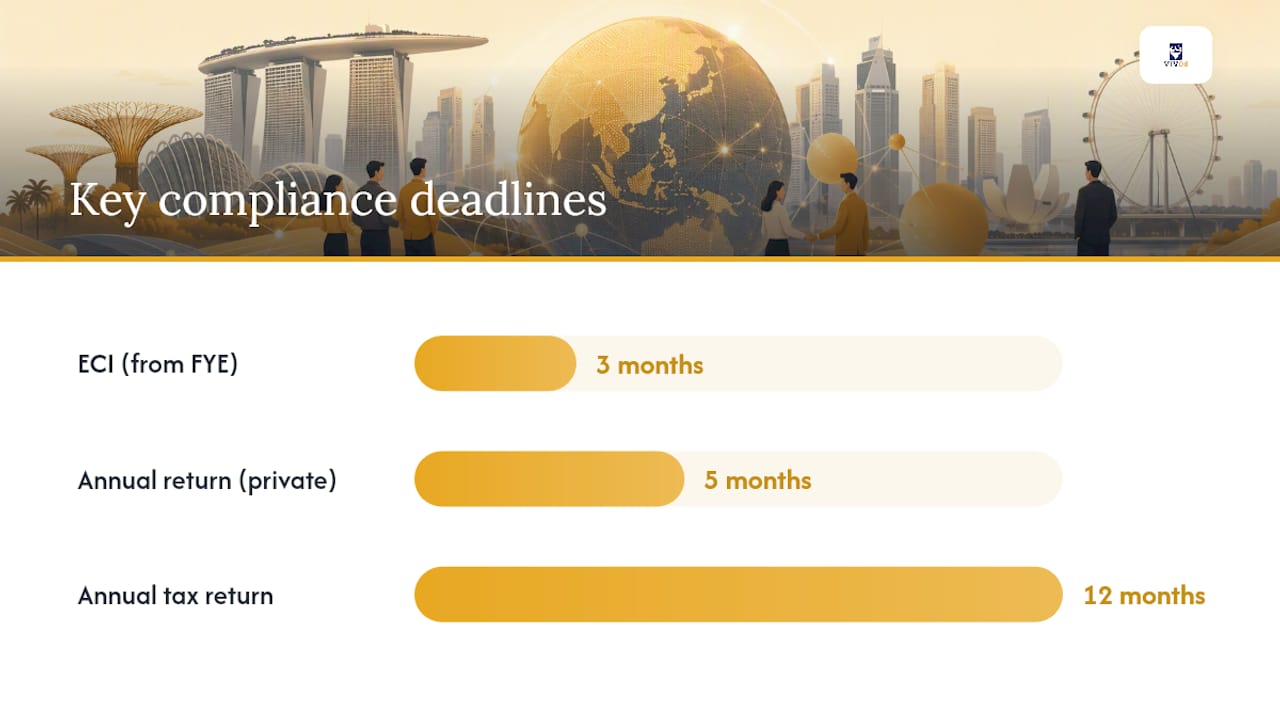
The most important ongoing obligations are ECI filing within three months of the financial year end, annual corporate tax return (Form C or Form C-S) submission, and annual return filing with ACRA. Missing any of these deadlines triggers penalties.
| Obligation | Deadline | Authority | Notes |
|---|---|---|---|
| Estimated Chargeable Income (ECI) | Within 3 months of financial year end | IRAS | Waived if annual revenue is S$5 million or below and ECI is nil |
| Form C-S (simplified) | Annually each year | IRAS | For companies with revenue ≤ S$5 million and meeting other criteria |
| Form C (full) | Annually each year | IRAS | For companies not qualifying for Form C-S |
| Annual Return | Within 5 months of financial year end (private company) | ACRA via BizFile | Includes financial statements unless exempt |
| GST registration | When taxable turnover exceeds S$1 million in 12 months | IRAS | Most passive IHCs do not reach this threshold |
| Audit | Required unless exempt | ACRA | Small company exemption applies if two of three criteria met |
The small company audit exemption applies when a company meets at least two of three criteria: annual revenue not exceeding S$10 million, total assets not exceeding S$10 million, and having no more than 50 employees. Most newly incorporated holding companies qualify. However, if the holding company is part of a group, the group-level criteria apply.
Annual tax filing for an IHC requires presenting investment income by source, allocating direct and non-direct expenses, and reconciling the tax computation to the financial statements. The IRAS basic format documents are the reference standard for this presentation.
Pro Tip: Maintain a dedicated expense log from the first month of operation, categorizing each cost as direct (attributable to a specific investment) or non-direct (general overhead). A clean log makes the annual tax computation straightforward and provides the audit trail IRAS expects if it reviews the filing.
Incorporation is relatively inexpensive. The ACRA government fee for incorporating a private limited company is S$315 (as of current ACRA schedules). Professional fees for a corporate service provider to handle the incorporation, prepare the constitution, and manage the BizFile filing typically range from S$800 to S$2,000 for a standard IHC.

| Item | Typical cost range | Notes |
|---|---|---|
| ACRA incorporation fee | S$315 | Government fee, fixed |
| Professional incorporation fee | S$800 – S$2,000 | Varies by provider and complexity |
| Registered address (annual) | — | Required if no physical office |
| Nominee director fee (annual) | — | Required for non-resident founders |
| Corporate secretarial (annual) | — | Annual return, minutes, statutory registers |
| Accounting and tax filing (annual) | — | Depends on transaction volume |
| Bank account opening support | — | Optional; reduces KYC delays |
First-year total costs for a straightforward IHC with a nominee director, registered address, secretarial, accounting, and tax filing typically fall within the range of S$5,000 to S$10,000. A VCC or a structure with MAS regulatory involvement adds meaningful cost and time: VCC setup involves MAS authorization and specialist legal work, and FHC structures require ongoing regulatory reporting.
Timeline summary:
Complexity increases both cost and time. A holding structure spanning multiple jurisdictions, or one that requires transfer pricing documentation, substance analysis, or MAS engagement, should budget for specialist legal and tax advisory fees that can reach S$15,000 or more in the first year.
The top risks are income misclassification, over-claiming non-direct expenses, poor documentation, failure to monitor MAS triggers, and bank KYC delays. Each is avoidable with the right preparation.
Common pitfalls:
Red flags that require immediate adviser engagement:
Arriving at an adviser meeting with the right documents and questions shortens the engagement and produces better advice. The checklist below is designed to be used directly.
What the answers signal: A straightforward “yes, IHC” answer to question 1 means standard setup. If the adviser flags dealing risk or mixed-activity treatment, expect a more detailed tax analysis and potentially a ruling application to IRAS. A “yes” to MAS triggers means the engagement scope expands significantly — budget for regulatory counsel in addition to corporate services.
A Singapore holding company delivers its full tax and structural benefits only when the IHC classification is correctly maintained, expense documentation is audit-ready, and MAS triggers are actively monitored.
| Point | Details |
|---|---|
| IHC classification is the foundation | IRAS distinguishes IHCs from investment dealing companies; misclassification makes gains taxable and disallows IHC expense rules. |
| No capital gains tax is a structural feature | Singapore does not tax capital gains, making share disposals and asset sales generally non-taxable for a correctly structured IHC. |
| Non-direct expenses face a 5% working rule | IRAS scrutinizes non-direct expenses that materially exceed 5% of gross investment income; document all allocations from day one. |
| ECI filing is due within 3 months of year end | New holding companies frequently miss this IRAS deadline; engage a tax adviser before the financial year closes. |
| Vivos handles incorporation through ongoing compliance | Vivos supports international founders from ACRA incorporation and nominee director arrangements through annual tax filing and banking introductions. |
Most guides focus on the headline benefits — no capital gains tax, low corporate rate, easy incorporation — and leave founders to discover the operational constraints after the fact. The IRAS expense deduction rules for IHCs are where most holding company tax plans quietly underperform.
The 5% working rule for non-direct expenses is not widely discussed in general incorporation guides, but it is the single most common source of IRAS adjustments for holding companies. Founders who charge management fees, director remuneration, or shared service costs to the IHC without a documented allocation methodology often find those deductions disallowed at assessment. The tax saving they expected from the holding structure is partially or fully offset by the disallowance.
The second underappreciated issue is the IHC versus investment dealing distinction. Founders who actively rebalance their investment portfolio, sell and reinvest frequently, or hold investments for short periods risk IRAS reclassifying the company as a dealing entity. That reclassification is not just a tax rate issue — it changes the entire expense deduction framework and can trigger back-assessments.
The holding company structure works well when it is set up with a clear investment policy, a documented expense allocation methodology, and a compliance calendar that treats the ECI deadline as non-negotiable. Founders who treat incorporation as the finish line rather than the starting point are the ones who end up in IRAS correspondence two years later.
Vivos gives international founders a single point of contact for every stage of holding company formation in Singapore — from ACRA incorporation and nominee director arrangements to corporate secretarial services, annual tax filing, and banking introductions. The practical gap most founders face is not knowing what they do not know: the IHC expense rules, the ECI deadline, the bank KYC requirements. Vivos closes that gap with structured onboarding and a compliance calendar built into every engagement.
Core services for holding company clients:
Start with a free company name availability check or book a consultation with the Vivos team at vivos.com.sg/singapore-company-registration.
Official references for verifying rules, downloading IRAS formats, and accessing ACRA filing services:
This article provides general information on Singapore holding company structures and is not legal, tax, or financial advice. Rules, thresholds, and fees are subject to change. Confirm current requirements with IRAS, ACRA, MAS, or a qualified professional before making structural or filing decisions.
 2 January, 2025
 2 January, 2025
ACRA大多在付款后即批准注册(名称15新元+注册300新元,通常当天完成)。真正拖慢创始人的是未决定的事项:财年、股权、注册地址、银行KYC文件。
ACRA approves most Singapore incorporations soon after payment (S$15 name + S$300). A true client story on what really slows founders down — and the…

了解新加坡公司注册费用:官方 315 新元起、首年第三方费用可明显上升,逐项报价与合规建议帮您控预算并加速开户,含处理时效与开户风险说明。