
Secure Singapore PR: 3 Global Investor Programme Routes Compared

Compare the GIP's three routes and thresholds (≈S$10M, ≈S$25M, S$200M). Learn timelines, REP renewal rules, tax implications, common risks, and advisor...
Published: 29 July 2026 · Last reviewed: 15 September 2026
For most foreign SMEs entering Singapore, a locally incorporated subsidiary (Pte. Ltd.) is the stronger long-term choice. It limits parent liability, qualifies for local tax incentives, and builds local credibility. A branch, by contrast, is an extension of the foreign parent under the Companies Act 1967, leaving the parent fully exposed to Singapore obligations. The Accounting and Corporate Regulatory Authority (ACRA) recognizes both structures, and the Inland Revenue Authority of Singapore (IRAS) treats them differently for tax purposes. The Ministry of Manpower (MOM) rules on hiring apply to both, but entity choice affects how employment is structured. Vivos handles the full setup and ongoing compliance for either structure.
Contact Vivos for a free setup consultation or review the decision checklist in Section 9 below.
ACRA’s guidance draws a clear line: a Singapore subsidiary is a locally incorporated private limited company with its own legal personality, while a branch is simply a registered extension of the foreign parent company.
That distinction has direct operational consequences. A subsidiary signs contracts under its own name, holds its own bank accounts, and owns local assets outright. A branch signs in the parent’s name, and Singapore counterparties are contracting with the foreign entity. Banks and landlords in Singapore often prefer dealing with a locally incorporated entity, which affects everything from lease negotiations to credit facilities.
Governance requirements also differ. A subsidiary must appoint at least one Singapore-resident director and a qualified company secretary, both under the Companies Act. A branch must appoint a locally resident authorized representative who is personally responsible for the branch’s statutory compliance. Neither structure is self-managing: both require ongoing ACRA filings and a registered local address.

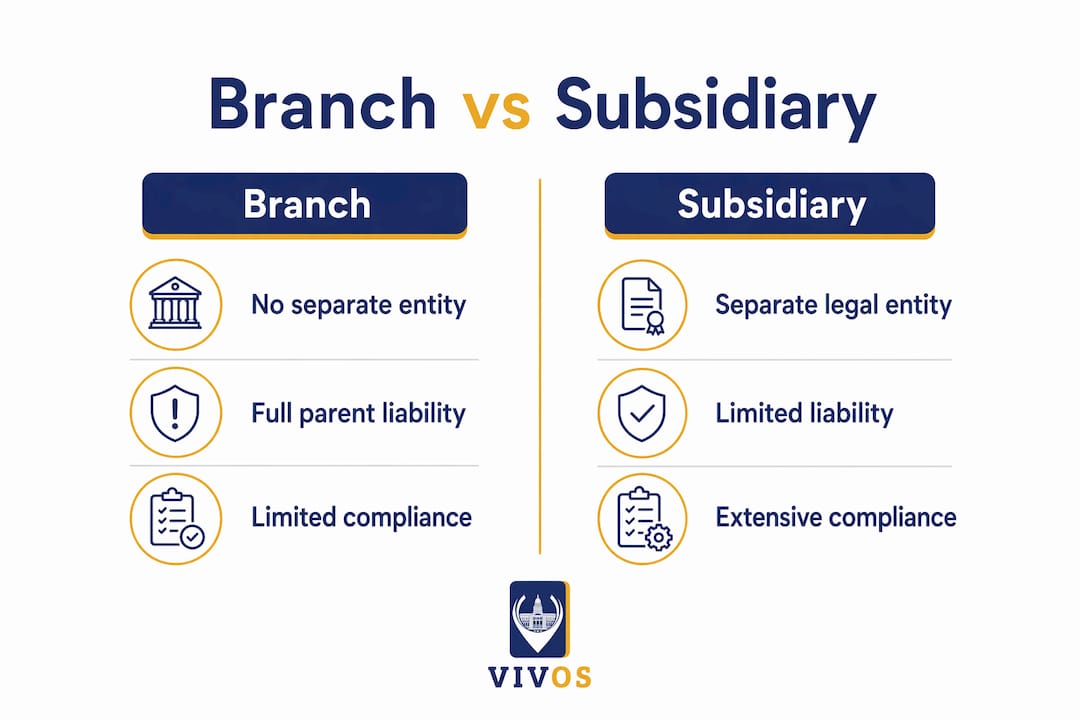
A subsidiary limits the parent’s exposure to the capital it has invested. Creditors of the Singapore subsidiary can pursue the subsidiary’s assets, but they cannot reach the parent’s balance sheet unless the parent has provided a personal guarantee or the corporate veil is pierced in exceptional circumstances.
A branch carries no such protection. If the Singapore branch incurs a debt, defaults on a lease, or faces a tort claim, the creditor can pursue the foreign parent directly. The parent’s global assets are in scope.
Pro Tip: If your Singapore operations involve material contracts, lease commitments, or regulatory exposure (financial services, construction, healthcare), the branch structure puts your entire parent entity at risk. A subsidiary ring-fences that exposure from day one.
Consider a realistic scenario: a foreign manufacturer registers a Singapore branch to handle regional sales. A product liability claim arises from a Singapore customer. Because the branch is not a separate entity, the claim runs directly against the parent. The same claim against a Singapore Pte. Ltd. would be confined to the subsidiary’s assets, assuming no parent guarantee was given.
Risk mitigation for branches includes commercial insurance, contractual indemnities, and careful scoping of branch activities. But none of these eliminate the structural exposure the way incorporation does. ACRA’s registration requirements for foreign company branches make clear that the parent remains the responsible party for all branch obligations.
Singapore’s headline corporate tax rate is 17% for both structures. The critical difference is tax residency and incentive access.

A locally managed subsidiary can qualify as a Singapore tax resident if control and management are exercised in Singapore. Residency unlocks Singapore’s network of Double Taxation Avoidance Agreements (DTAAs) and, more importantly for early-stage companies, the Start-Up Tax Exemption (SUTE).
A branch is typically treated as non-resident and taxed only on Singapore-source income. It can access the Partial Tax Exemption (PTE) but not SUTE.
SUTE structure for qualifying newly incorporated companies:
SUTE can substantially reduce taxable income for qualifying subsidiaries in their early years, while branches do not have access to this relief.
Key IRAS filing differences:
Tax residency for a subsidiary is not automatic. IRAS looks at where board decisions are actually made. Holding board meetings outside Singapore, or having all strategic decisions made at the parent level, can cause a subsidiary to be treated as non-resident, losing DTAA and SUTE access. Maintain documented board minutes showing Singapore-based decision-making.
Branch registration with ACRA is typically faster and cheaper upfront than incorporation, but the documentation burden is heavier because it involves certified parent-company records.
Required documents checklist:
Incorporating a Pte. Ltd. involves more governance steps than branch registration, but the result is a fully independent Singapore entity with its own legal standing.
Nominee director note: Since the Corporate Service Providers Act 2024 took effect on June 9, 2025, nominee directors must be sourced through an ACRA-registered provider. Non-compliance carries regulatory penalties. Vivos, as a registered provider, sources nominee directors in full compliance with these requirements.
Typical upfront cost items include the ACRA incorporation fee, corporate secretarial retainer, nominee director fee (if required), and bank account opening support. Setup cost estimates for a subsidiary are generally higher than those for a branch registration.
Both structures carry annual compliance obligations. The subsidiary’s obligations are more extensive but self-contained. The branch’s obligations are simpler in some respects but require parent-level disclosure.
| Obligation | Singapore Subsidiary (Pte. Ltd.) | Singapore Branch |
|---|---|---|
| ACRA annual return | Required; filed annually | Required; filed annually |
| Financial statements | Subsidiary’s own audited or unaudited accounts (audit threshold applies) | Parent’s audited accounts filed with ACRA |
| IRAS corporate tax return | Form C or Form C-S; based on worldwide income of resident company | Based on Singapore-source income only |
| Audit requirement | Required if revenue exceeds SGD 1 million or meets size thresholds | Parent accounts must be audited; branch accounts may also be required |
| Company secretary | Required; Singapore-resident | Not required; authorized representative instead |
| MOM/CPF obligations | Apply when hiring local employees | Apply when hiring local employees |
| Typical annual service costs for subsidiaries are generally higher than for branches, covering secretarial, accounting, and tax filing services. |
The branch’s requirement to file parent audited accounts with ACRA is a significant disclosure consideration. Private parent companies that want to limit visibility of global financials will find the subsidiary structure more appropriate.
For companies hiring local staff, MOM work pass rules and CPF contribution obligations apply regardless of structure. The entity type affects how employment contracts are structured and which entity is the legal employer.
A representative office (RO) sits below both a branch and a subsidiary in terms of operational scope. It is not a separate legal entity and cannot generate revenue.
ROs are restricted to non-commercial activities such as market research, feasibility studies, and liaison work on behalf of the parent. They cannot sign commercial contracts, invoice customers, or conduct any revenue-generating activity in Singapore.
| Feature | Representative Office | Branch | Subsidiary (Pte. Ltd.) |
|---|---|---|---|
| Legal status | Not a legal entity | Extension of parent | Separate legal entity |
| Revenue-generating activity | Not permitted | Permitted | Permitted |
| Contract signing | Not permitted | In parent’s name | In own name |
| Tax filing with IRAS | Not required (no taxable income) | Required on Singapore-source income | Required; resident company rules |
| Parent liability | Full (parent is the entity) | Full | Limited to equity invested |
| Best for | Market testing, pre-entry research | Trading under parent brand | Most foreign SMEs |
| Typical setup cost (SGD) | Lower than branch | SGD 800–1,500 | SGD 1,500–3,500 |
The trigger to upgrade from an RO is straightforward: any commercial activity, contract, or revenue stream requires either a branch registration or subsidiary incorporation. Operating commercially through an RO is a regulatory violation. Foreign companies that have completed market research and confirmed a Singapore opportunity should move to a Pte. Ltd. or branch before any commercial engagement.
Work through these questions before engaging a corporate service provider. Your answers will determine which structure is appropriate.
Liability and risk:
Tax and incentives:
Credibility and financing:
Disclosure sensitivity:
Red flags that point firmly toward a subsidiary:
Pro Tip: If you are using a branch temporarily while evaluating the market, negotiate short-term lease and contract terms to limit the parent’s exposure. Avoid multi-year commitments until you have converted to a subsidiary.
Questions to ask your corporate service provider:
Vivos works with foreign founders and multinationals at every stage of Singapore market entry, from initial structure selection through ongoing compliance. The services map directly to the decisions in this article.
Core services Vivos provides:
A representative client outcome: a European technology firm engaged Vivos to incorporate a Singapore Pte. Ltd. as its regional hub. Incorporation was completed within three business days. Vivos documented management-and-control evidence to support Singapore tax residency, enabling SUTE access in the first Year of Assessment. Ongoing corporate secretarial, accounting, and tax filing are managed by Vivos, with the client’s team focused entirely on operations.
For readers ready to proceed, Vivos’s corporate advisory team can assess the right structure and manage the full setup process.
For most foreign SMEs, a Singapore Pte. Ltd. is the correct structure because it limits parent liability, qualifies for SUTE, and supports local financing and credibility.
| Point | Details |
|---|---|
| Legal separation | A subsidiary is a separate legal entity; a branch is an extension of the foreign parent with no liability shield. |
| Tax incentive access | Subsidiaries can access SUTE (75% on first SGD 100,000; 50% on next SGD 100,000); branches cannot. |
| Parent disclosure risk | Branches must file parent audited accounts with ACRA; subsidiaries file their own financial statements only. |
| Setup cost range | Subsidiary incorporation costs are generally higher than branch registration costs. |
| Vivos next step | Vivos handles incorporation, nominee director compliance, banking support, and ongoing ACRA and IRAS filings for foreign-owned Singapore entities. |
Most foreign SMEs that come to Vivos for Singapore market entry choose the Pte. Ltd. without much deliberation once the liability and tax picture is clear. The branch structure appears mainly among established multinationals that want to trade under the parent brand name and have no concern about parent financial disclosure.
The one area where clients consistently underestimate the complexity is documentation for tax residency. Incorporating a subsidiary is straightforward. Maintaining its Singapore tax residency requires ongoing discipline: board meetings held in Singapore, decisions documented in Singapore-signed minutes, and strategic direction demonstrably exercised locally. Clients who treat this as a formality risk losing SUTE eligibility and DTAA access mid-stream.
The Corporate Service Providers Act 2024, which took effect June 9, 2025, has also changed the nominee director market. Sourcing a nominee director from an unregistered provider is no longer a minor compliance gap; it carries direct regulatory risk. Foreign founders should confirm that their corporate service provider is ACRA-registered before any nominee director arrangement is put in place.
One practical tip drawn from client experience: prepare the parent company’s board resolution and certified constitutional documents before engaging ACRA. Delays in branch and subsidiary registrations almost always trace back to incomplete or uncertified parent documents, not to ACRA processing times.
Foreign founders choosing between a branch and a subsidiary in Singapore face a decision with real legal, tax, and operational consequences. Vivos removes the complexity by handling every step: structure selection, company incorporation, nominee director sourcing under the Corporate Service Providers Act 2024, corporate secretarial compliance, banking introductions, and IRAS tax filing.
The difference between a well-structured Singapore entity and a poorly documented one shows up at tax time, at the bank, and when a creditor appears. Vivos’s team has guided international clients through both branch registrations and Pte. Ltd. incorporations, with compliance managed end-to-end. For founders who want SUTE eligibility assessed, a resident director in place, and ACRA filings handled from day one, Vivos’s corporate secretarial services are the direct next step. Book a discovery call to confirm the right structure for your situation.
 2 January, 2025
 2 January, 2025
Compare the GIP's three routes and thresholds (≈S$10M, ≈S$25M, S$200M). Learn timelines, REP renewal rules, tax implications, common risks, and advisor...

Singapore’s Corporate Service Providers Act 2024 (CSP Act) took effect on 9 June 2025, and the grace period for previously-unregistered providers ended 9 December 2025…

14 point Singapore due diligence checklist for foreign founders and investors. Includes ACRA, IRAS and SLA checks plus contracts, tax, CPF, work pass and...