
Foreign Founders: Skip the Company Seal in Singapore and Sign Remotely

Ray Tay
Foreign founders: why a company seal is optional in Singapore since 2017, how Section 41B lets you sign deeds, and practical remote signing workflows.
Published: 18 September 2026 · Last reviewed: 30 September 2026 · Reviewed by Ray Tay, Co-Founder & Managing Director, VIVOS PTE. LTD. (ACRA Filing Agent FA20240323 · MOM EA Licence 24S2425)
Quick answer: Yes, you can incorporate a Singapore Pte Ltd for a crypto business, but running one now almost always requires a MAS Digital Payment Token (DPT) service licence under the Payment Services Act 2019 — as a Standard Payment Institution (S$100,000 base capital) or, more often for DPT activity, a Major Payment Institution (S$500,000 base capital). Since 30 June 2025, this applies even if your company serves only customers outside Singapore — MAS closed the “overseas-only” exemption that many crypto firms previously relied on. Incorporation takes 1-3 days; the MAS licence typically takes 8-14 months.
TL;DR:
- Buying, selling, exchanging, transferring, or providing custodial wallet services for cryptocurrency in or from Singapore is a regulated “digital payment token service” under the Payment Services Act.
- DPT service providers need an SPI or MPI licence — in practice, most crypto exchanges and custodians end up at MPI, with S$500,000 base capital (higher than the standard S$250,000 MPI tier for other payment services).
- The “overseas-only” loophole is closed. From 30 June 2025, a Singapore-incorporated digital token service provider serving only customers outside Singapore must still be licensed as a Digital Token Service Provider (DTSP).
- MAS restricts marketing DPT services to Singapore retail customers — this shapes how you can advertise even once licensed.
- Expect 8-14 months from a complete application to a decision, plus a resident director, an approved compliance officer, and a full AML/CFT and technology-risk framework before you apply.
- VIVOS incorporates the entity and structures it for a licence application; the DPT/DTSP licence filing itself runs alongside a specialist crypto-compliance consultant or law firm.
“Digital payment token” is MAS’s regulatory term for cryptocurrency — Bitcoin, Ethereum, and similar tokens that function as a medium of exchange (it does not cover securities tokens or NFTs used purely as collectibles, which sit under different rules). A DPT service, requiring a licence, includes:
If your Singapore entity does any of the above, incorporation alone is not enough — you need a Payment Services Act licence before you can legally operate.
| Factor | Standard Payment Institution (SPI) | Major Payment Institution (MPI) |
|---|---|---|
| Base capital | S$100,000 | S$500,000 for DPT services (vs S$250,000 for other MPI activities) |
| Application fee | S$1,500 | S$5,000 |
| Security deposit | Not required | S$100,000-S$200,000 depending on monthly volume |
| Who typically fits | Very low-volume DPT activity, early-stage | Most operating crypto exchanges and custodians |
| Typical processing time | 5-9 months | 8-14 months |
Because DPT-specific MPI base capital (S$500,000) is double the standard MPI tier for other payment activities, most serious crypto businesses budget for MPI from day one rather than starting at SPI and upgrading — the compliance build-out required for either tier is similar, so there is little benefit to starting smaller unless transaction volumes are genuinely minimal. For the full MPI/SPI framework shared across all payment services, see our fintech and payment services licensing guide.
For years, a common structure was a Singapore-incorporated crypto company that deliberately served only customers outside Singapore, on the understanding that MAS’s licensing regime was aimed at businesses serving the local market. MAS’s Guidelines on Licensing for Digital Token Service Providers, which took effect 30 June 2025, closed that gap. A Singapore-incorporated (or Singapore-based) entity providing digital token services solely to customers outside Singapore must now be licensed as a Digital Token Service Provider (DTSP) — a separate licensing track from the standard DPT service provider licence, but built on the same fit-and-proper, AML/CFT, and capital foundations.
Practically, this means the old “we’re Singapore-incorporated but Singapore isn’t our market, so we’re not MAS’s problem” position no longer holds. If your entity is set up in Singapore and touches crypto in any of the five regulated ways, MAS now expects a licence application regardless of where your customers sit.
Even once licensed, MAS restricts how DPT services can be marketed to the Singapore retail public — this includes limits on advertising in public areas, through social media influencers, and via unsolicited outreach, reflecting MAS’s consumer-protection stance on crypto specifically (a stricter posture than for most other payment services). Plan your Singapore go-to-market with this in mind from the outset rather than discovering the restriction after building a consumer marketing campaign.
“For a crypto business, the incorporation is usually the easy part — we can have your Pte Ltd registered in a few days,” says Ray Tay, Co-Founder and Managing Director of VIVOS. “Where founders actually get stuck is the bank account and the MAS licence itself. We structure the entity correctly for a DPT or DTSP application — resident director, paid-up capital, registered address — and we keep the company secretary and accounting compliant throughout. What we do not do is file the DPT or DTSP licence application, write your AML/CFT and travel-rule policies, or act as your compliance officer — that is specialist crypto-regulatory work, and we bring in a dedicated crypto-compliance consultant or law firm for that part rather than claiming expertise we do not have.”
VIVOS incorporates the Pte Ltd, structures the resident director and paid-up capital requirements, and keeps your company secretary and accounting compliant while your MAS DPT or DTSP application is in progress. Read our fintech and payment services licensing guide for the shared MPI/SPI framework, or get in touch to discuss your crypto structure.
This guide draws on MAS’s Payment Services Act 2019, its Guidelines on Licensing for Digital Token Service Providers, and its Guidelines on Provision of Digital Payment Token Services to the Public, cross-checked against 2026 regulatory-compliance publications. Licensing rules and thresholds can change — always confirm current requirements with MAS or a licensed crypto-compliance advisor before applying. Read our editorial and accuracy policy.
Yes. Dealing in digital payment tokens or facilitating their exchange is a regulated activity under the Payment Services Act. You need a Standard or Major Payment Institution licence before operating, and since 30 June 2025 this applies even if all your customers are outside Singapore.
No, not any more. MAS’s Guidelines on Licensing for Digital Token Service Providers, effective 30 June 2025, require Singapore-incorporated entities serving only overseas customers to hold a Digital Token Service Provider (DTSP) licence — the previous exemption for overseas-only business is closed.
S$100,000 in paid-up base capital if you qualify for a Standard Payment Institution licence, or S$500,000 if you sit at Major Payment Institution tier for DPT services — which most operating crypto exchanges and custodians do. This is on top of working capital for 8-14 months of MAS review.
Yes — this is consistently the step crypto founders underestimate. Singapore banks apply enhanced AML scrutiny to crypto-related businesses, and some decline these accounts outright regardless of licensing status. Build extra time into your plan for this specifically, ideally before you finalise your incorporation timeline.
Generally no, if the NFTs function purely as collectibles rather than as a medium of exchange or investment instrument — but the line can blur depending on how the NFT is structured and marketed. Get a specific scoping opinion from a crypto-compliance advisor before assuming you are outside MAS’s regulatory perimeter.
 2 January, 2025
 2 January, 2025

Foreign founders: why a company seal is optional in Singapore since 2017, how Section 41B lets you sign deeds, and practical remote signing workflows.
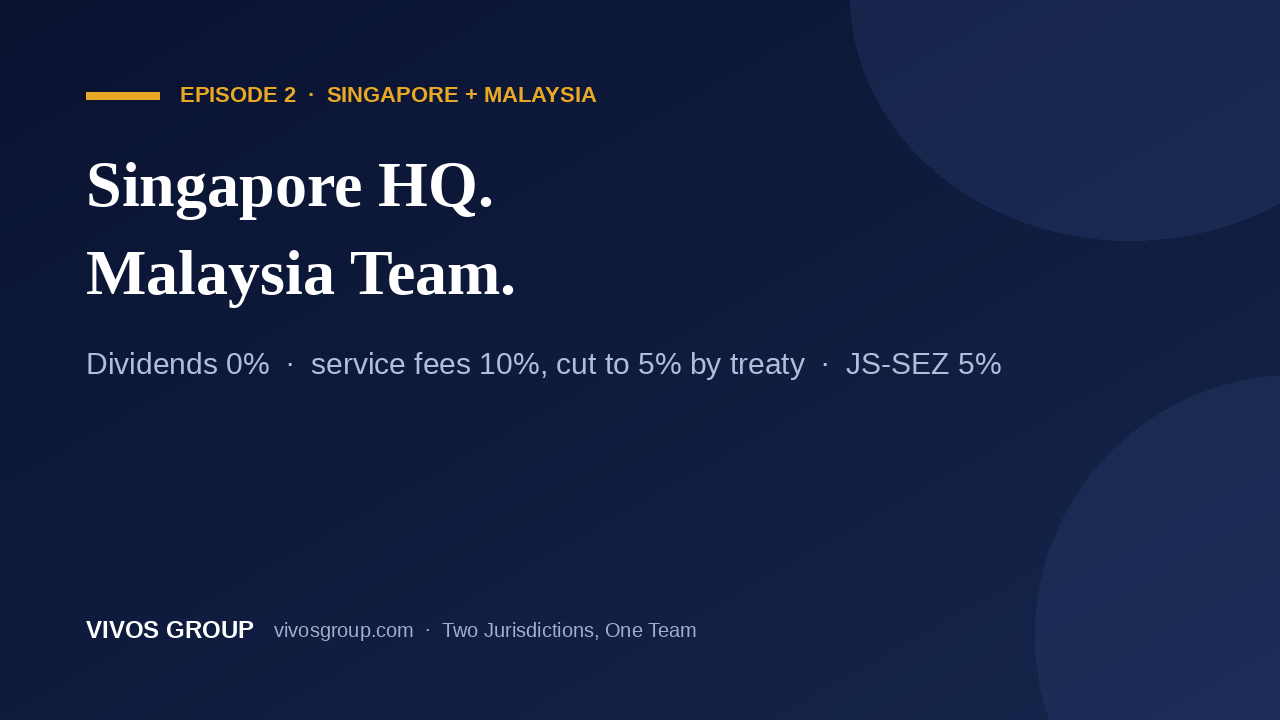
What the Singapore parent of a Malaysian Sdn. Bhd. must get right in 2026: tax-exempt Malaysian dividends under section 13(8), invoicing and 5% treaty withholding,…