
Avoid 4x Penalty: Transferring Shares in Singapore for Founders

Ray Tay
Practitioner checklist for founders transferring shares in Singapore: compute 0.2% stamp duty, meet the 14 or 30 day deadlines, secure board approval, and...
Published: 21 August 2026 · Last reviewed: 30 September 2026 · Reviewed by Ray Tay, Co-Founder & Managing Director, VIVOS PTE. LTD. (ACRA Filing Agent FA20240323 · MOM EA Licence 24S2425)
Paid-up capital is the amount shareholders have actually paid the company for shares issued to them. For a standard Singapore private limited company, the statutory floor is S$1 and that figure gets recorded through ACRA via BizFile+ at the point of incorporation.
Quick fact: Companies with paid-up share capital of S$500,000 or more automatically become members of the Singapore Business Federation, a threshold that matters far more to trade credibility than the S$1 legal minimum ever will.
Singapore sets no meaningful capital barrier to incorporation, but the paid-up capital figure you choose shapes banking relationships, sector licensing, and SBF eligibility long after the filing is done.
| Point | Details |
|---|---|
| Statutory minimum is S$1 | Standard private limited companies need only S$1 in paid-up capital under ACRA rules. |
| Issued and paid-up capital differ | Issued capital is what’s allotted; paid-up capital is only the portion actually paid for. |
| SBF membership triggers at S$500,000 | Paid-up capital of S$500,000 or more brings automatic Singapore Business Federation membership. |
| Reductions require formal process | Returning paid-up capital to shareholders needs a Companies Act procedure, not an informal transfer. |
| Vivos manages the full filing chain | Vivos coordinates BizFile+ share capital entries, bank onboarding, and capital increase filings for founders in Singapore. |
Paid-up capital is the cash or value shareholders have handed over in exchange for shares the company issued to them. It’s not a fee. It’s not a deposit held by the government. It’s equity, sitting in the company’s own bank account, available for the business to spend on rent, payroll, inventory, or whatever the founders need.
Here’s a worked example. Say a company issues 100,000 shares at S$1 each, giving it an issued share capital of S$100,000. If shareholders have only paid for half of those shares so far, the paid-up capital is S$50,000, even though 100,000 shares technically exist on the register.
Pro Tip: Match your declared paid-up capital to what actually lands in the corporate bank account before you file. A mismatch between BizFile+ records and bank statements is one of the fastest ways to trigger questions during an audit or a bank’s periodic review.
These three terms get mixed up constantly, and the confusion usually starts with outdated advice. Authorised capital, the old cap on how many shares a company could ever issue, was effectively abolished for Singapore companies incorporated after 2006, which simplifies things considerably for anyone setting up today.
The Companies Act 1967 governs how share capital is created, allotted, and adjusted. Its provisions on capital reduction exist specifically to protect creditors, which is why paid-up capital can’t simply be returned to shareholders on request.
On a BizFile+ business profile, you’ll see issued and paid-up capital listed as separate line items. Authorised capital typically won’t appear at all for newer entities.
The statutory floor for an ordinary private limited company is S$1, and ACRA has held that position consistently. That’s the entire legal requirement. You don’t need S$1,000, S$10,000, or any round number some incorporation guide suggests.
Regulated sectors are a different story entirely; for instance, understanding the Singapore Crypto Licence: Real Costs can help crypto businesses navigate the specific paid-up capital and licensing fees required in Singapore. Certain licensed activities carry their own minimums that sit well above the statutory floor:
Quick fact: Paid-up capital of S$500,000 or above triggers automatic Singapore Business Federation membership for the company. It’s not a legal requirement to hit that number, but plenty of founders raise their paid-up capital specifically to unlock SBF’s networking and trade-advocacy access.
BizFile+ gives you four ways to pay for shares when you incorporate: all in cash, all otherwise than in cash (non-cash consideration like equipment or intellectual property), partly in cash and partly otherwise, or no consideration at all (bonus shares). Each option changes what documentation you’ll need to support the filing.
Here’s the step sequence you’ll follow when entering share capital details in BizFile+:
If you’re setting this up from overseas, the process has a few extra wrinkles worth reading up on in Vivos’s guide to incorporating as a foreign founder.
Once paid-up capital lands in the company’s bank account, it becomes a company asset. That means the business can spend it on operations, and it also means creditors have a claim on it if things go badly. This dual nature is exactly why paid-up capital isn’t something shareholders can simply pull back out whenever they want.
Reducing share capital generally demands a solvency statement from directors, shareholder approval, and in many cases a waiting period for creditor objections before the Registrar will accept the change. It’s a procedure, not a transaction.
A founder who overcapitalizes early and later wants to release cash back to shareholders will find that process considerably slower than the deposit was. Vivos’s guide to capital reduction in Singapore walks through what that filing actually involves.
Verifying paid-up capital is straightforward if you know where to look. Follow this sequence:
Pro Tip: Before any bank review or investor due diligence, reconcile your BizFile+ paid-up capital figure against your actual bank deposit records yourself. Catching a discrepancy before an auditor or banker does saves weeks of back-and-forth.
Companies raise paid-up capital for a few common reasons: meeting a regulated-sector minimum, hitting the S$500,000 SBF threshold, or simply satisfying an investor who wants to see more skin in the game before a raise closes.
There are three standard mechanisms:
The filing sequence typically looks like this:
Pro Tip: Loop in your corporate secretary, accountant, and bank at the same time when increasing paid-up capital. A capital increase that’s filed with ACRA but never reflected in the bank’s records or the company’s books creates exactly the kind of mismatch that slows down a future audit.
The most common error is filing a paid-up capital figure that doesn’t match what actually gets deposited into the corporate bank account. A close second: treating issued capital and paid-up capital as the same number when they’re not.
Banks and regulators both watch for unexplained large capital injections and filings that don’t line up with deposit history. If you spot a gap, reconcile the records, file a correction through ACRA, and bring in a corporate secretary or accountant who can confirm the fix is done properly.
Getting the paid-up capital entry right in BizFile+ is one small step in a much longer setup process, and it’s the kind of detail that’s easy to get wrong when you’re juggling incorporation, banking, and compliance at the same time.
A typical client workflow runs incorporation through BizFile+ share-capital entry, then bank account setup, then post-incorporation filings, all tracked so the numbers never drift apart.
Founders who’ve worked through this process with Vivos consistently point to that single point of coordination as the difference between a clean setup and a scramble months later.
Founders often default to S$1 because it’s legally sufficient, then get surprised when a bank asks pointed questions about undercapitalization during account opening. The number on your BizFile+ filing is often the first thing a relationship manager checks.

Pro Tip: Time your capital deposit to land in the bank account before, or immediately alongside, your BizFile+ submission. Filing first and depositing weeks later is exactly the gap that creates reconciliation headaches down the road.
Getting paid-up capital right on your first BizFile+ submission avoids the reconciliation headaches described above, and that’s precisely where a corporate secretarial partner earns its keep. Vivos structures the share capital entry, coordinates the bank account opening around your actual deposit, and keeps every subsequent filing in sync with what’s sitting in your corporate account.

Whether you’re setting up your first Singapore entity or raising paid-up capital ahead of an investment round, Vivos’s company formation service covers the filing itself, and the corporate secretarial team keeps your records accurate afterward. If a capital increase or bank introduction is next on your list, reach out for a consultation and get the specifics mapped to your situation before you file anything.
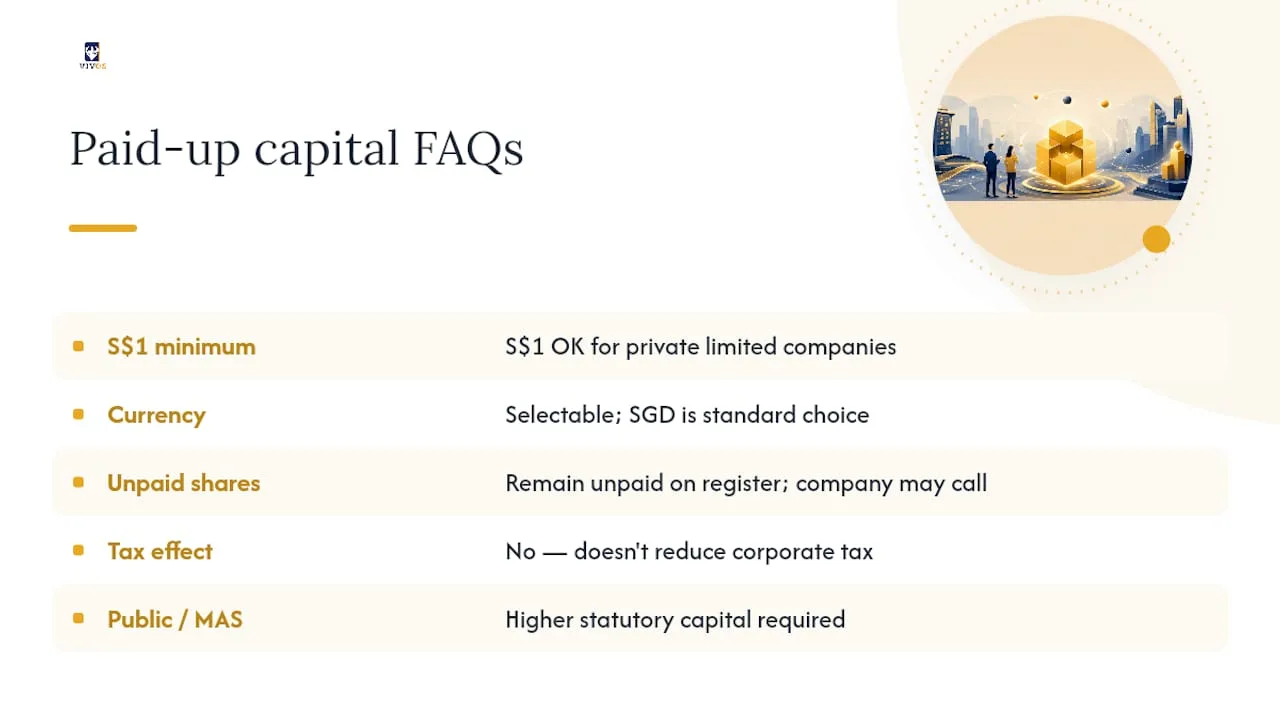
Yes, for a standard private limited company. ACRA sets no higher statutory floor, though banks and investors may expect more depending on your industry.
BizFile+ lets you select the currency during registration, but Singapore dollars remain the standard choice for most private companies.
Unpaid or partly paid shares stay on the register as such. The company can call for the remaining amount later, but it must be reflected accurately in filings.
No. Paid-up capital is an equity figure, not a deductible expense, and it has no direct bearing on corporate tax rates or filings.
No. Public companies and licensed entities such as banks or insurers face materially higher requirements tied to their specific regulatory framework.
Yes. Financial institutions and other MAS-licensed entities operate under capital adequacy requirements set by their specific license category, well beyond the general Companies Act minimum.

 2 January, 2025
 2 January, 2025
Practitioner checklist for founders transferring shares in Singapore: compute 0.2% stamp duty, meet the 14 or 30 day deadlines, secure board approval, and...
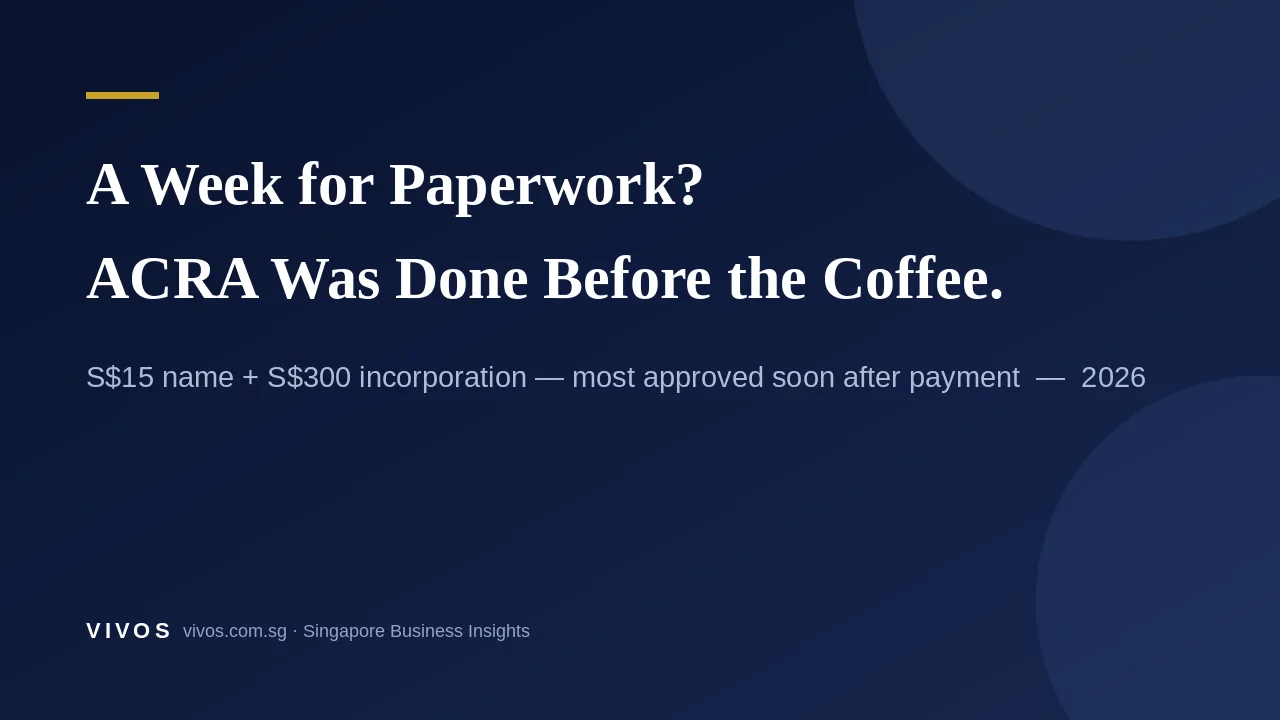
ACRA大多在付款后即批准注册(名称15新元+注册300新元,通常当天完成)。真正拖慢创始人的是未决定的事项:财年、股权、注册地址、银行KYC文件。
ACRA approves most Singapore incorporations soon after payment (S$15 name + S$300). A true client story on what really slows founders down — and the…