

Avoid 4x Penalty: Transferring Shares in Singapore for Founders

Ray Tay
Practitioner checklist for founders transferring shares in Singapore: compute 0.2% stamp duty, meet the 14 or 30 day deadlines, secure board approval, and...
Published: 19 August 2026 · Last reviewed: 30 September 2026 · Reviewed by Ray Tay, Co-Founder & Managing Director, VIVOS PTE. LTD. (ACRA Filing Agent FA20240323 · MOM EA Licence 24S2425)
Yes. If your business is GST-registered in Singapore, InvoiceNow submission to IRAS becomes mandatory on a phased schedule that started November 1, 2025. The requirement is not optional and not industry-specific. It applies based on your annual taxable turnover, with the largest businesses onboarding first.
Three things to do this week:
Pro Tip: Don’t wait for your cohort date to arrive before testing. IRAS and IMDA both recommend onboarding early, and the Free-of-Charge solution packages won’t be available forever.
InvoiceNow compliance for GST-registered businesses in Singapore hinges on identifying your cohort deadline early and testing your invoice data transmission before that date arrives.
| Point | Details |
|---|---|
| Mandate is phased, not optional | Deadlines run from November 1, 2025 through April 1, 2031, based on annual taxable turnover. |
| Submission timing follows the “earlier of” rule | Invoice data must reach IRAS by transmission date or your GST return due date, whichever comes first. |
| FOC packages reduce cost barriers | Free-of-Charge solutions are listed until March 31, 2027, with support extending to March 31, 2031. |
| Onboarding follows four fixed steps | Ready your solution or Access Point, get your Peppol ID, connect via API, then activate and test. |
| Vivos supports the compliance side | Vivos ties GST advisory and accounting integration into InvoiceNow onboarding so deadlines don’t slip. |
InvoiceNow is Singapore’s nationwide e-invoicing network, built on the international Peppol standard, and it works nothing like emailing a PDF invoice. A PDF still requires someone on the receiving end to open it and key the data into their accounting system by hand. InvoiceNow transmits structured invoice data directly between systems, no rekeying, no attachment, no manual entry.
The practical payoff is real. IMDA’s own research puts the processing savings at roughly S$8 per invoice once a business shifts from paper or PDF workflows to structured e-invoicing, with rectification costs for paper invoices being significantly higher.
Beyond cost, InvoiceNow gives every business a Peppol ID tied to its UEN. That single, persistent digital identity means:
The GST InvoiceNow Requirement rolls out in stages tied to annual taxable turnover, not industry or company age. Larger GST-registered businesses go first; smaller ones get more runway.
The phased schedule runs as follows:
Not every transaction line needs the same treatment, but the scope is broad. In-scope submissions generally include standard-rated supplies, zero-rated supplies, exports, reverse charge transactions, and deemed supplies, essentially anything that feeds into your GST return. Exempt supplies are typically excluded unless separately flagged by IRAS guidance for your sector.
Exemptions exist but are narrow. Don’t assume your business qualifies just because it’s small. Confirm your exact cohort and deadline directly through IRAS notifications tied to your GST registration, since misreading the schedule is one of the more common early mistakes finance teams make.
Onboarding follows four steps, and they’re the same four steps IRAS and GoBusiness outline for every GST-registered business:
Pro Tip: Search the SG Peppol Directory before you commit to a provider. It shows you which trading partners are already reachable on the network, which tells you how much friction you’ll actually face at go-live.
Have your Corppass authorization ready before requesting Peppol ID registration. Accredited providers are expected to complete business user registration within three working days of that authorization, but delays on your end push that clock back.
The scope mirrors your GST return. If a transaction shows up on your return, it generally needs to be transmitted through InvoiceNow. That includes standard-rated supplies, zero-rated supplies, exports, reverse charge transactions, and deemed supplies.
The deadline rule is the part most finance teams get wrong: you must submit invoice data to IRAS by whichever comes first, the date you actually transmit the invoice, or your GST return filing due date. It’s not one fixed calendar date across the board. It’s tied to your own filing cycle, so a business filing monthly faces a tighter turnaround than one filing quarterly.
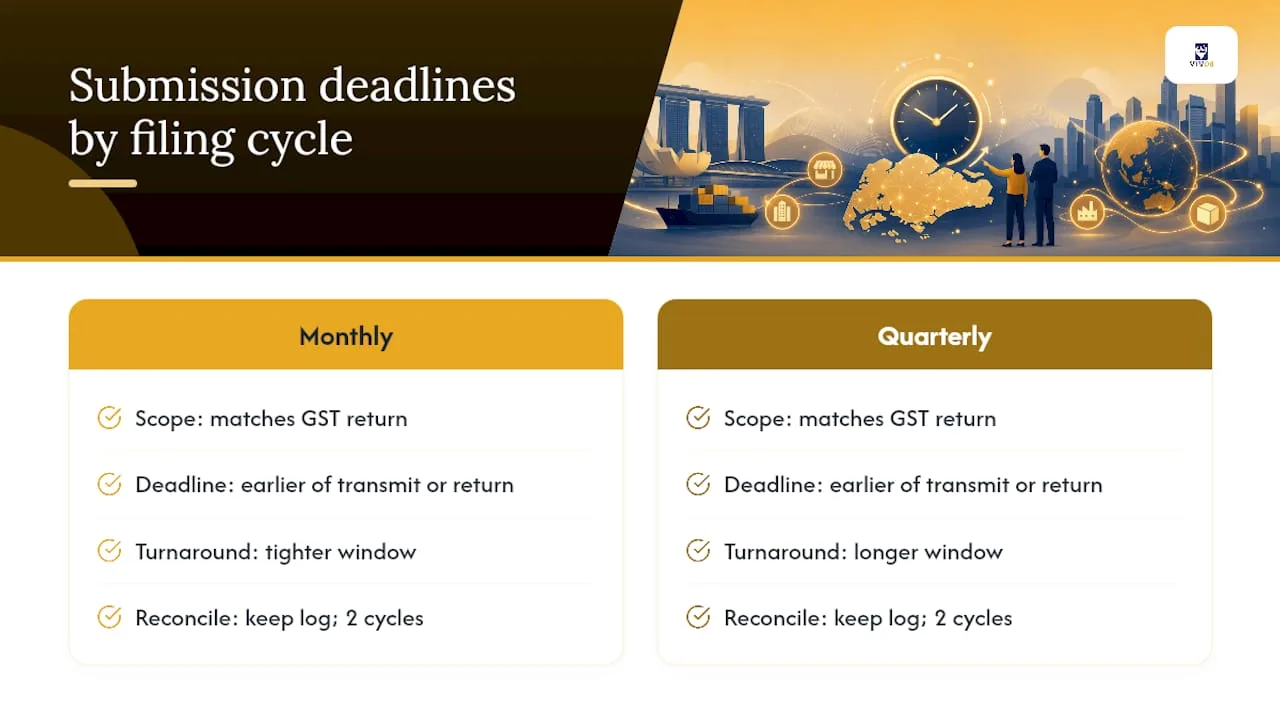
Keep a transmission log and reconcile it against your filed GST returns for at least the first two reporting cycles after onboarding. IRAS guidance flags this reconciliation step specifically because early mismatches between what’s transmitted and what’s declared are a common audit trigger.
Cost shouldn’t be the reason you delay onboarding. IMDA and IRAS jointly publish Free-of-Charge solution packages specifically for GST-registered businesses, and the support runs longer than most finance teams expect.
Don’t treat these dates as fixed forever. Provider lists change as accreditation status shifts, so confirm the current window directly on IMDA’s site before you budget procurement around a package that may have already been superseded.
You have two routes onto the network. Route A: use accounting software that’s already InvoiceNow-ready, meaning it connects to Peppol natively. Route B: keep your existing system and connect through an IMDA-accredited Access Point Provider that handles the Peppol transmission layer on your behalf.

Neither route is inherently better. Route A tends to suit smaller businesses already using cloud accounting software. Route B often fits businesses with legacy or custom systems that aren’t worth replacing just for e-invoicing.
Whichever route you pick, ask your provider these questions before signing anything:
Pro Tip: Treat “no dedicated testing environment” as a hard red flag. So is a provider who can’t clearly explain their IMDA accreditation status. Both usually mean you’ll be debugging in production.
Run through this before your cohort deadline:
The mistakes that cause the most rework are almost always avoidable. A mismatched UEN or Peppol ID silently breaks transmission. Untested field mappings surface as reconciliation errors weeks later, not immediately. And teams that forget to update purchase order templates and contracts often end up chasing suppliers for corrected details after go-live.
Pro Tip: Schedule a recurring monthly test transmission even after go-live, and automate exception reporting so a failed send doesn’t sit unnoticed until GST filing week.
Most compliance delays come down to sequencing, not complexity. Businesses that treat Peppol ID registration, API testing, and supplier outreach as parallel tasks rather than a strict sequence tend to hit deadlines without the last-minute scramble.
Where businesses most often need outside help is Peppol ID setup, API testing against IRAS, and coordinating supplier communication before go-live.
Reading the IRAS timeline is one thing. Mapping your specific transaction types to SG PINT fields, coordinating with an Access Point Provider, and reconciling your first two GST cycles against transmitted invoice data is where finance teams actually lose time.
Vivos supports GST-registered businesses through exactly this kind of implementation work, tying GST advisory directly into your accounting setup so InvoiceNow onboarding doesn’t sit as a separate IT project bolted onto your existing filing process. That includes reviewing your cohort deadline, checking your invoice data scope against your GST return, and coordinating with your Access Point Provider or software vendor on testing.
Ongoing compliance support matters too, once InvoiceNow is live, corporate secretarial services keep your broader statutory obligations aligned with the same operational calendar. If you want a structured review of where your business stands against its IRAS deadline, request a GST compliance consultation with Vivos before your cohort date arrives.
Yes, but on a phased basis. Your exact deadline depends on your annual taxable turnover and, for some cohorts, your GST registration date, running from November 1, 2025 through April 1, 2031.
InvoiceNow transmits structured invoice data directly between systems using the Peppol network. A PDF still needs someone to manually key the data into their accounting software on the receiving end.
Your Peppol ID is derived from your UEN and issued through an IMDA-accredited provider or Access Point, not directly by IMDA. You’ll need Corppass authorization ready before requesting registration.
Yes. Free-of-Charge solution packages are available, with the current list running until March 31, 2027, and broader FOC support extending through March 31, 2031.
Missing your cohort deadline puts you out of compliance with IRAS’s GST InvoiceNow Requirement, which can trigger closer scrutiny of your GST filings. Confirm your exact date early and test well before it arrives.
This article is general information, not a substitute for advice from a qualified financial advisor. Consult a qualified financial professional about your own circumstances before acting on anything here.

 2 January, 2025
 2 January, 2025
Practitioner checklist for founders transferring shares in Singapore: compute 0.2% stamp duty, meet the 14 or 30 day deadlines, secure board approval, and...
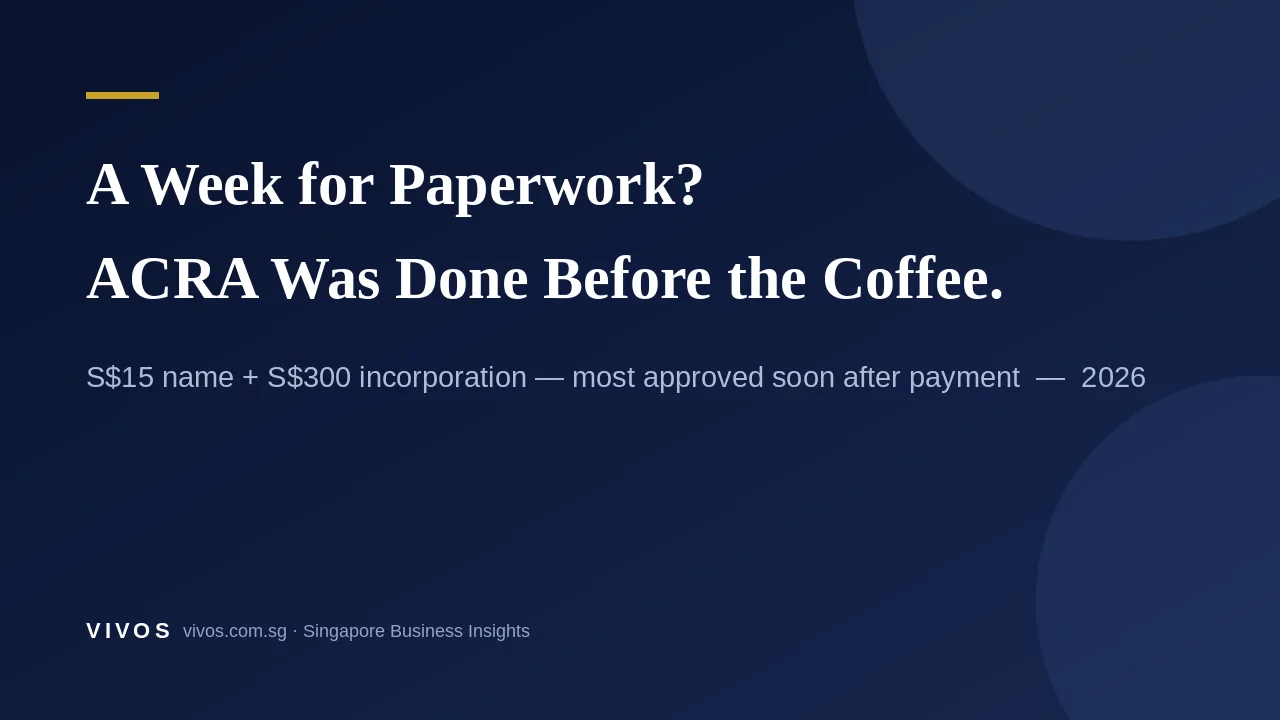
ACRA大多在付款后即批准注册(名称15新元+注册300新元,通常当天完成)。真正拖慢创始人的是未决定的事项:财年、股权、注册地址、银行KYC文件。
ACRA approves most Singapore incorporations soon after payment (S$15 name + S$300). A true client story on what really slows founders down — and the…