
ESOP in Singapore: How Employee Stock Options Are Taxed
Published: 22 August 2026 · Last reviewed: 30 September 2026 · Reviewed by Ray Tay, Co-Founder & Managing Director, VIVOS PTE. LTD. (ACRA Filing Agent FA20240323 · MOM EA Licence 24S2425)
An ESOP (Employee Stock Option Plan) grants employees the right to buy company shares at a fixed price after a vesting period, while its cousin, the ESOW (Employee Share Ownership plan), gives shares outright or as awards. The headline rule from IRAS: gains become taxable when options are exercised or shares vest, calculated as open market value minus the exercise price. This guide is written for founders designing a plan, employees holding grants, and foreign hires who need to understand deemed exercise rules before they leave Singapore.
- ESOP = right to buy shares later at a locked-in price.
- ESOW = shares or awards granted directly, often with a vesting condition.
- Taxable gain = OMV at exercise/vesting minus what the employee paid.
Quick fact: Under IRAS rules, this gain counts as employment income even if the employee has already left the company, and it must be reported through Form IR8A and Appendix 8A or 8B.
Key Takeaways
ESOP gains in Singapore are taxed at exercise or vesting based on OMV minus exercise price, and getting the valuation and reporting right protects both the company and its employees.
| Point | Details |
|---|---|
| Taxable event timing | Options are taxed at exercise; share awards are taxed at vesting or when restrictions lift. |
| Deemed exercise rule | Departing non-citizen employees are taxed on unexercised options one month before leaving Singapore. |
| Reporting obligations | Employers report gains via Form IR8A with Appendix 8A (awards) or Appendix 8B (options). |
| Valuation discipline | A documented, defensible OMV methodology reduces the risk of IRAS adjustment during review. |
| Accounting impact | FRS requires expensing fair value of options over the vesting period, a non-cash P&L item investors expect to see. |
Table of Contents
- What Is an ESOP in Singapore and How Do Options Work?
- How Does IRAS Tax ESOP and ESOW Gains?
- How Do You Set Up an ESOP in Singapore? A Founder’s Checklist
- Why Does Valuation (OMV) Matter So Much for Private Companies?
- What Accounting Treatment Applies to ESOPs?
- What Types of ESOP Structures Do Singapore Companies Use?
- What Happens to ESOP Grants When an Employee Leaves?
- How Vivos Supports ESOP Rollout in Singapore
- Why the Standard ESOP Advice Misses What Matters Most
- Frequently Asked Questions
- Sources
What Is an ESOP in Singapore and How Do Options Work?
Founders in Singapore typically choose between three structures: options (ESOP), share awards (ESOW), and phantom or restricted stock units. Each moves value to employees differently, and the mechanics determine both morale impact and tax timing.
An option gives an employee the right, not the obligation, to buy shares at a fixed exercise price once vesting conditions are met. A share award hands over actual shares, sometimes with restrictions on sale. A phantom plan pays out cash pegged to share value without ever transferring equity or voting rights.
1. The company grants the option or award, specifying quantity, exercise price, and vesting schedule.
2. The employee vests over time, commonly a one-year cliff followed by monthly or quarterly vesting across three to four years.
3. The employee exercises the option (pays the exercise price) or the shares vest outright under an ESOW plan.
4. Sale restrictions, if any, delay when shares can be liquidated even after vesting.
Vesting schedules among Singapore startups vary, but a multi-year vest with an initial cliff period remains the most common structure, mirroring practice seen in Silicon Valley and increasingly standard across Southeast Asia. Some companies shorten cliffs to a shorter period to stay competitive for senior hires.
Sale restrictions matter beyond liquidity. If shares can’t be sold immediately, employees may face a tax bill on paper gains before they’ve received any cash. This mismatch between taxable event and cash-in-hand is one of the most misunderstood parts of employee stock options Singapore plans, and it catches first-time recipients off guard more often than any other feature of the scheme.
- Options: no tax until exercised, since no shares are held before that point.
- ESOW/share awards: taxable at vesting, regardless of whether the shares are sold.
- Phantom plans: taxed as cash bonus income when paid out, not as capital gains.
How Does IRAS Tax ESOP and ESOW Gains?
The taxable event for options is the exercise date. For share awards, it’s the vesting date, or the date restrictions lift if the award carries a selling moratorium. In both cases, the taxable gain equals OMV less the exercise price paid by the employee, and this figure is added to employment income for that year.

Key figure: Gains remain taxable in Singapore even after employment ends, since IRAS treats the exercise or vesting event, not the employment relationship, as the trigger.
Non-citizen employees face an added wrinkle: the deemed exercise rule, explained in detail in Moving to Singapore from the US: A Complete Guide. When a foreign employee ceases employment in Singapore or leaves the country for good, unexercised options and unvested awards granted during their Singapore employment are treated as exercised or vested one month before their departure date, even if they haven’t actually cashed out. IRAS applies tax on the notional gain at that point, based on OMV at the deemed date. This rule exists because Singapore has no ongoing jurisdiction to tax someone once they’ve left, so it collects tax before they go.
Because of this, employers must obtain tax clearance for departing foreign employees who hold unexercised ESOP grants, filing Form IR21 and settling any deemed gain before the final paycheck is released. Missing this step is a common compliance gap for startups with international teams.
On the reporting side, employers must:
- Report exercised or vested gains via Form IR8A, with equity-specific details captured in Appendix 8A (for ESOW awards) or Appendix 8B (for share options).
- Submit under the Auto-Inclusion Scheme (AIS) if the company is enrolled, which pre-fills the gain into the employee’s tax return.
- File tax clearance (Form IR21) for foreign employees leaving the company or leaving Singapore, factoring in deemed exercise where applicable.
- Retain vesting schedules and OMV calculations as supporting documentation in case of an IRAS query.
Singapore also offers a tax-deferment scheme for ESOP/ESOW gains from qualifying startups, allowing employees to defer tax payment (with interest) for up to five years from the date the tax would otherwise be due. This scheme was designed for cash-poor employees at pre-IPO companies who face a tax bill on shares they can’t yet sell, though eligibility depends on company size and scheme qualification criteria set by IRAS, so it’s worth confirming eligibility before assuming it applies.
How Do You Set Up an ESOP in Singapore? A Founder’s Checklist
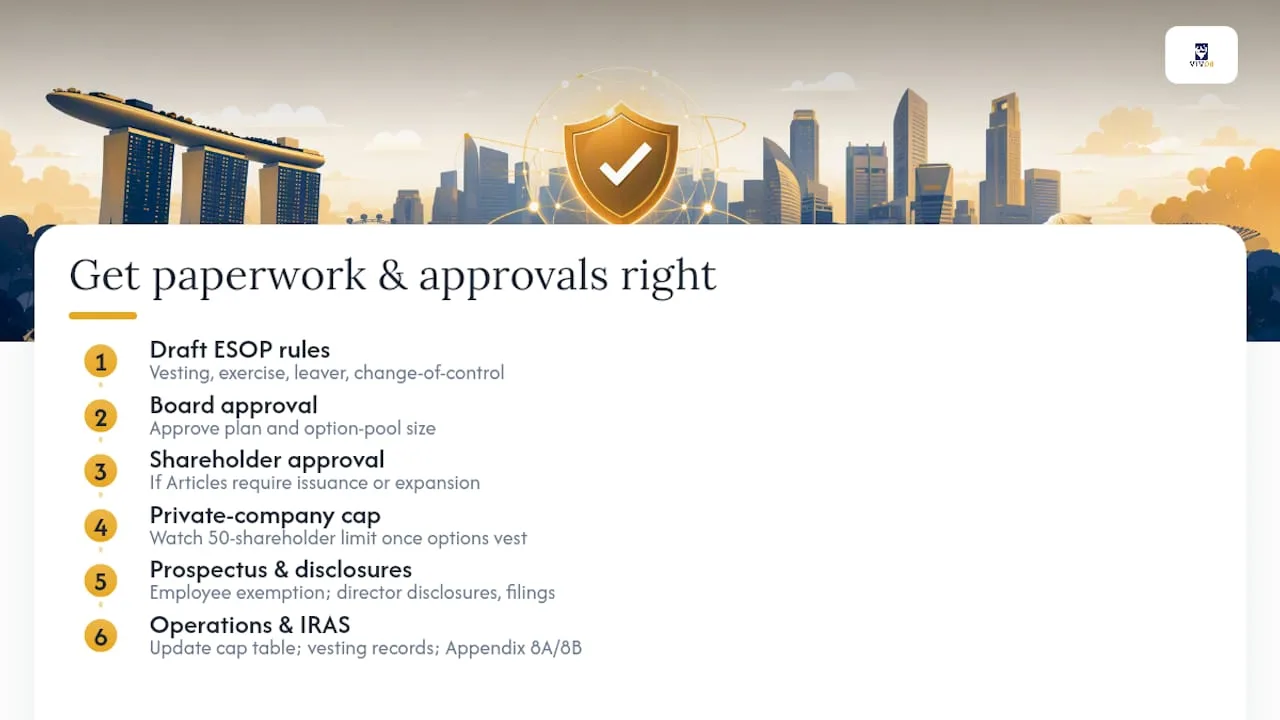
Getting the paperwork and approvals right the first time avoids a messy cap table later. Here’s the sequence most Singapore-incorporated companies follow.
1. Draft the ESOP rules and template grant letters. This document sets vesting terms, exercise windows, leaver provisions, and what happens on a change of control.
2. Secure board approval. Directors must approve the plan and the size of the option pool before any grants go out.
3. Get shareholder approval if required. Depending on your Articles of Association, issuing new shares or expanding an option pool beyond what’s already authorized may need a shareholder resolution.
**4. Private companies also need to watch the 50-shareholder cap under the Companies Act’s private company definition, since employee shareholders count toward that limit once options are exercised.
5. Confirm prospectus exemptions. Offers to employees are generally exempt from prospectus requirements under the Securities and Futures Act, but director disclosure obligations and proper corporate filings still apply.
6. Update operational records. Keep the cap table current, issue exercise notices promptly, log vesting dates per employee, and maintain a master participant list.
7. Prepare for IRAS reporting. Line up OMV documentation and vesting records well before year-end, since Appendix 8A/8B filings depend on accurate exercise and vesting dates.
Pro Tip: Set a recurring quarterly reminder to reconcile your option ledger against your cap table. Startups that only check this once a year often discover exercised options that were never recorded, which creates a scramble at tax filing time.
Why Does Valuation (OMV) Matter So Much for Private Companies?
Since taxable gain hinges entirely on OMV minus exercise price, an unreliable valuation creates two-sided risk: undervalue the shares and IRAS may adjust the gain upward on review; overvalue them and employees pay more tax than they should. Grant Thornton Singapore advises private companies without a public share price to adopt a defensible, well-documented valuation methodology rather than picking a round number.
Three approaches cover most private Singapore companies:
- Discounted cash flow (DCF): projects future cash flows and discounts them to present value, useful for companies with revenue history.
- Market comparables: benchmarks against similar companies’ valuation multiples, common for startups with recent funding rounds to reference.
- Option-pricing or backsolve methods: allocates enterprise value across share classes based on a recent priced round, often used right after a Series A or seed extension.
A documented valuation with clear assumptions materially lowers the risk of an aggressive IRAS adjustment during assessment, according to Grant Thornton’s guidance on equity compensation planning. For companies without recent funding or clean comparables, a blended approach combining income and market methods, backed by a short written report, is usually enough to withstand scrutiny.
Pro Tip: Refresh your valuation at each funding round or annually, whichever comes first. A stale valuation from two years ago is the fastest way to trigger questions during an IRAS review.
Engage a professional valuation provider once you’re granting options to more than a handful of employees or approaching a funding round. It’s cheaper than defending an ad hoc number later.
What Accounting Treatment Applies to ESOPs?
ESOPs aren’t just a tax and legal matter. Under Financial Reporting Standards (FRS), companies must recognize the fair value of share-based payments as an expense spread across the vesting period, even though no cash changes hands.
- Fair value is calculated at grant date and amortized over the vesting schedule, not expensed all at once.
- This creates a non-cash charge against profit and loss, which can surprise founders preparing investor updates or board packs.
- Investors reviewing your financials will expect to see this line item; omitting it or getting it wrong raises credibility questions during due diligence.
Founders often underestimate how much this expense affects reported net income, particularly in the year a large option pool is granted. Bring your accountant into the conversation when you’re designing the pool size, not after the grants are signed, so the valuation inputs feed cleanly into both your tax filings and your statutory accounts.
What Types of ESOP Structures Do Singapore Companies Use?
- Traditional ESOP: options with a fixed exercise price, most common for early-stage startups wanting maximum upside potential for employees.
- ESOW/share awards: shares granted directly, often used for senior hires or as a retention tool post-funding round.
- RSUs (restricted stock units): a promise of shares on vesting, popular with more mature private companies and pre-IPO firms.
- Phantom plans: cash payouts tied to share value without transferring equity, which lets founders reward performance without diluting the cap table or giving up voting control.
Companies with tight control preferences, family-owned businesses transitioning to venture backing, for instance, often lean toward phantom plans or non-voting share classes. For cross-border teams, plan design gets more complex: a Singapore-incorporated company granting options to an employee based in Malaysia or Hong Kong needs to check that jurisdiction’s own tax treatment, since contractor vs employee Singapore classification and cross-border tax residency both affect how the grant is taxed on the other end.
What Happens to ESOP Grants When an Employee Leaves?
Grant documentation should spell out eligibility and leaver terms clearly before anyone signs. Vague language here is the single biggest source of disputes when someone exits.
1. Check the grant letter for what happens to unvested options. Standard practice forfeits unvested shares immediately upon resignation or termination.
2. Check what happens to vested but unexercised options. Most plans set a 90-day exercise window post-termination, after which the option lapses.
3. For termination “for cause,” some plans claw back even vested shares. This clause should be read carefully before signing any grant.
4. For a change of control (acquisition or merger), check for acceleration clauses that vest options early.
- Foreign employees leaving Singapore trigger the deemed exercise rule, with unexercised vested and sometimes unvested options taxed one month before departure.
- Employers must complete tax clearance (Form IR21) before releasing final pay to a departing foreign employee.
- Employees should confirm exercise windows, forfeiture triggers, and tax withholding obligations in writing before accepting a grant, not after a resignation letter is already on the table.
How Vivos Supports ESOP Rollout in Singapore
Vivos handles the groundwork that has to be right before an ESOP even launches: Singapore company incorporation, corporate secretarial filings for share issuances, and introductions to banking partners for the corporate account that will process exercise payments.
- Incorporation and share structure setup, so the option pool sits on a properly constituted cap table from day one.
- Ongoing corporate secretarial support for share registry updates and statutory filings tied to each exercise event.
- Tax reporting support around IR8A and Appendix 8A/8B season.
Ray Tay, Managing Director of Vivos, notes that banks in 2026 are asking sharper questions earlier: “Banks now want to see the option pool disclosed in the shareholder register before they’ll process a corporate account for a company that’s already granted equity. Founders who wait until after the ESOP is live to sort out their banking relationship lose weeks.”
Why the Standard ESOP Advice Misses What Matters Most
Most ESOP guides treat this as a legal drafting exercise: get the rules right, get board approval, done. That’s backwards. The tax mechanics, particularly the deemed exercise rule and the OMV calculation, are where founders and employees actually get burned, and they’re usually the last thing anyone reads carefully.
The conventional advice to “set a competitive option pool size” ignores the harder question: does your company have a valuation methodology that will survive an IRAS review three years from now, when the exercise event actually happens? A pool sized correctly on paper is worthless if the OMV backing it was a guess.
If you’re a founder, prioritize the valuation documentation before you prioritize the plan’s generosity. If you’re an employee, read the deemed exercise clause before you read the vesting schedule, especially if you’re not a Singapore citizen or permanent resident. The upside of an ESOP is real, but it’s only real once the tax mechanics are handled correctly, and that part gets far less attention than it deserves.
Frequently Asked Questions
Is an ESOP taxable if I never sell the shares?
Yes. For options, tax is triggered at exercise based on OMV at that date, regardless of whether you later sell. For share awards, tax applies at vesting. Selling the shares afterward is a separate event that doesn’t affect this initial income tax liability.
What is the deemed exercise rule and who does it affect?
It applies to non-citizen employees leaving Singapore or ending employment. Unexercised options and unvested awards granted during their Singapore employment get taxed as if exercised one month before departure, based on OMV at that point, even without an actual sale.
Do startups need a professional valuation for their ESOP?
Not always at the earliest stage, but once you’re granting to multiple employees or nearing a funding round, a documented valuation using DCF, comparables, or a backsolve method becomes important. It protects both the company and employees from IRAS adjustment risk.
How does an ESOP affect a company’s financial statements?
Under FRS, companies must expense the fair value of options over the vesting period as a non-cash charge. This lowers reported net income even though no cash leaves the business, and investors reviewing your accounts will expect this treatment to be applied correctly.
Sources
- Gains from the exercise of stock options — IRAS
- Setting up an equity compensation plan – Legal and Tax Considerations | Grant Thornton Singapore
Recommended
- Singapore Corporate Tax Rate 2026: What Founders Actually Pay | VIVOS
- Switch to VIVOS | Expert Corporate Services Provider in Singapore
- Singapore Corporate Tax Calculator | Free Tax Estimate Tool
- Singapore Tax Services 2026 | Corporate Tax, GST & More | Vivos
Related guides
Most Popular
 2 January, 2025
Why Singapore Comes Into Action For Chinese Companies
 2 January, 2025
Malaysia’s Budget 2025: What The Dividend Tax Means For You
Recents Blogs



InvoiceNow Mandatory by Apr 2031: Singapore GST Invoicing for Founders

Singapore invoice guide: required GST fields (9%), the 2026 InvoiceNow rollout, plus a technical onboarding checklist for foreign founders.
Paying Your Hong Kong Sister Company from Singapore: The Withholding Tax Checklist
A Singapore company paying its Hong Kong sister company must withhold 15% on interest and 10% on royalties, and file and pay that tax to…