Crossover at $12.5M: Valuation Cap vs Discount for Singapore Founders
Published: 19 September 2026
A valuation cap sets the maximum valuation at which a SAFE or convertible note converts into equity. A discount rate gives the investor a set percentage off the price of the next priced round. When a note carries both, conversion uses whichever mechanism produces the lower per-share price, giving the investor more shares for the same money.
TL;DR:
The valuation cap determines the maximum conversion price at a future round, not the company’s current worth, and is rarely below the company’s actual valuation.
The crossover valuation at which a discount or a cap offers the better deal depends on the formula: cap divided by one minus the discount rate, guiding founders before signing any terms.
A safe valuation cap kept far below the expected next round pricing signals potential excessive dilution risks for founders.
Discrepancies between premoney and postmoney caps can cause significant ownership disputes, making precise drafting and calculations essential pre-financing.
Running accurate cap table models and filing share allotments correctly are vital to make SAFE conversions legally effective and reflect true investor ownership.
Vivos
Navigate Your Singapore Conversion
Vivos helps international founders manage incorporation, compliance, accounting, taxation, and corporate advisory across Singapore and other key markets.
A valuation cap is not a valuation. That distinction trips up more first-time founders than any other term in a SAFE or convertible note. The cap is a ceiling used only at conversion. It never claims the company is worth that amount today, and it has no bearing on how the company markets itself to customers or future investors.
The math behind it is simple:
Cap price per share = Valuation cap ÷ fully diluted share count.
If a company sets a $10 million cap and has 10 million fully diluted shares outstanding, the cap price works out to $1.00 per share, regardless of what the next priced round actually values the company at. If that round prices shares at $1.50, the SAFE holder still converts at $1.00, buying more ownership for the same check size.
Caps exist because early investors take on the most risk with the least information. In exchange, they get a guaranteed ceiling on the price they pay if the company takes off before the next round closes. The mechanism has become close to standard.
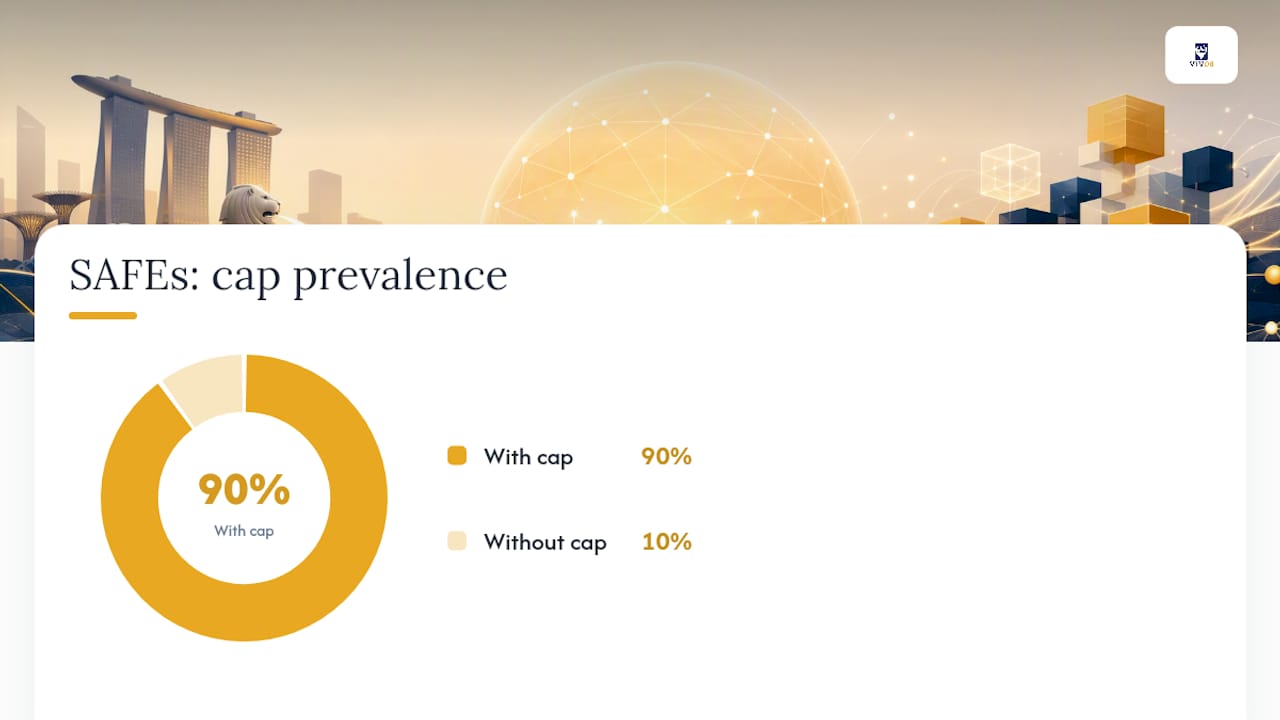
More than 90% of SAFEs include a valuation cap, according to Stripe’s own analysis of SAFE structures. A note without one is rare enough that investors will usually ask why.
For a founder raising through a Singapore holding entity, the cap also shapes how much dilution shows up on the cap table the moment the next round prices. That is exactly the kind of number a corporate secretary needs before filing any post-conversion share allotment.
How Does a Discount Rate Work?
A discount rate gives the note holder a fixed percentage off whatever price the next priced round sets, independent of any cap. The formula is:
Discount price per share = Round price per share × (1 − discount rate).
If the priced round sells shares at $2.00 and the note carries a 20% discount, the note converts at $1.60 per share; no valuation ceiling is involved. The investor simply pays less than the new money coming in.
Typical discount ranges run 10% to 25%, with 20% appearing most often in early-stage term sheets. A discount alone is more common in later or smaller bridge rounds where the founder and investor already have a good sense of near-term valuation and want to keep the paperwork simple.
Discounts win at conversion when the priced round comes in relatively low. A modest raise at a modest valuation can make the discounted price lower than the cap price, handing the discount holder the better deal without any cap ever kicking in.
Founders tend to underestimate how much a discount actually costs them. A flat 20% might look minor next to a hard-negotiated cap, but stacked across multiple notes it compounds fast, and Triumph Law’s review of SAFE mechanics points out that discounts alone can produce meaningful dilution in growth scenarios founders rarely model in advance.
Which Gives Investors a Better Deal?
Neither mechanism wins outright. The one that produces the lower per-share price at conversion is the one that applies, and that depends entirely on where the next round prices.
There is a specific crossover point where the two mechanisms produce an identical result:
Crossover valuation = Cap ÷ (1 − discount rate).
With a $10 million cap and a 20% discount, the crossover sits at $10,000,000 ÷ 0.80, or $12.5 million. Below that valuation, the discount produces the lower price and wins. Above it, the cap produces the lower price and wins. This single formula is the fastest way to know, before a term sheet is even signed, which mechanism will actually govern conversion.
Caps dominate in high-growth outcomes because a discount only ever shaves a fixed percentage off the round price, while a cap holds the conversion price flat no matter how high the valuation climbs. A company that triples in value between the SAFE and the priced round will see its cap price stay put, while the discount price keeps rising right along with the round.
Structure
Predictability
Investor protection
Founder dilution risk
Drafting complexity
Cap only
High if growth is strong
Strong in high-growth rounds
Concentrated at high valuations
Low
Discount only
Moderate
Weaker in high-growth rounds
Spread evenly across outcomes
Low
Cap + discount
Highest
Strongest overall
Depends on which mechanism triggers
Higher, needs precise drafting
A few practical takeaways for anyone negotiating either side of this:
Ask for the cap and discount both stated in dollar and percentage terms, not just one or the other.
Run the crossover formula before agreeing to any specific cap number.
Treat a cap set far below expected next-round pricing as a red flag on founder dilution.
Worked Numerical Example
Real numbers make this easier to internalize than any formula on its own.
Cap price: $10,000,000 ÷ 10,000,000 shares = $1.00 per share.
Scenario A, round prices at $12 million: round price per share is $1.20. Discount price = $1.20 × 0.80 = $0.96. Since $0.96 is lower than the $1.00 cap price, the discount wins. The investor buys 520,833 shares ($500,000 ÷ $0.96).
Scenario B, round prices at $8 million: round price per share is $0.80. Discount price = $0.80 × 0.80 = $0.64. Since $0.64 is lower than $1.00, the discount wins again, and the investor gets 781,250 shares.
Scenario C, round prices at $15 million: round price per share is $1.50. Discount price = $1.50 × 0.80 = $1.20. Now $1.00, the cap price, is lower. The cap wins, and the investor buys 500,000 shares instead of the 416,667 shares the discount alone would have delivered.
This lines up with LegalClarity’s breakdown of the two-price conversion mechanism: whichever price is lower governs the conversion, full stop. Scenario C is the one founders forget to model. It is the exact point where a cap that looked generous at signing suddenly becomes the more expensive mechanism at conversion.
Premoney vs Postmoney Caps and Drafting Pitfalls
A premoney cap values the company before the new investment is added. A postmoney cap values it after, which means the investor’s ownership percentage is locked in regardless of how many other SAFEs convert alongside it. Postmoney caps have become the more common structure in recent years precisely because they let an investor know their exact ownership stake at signing, rather than discovering it diluted by every other note that converts at the same time.
The ownership difference is not trivial.
Ambiguous drafting over which type of cap applies is one of the most expensive mistakes a founder can make. WilmerHale Launch’s review of valuation cap disputes found that this exact confusion, premoney versus postmoney, has materially changed ownership outcomes and triggered real disputes at conversion.
Before signing anything, confirm:
Whether the cap is explicitly labeled premoney or postmoney, in writing.
How the fully diluted share count is defined, including any option pool top-up.
Whether multiple SAFEs are layered and how their combined postmoney claims interact.
Pro Tip:Build a simple spreadsheet that models your fully diluted cap table under every SAFE you have signed, using postmoney math for each one. Stacking postmoney SAFEs without checking the combined effect is the single fastest way to give away more of the company than you intended.
How to Choose Between a Cap, a Discount, or Both
The right structure depends less on what sounds fair and more on how the company is likely to grow before its next priced round.
Estimate your growth trajectory. If you expect a sharp valuation jump before the next round, a cap protects the investor and will likely be requested regardless of your preference.
Match the mechanism to raise size. Smaller bridge rounds closing quickly often use a discount only, since there is less time for valuation to move much.
Weigh investor sophistication. Institutional and experienced angel investors will almost always ask for a cap, sometimes both a cap and a discount together.
Model best, mid, and worst-case round valuations. Run the crossover formula against each scenario before agreeing to specific numbers.
Watch for red flags. A cap set well below what the company is realistically worth today, or postmoney SAFEs stacked without a combined ownership check, both signal terms that need renegotiation.
Get counsel involved early, particularly if you are raising into a Singapore holding structure where statutory filings and share allotment timing carry their own deadlines.
Pro Tip:Never agree to a cap number in a live negotiation without running it through the crossover formula first. A cap that sounds generous in the room can turn out to be the more expensive mechanism the moment your next round prices above the crossover point.
Founders raising through a Singapore entity have one more variable to track: once terms are agreed, the conversion has to be reflected correctly in statutory records, not just in a spreadsheet.
Vivos Perspective: Getting From Signed Note to Filed Shares
Once a cap or discount is negotiated, the paperwork does not end there. Converting a SAFE or note into real equity means updating the cap table, filing share allotments, and keeping the company’s statutory records current, work that sits squarely with incorporation and corporate secretarial services.
For foreign founders building a Singapore holding company, that means Singapore company incorporation, a nominee resident director, a registered address, an appointed corporate secretary, and the actual share allotment filings once conversion happens. Vivos handles each of these steps, along with equivalent incorporation and compliance work in Malaysia, Hong Kong, and the UAE.
“Founders get the valuation math right and then stall on the filings,” says Ray Tay, Managing Director of Vivos. “A conversion isn’t finished until the share allotment is filed correctly and the cap table matches what investors were actually promised.”
The sequencing matters: model your cap and discount scenarios first, sign term sheets once the numbers are clear, then bring in a corporate secretary to prepare the allotment filings before any deadline passes.
— Ray
How Vivos Supports Founders Through Conversion
Getting the cap-versus-discount math right is only half the job. The other half is making sure the resulting shares actually get issued and filed correctly under Singapore company law, and that is where most solo founders lose time they do not have.
Vivos handles the operational side of every SAFE or note conversion for foreign founders: Singapore company incorporation, a nominee resident director, a registered address, an appointed corporate secretary, and the share allotment filings that follow once terms are signed. The same setup extends to founders incorporating in Malaysia, Hong Kong, or the UAE. Rather than piecing together a director, a registered address, and a filings process from separate providers, founders working with Vivos get all four handled under one engagement.
Foreign-founder incorporation starts at $4,600 (one-off), with corporate secretary service available from $800 per year, both listed on the Vivos pricing page. If a term sheet is already in hand, the practical next step is a consultation to confirm the allotment timeline and get the corporate secretary work started before any filing deadline.
A lower cap favors investors because it locks in a lower conversion price, giving them more shares for the same investment. Founders generally push for a higher cap, since it limits dilution if the company’s valuation climbs quickly before the next priced round.
What Does a Valuation Cap Mean?
A valuation cap is the maximum company valuation used to calculate the conversion price when a SAFE or note turns into equity. It protects early investors from paying a higher effective price if the company’s valuation rises sharply before the next round, and over 90% of SAFEs include one.
What Is the Difference Between Cap Rate and Discount Rate?
A valuation cap sets a fixed ceiling on the conversion valuation, while a discount rate applies a percentage reduction to whatever price the next priced round actually sets. Conversion uses whichever mechanism produces the lower per-share price for the investor.
Is 10% a Good Discount Rate?
It can work in a founder’s favor if a priced round is expected soon, since it limits how much less investors pay compared with new money coming in.
Which consulting niches need a licence in Singapore, PDPA obligations every consulting firm carries, and the SS 680:2021 standard that replaced TR 43:2015 for Enterprise…
MSI-AIS, MSI-ML and MSI-SSS explained: full tax exemption on qualifying shipping income, the 2031 sunset extension, and what MPA looks for before approving an award.