新加坡商业许可申请全攻略:ACRA 注册后该怎么做

Ray Tay
了解新加坡商业许可如何按行业判定,注册后用 GoBusiness 查询牌照要求,并掌握餐饮、按摩、进出口审批及场地合规要点,避免申请受阻。
Published: 25 August 2026 · Last reviewed: 30 September 2026 · Reviewed by Ray Tay, Co-Founder & Managing Director, VIVOS PTE. LTD. (ACRA Filing Agent FA20240323 · MOM EA Licence 24S2425)
Individuals generally owe no Singapore tax on foreign-sourced income, whether it lands in a personal bank account or a suitcase, with narrow exceptions for income received through a Singapore partnership. Companies face a different calculus: remitted foreign income is taxable unless it qualifies for the Foreign-Sourced Income Exemption (FSIE), which turns on three tests, subject-to-tax status, a foreign headline tax rate of at least 15%, and the Comptroller’s discretion. Where FSIE does not apply, foreign tax credits and Singapore’s tax treaties usually prevent double taxation anyway.
Foreign-sourced income in Singapore is generally tax-free for individuals but taxable for companies on remittance unless FSIE conditions are met.
| Point | Details |
|---|---|
| Individual exemption is broad | Foreign income received in Singapore is typically exempt except through a Singapore partnership. |
| FSIE has three tests | Companies need subject-to-tax status, a 15% foreign headline tax rate, and Comptroller approval. |
| Remittance is the trigger | Bringing funds in, settling local debts, or buying movable property brought to Singapore all count. |
| Documentation decides outcomes | Tax certificates and dividend vouchers must be collected as income arrives, not at filing time. |
| FTC is the fallback | Foreign tax credits and DTAs prevent double taxation when FSIE conditions are not met. |
IRAS defines foreign-sourced income as income derived from outside Singapore that does not arise from a trade or business carried on within Singapore. That second clause matters more than most founders realize: if your Singapore-registered company actively runs an offshore sales operation, IRAS may treat that income as taxable on accrual rather than on remittance, per its guidance for companies receiving foreign income.
For companies, three categories drive most FSIE analysis:
Individuals face a simpler picture, with one carve-out: income routed through a Singapore partnership loses its exemption, according to PwC’s tax summary. A freelancer paid directly by a foreign client into their personal account sits in a different tax position than the same income passing through a local partnership structure.
Foreign income becomes taxable in Singapore the moment it is remitted, not the moment it is earned. Section 10(25) of the Income Tax Act sets out three specific triggers, and each one catches taxpayers off guard in different ways.
Practitioner analysis from EY Singapore flags two modern complications: promissory notes, where the physical location of the underlying document can determine whether remittance occurred, and crypto transfers, where moving digital assets into a wallet operable from Singapore may itself constitute constructive receipt.
Where this gets overlooked: an employee whose overseas work is incidental to a Singapore-based role still has that overseas income taxed in Singapore, per IRAS. Only genuinely separate overseas employment escapes the net.
FSIE exemption under Section 13(9) of the Income Tax Act hinges on three conditions, and missing any one of them means the income becomes fully taxable on remittance.
Companies must also allocate expenses correctly. Costs directly attributable to exempt foreign income can only be deducted against that same income, not offset against other taxable profits.
Pro Tip: Keep a running file of foreign tax certificates and dividend vouchers as income is received, not at filing time. Reconstructing proof of foreign tax paid a year later, especially from jurisdictions with slow tax authorities, is where most FSIE claims stall.
For complex or high-value transactions, companies can apply for an advance ruling from IRAS or explore relief under Section 13(12) before the income is remitted, rather than after.
Failing the FSIE test does not mean paying tax twice. Singapore’s foreign tax credit (FTC) system lets companies offset Singapore tax payable with tax already paid overseas on the same income, provided they hold documentary proof of the foreign tax paid.
Choosing between FSIE and FTC is not always either/or. VIVOS structures cross-border tax positions to work out which relief route actually leaves less tax on the table.
Getting the exemption or credit approved depends entirely on the paper trail you can produce at filing time.
Pro Tip: File your FSIE supporting schedule the same year you receive the income, even if the exemption claim itself is straightforward. IRAS reviews are far less painful when the paper trail is contemporaneous rather than reconstructed.
VIVOS’s annual tax filing service handles this documentation cycle for clients managing multiple foreign income streams.
Facts decide outcomes here more than intentions do.
VIVOS supports founders and finance teams through Singapore company incorporation and the tax questions that follow it, including corporate tax computation and filing, cross-border tax advisory, and preparing the documentation FSIE and FTC claims require.
Before reaching out, gather your foreign tax certificates, dividend vouchers, and service contracts. It shortens the first consultation considerably.
For businesses weighing FSIE against foreign tax credit relief, VIVOS’s cross-border tax services walk through both paths and which one actually reduces the tax bill. Companies already past incorporation and filing corporate returns can also use VIVOS’s corporate tax computation and filing service to get FSIE and FTC claims filed correctly the first time.
Most guidance on foreign-sourced income treats the remittance rule as a simple binary: bring money in, get taxed; leave it offshore, stay exempt. That framing misses where companies actually get burned. The Comptroller’s discretion clause in the FSIE test is not a formality. IRAS can decline exemption even when the subject-to-tax and headline-rate conditions are technically met, if the documentation looks thin or the structure looks designed purely to dodge tax.
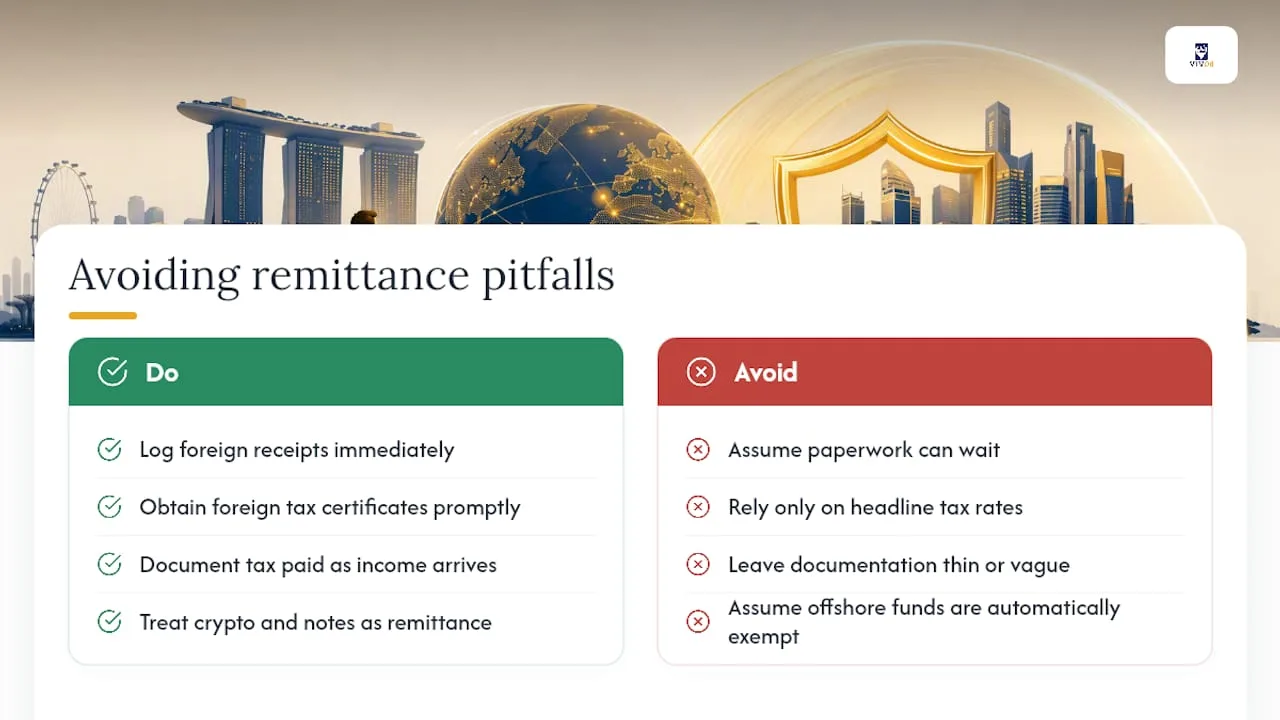
The bigger blind spot is timing. Founders assume they can sort out FSIE paperwork after the money arrives. In practice, tax certificates from some jurisdictions take months to issue, and reconstructing proof of foreign tax paid a year after the fact is far harder than logging it as income comes in. Crypto and promissory notes deserve more attention than they get, too. Digital assets moving into a Singapore-operable wallet, or a note sitting in a Singapore office drawer, can trigger the exact same remittance consequences as a wire transfer.
Get the paperwork habit right from the first foreign receipt. Everything downstream, exemption, credit, or clean audit, follows from that.
— Ray
 2 January, 2025
 2 January, 2025
了解新加坡商业许可如何按行业判定,注册后用 GoBusiness 查询牌照要求,并掌握餐饮、按摩、进出口审批及场地合规要点,避免申请受阻。

Learn how Singapore taxes nonresident employees, when the 60 day exemption applies, and how employers meet IR21, IR8A, and departure filing deadlines.