
新加坡商业许可申请全攻略:ACRA 注册后该怎么做

Ray Tay
了解新加坡商业许可如何按行业判定,注册后用 GoBusiness 查询牌照要求,并掌握餐饮、按摩、进出口审批及场地合规要点,避免申请受阻。
Published: 14 October 2026 · Reviewed by Ray Tay, Co-Founder & Managing Director, VIVOS PTE. LTD. (ACRA Filing Agent FA20240323 · MOM EA Licence 24S2425)
Under 183 days of stay or work in Singapore in a calendar year, an employee is non-resident for tax purposes. Employment income is taxed at a flat 15% or at resident progressive rates, whichever gives the higher amount, while director fees are taxed at 24%. Stays of 60 days or less are exempt, except for directors, public entertainers, and visiting professionals, per IRAS, as of 2026.
TL;DR:
- The exemption for stays of 60 days or less covers employees, but directors, public entertainers, and professionals remain taxable; weekends and incidental days count.
- Employers must file Form IR21 a month before employment ends or an overseas posting, then withhold all amounts due until clearance or 30 days pass.
- Foreign and domestic employers must report income through Form IR8A or AIS by March 1 of the following year; director fees require separate coding.
- Income for work performed in Singapore remains taxable even when paid overseas, and nonresidents cannot claim personal tax reliefs available to residents.
Tax residency in Singapore turns on physical presence, not nationality or pass type. An individual who stays or works in Singapore for fewer than 183 days in a calendar year is non-resident for that year. A separate continuous three-year rule can grant residency across straddling years, but it does not apply to short, one-off engagements.
For employment income, non-residents pay the higher of two figures: a flat 15% rate, or the resident progressive rates that would apply if the person were a tax resident. Say a foreign hire earns S$80,000 in employment income for the year. The flat calculation gives S$12,000. The progressive calculation, run as if the person were resident, would land lower at that income level, so the employee pays the S$12,000 flat amount because it is higher.
Other income categories follow different rules:
Short-term employment of 60 days or less in a calendar year is exempt from Singapore tax under the 60-day exemption. This covers genuine short visits, such as a project assignment or temporary cover, where the employee has no other Singapore tax exposure for the year.
The exemption does not cover everyone:
Day counts include weekends, public holidays, and any incidental days spent in Singapore around the work itself, not just working days.
Pro Tip: Classify the person’s service capacity (employee, director, or professional) before counting days, since the same 60-day stay can be fully exempt for one category and fully taxable for another.
IRAS treats a broad set of payments and perks as taxable employment income for non-residents, not just base salary.
Non-residents cannot claim the personal reliefs available to tax residents, such as earned income relief or course fee relief, which is a large part of why the flat-rate comparison matters.
Employers carry the compliance burden here, and the clock starts the moment a non-resident employee’s departure, posting, or resignation is known. Missing the window creates real exposure for the company and its officers.
IRAS processes most complete e-filed IR21 cases within seven working days, which rewards employers who prepare documentation before the departure date rather than after. Our guide to IR21 tax clearance walks through the documentation employers typically need to assemble. Failing to withhold correctly can expose the company and its officers to personal liability for the unpaid tax, which is the main reason this process deserves a calendar reminder, not an afterthought.
When tax clearance under IR21 is not triggered, employers still have an annual reporting duty. Employment income must be reported via Form IR8A or the Auto-Inclusion Scheme (AIS) by March 1 of the year following the one in which the income was earned.
Late or incorrect reporting can draw penalties and follow-up queries from IRAS, and foreign employers are not exempt. Income earned for services rendered in Singapore stays taxable even when paid from an overseas entity, and that entity is treated as a non-resident employer with the same IR8A deadline.
Director fees sit outside the employment income comparison entirely. Companies must withhold tax at 24% on fees paid to non-resident directors, file the withholding, and pay IRAS by the 15th of the second month after the fee is paid.
| Factor | Tax resident | Non-resident |
|---|---|---|
| Residency trigger | 183 days or more in a calendar year, or qualifying 3-year pattern | Fewer than 183 days in the year |
| Employment income | Progressive resident rates | Higher of 15% flat or resident progressive rates |
| Director fees / other income | Progressive resident rates | 24% flat |
| Personal reliefs | Eligible | Not eligible |
| 60-day short-term exemption | Not applicable | Applies to employment, excludes directors and professionals |
| Employer filing | IR8A or AIS by March 1 | IR8A/AIS, or IR21 if cessation, overseas posting, or exit applies |
“The most common mistake we see is a founder treating a director role and a short consulting stint as the same thing for tax purposes. They are not, and the 60-day exemption only ever covers one of them,” says Ray Tay, Managing Director of VIVOS.
We provide company incorporation, nominee resident director, registered address, corporate secretary, payroll and tax filing services in Singapore, Malaysia, Hong Kong, and UAE. Our practical advice: classify each person’s service capacity before the first payment runs, and route IR21 and payroll reporting through a dedicated process rather than handling it ad hoc when someone resigns.
Pass type and tax residency are separate questions, and conflating them causes avoidable errors. An Employment Pass holder who works in Singapore for fewer than 183 days in the calendar year is still non-resident for tax purposes, even though the pass itself signals a longer-term working arrangement. The same logic applies to Dependant’s Pass holders who take on work, S Pass holders, and even short-term Work Permit arrangements where applicable.
What differs between pass types is less the tax treatment and more the supporting documentation employers need to keep. A new Employment Pass holder typically starts a continuous Singapore posting, which often pushes the person past 183 days within the first year and into resident treatment going forward, or qualifies them under the three-year administrative concession once a second year is confirmed. A short-term pass or business visit arrangement, by contrast, is more likely to stay under the 60-day or 183-day thresholds and remain non-resident throughout the engagement.
Foreign founders who move to Singapore on an Employment Pass to run their own company should not assume the pass guarantees resident tax treatment in year one. The 183-day count for that calendar year still governs, which matters for anyone relocating partway through the year and drawing a director’s salary or fee from day one.
Singapore maintains an extensive network of double taxation agreements with other jurisdictions, and these agreements can change how a non-resident employee’s income is taxed when the same income is also taxable in the person’s home country. A DTA typically allocates taxing rights between Singapore and the treaty partner, sets out relief mechanisms such as tax credits, and in some cases provides a short-stay exemption that is separate from Singapore’s own domestic 60-day rule.
For a non-resident employee, the practical effect usually shows up at home: tax already paid or withheld in Singapore can often be credited against the tax due in the employee’s country of residence, reducing or eliminating double taxation on the same income. The exact mechanism, and whether a short-stay treaty exemption applies instead of Singapore’s domestic rules, depends entirely on the specific treaty text between Singapore and that country.
Employers and foreign founders with cross-border arrangements should treat the relevant DTA as a separate check from the domestic residency and rate rules covered above, not a substitute for them. Singapore’s domestic 60-day exemption and the 183-day residency threshold apply regardless of treaty status, and a DTA only comes into play once a liability has been established under domestic law and double taxation is actually at risk.
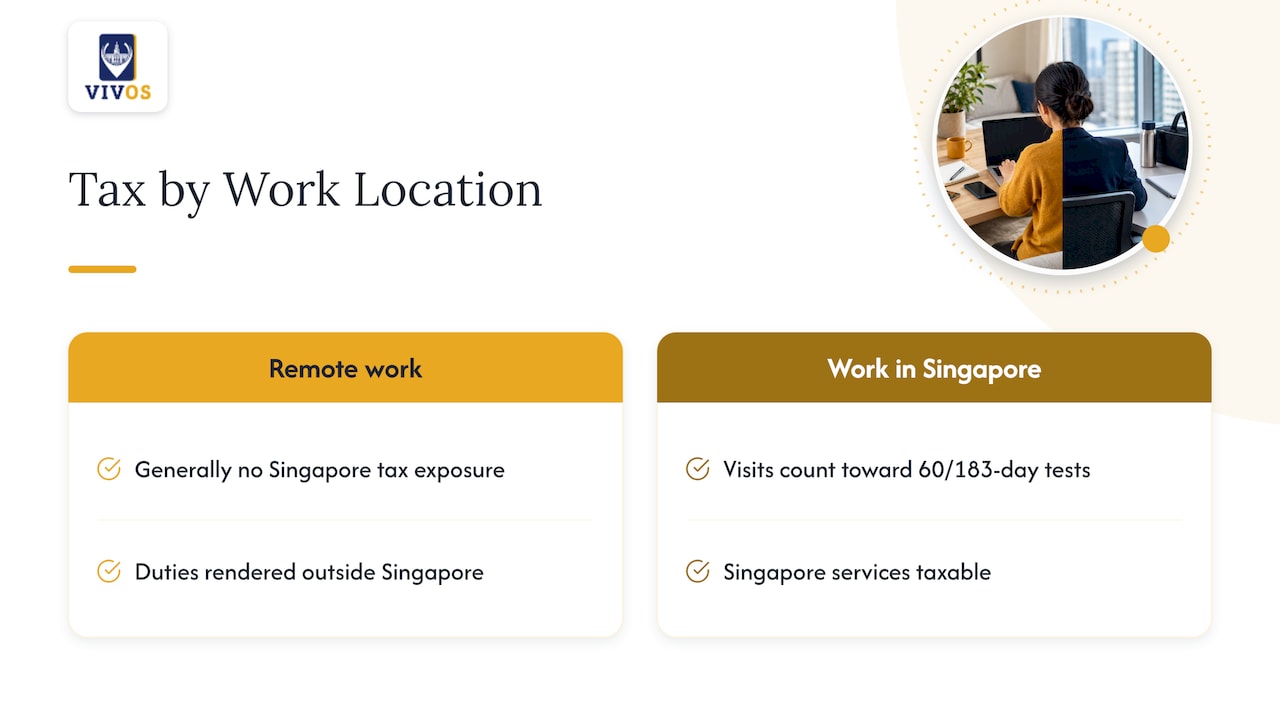
Physical presence is the test that governs Singapore tax residency and the 60-day and 183-day thresholds, not where an employment contract is signed or where a company is incorporated. An employee who performs their duties entirely from outside Singapore, for a Singapore-registered company, generally has no Singapore tax exposure on that income, because the work itself was not rendered in Singapore.
The moment that person travels to Singapore for meetings, training, or any work performed physically within the country, those days start counting toward the 60-day and 183-day thresholds, regardless of how brief the trip is or whether it was planned as a business trip rather than an assignment. Income for services rendered in Singapore is taxable even when the payment itself is made from an overseas bank account or payroll system.
This distinction matters most for foreign founders who split their time between Singapore and another base. A founder who visits Singapore briefly each quarter to handle board matters and operations may stay well under the 60-day threshold and avoid Singapore employment tax on the bulk of their income, while a founder who relocates and works from Singapore day to day will cross into non-resident, and eventually resident, tax treatment on the income tied to those Singapore workdays.
Businesses with non-resident staff have a handful of legitimate ways to manage tax outcomes, all of which start with accurate classification rather than aggressive structuring.
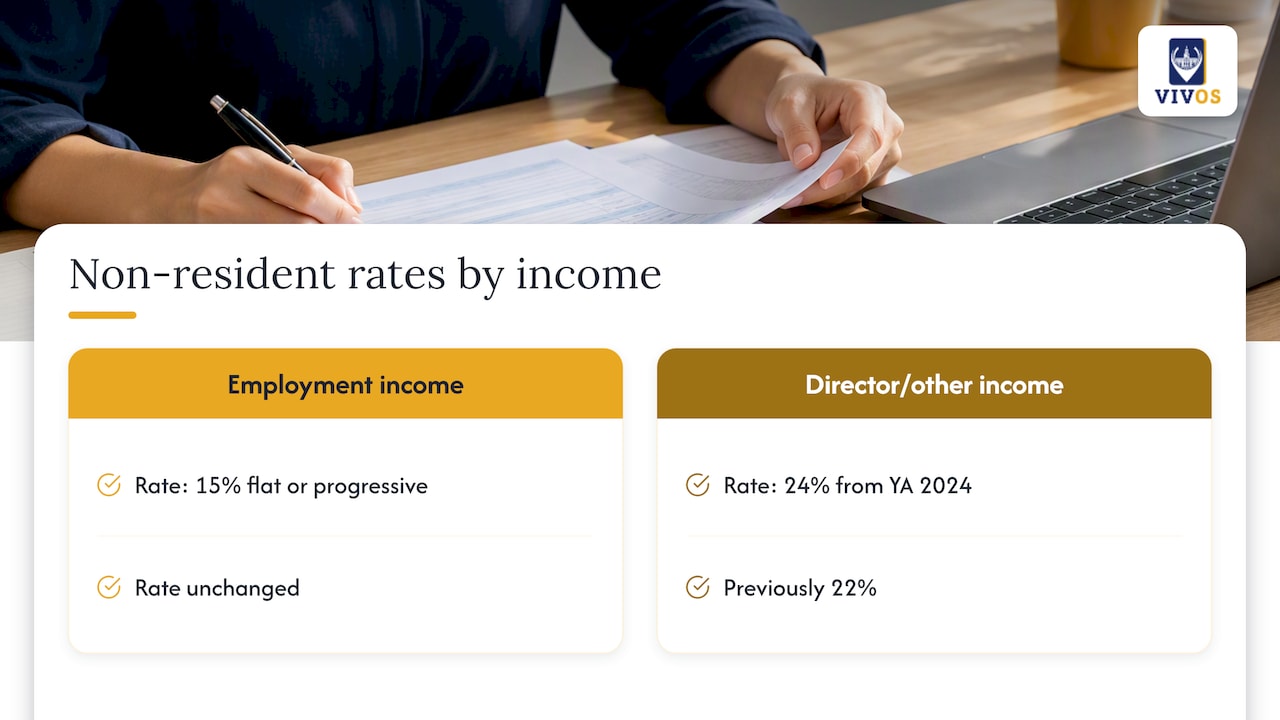
The most consequential recent change for non-resident employees is the increase in the general non-resident tax rate to 24% from Year of Assessment 2024 onward, up from the previous 22%. This rate covers director fees and most other non-employment non-resident income, so any employer still budgeting payroll or director fee withholding against the older rate is underpaying what IRAS now requires.
Employment income itself was not swept into that increase. The 15%-flat-or-progressive comparison for employment income remains unchanged, which means employers need to apply two different non-resident rates depending on whether a payment is salary or a director’s fee, a distinction that is easy to blur in a small company where the same person wears both hats.
As of 2026, these are the figures and thresholds IRAS currently applies, and employers should check the IRAS website directly before finalizing payroll calculations for any non-resident hire, since rate schedules are reviewed periodically and a stale reference figure is one of the easier compliance mistakes to make.
Foreign founders setting up in Singapore face the same residency tests and rate rules as any other employer, but the practical traps tend to cluster around the founder’s own pay. A founder who draws a director’s fee from their newly incorporated Singapore company is subject to the 24% withholding rate on that fee from the first dollar, regardless of how many days they personally spend in Singapore that year.
A foreign company employing staff in Singapore, or a Singapore subsidiary of an overseas parent, is treated as a non-resident employer for reporting purposes but still carries the full IR8A or AIS reporting obligation by March 1 each year. IRAS treats this obligation the same way regardless of where the parent company is based.
We provide company incorporation, nominee resident director, registered address, corporate secretary, payroll and tax filing services in Singapore, Malaysia, Hong Kong, and UAE. For a founder juggling incorporation, a nominee resident director requirement, and their own personal tax position simultaneously, getting the director fee versus employment income split right from the outset avoids a messy reclassification later. Our payroll compliance guide for foreign founders covers the operational side of getting this right from the first payroll run.
Most explainers on this topic stop at the headline rates and leave the reader to figure out the rest. The real risk for non-resident employees and the founders who pay them is not the rate itself, it is misclassification: treating a director as an employee, treating a 45-day consulting trip as automatically exempt, or assuming an Employment Pass guarantees resident tax treatment from day one.
The conventional advice to “check if you’re under 183 days” is true but incomplete. It ignores that a director’s fee is taxed at 24% no matter how few days are spent in Singapore, and it ignores that the 60-day exemption has three explicit carve-outs that catch a surprising number of consultants and trainers off guard.
If there is one thing to prioritize first, it is building a simple day-count log and a clear service-capacity label for every non-resident person on the payroll, before the first payment goes out. Fixing a misclassification after IRAS flags it is far more disruptive than setting it up correctly from the start.
— Ray
We help employers and foreign founders keep non-resident employee tax compliance off their own plate, from the first payroll run through the final IR21 filing when someone leaves. We provide company incorporation, nominee resident director, registered address, corporate secretary, payroll and tax filing services in Singapore, Malaysia, Hong Kong, and UAE.

Our services relevant to this guide include insights into the education allowance for Singapore expats to help families navigate costs effectively.
If payroll and tax clearance for a non-resident hire feels like one deadline too many this quarter, check our pricing and get started.
Employment income for non-residents is taxed at the higher of a flat 15% or resident progressive rates. Director fees and most other non-resident income are taxed at a flat 24%.
It depends on the income type and amount. Employment income uses the 15%-or-progressive comparison described above, while director fees and most other income use a flat 24% rate, so two people with the same total income can owe very different amounts depending on how that income is classified.
Taxable income includes salary, bonuses, allowances, director fees, accommodation benefits, and other benefits-in-kind earned for work performed in Singapore. Income for services rendered in Singapore stays taxable even when paid from an overseas account, and non-residents cannot claim personal reliefs against this income.
Foreign employees who qualify as tax residents pay progressive resident rates. Those who stay non-resident pay the higher of 15% flat or the resident progressive rate on employment income, with a 60-day exemption available for genuinely short stays outside of director or professional roles.

 2 January, 2025
 2 January, 2025
了解新加坡商业许可如何按行业判定,注册后用 GoBusiness 查询牌照要求,并掌握餐饮、按摩、进出口审批及场地合规要点,避免申请受阻。


Appointing a director in Singapore means meeting residency rules and filing on BizFile+ within 14 days. Compare foreign, resident, and nominee options.