
新加坡商业许可申请全攻略:ACRA 注册后该怎么做

Ray Tay
了解新加坡商业许可如何按行业判定,注册后用 GoBusiness 查询牌照要求,并掌握餐饮、按摩、进出口审批及场地合规要点,避免申请受阻。
Published: 11 August 2026 · Last reviewed: 30 September 2026 · Reviewed by Ray Tay, Co-Founder & Managing Director, VIVOS PTE. LTD. (ACRA Filing Agent FA20240323 · MOM EA Licence 24S2425)
Singapore imposes withholding tax (WHT) on specified payments made to non-residents. The obligation falls entirely on the payer: you must identify the payee’s residency status, classify the payment type, apply the correct rate or any applicable Double Taxation Agreement (DTA) relief, withhold the tax from the gross payment, and remit it to the Inland Revenue Authority of Singapore (IRAS) by the statutory deadline. Failure to do so exposes the payer, not the payee, to penalties and interest.
Core payer obligations at a glance:
The primary statutory authority is the Income Tax Act, administered by IRAS. For complex treaty questions or related-party structures, professional-firm commentary from PwC Singapore provides a useful secondary reference alongside IRAS guidance.
Singapore withholding tax places the full compliance burden on the payer: correct classification, timely filing, and complete documentation are non-negotiable obligations under the Income Tax Act.
| Point | Details |
|---|---|
| Filing deadline | WHT must be filed and paid by the 15th of the second month after the payment date. |
| Standard rates | Interest and rent of movable property are withheld at 15%; services performed in Singapore at — (provisional). |
| DTA relief requires documentation | A valid Certificate of Residence and beneficial ownership declaration must be held before applying a reduced treaty rate. |
| Provisional withholding is recoverable | Non-residents overwithheld on Singapore service fees can submit certified accounts to IRAS and claim a refund. |
| VIVOS compliance support | VIVOS provides WHT classification, DTA documentation review, IRAS filing, and refund assistance for cross-border payers. |
Singapore’s tax system, administered by IRAS, uses a combination of direct and indirect taxes to meet fiscal and economic objectives. WHT sits within the direct-tax framework as a collection mechanism: rather than requiring a non-resident payee to file a Singapore tax return, the law places the collection burden on the resident payer.
Statutory basis: Withholding tax in Singapore is imposed under the Income Tax Act. IRAS administers WHT obligations and publishes applicability guides, rate schedules, and filing procedures that payers must follow. Non-compliance is treated as a tax debt owed by the payer, not the payee.
The key distinctions payers need to understand:
IRAS is also implementing international tax rules, including Pillar Two measures (the Multinational Top-up Tax and Domestic Top-up Tax), which affect multinational groups operating in Singapore and reinforce the importance of treating WHT as part of a broader, integrated tax compliance strategy.
IRAS defines the payer as any person (individual or entity) in Singapore that makes a specified payment to a non-resident. The payer is legally responsible for withholding and remitting the correct amount. If the payer fails to withhold, IRAS treats the full tax as a debt owed by the payer.
Determining company tax residency
A company is tax-resident in Singapore if its control and management are exercised in Singapore. Place of incorporation alone is not determinative. A company incorporated in Singapore but managed from overseas may be non-resident. Conversely, a foreign-incorporated company whose board meetings and strategic decisions occur in Singapore may qualify as resident.
Common pitfalls:
Determining individual tax residency
An individual is tax-resident in Singapore if they are physically present or employed in Singapore for 183 days or more in a calendar year. Edge cases include:
Quick decision flow for payers
IRAS sets standard WHT rates by payment type. The rate depends on the nature of the payment and whether the underlying activity was carried out in Singapore.
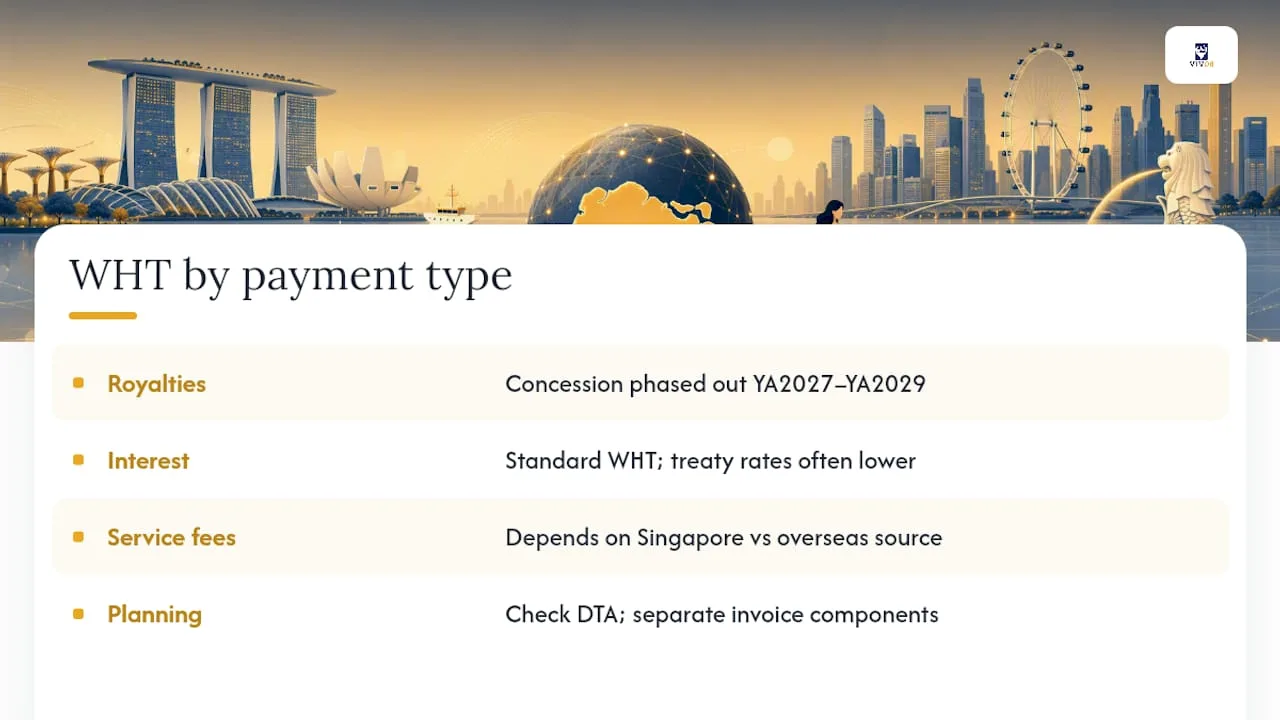
Under Budget 2024 guidance, IRAS is phasing out this concession from Year of Assessment (YA) 2027, with full taxation of net royalties taking effect by YA 2029. Payers of royalties should plan for higher effective rates on payments made from 2027 onward.
The non-resident payee can submit certified accounts and a corporate tax computation to IRAS, claim allowable deductions against the gross fee, and recover any overwithheld amount. This makes contract-stage planning important: structuring invoices to clearly separate Singapore-sourced from overseas-sourced service components can reduce the gross amount subject to withholding.
Pro Tip: Always check whether a DTA applies before applying the standard rate. Singapore’s DTA network covers over 90 jurisdictions, and treaty rates for interest and royalties are often lower than the domestic rates listed above.
Not every cross-border payment to a non-resident triggers WHT. Knowing the exclusions prevents unnecessary withholding and avoids over-filing.
A DTA between Singapore and the payee’s country of residence can reduce or eliminate the standard WHT rate. The payer applies the DTA rate at source, but the burden of proof rests on the payer to hold valid documentation before making the reduced-rate payment.
Step-by-step process for claiming DTA relief
Common documentation pitfalls
For cross-border tax advisory on treaty applications, professional guidance reduces the risk of documentation gaps that trigger IRAS queries.
Timing is the most common source of WHT penalties. The rules are precise and leave little room for error.
Core deadlines
Available payment methods
Confirmation of Payment (CP)
After successful payment, IRAS issues a Confirmation of Payment. Retain this document as proof of remittance. The CP is also the document the non-resident payee may need to claim a foreign tax credit in their home jurisdiction.
Common filing errors to avoid
Pro Tip: Set a calendar trigger in your accounting system on the payment date itself, not the due date. Working backward from the 15th of the second month gives you roughly six weeks, but documentation preparation for DTA claims often takes longer than payers expect.
The following scenarios illustrate how to apply WHT rates, claim DTA relief, and identify final versus provisional treatment.
The withholding is a final tax. The non-resident has no further Singapore tax obligation on this royalty income.
Assumptions: A Singapore company pays SGD 200,000 to a non-resident company for consulting services performed in Singapore. No DTA applies.
This withholding is provisional. The non-resident company can submit certified accounts and a tax computation to IRAS. IRAS would refund the SGD 20,400 difference.
Assumptions: A Singapore company pays SGD 10,000 in interest on overdue trade receivables to a non-resident company. The funds are not placed in an approved bank.
If the funds had been placed in an approved bank in Singapore and the bank-approved exemption conditions were met, no WHT would apply. The distinction turns on whether the interest is paid by an approved bank and whether the underlying funds are derived from Singapore operations.
Understanding whether withholding is final or provisional determines whether the non-resident payee has any further action to take.
When withholding is final
For interest, royalties, rent of movable property, director’s fees, and REIT distributions, WHT is a final tax. The non-resident payee does not need to file a Singapore tax return for that income. The withheld amount fully discharges the Singapore tax liability on the payment.
When withholding is provisional
The non-resident payee can:
Refund process
IRAS processes refunds after completing the tax assessment. The non-resident payee should submit accounts and computations promptly after the financial year ends to minimize the period of cash-flow lock-up. Refunds are typically credited to a designated bank account. The Singapore corporate tax calculator from VIVOS can help estimate the net tax position before submitting accounts to IRAS.
A key indicator of a successful refund claim is clear documentation showing that the gross fee overstates the actual taxable profit. Payers can assist payees by providing detailed invoices that separate cost components, making it easier for the payee to construct a credible tax computation.
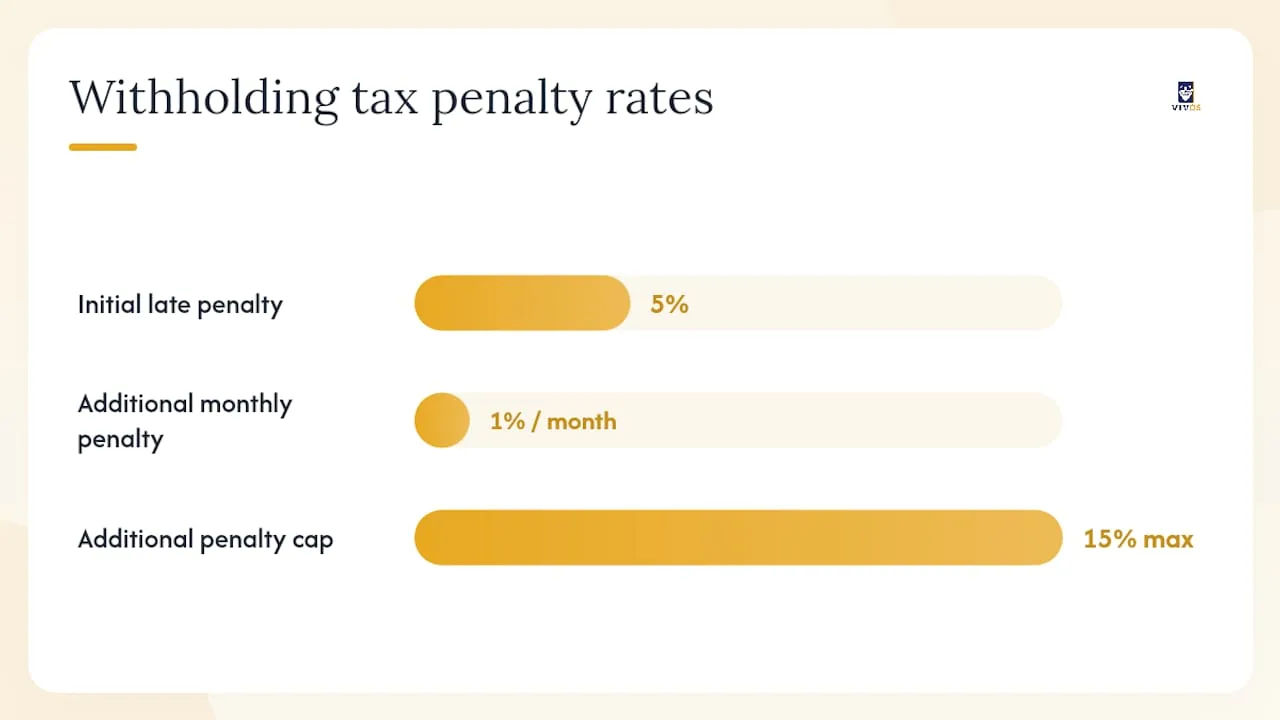
IRAS treats WHT non-compliance as a tax debt owed by the payer. The penalties are structured to incentivize prompt, accurate filing.
Types of penalties
How to amend past filings
Reducing penalty exposure
Pro Tip: If you discover a WHT error, disclose it to IRAS before they contact you. Voluntary disclosure consistently results in lower penalties than errors discovered during an IRAS audit or compliance review.
Use this checklist before issuing any cross-border payment to a non-resident.
Pre-payment
At payment
Post-payment
Pro Tip: Integrate WHT triggers into your accounts payable workflow. When a new vendor is onboarded as a non-resident, the system should automatically flag the payment category and prompt the finance team to collect residency documentation before the first payment is processed. Good bookkeeping and compliance infrastructure makes this systematic rather than reactive.
VIVOS provides end-to-end WHT compliance support for businesses operating across Singapore, Malaysia, Hong Kong, and the UAE. For finance teams managing cross-border payments, the practical value is in having a single advisory team that handles classification, documentation, filing, and dispute resolution.
Relevant VIVOS services for WHT compliance:
A common scenario VIVOS addresses: A business making regular service payments to an overseas parent company withholds at the domestic rate without checking whether a DTA applies. Over 12 months, the cumulative overwithholding creates a material cash-flow drag for the parent. A structured DTA documentation review, implemented before the next payment cycle, corrects the rate and supports a refund claim for prior periods where the treaty was not applied.
For a WHT health-check or to discuss your specific payment structure, contact VIVOS directly through the withholding tax service page.
Most WHT errors are not the result of ignorance. They come from timing. A payer knows a DTA exists but has not collected the COR before the payment date. A finance team applies the correct rate but files one day late because the payment date was logged incorrectly. A non-resident payee is overwithheld on service fees for two years because no one at the payer entity knew provisional withholding was recoverable.
The DTA documentation gap is the most expensive of these. Over multiple payment cycles, the cumulative difference is material. The fix is straightforward: build COR collection into the vendor onboarding process, not the payment approval process. By the time a payment is ready to go, the documentation should already be on file.
The second underestimated issue is provisional withholding on service fees. But the non-resident payee, particularly a foreign subsidiary or parent company, may have significant deductible expenses against that fee. Submitting certified accounts to IRAS can recover a substantial portion of the withheld amount. The barrier is usually administrative: the payee does not know the refund mechanism exists, or the payer does not flag it. A brief note in the payment confirmation to the payee, pointing to the IRAS refund process, costs nothing and can recover real cash.
Professional commentary from PwC Singapore provides useful secondary guidance on treaty interactions and rate applications for complex structures, and is worth consulting alongside IRAS guidance for multi-jurisdiction arrangements.
WHT compliance in Singapore requires precise classification, timely documentation, and exact filing deadlines. For businesses managing multiple cross-border payment streams, the administrative load compounds quickly, and a single missed deadline or incorrect rate creates penalty exposure that a structured compliance process would have prevented entirely.
VIVOS Pte. Ltd. is an ACRA Registered Filing Agent (Licence FA20240323) and MOM-licensed Employment Agency (Licence 24S2425), advising Singapore businesses on withholding tax, incorporation, and compliance under one team.

VIVOS offers a direct alternative to managing WHT obligations in-house without specialist support. The team handles payment classification, DTA documentation review, IRAS filing, and refund applications under one engagement, reducing the risk of errors that stem from fragmented responsibility across finance, legal, and external advisers. For businesses already using VIVOS for corporate tax filing or accounting and finance advisory, WHT management integrates directly into the existing compliance workflow.
For professional tax management practices that reduce compliance risk, the tax management resources from Mastermind Advisor also offer useful context on how structured advisory support reduces exposure across complex payment structures.
Contact VIVOS for a WHT health-check: review your current payment classifications, identify any DTA opportunities you may not be claiming, and confirm your filing deadlines are correctly mapped in your accounting system.
The following official and professional resources provide the statutory text, rate schedules, and filing procedures referenced throughout this article.
IRAS official pages
Statutory source
Professional commentary
This article is general information, not a substitute for advice from a qualified financial advisor. Consult a qualified financial professional about your own circumstances before acting on anything here.

 2 January, 2025
 2 January, 2025
了解新加坡商业许可如何按行业判定,注册后用 GoBusiness 查询牌照要求,并掌握餐饮、按摩、进出口审批及场地合规要点,避免申请受阻。

Learn how Singapore taxes nonresident employees, when the 60 day exemption applies, and how employers meet IR21, IR8A, and departure filing deadlines.