

新加坡商业许可申请全攻略:ACRA 注册后该怎么做

Ray Tay
了解新加坡商业许可如何按行业判定,注册后用 GoBusiness 查询牌照要求,并掌握餐饮、按摩、进出口审批及场地合规要点,避免申请受阻。
Published: 6 August 2026 · Last reviewed: 30 September 2026 · Reviewed by Ray Tay, Co-Founder & Managing Director, VIVOS PTE. LTD. (ACRA Filing Agent FA20240323 · MOM EA Licence 24S2425)
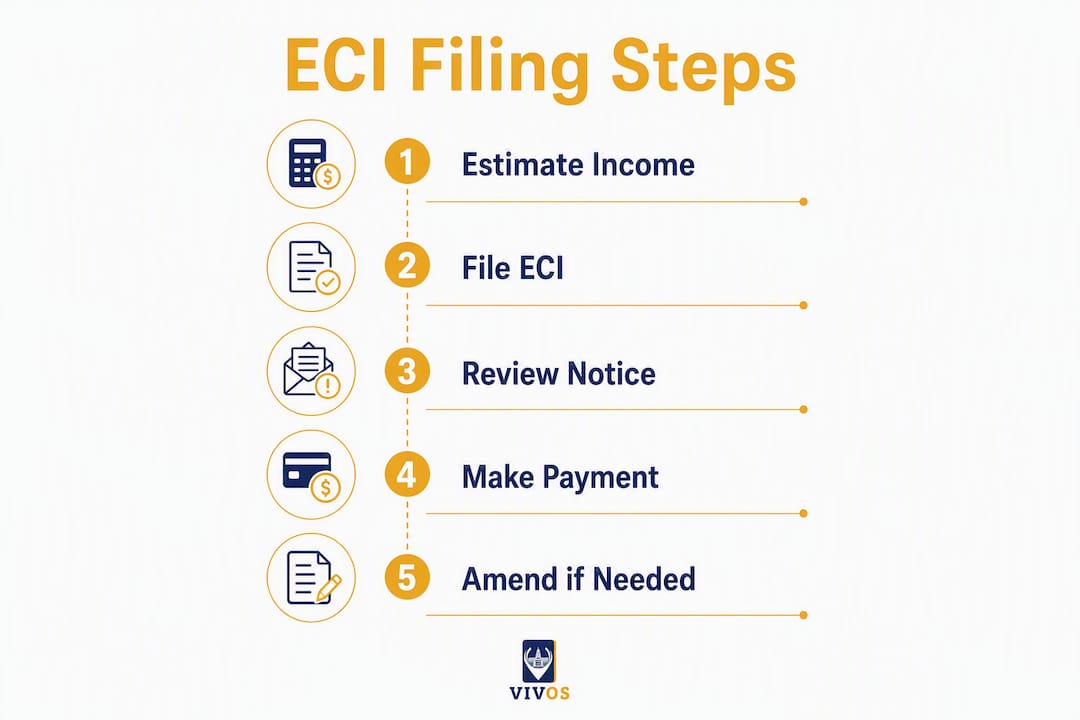
Estimated Chargeable Income (ECI)-filing) is IRAS’s term for a company’s estimated taxable profit for a Year of Assessment (YA), calculated after deducting tax-allowable expenses. Every Singapore-incorporated company must file ECI on myTax Portal within 3 months of its financial year end, unless both waiver conditions are met. If you are unsure whether your company qualifies for an exemption, file anyway or contact a qualified tax advisor before the window closes.
ECI is a forecast, not a final figure. IRAS uses it to collect advance tax before the full corporate return is submitted. The final chargeable income is declared later through Form C or Form C-S, and any difference is reconciled at that point.
Components of chargeable income:
Statistic callout: Singapore’s corporate tax rate is a flat 17% of chargeable income for both local and foreign companies. The ECI waiver applies only when annual revenue is at or below the waiver threshold and ECI is nil.
The key distinction between ECI and Form C / Form C-S: ECI is an estimate filed within 3 months of financial year end; Form C / Form C-S is the final annual return due by November 30 each year. They serve different purposes and have different deadlines.
One critical reporting rule: ECI must be declared before deducting exempt amounts such as the start-up tax exemption or partial tax exemption. Reporting the post-exemption figure is one of the most common errors directors make.
Watch on YouTube: Singapore Tax Filing Deadlines: ECI & Corporate Tax Return Guide · 45 sec.
All Singapore-incorporated companies must file ECI for each YA unless both of the following conditions are satisfied:
If either condition is not met, the company must file, even if ECI is zero but revenue exceeds S$5 million.
Director decision checklist:
Special cases to watch:
Pro Tip: Set a calendar reminder the day your financial year closes. The 90-day ECI window starts immediately, and the first filing for a newly incorporated company is the one most often missed because no IRAS notification arrives in that year.
The statutory ECI deadline is fixed: file within 3 months (90 days) from the last day of the company’s financial year end. There are no extensions for this deadline under normal circumstances.

| Financial Year End | ECI Due Date | Effect of Late Filing |
|---|---|---|
| — | — | Loss of GIRO instalment eligibility; estimated NOA issued |
| — | June 30 | Loss of GIRO instalment eligibility; estimated NOA issued |
| June 30 | September 30 | Loss of GIRO instalment eligibility; estimated NOA issued |
| September 30 | — | Loss of GIRO instalment eligibility; estimated NOA issued |
IRAS may issue a Notice of Assessment (NOA) based on available information-filing) such as prior years’ income, and the company loses the right to pay by instalments. The full tax amount becomes due within 1 month from the NOA date.
GIRO instalments:
Lump-sum payment on NOA:
Pro Tip: Sign up for GIRO at least 3 weeks before you plan to file ECI. If the approval does not clear before the payment due date, instalment eligibility is lost for that YA regardless of whether ECI was filed on time.

Start with the company’s net profit before tax from the management accounts, then apply the following adjustments in sequence.
| Item | Amount (S$) |
|---|---|
| Net profit before tax (per accounts) | 175,000 |
| ECI (before exempt amounts) | 175,000 |
The company would report S$175,000 as ECI on myTax Portal. Start-up or partial exemptions are applied by IRAS when issuing the NOA, not by the company when filing ECI.
Common adjustment traps:
Pro Tip: Use the IRAS Basic Corporate Income Tax Calculator to cross-check your manual computation before filing. It includes validation checks against common errors and explanatory notes for each line.
Filing ECI requires a Corppass account with the appropriate tax filing role assigned. Have the following figures ready before logging in:
ECI can be revised after submission if the initial estimate was materially incorrect. Submit a revised ECI through myTax Portal before the Form C / Form C-S filing deadline. IRAS expects the final chargeable income declared in Form C / Form C-S to reconcile with the ECI; large unexplained variances may prompt a review.
Directors may authorize a corporate secretary or tax agent to file on their behalf via Corppass. The authorized party must be granted the “Corporate Tax (Filing Agent)” role. Recordkeeping obligations remain with the company: retain all supporting schedules, management accounts, and capital allowance workings for at least 5 years.
IRAS guidance identifies several recurring errors that increase audit risk and can result in penalties or estimated assessments.
Frequent filing and calculation mistakes:
IRAS consequences:
Pro Tip: File a conservative but supportable ECI estimate on time, even if the accounts are not fully closed. It is far better to revise upward in Form C than to miss the deadline and lose instalment eligibility. A documented, reasonable estimate also reduces downstream audit exposure.
The waiver rule is precise: a company does not need to file ECI for a YA only when both conditions are met simultaneously: ECI is nil (before exempt amounts) AND annual revenue is S$5 million or below.
Dormant company checklist:
Loss-making company checklist:
Director’s declaration template (nil ECI, waiver applies): “For the financial year ended [date], the company’s annual revenue was S$[amount] (below S$5 million) and ECI is nil before deducting exempt amounts. No ECI filing is required for YA [year] under the IRAS ECI filing waiver.”
IRAS notes that directors commonly assume dormancy or losses remove the filing obligation. Proactivity is safer than assuming exemption. When in doubt, contact IRAS directly or engage a tax advisor to confirm the position before the 90-day window closes.
ECI is the first step in a two-stage corporate tax process. The second stage is the final annual return.
Timeline:
Form C / Form C-S is the annual return that reports final chargeable income-form-c-filing/guidance-on-filing-form-c-s-form-c-s-(lite)-form-c); Form C is due by November 30 each year. For a deeper walkthrough of the corporate income tax filing process, including Form C-S eligibility and reconciliation steps, VIVOS maintains a detailed guide on its site.
Large variances between ECI and final chargeable income can trigger an IRAS review. A company that consistently files ECI far below its eventual assessed income may face increased scrutiny on future returns. Conservative, documented estimates reduce this risk and simplify the Form C reconciliation.
Filing ECI on time and enrolling in GIRO converts a single large tax payment into a series of smaller monthly deductions, which directly improves working capital management.
Consider a growing Singapore SME with an estimated tax liability of S$60,000. Paying that amount in one lump sum within 1 month of the NOA can strain operating cash reserves, particularly for businesses with seasonal revenue. With GIRO instalments, the same liability is spread across multiple months, allowing the company to retain cash for payroll, inventory, and growth spending during the interim period.
When to outsource ECI preparation:
Any one of these conditions is a reasonable trigger to engage a tax professional for ECI preparation rather than rely on internal resources alone.
Filing ECI accurately and on time is the single most effective action a Singapore company director can take to preserve instalment eligibility, avoid estimated assessments, and reduce audit exposure.
| Point | Details |
|---|---|
| 90-day filing deadline | ECI must be filed within 3 months of financial year end; no standard extension applies. |
| ECI vs. Form C | ECI is an estimate filed early; Form C / Form C-S is the final return due by November 30 each year. |
| GIRO instalment setup | Enroll in GIRO at least 3 weeks before filing ECI to qualify for monthly instalment payments. |
| Waiver conditions | Both conditions must be met: annual revenue S$5 million or below AND ECI nil before exempt amounts. |
| VIVOS ECI support | VIVOS handles ECI calculation, GIRO setup, and Form C filing for Singapore companies, including newly incorporated entities. |
Most ECI compliance failures are not caused by ignorance of the deadline. They are caused by a disconnect between the accounting close calendar and the tax filing calendar. Directors who treat ECI as a tax department task often discover, too late, that the accounts are not ready in time to support a defensible estimate.
The practical fix is structural: align the accounting close target to no later than 6 weeks after financial year end. That leaves 6 weeks to prepare the ECI, review adjustments, and file. Companies that close accounts in 8 or 10 weeks routinely find themselves filing ECI under pressure, which increases the risk of errors and, in some cases, late filing.
A second overlooked point: the ECI figure should be documented, not just filed. Directors who can produce a one-page reconciliation from net profit to ECI, with supporting schedules for capital allowances and disallowable expenses, are in a materially stronger position if IRAS raises a query. The reconciliation takes less than an hour to prepare when the accounts are properly closed. Without it, responding to an IRAS query can take days.
The conventional advice to “file early and correct later” is sound, but it works only when the initial estimate is grounded in actual figures, not a rough guess. A documented, conservative estimate filed on time is the lowest-risk position a director can take.
VIVOS provides end-to-end corporate tax computation and filing for Singapore companies, covering ECI preparation, Form C / Form C-S filing, GIRO instalment setup, and bookkeeping reconciliation. For companies with complex capital allowance schedules, group relief elections, or cross-border income, VIVOS also provides tax dispute support and IRAS correspondence management.

Documents VIVOS typically requests for ECI preparation:
VIVOS can be authorized as a filing agent via Corppass, handling the full ECI submission on the company’s behalf. Directors of newly incorporated companies can engage VIVOS from the first financial year end to avoid missing the initial ECI deadline. To get started, book a consultation with the VIVOS team.
Official IRAS pages and VIVOS resources to support ECI preparation and filing:

 2 January, 2025
 2 January, 2025
了解新加坡商业许可如何按行业判定,注册后用 GoBusiness 查询牌照要求,并掌握餐饮、按摩、进出口审批及场地合规要点,避免申请受阻。

Learn how Singapore taxes nonresident employees, when the 60 day exemption applies, and how employers meet IR21, IR8A, and departure filing deadlines.