
Corporate Secretarial Services in Singapore Compared (2026): 10 Firms and Fees

Ray Tay
10 Singapore corporate secretary providers compared: published fees from S$199 to S$800 a year, what each includes, and the ACRA rules. Checked Oct 2026.
Published: 16 October 2026 · Reviewed by Ray Tay, Co-Founder & Managing Director, VIVOS PTE. LTD. (ACRA Filing Agent FA20240323 · MOM EA Licence 24S2425)
As of 2026, MOM defines a part-time employee as someone contracted to work under 35 hours a week, covered by the Employment Act and the Employment (Part-Time Employees) Regulations. Entitlements include pro-rated annual leave, sick leave and public holidays, overtime at 1.5x the hourly basic rate beyond full-time daily hours, and CPF for citizens and PRs earning above S$50 a month.
TL;DR:
- Annual, sick, childcare, and public holiday entitlements are prorated against a comparable full time employee’s hours, so document the role’s baseline before hiring.
- CPF applies to citizens and permanent residents earning over S$50 monthly; rates vary by age, residency status, and wages, so calculate contributions each pay cycle.
- Overtime pays 1.5 times the basic hourly rate only after full time daily hours; Part 4 employees also face a 72 hour monthly cap.
- Contracts must list basic and gross hourly rates, itemized allowances, daily and weekly hours, and working days; payslips and hour records support later claims.
- Employment Pass and S Pass holders generally cannot take secondary jobs, so verify pass conditions before offering a foreign worker any shifts.
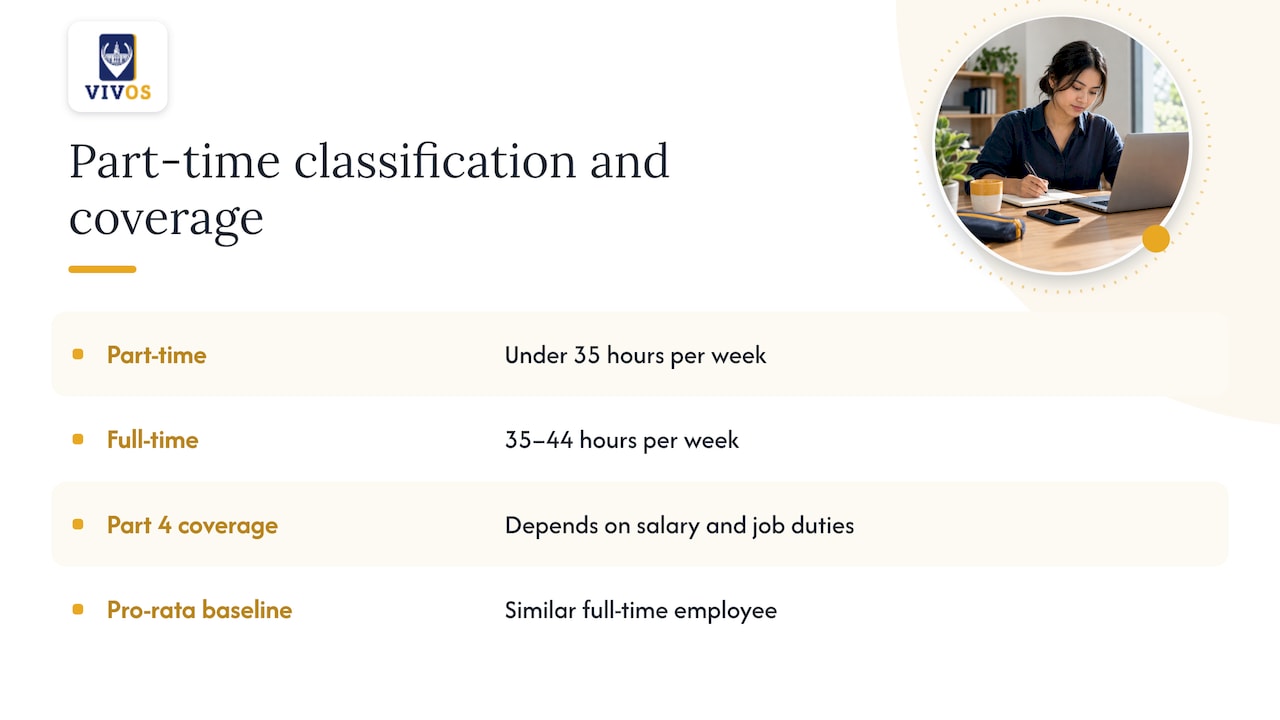
The Employment (Part-Time Employees) Regulations draw the line by contracted hours. Under 35 hours a week is part-time. A full-time employee works 35 to 44 hours. The Regulations also let the Minister modify how the rules apply to particular classes, so the statute is always the final reference when your case is unusual.
Classification is separate from coverage. Part 4 of the Employment Act applies depending on salary thresholds and job duties. Managers and executives, and certain other categories, may fall outside Part 4 even when they work under a contract of service. A part-timer outside Part 4 still has a contract, but the statutory overtime rules and the monthly overtime cap discussed below tie to Part 4 coverage.
Every pro-rata formula compares your part-timer to a “similar full-time employee”: someone in the same establishment doing the same kind of work under the same type of contract. If no such person exists, for example because your new company has only just made its first hire, you build the baseline from the closest comparable role. In practice, that means documenting the full-time hours you would expect for the job and using that as the denominator.
We are an ACRA-registered filing agent providing Singapore company incorporation for foreign founders, and we see this step skipped most often. Founders hire first and define the baseline later, which makes leave calculations hard to defend.
Yes on both, with conditions. Employers pay CPF contributions for part-time employees who are Singapore Citizens or Permanent Residents and earn more than S$50 in total wages a month. Rates for 2026 depend on age, residency status and total monthly wages, so use the official CPF contribution calculator rather than a flat percentage. Our CPF contribution rates guide walks through the inputs. CPF applies to part-time and casual staff, including students, employed under a contract of service.
Leave follows the pro-rata principle. Annual leave, sick leave, childcare leave and maternity entitlements are scaled by the ratio of the part-timer’s hours to the similar full-time employee’s hours.
An illustrative example: compare the part-timer’s hours with those of a similar full-time employee. The part-timer’s leave entitlement is calculated in relation to the full-time employee’s entitlement.
A part-timer may agree to give up public holidays or leave in exchange for pay. Where that happens, the allowance should be written into the contract and built into the hourly gross rate, so the payslip shows what the person actually earns per hour. Without that record, an unpaid-leave dispute is hard to resolve.
Every part-time contract must state two rates: the hourly basic rate and the hourly gross rate. The gross rate includes allowances, itemised, so an employee can see what portion of their pay is basic.
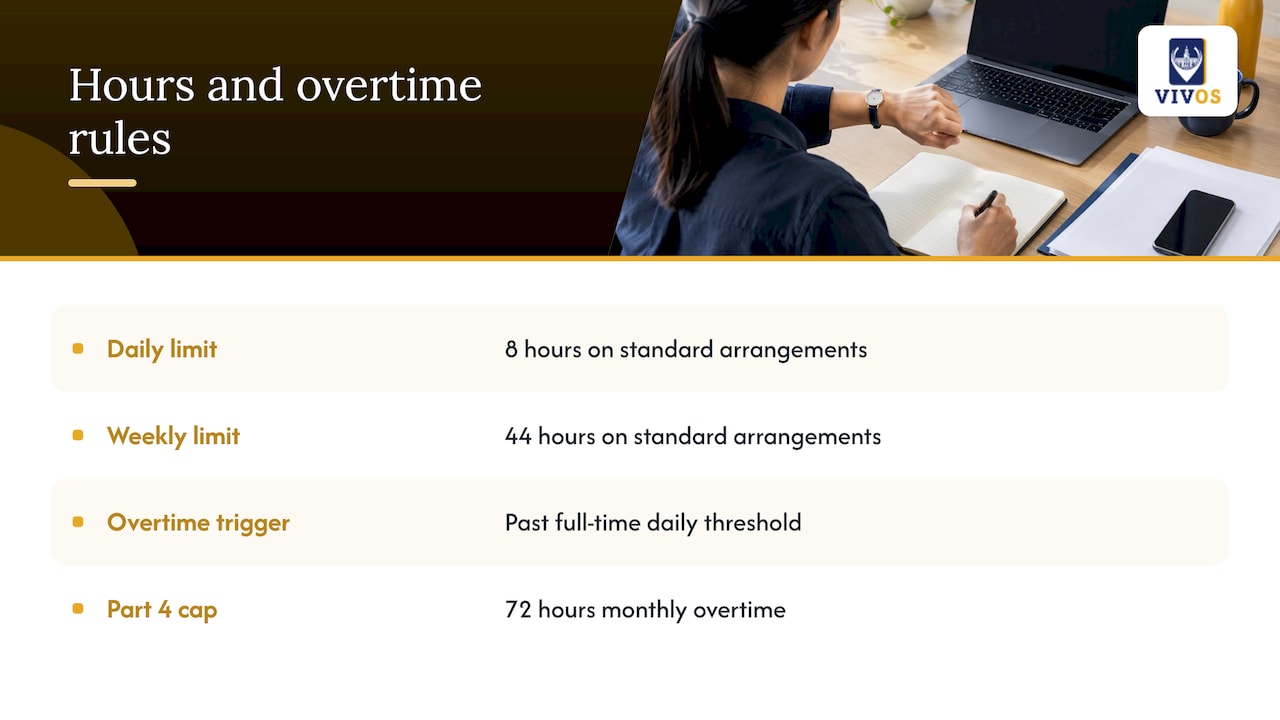
This is the point many founders get wrong. A part-timer who works a long shift but stays within full-time daily hours is not in overtime. Overtime starts only past the full-time daily threshold, as MOM’s part-time guidance explains. Contractual hours also cannot exceed 8 hours a day or 44 hours a week on standard arrangements, per MOM’s guide on employment laws.
For employees covered by Part 4, a 72-hour monthly overtime limit applies. Plan rosters so that an overtime-heavy month does not breach it.
If the Progressive Wage Model (PWM) applies to your sector, the calculation gets harder. MOM’s PWM overtime guidance requires you to meet the PWM total gross wage requirement, which can mean paying the higher of the Employment Act overtime obligation and the PWM figure. Monthly limits and rounding rules apply.
Rest-day and public-holiday work is paid on the hourly basic rate, with the premium set by the hours worked and whether the work was at the employer’s request. Record the hours worked on those days separately from ordinary hours.
A compliant part-time contract names the hourly basic rate, the hours of work per day and per week, the number of working days, and an itemised hourly gross rate with each allowance listed. Keep the wording plain. Ambiguity about hours is the usual starting point for a later claim.
Beyond the contract, three habits protect you:
The Regulations set statutory fines for failing to pay what part-timers are owed. The exact amounts are in the Regulations on Statutes Online, and we recommend reading them before drafting your first contract. Employees who believe they are underpaid can lodge a complaint with MOM, which refers disputes to the Tripartite Alliance for Dispute Management (TADM). Our payroll compliance guide for foreign founders covers the record-keeping side in more depth.
Yes. A newly incorporated Singapore company can employ part-timers from day one, provided it follows the steps below. As an ACRA-registered filing agent, we provide incorporation for foreign founders, including a nominee resident director, a registered address and a corporate secretary, and we also support payroll and CPF. We serve Malaysia, Hong Kong and the UAE as well. A founder hiring a first local part-timer needs the company, the employer CPF registration and the payroll process in place together.
| Entitlement | Full-time baseline | Part-time formula |
|---|---|---|
| Annual leave | Full-time entitlement in days | Part-timer’s hours ÷ similar full-time employee’s hours × full-time entitlement |
| Public holidays | Paid public holidays | Same ratio applied to the holiday entitlement |
| Sick leave | Full-time sick leave days | Same ratio applied to the days |
| Childcare leave | Full-time childcare days | Same ratio applied to the days |
| Overtime | 1.5x hourly basic rate beyond normal daily hours | 1.5x hourly basic rate beyond the full-time daily hours |
Worked examples should compare the part-timer’s hours with the similar full-time employee’s hours to calculate the pro-rata leave entitlement.
Singapore law does not set a fixed probation length. Probation is a contractual term, so the contract should state its duration, what the employee is assessed on and whether it can be extended. Probation length is a matter of contract, not a fixed statutory period.
Notice follows the same logic. Either party may end the contract by giving the notice period agreed in writing. Where the contract is silent, the Employment Act provides default notice periods that scale with length of service, so a missing clause does not leave you without a rule. We advise stating notice in the contract regardless, since part-timers on irregular rosters are the group most likely to dispute informal arrangements.
Two practical points apply to probation. First, probationers who are covered by Part 4 keep their statutory entitlements during the probation period, including pro-rated leave and overtime. Second, confirming employment at the end of probation should be done in writing, with the new terms stated if anything changes. A short confirmation letter is enough.
Because the contract carries so much weight, we help founders keep its terms consistent with the formulas above. That keeps probation, pay and exit terms consistent with one another.
The answer depends on the pass. Employment Pass and S Pass holders are tied to the employer and role for which the pass was approved. MOM states that work pass holders are generally prohibited from taking secondary part-time jobs. Local employees, by contrast, may hold several jobs, though each employer should watch total hours and CPF across employers.
For a foreign founder, two situations come up. The first is hiring a pass holder for part-time hours alongside their main job elsewhere. That is generally not permitted, so do not offer the work without checking the pass conditions with MOM. The second is the founder’s own status. Holding an Employment Pass through your own company is a separate question from employing part-timers, and the hours you work for your company are governed by the pass terms.
If you plan to bring in a foreign hire full-time, the pass application comes first and the contract second. Our article on which corporate service providers handle Employment Pass applications in-house explains what to ask a provider. We also support Employment Pass and family visa applications for founders who need them.
Part-timers who are Singapore Citizens or PRs raise no pass issue, but they do trigger the CPF obligations covered earlier.
The Workplace Safety and Health Act places duties on employers toward everyone who works at the workplace. Employment status and weekly hours do not narrow those duties, so a part-timer is owed the same safe workplace as a full-time colleague.
In practice, three things matter for a small employer. Provide a safe working environment and safe systems of work. Give each person the information, instruction and supervision they need for the tasks, which includes induction on their first shift. And assess risks for the work being done, whether that is an office, a retail floor or a kitchen.
Part-timers are easy to overlook because they are on site less often. Rostered staff may miss a briefing that full-timers received on a different day. We suggest scheduling safety induction as part of the first shift and keeping a dated record that it happened. If your business uses contractors or agency staff alongside part-timers, check who controls the workplace and who is responsible for each risk.
For office-based startups, the exposure is usually modest, but the duty still exists. Sector-specific rules may add requirements, so confirm them with the relevant regulator before you open your doors.
The Retirement and Re-employment Act (RRA) concerns the minimum retirement age and the duty to offer re-employment to eligible employees as they approach it. It applies to employees, so being part-time does not by itself take someone out of scope. Whether a specific employee qualifies depends on the Act’s conditions, such as age, length of service and work performance.
For a new company with young hires, the RRA is unlikely to be an issue in the first years. It becomes relevant if you employ older part-timers, for instance semi-retired professionals working a few days a week. In that case, check the Act’s conditions before ending the contract on age grounds, and treat age as something you must handle through process, not assumption.
Two habits help. Record the employee’s date of birth and service start date in your payroll file so eligibility can be checked later. And handle any retirement conversation in writing, with the relevant terms laid out.
We recommend reading the RRA on Statutes Online and the relevant MOM guidance if you employ anyone near retirement age, because the rules on eligibility and the re-employment offer are specific. For founders who prefer not to track these dates themselves, managed payroll keeps the data in one place.
Termination follows the contract and the Employment Act. Start with the notice clause: give the agreed notice in writing, or pay salary in lieu of notice if the contract allows it. Where the contract is silent, the statutory default periods apply.
Be careful about the reason. Dismissing someone without a documented, fair reason invites a claim, and part-timers can bring one through MOM and TADM like any other employee. For misconduct, hold an inquiry, record the findings and keep the paperwork. For redundancy, document the business reason and the selection basis, and apply the same criteria to part-time and full-time staff.
Severance is not automatic. Retrenchment benefit depends on the employee’s length of service and what the contract provides, and entitlement to it generally builds with service. Whether a statutory retrenchment payment is due depends on the applicable rules and circumstances, and the contract may provide for a payment.
On exit day, pay all outstanding salary, any pro-rated leave you have agreed to encash, and CPF up to the final month. Issue a final payslip showing the itemised hourly gross rate. Keep the contract, payslips and hour records for a sensible period after the person leaves, in case a claim arrives later. Our bookkeeping and compliance service keeps those records in order for clients.
Most first-hire problems we see are not malicious. They are classification mistakes, missing hourly rate statements and late CPF remittances, all avoidable with a checklist and a calendar. Founders often treat a part-timer as a casual favor and discover later that the full pro-rata framework applied from day one.
We built our service around that gap. We are an ACRA-registered filing agent providing Singapore company incorporation for foreign founders, with a nominee resident director, a registered address, a corporate secretary, payroll and CPF support, and the same coverage in Malaysia, Hong Kong and the UAE. Ray Tay, Managing Director of VIVOS, puts it this way: “Founders rarely get hiring wrong on purpose. They get it wrong because nobody told them the rules before the first contract was signed.”
— Ray
We support each stage of the hiring checklist above, from the company to the payslip:
Incorporation maps to step one, payroll to steps three and four, and our team to the contract and classification checks. Pricing for each service is on our pricing page, and you can contact us there to arrange a consultation before your first hire.
Part-time means contracted to work under 35 hours a week. A full-time employee works 35 to 44 hours under the Employment (Part-Time Employees) Regulations. Whether a role is full-time or part-time follows the contract, not the job title.
For Singapore Citizens and PRs, it is generally allowed, though each employer should monitor total hours and CPF. Work pass holders are generally prohibited from secondary part-time jobs.
Yes, where the rules apply. Overtime is paid at 1.5x the hourly basic rate for hours beyond the normal daily hours of a full-time employee, as MOM’s part-time guidance states. Employees covered by Part 4 are also subject to a monthly overtime limit.
Yes, for Singapore Citizens and PRs earning more than S$50 a month in total wages, per the CPF Board. Use the official contribution calculator to get the exact amount for each pay period.

 2 January, 2025
 2 January, 2025
10 Singapore corporate secretary providers compared: published fees from S$199 to S$800 a year, what each includes, and the ACRA rules. Checked Oct 2026.

10 Singapore Employment Pass agencies compared on MOM licence, published fees, passes handled and whether they also incorporate companies. Checked 16 Oct 2026.