
新加坡公司注册文件清单:创业者与投资人实操指南

Ray Tay
注册新加坡公司,先备齐名称、章程、董事股东证件、注册地址及股本信息。本文梳理提交步骤、315新币官方费用与审批要点,助您少补件、顺利完成申请。
Published: 24 August 2026 · Last reviewed: 7 October 2026 · Reviewed by Ray Tay, Co-Founder & Managing Director, VIVOS PTE. LTD. (ACRA Filing Agent FA20240323 · MOM EA Licence 24S2425)
Yes, a foreign founder can get an Employment Pass for their own Singapore company. The company must pay a qualifying salary that meets the minimum qualifying salary requirement, which varies by sector and the application must clear the COMPASS assessment with a minimum of 40 points, as of 2026.
Foreign founders can secure an Employment Pass for their own Singapore company by meeting the qualifying salary and clearing COMPASS at 40 points, or use EntrePass when the business is still funding or IP-stage.
| Point | Details |
|---|---|
| EP salary floor | S$5,600 general, S$6,200 for financial services roles, as of 2026; S$6,000 and S$6,600 for new applications from 1 January 2027. |
| COMPASS pass mark | Applications need at least 40 combined points across salary, qualifications, diversity, and local employment. |
| EntrePass fit | Best for founders with venture funding, incubator backing, or registered IP rather than immediate salary capacity. |
| Processing timelines | EntrePass typically clears within 6 weeks; EP renewals can run up to 3 years. |
| Managed support | Vivos coordinates Singapore company incorporation with EP application support to reduce rejection risk. |
An Employment Pass works for founders who can put the company on solid enough footing to justify paying themselves the qualifying salary from day one. MOM expects a genuine operational business, not a shell built purely to sponsor a pass. That means real paid-up capital, a lease or registered address, and a business plan that shows actual trading activity or client pipeline.
The founder becomes an employee-director of the company, with the company itself acting as the sponsoring employer. This is different from EntrePass, which is built around the entrepreneur profile rather than the business owner-operator profile.
EntrePass fits a narrower founder type: someone running a venture-backed or innovation-driven business. Eligibility requires a private limited company registered with ACRA plus proof of at least one of the following: venture funding of S$100,000 or more in a single round, incubator or accelerator backing, registered intellectual property, or a research collaboration with a recognized institution. The pass holder must also hold at least 30% of company shares.
For very high-earning tech founders, Tech.Pass exists as a separate scheme through the Economic Development Board, with income and track record thresholds well above standard EP levels.
How the paths tend to break down in practice:
The qualifying salary isn’t a flat number for everyone. MOM applies progressive, age-linked benchmarks, so a 45-year-old applicant needs a higher fixed monthly salary than someone in their late twenties to clear the same COMPASS salary criterion. The general floor is S$5,600; financial services roles start at S$6,200. From 1 January 2027, new applications need S$6,000 and S$6,600.
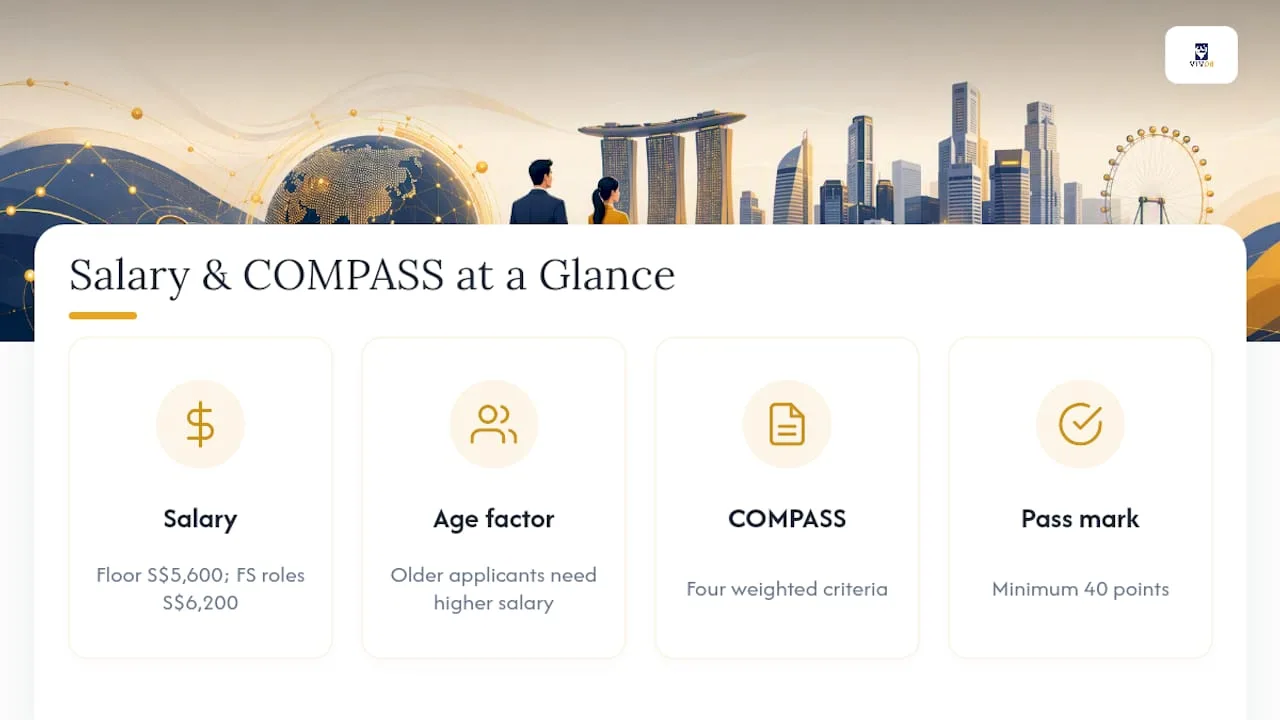
Salary alone doesn’t decide the outcome. COMPASS scores the application across four weighted criteria, and the pass requires a combined score of at least 40 points.
Pro Tip: A founder who pays below-market salary to preserve cash often loses more points on C1 than they gain elsewhere. It’s usually cheaper to raise the salary slightly than to try to offset a weak score through qualifications or diversity criteria.
Some applications qualify for automatic COMPASS exemption or bonus points under specific conditions, but the baseline pass mark of 40 points still applies to the vast majority of founder applications.
| Factor | Employment Pass | EntrePass | ONE Pass |
|---|---|---|---|
| Who it’s for | Founders running an operating company that can pay a qualifying salary | Venture-backed, IP-driven, or incubator-supported entrepreneurs | Top-tier, high-earning global talent (not founder-specific) |
| Minimum salary | S$5,600 general / S$6,200 financial services | No fixed salary test | S$5,600 monthly fixed salary |
| Ownership requirement | No fixed minimum, but founder is typically a substantial shareholder | At least 30% shareholding | Not tied to company ownership |
| Business validation needed | Company substance, real trading activity, salary evidence | Funding, incubator support, registered IP, or research collaboration | Track record in a leading firm or exceptional achievement |
| Initial validity | Up to 2 years first-time, up to 3 years on renewal | Typically 1 year first-time, longer on renewal with business progress | Up to 5 years |
| Processing time | A few weeks after complete submission | Within 6 weeks | Several weeks, case dependent |
For most founders reading this, the decision comes down to one question: can the company pay the qualifying salary today? If yes, EP is usually the faster, more predictable route.
Employers hiring for supporting roles alongside the founder must also comply with the Fair Consideration Framework, advertising the position on MyCareersFuture before applying.
Founders who get rejected almost always fall short on documentation, not eligibility. Build the file before you submit, not after MOM asks for it.
EntrePass carries fixed fees: S$105 on application, S$225 on issuance, per MOM’s published schedule. EP applications don’t carry a standard flat fee in the same way, but administrative and issuance costs apply once the IPA is granted.
A nominee director is often needed at incorporation stage purely to satisfy banking and administrative requirements before the EP is approved. It’s a temporary structural fix, not a permanent feature of the business.

Renewal isn’t automatic for either pass type.
Founders who treat renewal as a formality tend to get caught out. Build the KPI evidence as you go, not in the weeks before the pass expires.
Founder applications fail for predictable reasons. The table below is drawn from the cases we see most often at VIVOS as an MOM-licensed employment agency (24S2425).
| Mistake | Effect on the application | What to do instead |
|---|---|---|
| Applying days after incorporation with no substance | MOM questions whether the company can genuinely employ you | Build evidence first: office address, bank account, contracts or pipeline, website, a business plan and a paid-up capital figure that matches the plan |
| Salary set at the bare qualifying floor for your age | Low COMPASS C1 points and a weak signal on role seniority | Benchmark the role against local PMET pay for the sector and pay at or above the 65th percentile where the business can support it |
| Generic job title and description | MOM cannot see why a foreign hire is needed | Describe managerial, strategic or technical responsibilities specific to the company |
| Skipping or mis-running the MyCareersFuture advertisement | Automatic rejection unless the company is exempt (fewer than 10 employees or S$22,500+ salary) | Run the advertisement for at least 14 consecutive days with a compliant salary range and quote the reference in the application |
| Qualifications that cannot be verified | Zero COMPASS C2 points or rejection | Use accredited institutions, include transcripts and, where required, third-party verification |
| Slow replies to MOM document requests | Processing stalls beyond 10 business days or the file is closed | Monitor the EP eService and answer requests within days, not weeks |
| Wrong pass for the situation | Rejection or a pass that restricts what you can do | Founders without a qualifying salary should look at the EntrePass; those earning S$30,000 a month should compare the ONE Pass |
Two structures cover most founder cases: a self-employed EP through a new Singapore private limited company, or an EP under the Singapore subsidiary or branch of an existing overseas business. In both, the company is the applicant and the founder is its employee, so the company must look credible on paper before the application is filed. The general rules, salary tiers and COMPASS scoring are in our Singapore Employment Pass 2026 guide.
Most EP rejections trace back to the same three gaps: incomplete documentation, a company that looks like a shell rather than an operating business, or salary evidence that doesn’t hold up under COMPASS scrutiny.
“The applications that get rejected almost always share one pattern: the company was incorporated as an afterthought, with no real operational substance behind it. When we handle incorporation and the EP application together, we can build the business file MOM actually wants to see, from day one,” says Ray Tay, Managing Director of Vivos.
Vivos combines Singapore company incorporation with EP application support, so the two workstreams don’t fight each other. That means:
Pro Tip: Founders who incorporate first and think about the EP later often have to redo their share structure or salary setup. Sequencing incorporation and EP planning together avoids that rework.
The conventional advice treats EP and EntrePass as a binary choice based purely on funding stage. That’s incomplete. COMPASS rewards company substance and salary discipline more than it rewards a polished pitch deck, and plenty of founders with modest but real revenue clear the bar faster than well-funded startups with thin local hiring.
The bigger mistake is sequencing: founders incorporate first, then scramble to retrofit the business for EP eligibility once salary and share structure are already locked in. Rebuilding that after the fact costs more time than doing it right from incorporation onward.
If there’s one thing to prioritize before anything else, it’s operational substance. A registered address and a paid-up capital figure on paper won’t satisfy MOM’s expectation of a genuine trading business. Founders who treat incorporation and the EP application as one connected process, rather than two separate tasks, tend to move through COMPASS scoring with far fewer surprises.
Vivos is the practical alternative to handling incorporation and immigration as two disconnected projects. Founders who incorporate separately from their EP planning often end up rebuilding share structures or salary terms mid-application, which costs weeks that a coordinated setup avoids entirely.
Vivos manages Singapore company incorporation and EP application support as one process, built around what COMPASS and MOM’s substance checks actually require. That includes structuring the founder’s salary correctly from the outset, preparing the documentation MOM expects to see, and coordinating timing between ACRA registration and pass submission. Founders who also need banking support or ongoing compliance can layer in corporate secretarial services once the company is live. If you’re planning to run your own Singapore business and need the EP to match, reach out to Vivos to scope your incorporation and EP application together before you file anything with MOM.
Yes. A foreign business owner can apply for an EP through their own Singapore company if the company pays the qualifying salary (S$5,600 general, S$6,200 financial services) and the application scores at least 40 points on COMPASS.
The minimum qualifying salary is S$5,600 a month for most sectors, rising to S$6,200 for financial services roles. Older applicants face higher age-linked benchmarks under MOM’s progressive salary framework.
Choose EntrePass if your business is pre-revenue but backed by funding, incubator support, or registered IP. Choose EP if your company can already pay the qualifying salary and you want faster, more predictable processing.
EntrePass applications typically process within 6 weeks. Employment Pass processing varies by case complexity, but the pass itself runs up to 2 years first-time and up to 3 years on renewal.

 2 January, 2025
 2 January, 2025
注册新加坡公司,先备齐名称、章程、董事股东证件、注册地址及股本信息。本文梳理提交步骤、315新币官方费用与审批要点,助您少补件、顺利完成申请。

Foreign founders can check Singapore’s 10% and 15% S Pass caps, S$650 monthly levy, and S$3,300 salary floor, then plan incorporation and pass filing with...

在新加坡使用虚拟地址,须登记境内实体地址、避开邮政信箱,并在变更后14天内申报。掌握2026年文件查阅新规、选址核验与违规风险,创业合规少走弯路。