

Part Time Employment: 1.5x Overtime for Foreign Founders in Singapore

Ray Tay
Singapore's part time rules put the line below 35 weekly hours and cover pro rated leave, CPF eligibility, and 1.5x overtime for foreign founders.
Published: 4 August 2026 · Last reviewed: 9 October 2026 · Reviewed by Ray Tay, Co-Founder & Managing Director, VIVOS PTE. LTD. (ACRA Filing Agent FA20240323 · MOM EA Licence 24S2425)
From 1 January 2026, CPF contribution rates changed for two senior worker age bands — above 55 to 60 and above 60 to 65 — and the monthly Ordinary Wage (OW) ceiling reached S$8,000 under its phased increase schedule. Every employer running Singapore payroll must update rate tables, verify age-band logic, and confirm OW ceiling handling before the next pay run.
Immediate actions for payroll and HR teams:
Key entities for compliance: CPF Board (cpf.gov.sg), Ministry of Manpower (mom.gov.sg), and VIVOS as the advisory resource for employers needing implementation support.
Pro Tip: Run a parallel payroll test for January 2026 using the updated rate tables before processing live payroll. Compare outputs against the CPF Contribution Calculator to catch discrepancies before they become late-payment liabilities.

The table below shows the full rate schedule by age band, including the employer/employee split and the change from 2025 rates. Rates apply to employees earning more than S$750 per month.

| Age Band | Employer % | Employee % | Total % | Change vs 2025 |
|---|---|---|---|---|
| 55 and below | 17% | 20% | 37% | No change |
| Above 55 to 60 | 16% | 18% | 34% | +1.5% total |
| Above 60 to 65 | 12.5% | 12.5% | 25% | +1% total |
| Above 65 | 9% | 7.5% | 16.5% | No change |
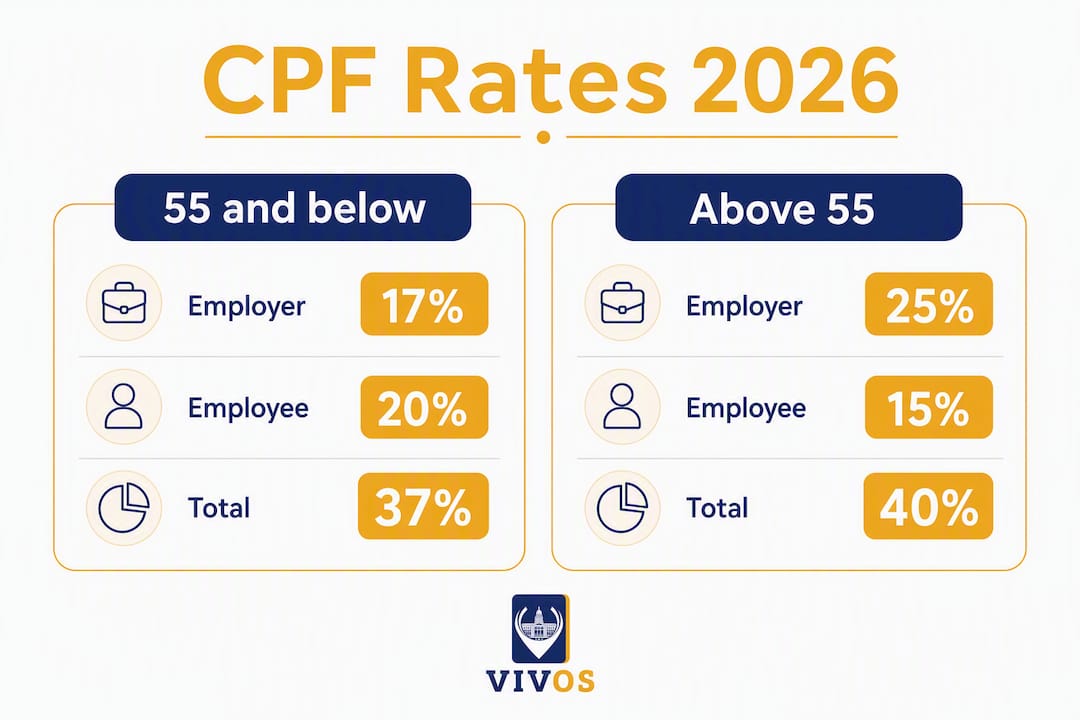
The increases for the above 55–60 band (+1.5% total) and the above 60–65 band (+1% total) represent the continuation of a phased strategy to strengthen retirement adequacy for senior workers. Both increases are allocated to the Retirement Account, not the Ordinary Account, up to the Full Retirement Sum — a distinction with direct implications for how payroll systems record the credit.
The monthly OW ceiling reached S$8,000 in 2026, completing a four-step phased increase from S$6,000 (pre-September 2023). For an employee earning S$9,000 per month, only S$8,000 attracts CPF contributions — the remaining S$1,000 is excluded from the OW calculation.
Data source: CPF Board — How much CPF contributions to pay. Rates confirmed effective 1 January 2026.
CPF contributions are mandatory for Singapore Citizens and Singapore Permanent Residents (SPRs). Foreign employees are excluded from mandatory CPF regardless of their salary level or employment type. Employers cannot make CPF contributions on behalf of foreign staff even if the employee requests it; interested foreign employees should be directed to the Supplementary Retirement Scheme (SRS) instead.
Covered employees:
Employment type coverage:
Employers managing Employment Pass or S Pass holders alongside local staff should note that CPF eligibility is tied to citizenship/PR status, not pass type. For Employment Pass salary thresholds and how they interact with payroll obligations, refer to the 2026 EP minimum salary thresholds published by VIVOS.
CPF contributions are split across up to four accounts depending on the employee’s age:
For the 2026 rate increases affecting the above 55–60 and above 60–65 bands, the additional contributions are credited directly to the Retirement Account up to the Full Retirement Sum. Once the RA reaches the Full Retirement Sum, excess contributions flow to the Ordinary Account. This allocation rule is specific to the incremental increases — it does not apply to the base contribution amounts, which follow the standard age-band allocation tables.
The CPF Annual Limit is S$37,740. This cap covers total annual CPF contributions from both Ordinary Wages and Additional Wages (AW) combined. When an employee’s OW contributions for the year are close to S$37,740, the employer must calculate the remaining AW ceiling before deducting CPF on bonuses or other AW payments. The formula: AW ceiling = S$37,740 minus total OW subject to CPF for the year.
With the OW ceiling now at S$8,000 per month, an employee earning S$8,000 or more every month will have OW contributions calculated on S$8,000 × 12 = S$96,000 in OW — but the Annual Limit of S$37,740 still caps total contributions, so AW headroom shrinks accordingly for high earners.
Pro Tip: Set an automated alert in your payroll system to flag employees whose year-to-date CPF contributions reach 90% of S$37,740. This gives you time to recalculate AW ceilings before processing year-end bonuses, avoiding over-deduction and the administrative burden of refunds.
The following examples use 2026 rates and the S$8,000 OW ceiling. The CPF Contribution Calculator should be used to verify all live payroll calculations.
| Input | Value |
|---|---|
| Age band | 55 and below |
| Monthly OW | S$5,000 |
| OW ceiling | S$8,000 |
| OW subject to CPF | S$5,000 |
| Employee CPF (20%) | S$1,000 |
Rates for the above 55–60 band apply from 1 April 2026 (first day of the month after the birthday month). January to March: use the 55-and-below rate (17% employer / 20% employee). April onward: use the above 55–60 rate (16% employer / 18% employee).
| Period | Employer % | Employee % | Monthly CPF |
|---|---|---|---|
| Jan–Mar 2026 | 17% | 20% | — |
| Apr–Dec 2026 | 16% | 18% | — |
The rate change applies automatically from April; payroll systems must detect the birthday month and switch rates on the first of the following month.
OW is capped at S$8,000. CPF is calculated on S$8,000 only.
Employee aged 40, annual OW = S$8,000 × 12 = S$96,000. OW subject to CPF = S$8,000 × 12 = S$96,000. AW ceiling = S$37,740 minus total OW CPF contributions already made. Use the Additional Wage Ceiling Calculator on cpf.gov.sg to compute the exact AW ceiling before processing the bonus.
Reconciliation checklist:
Pro Tip: Build a simple spreadsheet with columns for Employee ID, Age Band, OW, OW Capped, Employer CPF, Employee CPF, YTD Total, and AW Remaining. Updating it monthly takes minutes and catches ceiling breaches before they hit the submission deadline.
Compliance with the 2026 CPF contribution changes requires a structured payroll update process. Late payment attracts interest at 18% per annum (1.5% per month), and persistent non-payment can result in criminal penalties under MOM guidance.
Step-by-step employer checklist:
Submission deadlines and penalties:
Employers using multiple payroll systems or managing employees with more than one employer should note that the OW ceiling applies on a per-employment basis. Each employer calculates CPF independently on their own OW paid. If an employee’s combined OW across employers exceeds the ceiling, the employee may apply to the CPF Board for a refund of excess employee contributions — but the employer’s share is not refundable.
For small business owners building or reviewing payroll processes, the 2026 payroll management guide covers practical system setup and compliance workflows applicable alongside Singapore’s statutory requirements.
The CPF contribution rate increases for senior workers are part of a multi-year phased schedule. Employers should plan for the next round of increases taking effect 1 January 2027, which will again affect the above 55–60 and above 60–65 age bands.
Planning implications for HR and finance teams:
The phased approach to both rate increases and ceiling adjustments reflects the government’s long-term strategy to align CPF contributions with rising wages and retirement adequacy targets. For employers, the practical implication is that payroll cost modeling should treat CPF as a variable that changes annually for senior worker bands, not a fixed overhead.
Pro Tip: Add a recurring Q4 calendar item for payroll system reviews tied to CPF rate announcements. CPF Board typically publishes confirmed rate tables several months before the effective date, giving payroll teams a clear window for testing and communication.
VIVOS provides end-to-end payroll management services in Singapore that cover statutory rate updates, contribution calculations, CPF EZPay submissions, and reconciliations. For employers who lack in-house payroll expertise or who manage complex workforce structures — including senior workers, SPRs, and multi-employer arrangements — VIVOS handles the implementation detail so compliance is not left to chance.
Relevant VIVOS services for CPF compliance:
VIVOS supports implementation across the full cycle: updating rate tables, running test payroll batches, reconciling EZPay submissions, and liaising with CPF Board or MOM where clarification is needed. For international businesses establishing Singapore payroll for the first time, VIVOS also covers the setup of payroll infrastructure alongside bookkeeping and compliance services to meet statutory obligations from day one.

Pro Tip: Outsourcing payroll to a specialist like VIVOS reduces the risk of rate-table errors during statutory change periods — the most common source of CPF under- or over-payment. Contact VIVOS to review your current payroll setup ahead of the next pay run.
The 2026 CPF contribution rate changes require immediate payroll updates for senior worker age bands and OW ceiling adjustments for all employees — non-compliance carries an 18% per annum late-payment interest charge.
| Point | Details |
|---|---|
| Effective date | All 2026 rate and ceiling changes apply from 1 January 2026. |
| Senior worker rate increases | Above 55–60: total 34%; above 60–65: total 25% — both increased from 2025. |
| Monthly OW ceiling | Reached S$8,000 in 2026; CPF is calculated only on OW up to this amount per employment. |
| CPF Annual Limit | S$37,740 caps total annual contributions; calculate AW ceiling before processing bonuses. |
| Immediate payroll actions | Update rate tables, test payroll batch, verify age-band transition logic, reconcile with CPF EZPay. |
The birthday-month rule catches more payroll teams than any other CPF compliance detail. The rate change does not apply in the month of the birthday — it applies from the first day of the following month. A system that switches rates on the birthday date will under-deduct for the remainder of that month and create a reconciliation gap that compounds if not caught before the CPF submission deadline.
The second consistent error is the OW ceiling applied at the employee level rather than the employment level. For employees with two concurrent employers, each employer independently applies the S$8,000 ceiling to their own OW payments. An employer who reduces their CPF calculation because they assume the employee’s combined wages already exceed the ceiling is making an incorrect deduction — and is liable for the shortfall plus late-payment interest.
The practical fix for both: automate age-band transitions using the CPF EZPay tool and run a monthly reconciliation against the CPF Contribution Calculator before submission. For complex workforce structures, engaging a specialist like VIVOS removes the manual dependency entirely.
Payroll teams should bookmark the following official pages and verify all rate figures directly against primary sources before each payroll run.
| Resource | Use Case |
|---|---|
| CPF Contribution Calculator | Monthly spot-check for any employee |
| AW Ceiling Calculator | Pre-bonus AW headroom calculation |
| CPF EZPay | Submission and reconciliation |
| MOM employer CPF page | Penalty rates and enforcement guidance |
This article provides general information on CPF contribution obligations in Singapore and does not constitute professional payroll, legal, or tax advice. Confirm current rates and rules with the CPF Board, MOM, or a qualified advisor before processing payroll.

 2 January, 2025
 2 January, 2025
Singapore's part time rules put the line below 35 weekly hours and cover pro rated leave, CPF eligibility, and 1.5x overtime for foreign founders.

10 Singapore corporate secretary providers compared: published fees from S$199 to S$800 a year, what each includes, and the ACRA rules. Checked Oct 2026.

10 Singapore Employment Pass agencies compared on MOM licence, published fees, passes handled and whether they also incorporate companies. Checked 16 Oct 2026.