

新加坡商业许可申请全攻略:ACRA 注册后该怎么做

Ray Tay
了解新加坡商业许可如何按行业判定,注册后用 GoBusiness 查询牌照要求,并掌握餐饮、按摩、进出口审批及场地合规要点,避免申请受阻。
Published: 17 August 2026 · Last reviewed: 30 September 2026 · Reviewed by Ray Tay, Co-Founder & Managing Director, VIVOS PTE. LTD. (ACRA Filing Agent FA20240323 · MOM EA Licence 24S2425)
Miss an ACRA filing deadline and the penalty is fixed, not negotiable. For annual lodgments due on or after 14 Jan 2022, the two-tier penalty structure charges S$300 if you file within three months of the due date and S$600 if you file after that. Ad-hoc filings (director changes, registered address updates) sit on a separate, lower scale.
Here is what to do right now, before anything else:
The core rule is simple: annual lodgments filed within three months of the due date incur a fixed penalty, and filings later than that incur a higher fixed penalty, with ad-hoc filings following a separate, lower scale.
| Point | Details |
|---|---|
| Two-tier annual penalty | Two fixed penalty tiers apply for lodgments due on or after 14 Jan 2022. |
| Ad-hoc filings cost less | Officer or address changes typically incur lower fixed penalties depending on when filed. |
| Penalty appears at lodgment | BizFile calculates and displays the exact amount automatically when you file late. |
| Appeals don’t pause payment | File and pay first; appeals take about four weeks and the fee usually stays due meanwhile. |
| VIVOS supports recovery and prevention | VIVOS’s corporate secretarial team helps resolve overdue filings and build a compliance calendar to prevent repeats. |
Watch on YouTube: Singapore Business Compliance: Avoid Common ACRA Filing Mistakes · 39 sec.
A late lodgment penalty is the fee ACRA charges when a company, foreign entity, variable capital company (VCC), or limited liability partnership (LLP) misses a statutory filing deadline. The rationale is straightforward: Singapore’s corporate registry only works if the information on it is current, and ACRA’s enforcement approach treats register accuracy as a public good worth protecting.
Not every filing is treated the same way. ACRA splits its penalty framework into two broad categories:
Liability sits with the company itself, but directors and company secretaries carry personal responsibility for making sure filings happen. If you’re a director, you can’t outsource that obligation to a co-director and assume you’re covered. Repeated lapses can expose individual officers to disqualification, separate from any penalty the company pays.
The numbers below apply to filings due on or after 14 January 2022. Earlier filings may fall under a different (now retired) fee schedule, so if you’re dealing with a very old outstanding lodgment, confirm which framework applies before you assume the current rates apply.
| Filing Type | Within 3 Months of Due Date | More Than 3 Months After Due Date |
|---|---|---|
| Annual lodgment (annual return, annual declaration) | Fixed lower tier penalty applies | Fixed higher tier penalty applies |
| Most ad-hoc filings (e.g., officer changes, registered address) | Fixed lower penalty applies | Fixed higher penalty applies |
The two-tier structure means timing is the single biggest variable in what you pay. File on day 91 instead of day 89 for an annual return, and the penalty doubles from S$300 to S$600. There’s no sliding scale in between. It’s a cliff, not a ramp.
A few structural notes worth flagging:
Numbers on a page are one thing. Seeing how they land on an actual filing calendar makes the stakes clearer.
Scenario 1: Annual return filed 20 days late. A private company with a financial year end (FYE) of December 31 typically has seven months after FYE to hold its AGM and file its annual return, depending on the company’s constitution and any AGM exemptions. If the due date passes and the director files 20 days later, that’s comfortably inside the three-month window.
Scenario 2: Annual return filed 4 months late. Same company, same due date, but the director gets distracted by a fundraising round and doesn’t file until four months after the deadline. That crosses the three-month threshold. Penalty: the increased fixed amount as per ACRA’s schedule for more than three months late.
Scenario 3: Director change filed 4 months late. A company appoints a new director in March but the officer change isn’t lodged until August, well past the standard 14-day filing window for such updates. Since this is an ad-hoc filing rather than an annual lodgment, it falls under the lower scale. Being more than three months late here means a fixed penalty consistent with ACRA’s ad-hoc filing penalties, lower than for annual lodgments.
Notice that Scenario 3’s penalty is lower than Scenario 1’s despite the longer delay. The filing category matters more than the raw number of days late.
The dollar penalty is often just the opening move. ACRA’s own enforcement guidance lists a range of tools beyond the standard late lodgment fee:
Which tool ACRA reaches for depends on context. Its enforcement approach weighs the seriousness of the breach, the potential damage to register integrity, and the company’s compliance track record. A single late annual return from an otherwise clean company rarely triggers anything beyond the standard penalty. A pattern of missed filings, especially combined with unresponsive directors, moves ACRA toward prosecution or disqualification.
If you believe your penalty was applied unfairly or want it reduced, ACRA accepts appeals through its Late Lodgment Appeal representation form. Reviews are handled case by case and typically take around four weeks.
Pro Tip: File and pay the penalty first, then appeal. The original fee generally remains due while ACRA reviews your case, so paying upfront stops any risk of escalation while you make your case. Evidence of rectification (the corrected filing, dated confirmation) and a clean compliance history are what actually move an appeal outcome, not the explanation for why you were late.
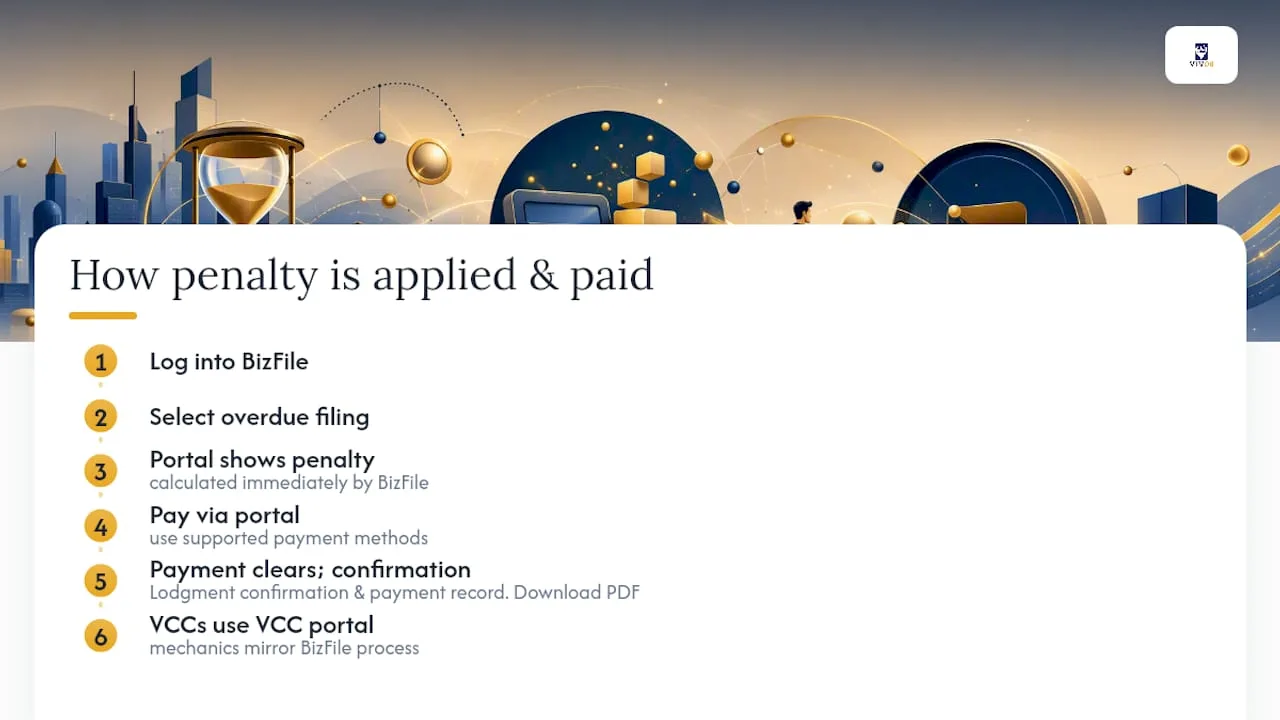
There’s no separate invoice, no waiting period, and no manual calculation on ACRA’s end. The moment you submit a late filing through BizFile, the system automatically calculates the applicable penalty based on the filing type and how many days past due it is.
The flow works like this: you log into BizFile, select the overdue filing, and the portal displays the penalty amount before you can proceed. You pay through the portal’s supported payment methods, and once payment clears, BizFile issues a lodgment confirmation and payment record. VCCs go through the dedicated VCC portal, but the mechanics mirror BizFile’s process closely.
Pro Tip: Download and save the confirmation PDF the moment you complete payment, not weeks later. If BizFile shows an amount that doesn’t match the two-tier structure you expected, don’t assume it’s an error. It usually means the filing is categorized differently than you thought (ad-hoc versus annual lodgment), so double-check the filing type before disputing anything.
An extension of time (EOT) lets you push back a filing deadline before it’s actually missed, which sidesteps the penalty altogether rather than trying to reduce it afterward. ACRA grants these for legitimate reasons: pending audit sign-off, a genuine force majeure event, or a documented administrative delay outside the company’s control.
Pro Tip: An EOT request rarely helps once you’re already past the due date. At that point you’re better off filing immediately, paying the resulting penalty, and appealing afterward if there’s a genuine mitigating reason. Chasing an EOT after the fact usually just adds delay without changing the outcome.
If you’re dealing with an overdue filing today, the sequence matters:
Preventing a repeat is a separate exercise, and it’s less about vigilance than about structure:
Pro Tip: The governance controls that stop most director-level breaches are unglamorous: a retained corporate secretary, XBRL readiness well before the financial statement deadline, and someone outside the company checking dates independently. Companies that build these in rarely see a repeat penalty.
The mistakes that generate late lodgment penalties are rarely dramatic. They’re procedural, and they repeat across companies of every size.
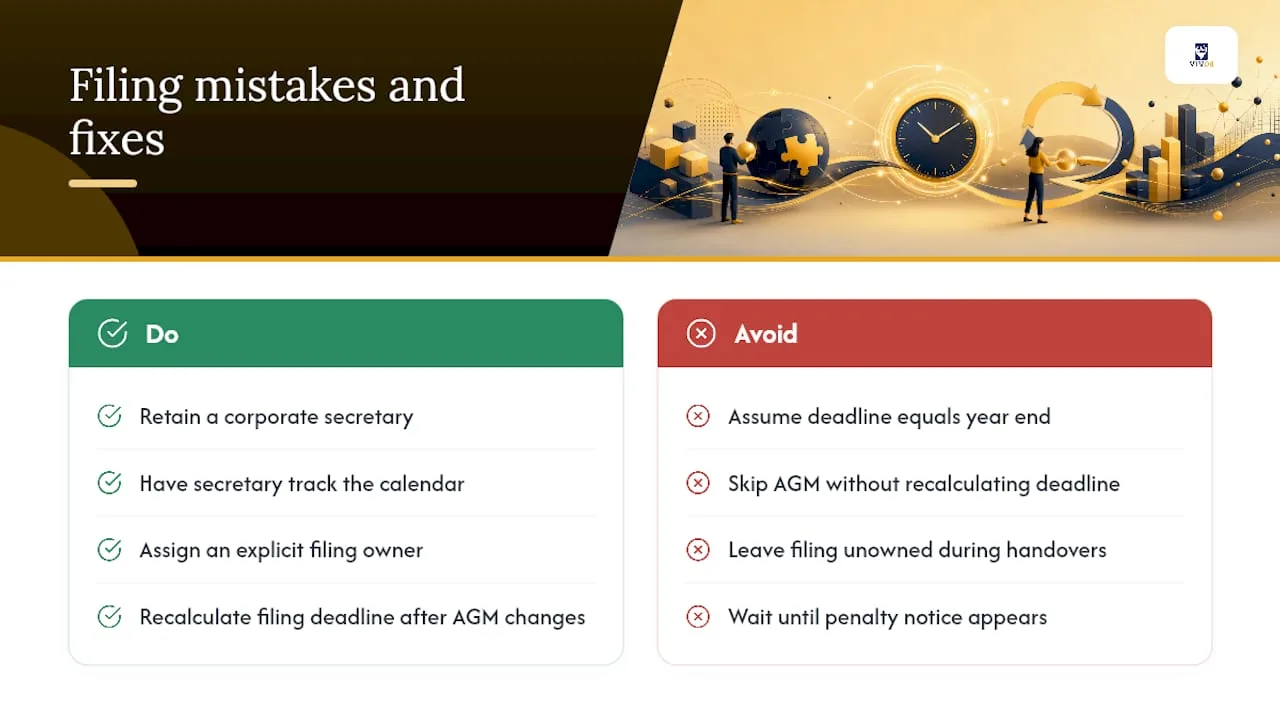
The most common one is misreading the filing window itself. Directors often assume the annual return deadline is tied purely to the financial year end, when in practice the AGM timing and any AGM exemptions shift the actual due date. A company that holds its AGM late, or skips it under an exemption without recalculating the filing deadline, walks straight into a penalty it didn’t see coming.
The second recurring failure is the handover gap. When a director resigns or a new one joins, filing responsibility often falls into a crack between the outgoing and incoming officer. Nobody explicitly owns the next deadline, and by the time anyone notices, the three-month window has already closed.
If there’s one structural fix worth prioritizing, it’s treating the corporate secretary function as a genuine control, not paperwork. A properly retained secretary tracks the calendar independently of whoever happens to be running the company that quarter, which removes the single point of failure that causes most of these breaches. Directors who wait until a penalty notice appears before thinking about their filing calendar are treating a fixed legal obligation like a flexible one. It isn’t.
VIVOS gets you back in good standing faster than handling ACRA correspondence alone, and keeps you there without a lock-in contract. Filing appeal documentation, correcting an overdue lodgment, and rebuilding a compliance calendar all take specific procedural knowledge that most in-house teams don’t use often enough to stay sharp on.

VIVOS’s corporate secretarial services cover exactly the gaps that produce late filing penalties in the first place: statutory deadline tracking mapped against your FYE and AGM dates, governance and meeting management so AGM timing never quietly shifts your annual return due date, and direct support if you’re already facing a penalty and need to file, pay, and prepare an appeal properly. If you’ve had a director handover recently or you’re not sure who currently owns your filing calendar, that’s usually the first sign of trouble. Talk to a VIVOS corporate secretarial specialist and get your compliance calendar reviewed before the next deadline, not after.

 2 January, 2025
 2 January, 2025
了解新加坡商业许可如何按行业判定,注册后用 GoBusiness 查询牌照要求,并掌握餐饮、按摩、进出口审批及场地合规要点,避免申请受阻。

Learn how Singapore taxes nonresident employees, when the 60 day exemption applies, and how employers meet IR21, IR8A, and departure filing deadlines.