

Does Singapore Offer Citizenship by Investment? (2026)

Ray Tay
Singapore has no citizenship by investment programme. Investors can get PR through the Global Investor Programme, then apply to ICA for citizenship after at least…
Published: 4 September 2026 · Last reviewed: 30 September 2026 · Reviewed by Ray Tay, Co-Founder & Managing Director, VIVOS PTE. LTD. (ACRA Filing Agent FA20240323 · MOM EA Licence 24S2425)
The Register of Registrable Controllers (RORC) is a private record of the individuals or entities that own a substantial portion of a company or otherwise exercise significant control over it. Any change to a controller’s particulars must be updated in the private RORC within seven days and lodged with ACRA’s Central RORC via BizFile+ within two business days, as of 2026.
TL;DR:
- Controllers exercising significant control via veto rights, director appointment powers, or contractual authority are subject to registration even without shareholding.
- The private RORC must be kept updates within seven days of a change, and filed with ACRA within two business days, with accurate identification and supporting documentation.
- Foreign founders must appoint a local agent or secretary to manage RORC compliance because deadlines and notifications are strictly enforced.
- Most errors stem from late filings, neglecting annual notices, or failing to trace effective control through layered corporate or nominee arrangements.
- Using professional corporate services can ensure timely, correct RORC maintenance from incorporation through ongoing compliance.
The RORC exists because ACRA and the Companies Act require transparency about who ultimately owns or controls a Singapore entity, not just who appears on the share ledger. Unless exempted, all companies, foreign companies registered in Singapore, and limited liability partnerships must set up and maintain a RORC. Certain listed entities and a small set of regulated financial institutions fall outside the requirement, but the default assumption for a private limited company should be that it applies.
Two separate registers matter here. The private RORC sits with the entity itself, usually at the registered office or with a Registered Filing Agent. The Central RORC sits with ACRA and is built from what entities lodge through BizFile+. Only law enforcement agencies can access the Central RORC. It is not searchable by the public, competitors, or even other shareholders, which is precisely why the private register still needs to exist independently and stay accurate at the entity level.
Recent amendments through 2025 refined filing mechanics and register formats under the Companies (Register of Controllers and Nominee Directors) regulations, but the core 25% and control tests have held steady.
Ownership percentage is the easy test. A registrable controller generally holds a significant portion of shares, voting rights, or profit distribution rights in the entity. The harder test, and the one directors get wrong most often, is significant control exercised through means other than shares.
That “other means” category covers a wide range of arrangements:
Legal ownership and beneficial ownership frequently diverge, and rights that grant effective control can make someone a controller even without shareholding. When a company genuinely cannot identify anyone meeting these tests after reasonable inquiry, ACRA’s guidance on identifying and sending annual notices to registrable controllers points to recording the individual with executive control instead, typically a managing director or CEO, rather than leaving the register blank.
The particulars required differ depending on whether the controller is a natural person or a corporate entity. Both the private RORC and any subsequent BizFile+ filing rely on the same underlying data, so getting the fields right the first time avoids repeat corrections.
| Particular | Individual controller | Corporate controller |
|---|---|---|
| Identity | Full name and any known aliases | Registered name and UEN or foreign registration number |
| Address | Residential address | Registered office address |
| Identification | NRIC, FIN, or passport number | Jurisdiction and legal form of incorporation |
| Nationality | Nationality | Place of incorporation |
| Other details | Date of birth, contact details | Contact details |
| Dates | Date became and (if applicable) ceased being a controller | Date became and (if applicable) ceased being a controller |
The private register must be kept at the registered office or with a Registered Filing Agent, in either physical or electronic form, so long as it can be produced on request. Loose spreadsheets scattered across personal drives do not satisfy this in practice, even when the data itself is correct.
Building a compliant register is a sequence, not a one-off task. Skipping the order, especially jumping straight to filing without proper identification, is where most errors creep in.
Pro Tip: Keep a standing folder of notice templates and dated proof-of-sending records. ACRA’s own RORC, ROND and RONS guidance includes reference templates, and having them pre-drafted shaves days off a compliance review when a controller changes unexpectedly.
The two statutory clocks run in sequence, not in parallel, and mixing them up is a common source of missed deadlines. Once you become aware of a change, you have seven days to update the private RORC. Once the private register is updated, you have two business days to file that change with the Central RORC via BizFile+.
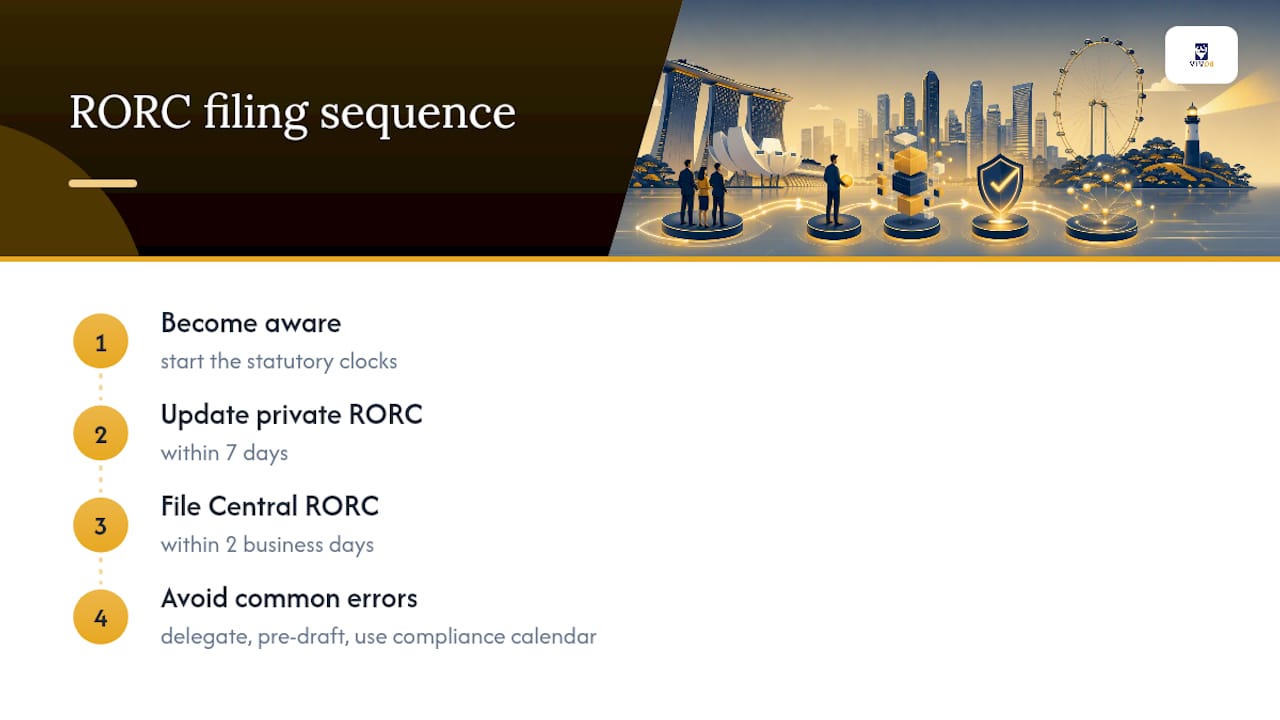
The two-business-day window is genuinely tight, particularly around public holidays or when the officer responsible is traveling. Filing runs through the Update Register of Registrable Controllers eService on BizFile+, accessible to company officers or an appointed filing agent using Singpass or CorpPass credentials. The most frequent user error is treating “two business days” as calendar days, which quietly eats into the buffer. Delegating the filing task to a corporate secretary, pre-drafting the submission fields, and maintaining a compliance calendar all reduce the risk of breaching this window.
Failing to maintain or lodge accurate RORC information is a statutory offense, not a paperwork formality. Since RORC lodgment became mandatory on 30 July 2020, ACRA has flagged that failure to file changes can attract a fine, with past guidance citing penalties of up to $5,000 for non-compliance.
Three mistakes account for most enforcement exposure: skipping annual notices because the details “haven’t changed,” accepting the first-layer corporate shareholder without tracing to the natural person behind it, and filing late because nobody owned the two-business-day deadline. If ACRA ever asks how controllers were identified, having dated notices, registry searches, and shareholder documentation on file is what demonstrates “reasonable steps” were taken.
Foreign owners are not exempt from RORC obligations, and the duty begins from the moment a Singapore entity is incorporated, not after the first financial year closes. For founders running a company from overseas, that creates an immediate operational gap: someone locally has to identify controllers, send notices, and file on tight deadlines.
Certain corporate service providers offer Singapore company incorporation for foreign founders, including nominee resident directors, registered addresses, and corporate secretarial services to maintain the RORC as part of ongoing statutory compliance. Some firms also incorporate entities in Malaysia, Hong Kong, and the UAE for founders expanding across the region.
“Directors underestimate how quickly a missed annual notice turns into an enforcement question,” says Ray Tay, Managing Director of VIVOS. “Accurate, timely RORC maintenance is not optional bookkeeping. It is a legal obligation that ACRA actively checks.”
If your compliance calendar has gaps around controller notices or BizFile+ deadlines, a review now is cheaper than an enforcement letter later.
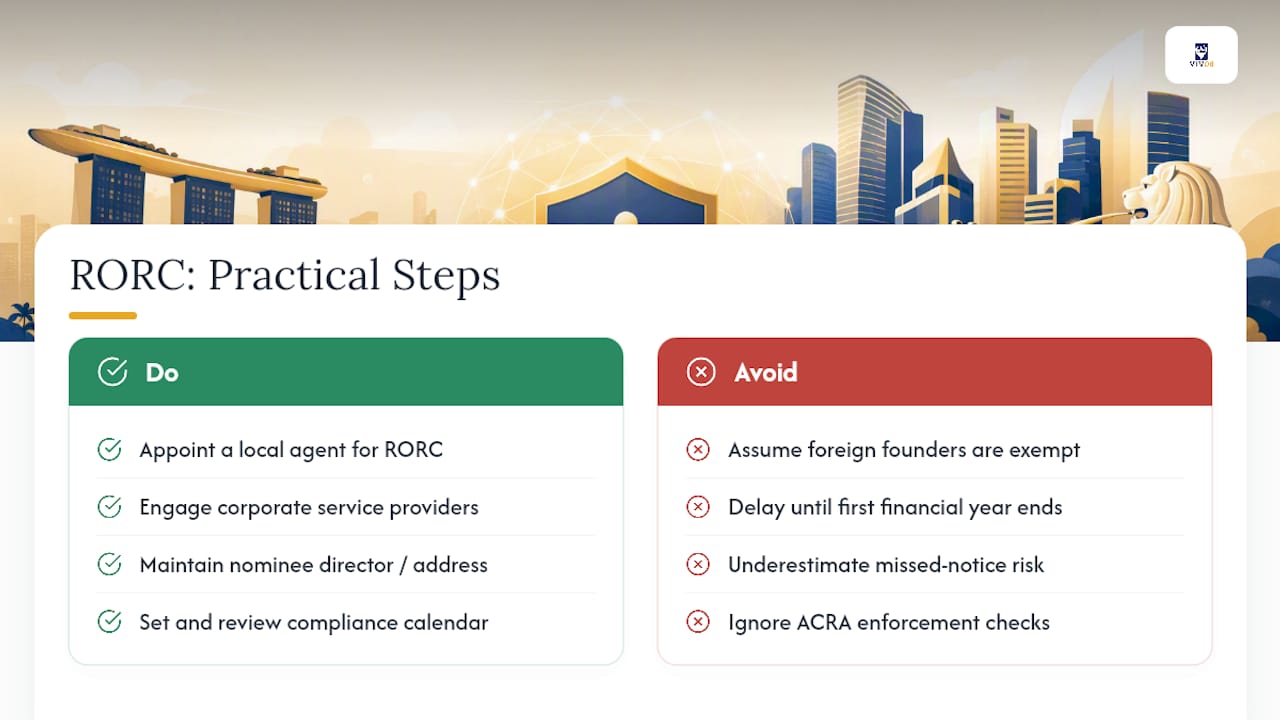
Some firms provide an alternative to juggling RORC deadlines yourself. Instead of tracking two separate statutory clocks across notices, updates, and BizFile+ filings on top of running a business, you can hand the entire cycle to a corporate secretary who does it for entities across multiple jurisdictions.

VIVOS’s corporate secretarial services cover RORC upkeep, annual notices, and Central RORC filings as a standing part of the engagement, not a one-off task. For foreign founders, that pairs naturally with Singapore company incorporation, where a nominee resident director and registered address are set up alongside the RORC from day one. Clients choose VIVOS because the local regulatory detail, deadlines, and documentation are handled end to end, without a founder needing to learn BizFile+ mechanics themselves. If your entity needs a compliance check on its current register, or you are incorporating and want the RORC built correctly from the start, you may consider requesting a review from a professional corporate services provider to get a clear answer on where you stand.

 2 January, 2025
 2 January, 2025
Singapore has no citizenship by investment programme. Investors can get PR through the Global Investor Programme, then apply to ICA for citizenship after at least…

2026年新加坡私人公司股份转让完整流程:章程核查、转让文书、IRAS印花税计算、ACRA申报与控制人名册更新,并附各环节时限总表。