
8 item checklist: Singapore compilation report for foreign founders
Published: 9 October 2026 · Reviewed by Ray Tay, Co-Founder & Managing Director, VIVOS PTE. LTD. (ACRA Filing Agent FA20240323 · MOM EA Licence 24S2425)
A compilation report is a set of unaudited financial statements prepared by an accountant under SSRS 4410 for audit-exempt small companies in Singapore. Directors use it for ACRA annual returns, IRAS Form C-S/C, and bank applications. It is not an audit, and it gives no assurance on whether the figures are accurate.
TL;DR:
- A company needs two of three tests for two consecutive years: revenue up to S$10 million, assets up to S$10 million, or 50 employees maximum.
- Group companies must also pass the small group test on a consolidated basis; newly incorporated companies generally meet the test before two financial years accrue.
- Banks often accept compiled statements for routine credit, but larger or complex loans may require audited figures or supporting documents; confirm requirements before commissioning the work.
- The engagement letter should define the compilation scope, management’s responsibility, intended users, and signing date; restricted use may prevent a bank from relying on the statements.
- Companies must retain tax records for at least five years from the relevant Year of Assessment; monthly bank reconciliations can reduce compilation delays and costs.
Table of Contents
- What is a compilation report?
- Do I need a compilation report or an audit?
- Compilation vs audit vs management accounts
- Who can issue a compilation report?
- What a compilation report contains
- How to prepare: documents and checklist
- Timeline: from financial year-end to filing
- How much does one cost?
- Filing and uses: ACRA, IRAS, and banks
- Record-keeping obligations
- Common errors to avoid in compilation reports
- Limitations and legal implications
- VIVOS perspective: compliance as a foundation for growth
- How VIVOS helps and next steps
- FAQ
- Sources
What is a compilation report?
A compilation report applies SSRS 4410 (Revised), the Singapore Standard on Related Services issued by ISCA. The standard sets out what a practitioner, usually a Chartered Accountant of Singapore or a registered public accountant, must do when assembling financial information supplied by management into a standard financial statement format.
The practitioner does not verify the numbers. Management stays responsible for the accuracy and completeness of the underlying records, and for the judgments behind figures like depreciation rates or provisions. The practitioner’s job is to apply accounting expertise to present the information clearly, check that it is not obviously misstated, and communicate the limits of that work.
A compilation engagement under SSRS 4410 typically involves:
- Collecting management’s trial balance, ledgers, and supporting schedules.
- Arranging the data into the required financial statement format.
- Applying basic consistency and arithmetic checks, not substantive testing.
- Issuing a signed, dated report that states the statements were compiled, not audited or reviewed.
ISCA’s own guidance makes the point explicitly: a compilation engagement does not provide assurance, and the practitioner’s report must say so in plain terms. That single sentence is often the most important line in the entire document for a founder trying to understand what they are paying for.
Do I need a compilation report or an audit?
Most newly incorporated private companies in Singapore qualify for audit exemption, which makes a compilation report the standard route for statutory compliance. Whether your company qualifies depends on the “small company” test that ACRA applies to private companies.
A private company qualifies as a small company, and is exempt from statutory audit, when it meets at least two of three thresholds for the past two consecutive financial years:
- Annual revenue of S$10 million or less.
- Total assets of S$10 million or less.
- No more than 50 full-time employees.
For a company that belongs to a group, the group itself must also qualify as a small group on a consolidated basis. A newly incorporated company with no prior financial years is generally treated as meeting the test from the start, since the “two consecutive years” condition has not yet been triggered against it.
Audit exemption does not remove the duty to prepare financial statements. Every Singapore-incorporated company must still prepare financial statements that comply with the Companies Act and Singapore Financial Reporting Standards, and directors must table them at the annual general meeting and file them with ACRA. The compilation report is what stands in place of an audit opinion for exempt companies.
For foreign founders opening a first Singapore entity, this usually means: incorporate, trade for a year, then prepare a compilation report rather than commission a statutory audit, provided the thresholds above are met. ACRA announced a 2026 review of the audit exemption framework aimed at reducing compliance costs further, so directors should keep an eye on whether the thresholds shift in the coming filing cycles.
Compilation vs audit vs management accounts
Each of the three document types answers a different question for a different audience, and the assurance level attached to each changes what it can be used for.
| Document | Who typically needs it | Assurance level | Typical cost range |
|---|---|---|---|
| Compilation report | Audit-exempt small companies filing with ACRA and IRAS | None, practitioner states no assurance is given | Lower end of professional accounting fees |
| Statutory audit | Companies above the small company thresholds, or those required by shareholders or lenders | Reasonable assurance, auditor expresses an opinion | Significantly higher than a compilation |
| Management accounts | Any company wanting internal visibility between year-ends | None, usually unaudited and unreported | Varies by frequency and complexity, often lower than a compilation |
A compilation report satisfies ACRA’s filing requirement for an exempt company and is generally accepted by IRAS for Form C-S or C-S (Lite) supporting schedules. Banks will usually accept compiled statements for smaller credit facilities, though larger or more complex lending decisions often call for audited figures or additional supporting documentation. Once you know which category your company sits in, the next step is confirming who is qualified to actually sign the report.
Who can issue a compilation report?
Only a suitably qualified practitioner can sign a compilation report under SSRS 4410. In practice, this means a Chartered Accountant of Singapore or a public accountant registered with the Accounting and Corporate Regulatory Authority, depending on the nature of the engagement.
A public accountant’s registration specifically covers public accountancy services, which include audits and certain other reserved activities. Compilation reports do not always require a public accountant, but many firms use one so the same practitioner can also handle any related assurance or tax attestation work without a gap in scope.
Before engaging a practitioner, directors should check the engagement letter for a few specific clauses:
- The precise scope of work, stated as a compilation, not a review or audit.
- A clear statement of management’s responsibility for the underlying figures.
- A restricted-use clause, if the statements are intended only for specified users such as the directors or a named lender.
- The date the report will be signed, since SSRS 4410 requires the practitioner to date the report on completion of the compilation.
A well-drafted engagement letter protects both sides. It tells the practitioner exactly what they are being asked to do, and it tells the founder exactly what they are and are not paying for.
What a compilation report contains
A compilation report wraps around a standard set of financial statements, prepared to the format required under the Companies Act and Singapore Financial Reporting Standards.
- Statement of financial position, showing assets, liabilities, and equity at financial year-end.
- Statement of profit or loss and other comprehensive income for the financial year.
- Statement of changes in equity.
- Cash flow statement, where one is prepared for the company’s reporting framework.
- Notes to the financial statements, covering accounting policies and breakdowns of major line items.
Alongside the financial statements, the package includes a directors’ statement confirming the statements give a true and fair view and that the company will be able to pay its debts as they fall due, both required under the Companies Act. The practitioner’s compilation report is then attached as a separate page, stating the scope of the engagement and carrying restricted-use wording where applicable. None of these components substitutes for the others: a directors’ statement does not make the figures audited, and a compilation report does not replace the directors’ own statutory declaration.
How to prepare: documents and checklist
Most of the delay and cost in a compilation engagement comes from incomplete records, not from the accounting work itself. Giving your practitioner a clean, complete set of documents up front shortens the engagement considerably.
- Full bank statements for the financial year, across every business account.
- Sales invoices and a sales listing reconciled to bank deposits.
- Purchase invoices and expense receipts, organized by month.
- Payroll records, including CPF contributions and any foreign worker levies.
- Loan agreements and statements for any director’s loans, shareholder loans, or bank facilities.
- Fixed asset schedules, including purchase dates and costs for depreciation calculations.
- GST returns and schedules, if your company is GST-registered.
- Prior-year financial statements and tax computations, for continuity.
Before you hand any of this over, run your own bank reconciliations and check for obvious cut-off issues, such as invoices dated just before or after year end that belong in the other period. Companies that keep monthly bookkeeping current, rather than reconstructing a year’s worth of transactions at once, consistently get faster and cheaper compilations.
For the eventual IRAS filing, remember that CorpPass governs who can prepare and who can approve a Form C-S submission. A company typically designates a preparer, who drafts the return, and an approver, usually a director, who authorizes final submission. Setting up these roles before your filing deadline approaches avoids a last-minute scramble.
Pro Tip: Reconcile your bank accounts monthly rather than annually. It turns a multi-week compilation into a few days’ work.
Timeline: from financial year-end to filing
Working backward from your statutory deadlines gives you a realistic schedule rather than a guess.
- Close your books within 2 to 4 weeks of financial year end, completing final reconciliations and accruals.
- Engage your practitioner and hand over the document checklist above, ideally within a month of year end.
- Receive a draft set of financial statements for review, typically 2 to 4 weeks after a complete document set is provided.
- Directors review and sign off on the financial statements and the directors’ statement.
- Prepare XBRL data in the format ACRA requires, usually handled alongside the compilation.
- Hold the annual general meeting or pass the relevant resolutions, and file financial statements with ACRA via BizFile.
- File Form C-S or Form C-S (Lite) through myTax Portal. IRAS typically opens the digital service for a Year of Assessment from May, with the standard filing due date of 30 November.
Newly incorporated companies get some flexibility on their first financial year-end date, but the filing clock still runs from whatever year end they choose. If a deadline looks tight, flag it to your practitioner early. Most accounting firms can prioritize a near-deadline file, but they need advance notice, not a request the week before Form C-S is due.
How much does one cost?
Compilation fees in Singapore scale with the volume and quality of your records, not with the size of your company’s revenue alone. A dormant or near-dormant company with a handful of transactions sits at the lower end of the fee scale; a trading company with hundreds of invoices, payroll, and GST obligations costs more to compile.
- Transaction volume is the single biggest driver: more invoices and bank lines mean more time spent reconciling.
- Bookkeeping quality matters just as much. A practitioner working from a clean set of monthly reconciled books spends far less time than one reconstructing a year of transactions from a shoebox of receipts.
- Additional notes, XBRL preparation, and prior-year adjustments each add incremental time and cost.
- Combining the compilation with related tax computation work can sometimes reduce the total fee compared with engaging two separate providers.
The largest single factor in the final invoice is usually how clean your bookkeeping was going into the engagement, not the headline fee a firm quotes you at the outset. Ask for a written engagement letter that states the scope clearly, including whether XBRL preparation and tax filing are included, so you are comparing like for like across quotes. Our accounting services team structures fees around exactly this distinction, since bookkeeping condition changes the work far more than company size does.
Filing and uses: ACRA, IRAS, and banks
A compiled set of financial statements serves three different audiences, each with its own format and timing requirements.
- ACRA requires financial statements to be filed in XBRL format, with the applicable template, Full XBRL or Simplified XBRL, depending on the company’s size and filing status. Smaller companies that qualify can generally use the simplified template, which asks for fewer data points.
- IRAS accepts Form C-S for qualifying companies, generally those with revenue of S$5 million or less, and Form C-S (Lite) for even smaller, straightforward cases. Filing happens through myTax Portal using CorpPass preparer and approver roles, with submissions due by 30 November for the relevant Year of Assessment.
- Banks generally accept compiled statements for routine credit facilities and account opening, though lenders assessing larger facilities often ask for audited figures or additional supporting schedules. A guide to SME loan documentation covers what lenders typically expect to see alongside financial statements when assessing a facility.
Our corporate secretarial services team handles the ACRA side of this process directly, coordinating the BizFile submission once directors have signed off on the compiled statements.
Record-keeping obligations
Singapore law requires companies to keep proper accounting records regardless of whether they engage a practitioner for a compilation or an audit. IRAS requires businesses to retain records and accounts for at least five years from the relevant Year of Assessment, to support tax filings such as Form C-S.
Records that must be kept include invoices, receipts, bank statements, accounting ledgers, and any contracts or agreements that explain the figures in your financial statements. This obligation sits separately from the compilation itself: a practitioner compiling your statements does not take over your record-keeping duty, and IRAS can request supporting documents well after a tax return has been filed and accepted.
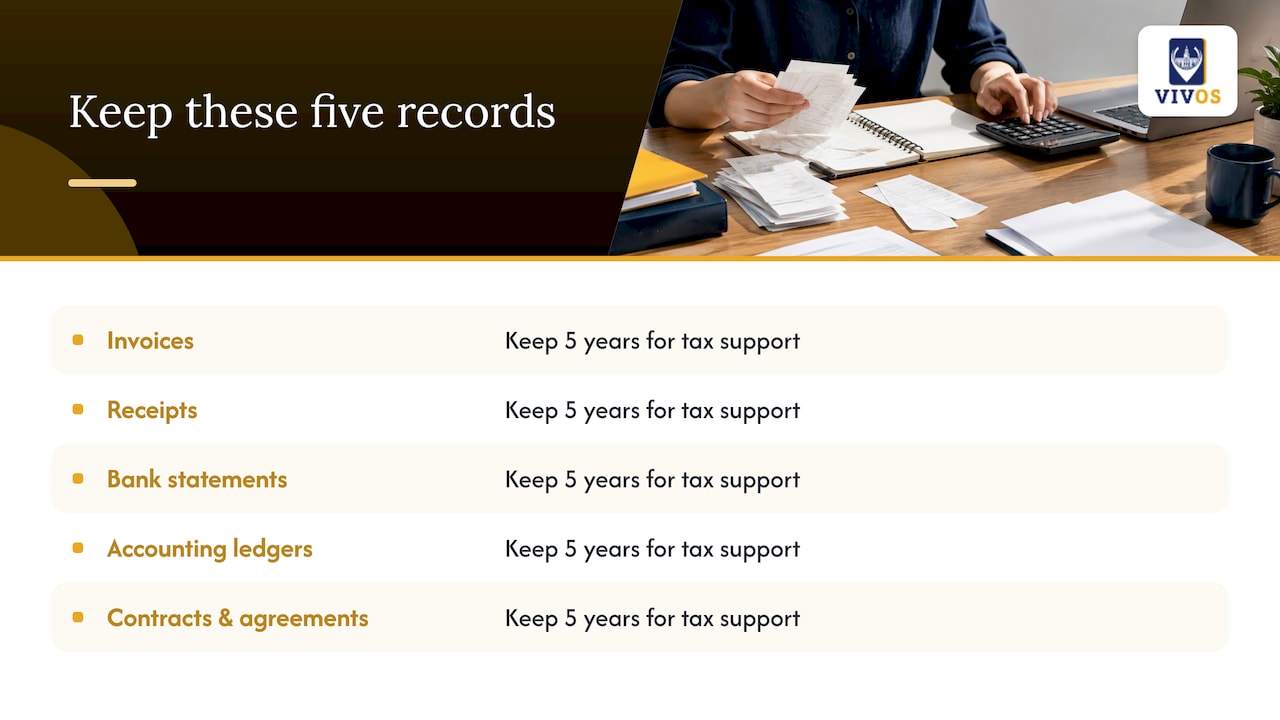
For foreign founders running a Singapore entity from overseas, this often means setting up a consistent digital filing system from day one, since physical paper records are harder to retrieve across borders five years after the fact. Cloud accounting software, used consistently, satisfies this requirement as long as records remain accessible and auditable for the full retention period.
Common errors to avoid in compilation reports
A handful of recurring mistakes account for most of the rework and delay in compilation engagements.
Treating the compilation report as a rubber stamp is the most common error. Directors sometimes assume the practitioner will catch and fix every error in the underlying bookkeeping, but a compilation is not designed to test the figures: material mistakes in the source records usually flow straight through into the final statements.
Mismatched cut-off dates cause a second common problem, where invoices or expenses get recorded in the wrong financial year because of confusion between invoice date, delivery date, and payment date.
Missing or incomplete notes to the financial statements is a third frequent gap, particularly around related-party transactions and director loans, both of which the Companies Act expects to be disclosed clearly.
Finally, companies sometimes skip the restricted-use clause in the engagement letter entirely, then later discover a bank or investor is unwilling to rely on a report that was explicitly scoped for internal use only. Getting the engagement letter’s intended-use wording right before the work starts avoids this entirely.
Limitations and legal implications
A compilation report carries real legal weight, but it is narrower than many founders assume. The practitioner’s signature confirms that the statements were assembled competently from the information management provided. It does not confirm that the figures are accurate, complete, or free of fraud.
This distinction matters for liability. If a compiled set of financial statements later turns out to be materially wrong because management supplied incomplete or false information, responsibility sits with the company’s directors, not primarily with the practitioner who compiled the figures from what they were given. Under the Companies Act, directors remain personally accountable for ensuring financial statements give a true and fair view, regardless of who compiled them.
Relying on a compilation report where a bank, investor, or regulator specifically requires audited figures can also create problems after the fact, since the two documents carry different assurance levels and are not interchangeable. Where a lender or an investor’s term sheet specifies audited financial statements, substituting a compilation report, however well prepared, does not satisfy that condition. Directors who are uncertain which document a counterparty actually needs should ask before the engagement starts, not after the statements are delivered.
VIVOS perspective: compliance as a foundation for growth
We see compliance paperwork treated as an afterthought far too often, particularly by founders setting up a Singapore entity from abroad for the first time. That is a mistake. A compilation report, done properly, is the clearest signal a small company can give a bank, an investor, or a tax authority that its internal numbers are being managed with discipline.
We provide company incorporation and full compliance services for foreign founders in Singapore, including nominee resident director, registered address, corporate secretary, accounting, and compilation, with similar offerings in Malaysia, Hong Kong, and UAE. Ray Tay, Managing Director of VIVOS, puts it directly:
The goal is to bridge the gap between internal records and regulatory expectations.
— Ray
How VIVOS helps and next steps
We built our service model around the reality that a foreign founder setting up in Singapore does not want to coordinate five separate vendors for incorporation, a registered address, a corporate secretary, bookkeeping, and an annual compilation. We offer a coordinated service model handling company incorporation, nominee resident director, registered address, corporate secretary, accounting, and compilation for foreign founders in Singapore and similarly in Malaysia, Hong Kong, and UAE.

Our relevant services include:
- Foreign-founder incorporation, structured for directors who are not Singapore residents.
- Corporate secretary support for statutory filings and director duties.
- Bookkeeping and compliance, which keeps your records ready for a smooth compilation.
- Accounting and XBRL preparation handled in-house, so your compilation and your ACRA filing format stay aligned.
If you are weighing whether to handle incorporation, accounting, and compliance separately or through one coordinated provider, request a quote through our pricing page and we will walk you through exactly what a compilation engagement looks like for a company at your stage.
This article is general information, not a substitute for advice from a qualified financial advisor. Consult a qualified financial professional about your own circumstances before acting on anything here.
FAQ
What is a compilation report?
A compilation report is a set of financial statements an accountant assembles from figures management provides, prepared under SSRS 4410. It gives no assurance on accuracy and is used mainly by audit-exempt small companies for ACRA and IRAS filings.
Who can issue a compilation report?
A compilation report must be signed by a qualified practitioner, typically a Chartered Accountant of Singapore or a public accountant registered under the rules that govern public accountancy services. The engagement letter should state the practitioner’s qualification and the exact scope of the work.
What is the difference between a compilation and an audit?
A compilation involves assembling financial statements from management’s figures with no testing of the underlying data, while an audit involves the practitioner gathering evidence and forming an opinion on whether the statements are free of material misstatement. Audits provide reasonable assurance; compilations provide none.
How much does a compilation report cost in Singapore?
Cost depends mainly on transaction volume and the quality of the bookkeeping handed to the practitioner, with clean monthly-reconciled records costing less to compile than a year of unreconciled transactions. Request a written quote tied to a clearly scoped engagement letter so you know exactly what is included before work starts.
Sources
- ACRA — Audit exemptions: Small company concept
- IRAS — FAQs: File Form C‑S / Form C‑S (Lite)
- ISCA — SSRS 4410 (Revised) Compilation engagements
Recommended
Most Popular


 2 January, 2025
Why Singapore Comes Into Action For Chinese Companies
 2 January, 2025
Malaysia’s Budget 2025: What The Dividend Tax Means For You
Recents Blogs



Foreign Founders: Skip the Company Seal in Singapore and Sign Remotely

Foreign founders: why a company seal is optional in Singapore since 2017, how Section 41B lets you sign deeds, and practical remote signing workflows.
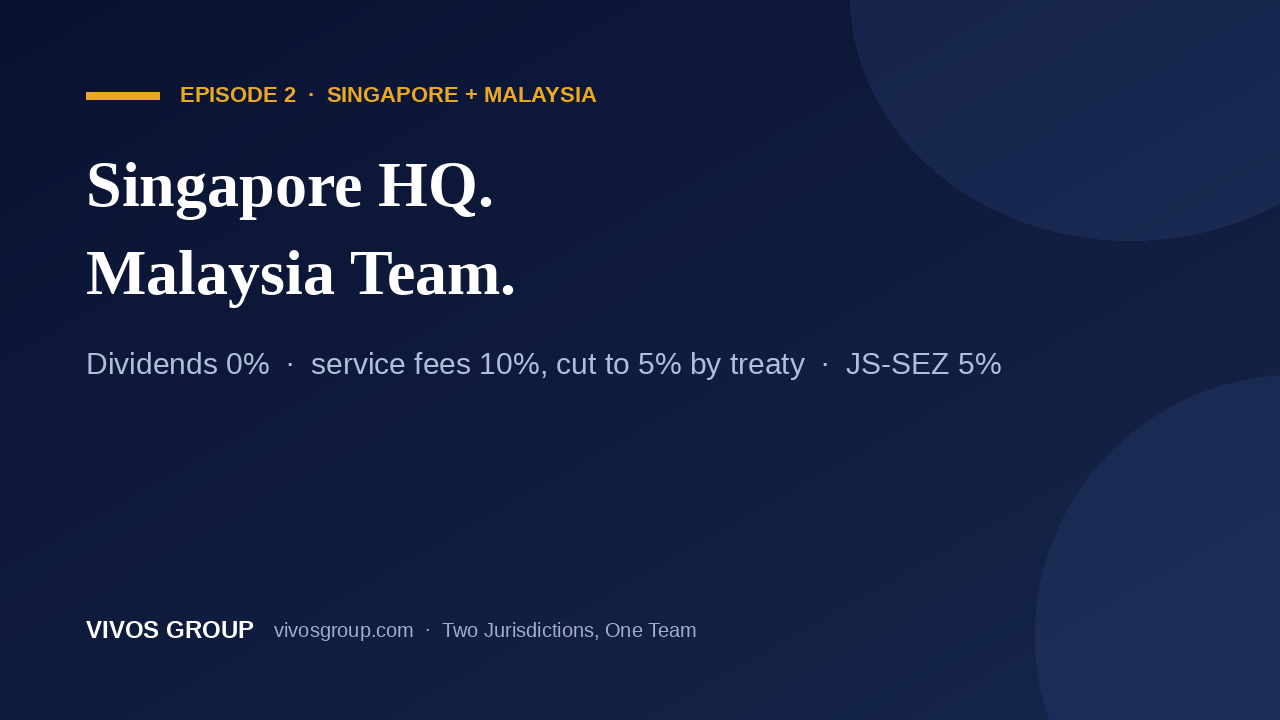
Running a Malaysian Team from Singapore: What the Singapore Company Must Get Right (2026)
What the Singapore parent of a Malaysian Sdn. Bhd. must get right in 2026: tax-exempt Malaysian dividends under section 13(8), invoicing and 5% treaty withholding,…