
Foreign Founders: Skip the Company Seal in Singapore and Sign Remotely
Published: 8 October 2026 · Reviewed by Ray Tay, Co-Founder & Managing Director, VIVOS PTE. LTD. (ACRA Filing Agent FA20240323 · MOM EA Licence 24S2425)
Since the Companies (Amendment) Act 2017, a common seal is optional for Singapore companies as of 2026. Deeds can be executed instead by two directors, by a director and a secretary, or by a director signing in front of a witness under section 41B of the Companies Act. As an ACRA-registered filing agent, we help foreign founders handle this execution process when they are incorporating or signing contracts from overseas.
TL;DR:
- A company seal is no longer required for Singapore companies since March 2017, and deeds can be executed through signatures by authorized individuals.
- Signatures under Section 41B have the same legal effect as using a seal if they involve a director and a secretary, two directors, or a director signing in front of a witness.
- Foreign founders can sign documents remotely with proper coordination by a nominee director or corporate secretary, eliminating the need for physical presence or a seal.
- Many jurisdictions, especially China and the Middle East, still expect a company seal, but a notarized, legalized, or verified signature generally suffices outside Singapore.
- Ordering a company seal or stamp is quick and inexpensive in Singapore, but most companies only keep one if dealing with seal-centric markets or specific bank requirements.
Table of Contents
- Is a company seal required in Singapore?
- How do I sign a deed without a seal?
- Do banks or overseas parties still ask for a seal?
- Company stamp vs common seal: what goes on it and how to order one
- How can foreign founders sign documents from overseas?
- When we recommend keeping a seal
- How VIVOS supports incorporation, execution and banking paperwork
- FAQ
- Sources
Is a company seal required in Singapore?
No. Under Section 41A of the Companies Act, a company “may have, but need not have, a common seal.” The requirement was removed with effect from March 31, 2017, under the Companies (Amendment) Act 2017, one of several reforms that ACRA introduced to cut compliance work for directors and corporate secretaries.
Before that date, Singapore companies generally needed a physical seal to execute deeds and certain formal documents. The amendment replaced that fixed rule with a choice. Section 41A confirms the seal is optional, Section 41B sets out the signature methods that carry the same legal weight, and Section 41C extends that flexibility to documents that are merely “executed” rather than sealed, such as share certificates.
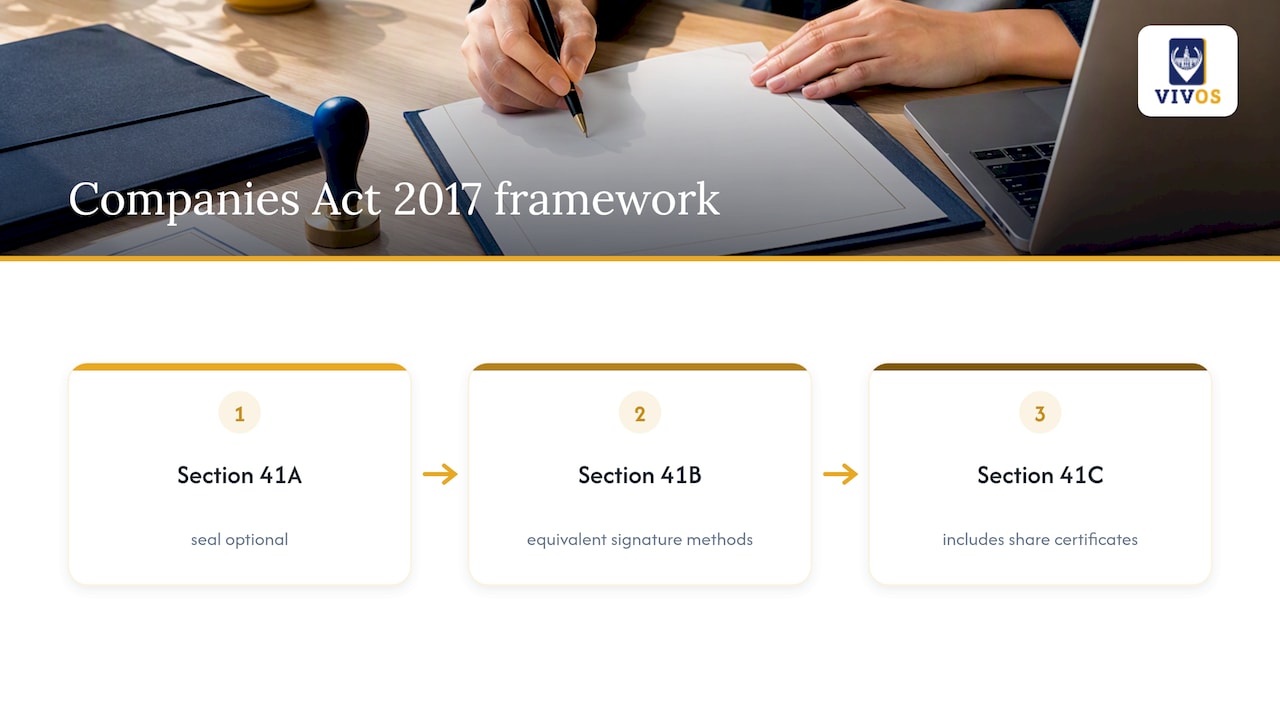
ACRA’s guidance on the 2017 reforms frames the change as part of a wider push to simplify statutory requirements, alongside adjustments to annual general meeting rules and filing timelines. For founders setting up a company from abroad, this matters immediately: incorporation documents, board resolutions and most commercial contracts no longer wait on a physical seal arriving by courier. Our guide to Singapore company requirements covers the related identifiers, including the UEN, that still appear on these documents.
How do I sign a deed without a seal?
A deed signed under Section 41B has the same legal effect as one executed under a common seal, provided the signatures follow one of three accepted combinations.
- A director and the company secretary sign together.
- Two directors sign together.
- One director signs in the presence of a witness, who then attests the signature.
When a director signs on behalf of more than one company party to the same deed, each signature should state clearly which company and capacity it represents, rather than a single undifferentiated signature block. A typical signing block names the company, the signatory’s role (director or secretary), the date and place of signing, and the witness’s name and address where applicable.
For documents headed overseas, notarization and an apostille (or consular legalization, depending on the destination country) often matter more than any seal, since they confirm the signatory’s identity and authority to a foreign registry or counterparty. Our incorporation guide for foreign founders walks through how this fits into a first-time setup.
Pro Tip: Keep a signed cover letter confirming the signatories’ director or secretary status handy. Banks and foreign registries often ask for it alongside the deed itself.
Do banks or overseas parties still ask for a seal?
Some counterparties still expect one, even though Singapore law does not require it. Banks occasionally request a seal for older account-opening templates, and counterparties in China and parts of the Middle East often work within legal cultures where a company chop or official seal remains the default form of proof, regardless of how the counterpart company is incorporated.
Where that happens, a few workarounds typically resolve it without reviving a physical seal for everyday use:
- Execute the document validly under Section 41B and offer to notarize it if the counterparty questions its form.
- Add an apostille or consular legalization for documents heading to a country outside the Apostille Convention’s recognition network.
- Provide a certified true copy of the constitution or board resolution confirming the signatories’ authority.
- Ask a corporate secretary to liaise directly with the bank or counterparty to confirm Singapore’s execution rules.
If your company regularly deals with seal-centric jurisdictions, keeping a seal in reserve avoids repeated explanations, even though it is never legally necessary.
Company stamp vs common seal: what goes on it and how to order one
A common seal and a rubber company stamp, often called a “chop,” serve different purposes and are easy to confuse. The common seal is the embossing device historically used to execute deeds; the rubber stamp is an everyday tool for invoices, letters and routine paperwork. Many Singapore businesses still use a rubber stamp for daily operations even after dropping the formal seal, since it speeds up document handling internally.
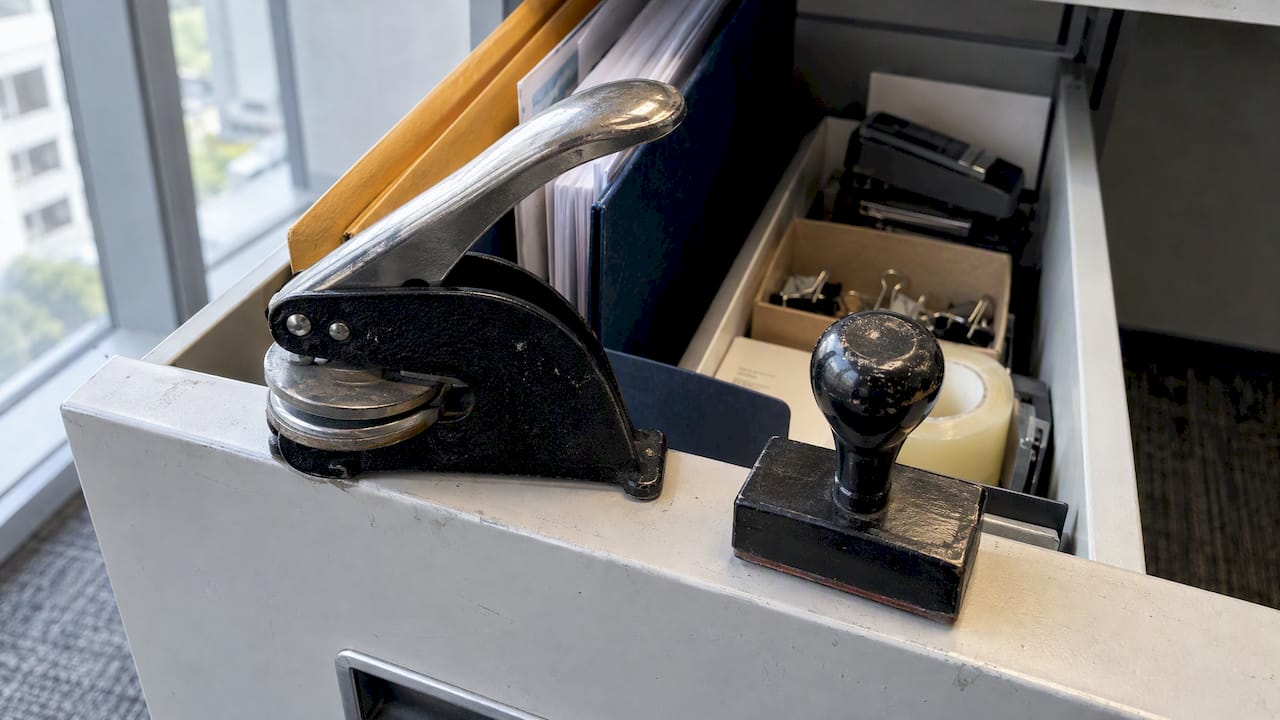
Whichever stamp type you order, it should carry your company’s full legal name and its Unique Entity Number, which Section 144(1A) requires on business letters, invoices and official correspondence.
Ordering one is straightforward: most stationery and stamp vendors in Singapore produce a chop within a day or two once you supply the company name, UEN and a signed instruction from a director or authorized officer.
| Stamp type | Typical use | Cost and lead time |
|---|---|---|
| Rubber company stamp (chop) | Invoices, letters, routine filings | Low cost; same-day to 2-day turnaround |
| Metallic embossing seal | Formal deeds, share certificates (optional) | Moderate cost; 2 day turnaround |
| Duplicate seal (if constitution allows) | Parallel execution across departments or entities | Moderate cost; ordered alongside primary seal |
How can foreign founders sign documents from overseas?
Signing from abroad is the part that trips up most first-time founders, not the legal mechanics. A workable remote execution flow usually looks like this:
- A local director or the corporate secretary prepares the deed with the correct Section 41B signing blocks.
- The overseas signatory signs physically and couriers the original, or signs via an agreed electronic signature method where the counterparty accepts it.
- A notary or commissioner for oaths in the signatory’s home country witnesses and certifies the signature if the receiving party requires it.
- The corporate secretary certifies true copies for banks or foreign registries that need supporting documentation.
As an ACRA-registered filing agent, we handle this coordination directly for foreign founders, providing a nominee resident director, a registered address, and a corporate secretary who manages execution so signatories abroad are not left chasing couriers or notaries on their own. This structure extends to our work in Malaysia, Hong Kong and the UAE as well, where similar execution questions come up for founders setting up outside their home market.
“Most founders assume they need to be physically present in Singapore to sign anything official. In practice, a properly arranged nominee director and corporate secretary can execute almost everything that a seal used to cover,” says Ray Tay, Managing Director of VIVOS.
Pro Tip: Before signing anything for a Singapore bank, ask your corporate secretary whether the bank’s own template still assumes a seal; some older forms do, even though the law has moved on.
Our guide on corporate secretary requirements covers how quickly this kind of support can be arranged after incorporation.
When we recommend keeping a seal
Most Singapore companies we work with do not need a seal at all. We generally recommend keeping one only if your counterparties sit in seal-centric markets like China or parts of the Middle East, or if your bank’s own paperwork still asks for it. The cost of ordering one is small next to the delay a confused overseas counterparty can cause. For clients who would rather not manage a seal themselves, our corporate secretary team can handle execution and liaison so the question rarely comes up.
— Ray
How VIVOS supports incorporation, execution and banking paperwork
As an ACRA-registered filing agent, we handle Singapore company incorporation for foreign founders end to end, providing nominee resident director, registered address and corporate secretary services who manage execution on your behalf. We provide similar support for founders setting up in Malaysia, Hong Kong and the UAE.

In practice, that means:
- Deeds and resolutions signed correctly under Section 41B, with no seal to courier or store.
- Certified true copies prepared for banks, foreign registries or counterparties that ask for extra documentation.
- Banking-ready paperwork coordinated directly with your bank, reducing back-and-forth from overseas.
If you are setting up a Singapore company or need help executing documents from abroad, our incorporation services page outlines how we structure this support, with pricing available on our pricing page.
FAQ
Is it mandatory for a company to have a common seal?
No, a common seal is optional under Section 41A of the Companies Act, a position in effect since the Companies (Amendment) Act 2017. Deeds can instead be executed through the signature methods set out in Section 41B.
How much does it cost to register a company in Singapore?
Costs depend on the service provider and the structure involved. Our foreign-founder incorporation service is available from S$4600 one-off, while local incorporation for Singapore-resident founders starts from S$615 one-off.
How do I order a company seal or stamp?
Most stamp and stationery vendors in Singapore can produce a rubber company stamp or metallic seal within a few days, once you supply the company name, UEN and a signed instruction from a director. The stamp should carry the company’s full legal name and UEN as required under Section 144(1A).
What is the size of a proprietorship stamp?
Singapore law does not set a fixed size for a company or proprietorship stamp. Most vendors offer standard rectangular sizes similar to common business stamps, and the choice usually comes down to vendor catalog options rather than any statutory requirement.
Sources
- Companies Act 1967 – Singapore Statutes Online (section 41A)
- Companies Act 1967 | Accounting and Corporate Regulatory Authority
- Company seals, rubber stamps: use and what to put on them — SingaporeLegalAdvice (2024)
Recommended
Most Popular


 2 January, 2025
Why Singapore Comes Into Action For Chinese Companies
 2 January, 2025
Malaysia’s Budget 2025: What The Dividend Tax Means For You
Recents Blogs


Running a Malaysian Team from Singapore: What the Singapore Company Must Get Right (2026)

What the Singapore parent of a Malaysian Sdn. Bhd. must get right in 2026: tax-exempt Malaysian dividends under section 13(8), invoicing and 5% treaty withholding,…