
新加坡公司注册费用:2026年官方收费与实务预算全解析

Ray Tay
了解新加坡公司注册费用:官方 315 新元起、首年第三方费用可明显上升,逐项报价与合规建议帮您控预算并加速开户,含处理时效与开户风险说明。
Published: 12 August 2026 · Last reviewed: 30 September 2026 · Reviewed by Ray Tay, Co-Founder & Managing Director, VIVOS PTE. LTD. (ACRA Filing Agent FA20240323 · MOM EA Licence 24S2425)
Every Singapore company must have a constitution lodged with ACRA at incorporation. There are no exceptions. The company constitution is a mandatory legal document that defines how your company is governed internally, and ACRA requires it as part of the incorporation application.
Your immediate next steps:
A Singapore company constitution is a mandatory statutory contract lodged at incorporation, and the choice between the Model Constitution and a bespoke document determines your governance flexibility for years ahead.
| Point | Details |
|---|---|
| Constitution required at incorporation | Every Singapore company must lodge a constitution with ACRA via BizFile before incorporation is complete. |
| Model vs. bespoke decision | Adopt the Model Constitution for simplicity; draft bespoke if you have multiple share classes, investor protections, or entrenchment needs. |
| Special resolution threshold | Amending the constitution requires at least 75% of votes cast, and entrenching provisions can set a higher threshold. |
| Signed copy at registered office | A signed constitution must be kept at the registered office at all times and made available for inspection. |
| Vivos incorporation support | Vivos provides fixed-fee incorporation packages covering constitution drafting, BizFile filing, and ongoing corporate secretarial compliance. |
Singapore replaced the separate Memorandum and Articles of Association with a single document called the Constitution. This consolidation means founders no longer manage two separate governing instruments. The Constitution is now the single governing document for every Singapore-incorporated company.
Once lodged with ACRA, the constitution becomes a statutory contract. It binds the company, its members (shareholders), directors, and company secretary. That legal effect is not symbolic. A shareholder can enforce a constitutional provision against the company, and the company can enforce it against a member, in the same way parties enforce a commercial contract.
The constitution is the foundational contract of your company. Every decision about share transfers, director appointments, dividend distributions, and meeting procedures flows from it. Founders who treat it as a formality often discover its importance only when a dispute arises.
Who is bound and what they must do:
Section 22 of the Companies Act specifies the minimum contents every constitution must include. Missing any of these items creates a defective document that ACRA will reject.
Statutory minimums under Section 22:
Beyond these minimums, most constitutions include a standard set of governance provisions:
Statutory constraints you cannot override: The Companies Act sets floors, not ceilings, for resolution thresholds. Ordinary resolutions require a simple majority (more than 50% of votes cast). Special resolutions require at least 75%. You can set higher thresholds in your constitution, but you cannot set them lower than these statutory floors.
Pro Tip: Always define key terms in a dedicated definitions clause at the front of the constitution. Ambiguous terms in operative clauses are the most common source of shareholder disputes, and a clear definitions section resolves most of them before they escalate.
The Companies (Model Constitutions) Regulations 2015 prescribe the Model Constitution for private companies limited by shares (First Schedule) and a separate schedule for companies limited by guarantee. ACRA makes the Model Constitution available as a direct download, and founders can adopt it at incorporation without uploading a separate document.
Advantages of adopting the Model Constitution:
Limitations of the Model Constitution:
When a bespoke constitution is the right choice:
Pro Tip: If you are raising a seed or Series A round within 12–18 months of incorporation, draft a bespoke constitution from day one. Retrofitting investor protections via a constitutional amendment after a round closes requires a special resolution and ACRA filing, adding cost and delay at a time when you have other priorities.
Lodging the constitution is part of the standard incorporation application on BizFile. The process differs slightly depending on whether you adopt the Model Constitution or upload a bespoke document. A full walkthrough of the incorporation process is available in the Vivos Singapore incorporation guide.
Practical timing notes:

Most constitutional amendments require a special resolution passed by at least 75% of votes cast. Ordinary resolutions (simple majority) suffice only for matters the constitution or the Companies Act expressly permits to be decided by ordinary resolution. Amending the constitution itself always requires the special resolution threshold.
This is a practical tool for protecting minority investors without relying on side letters or shareholders’ agreements alone. Entrenching provisions must be included in the constitution from the outset or added by a special resolution that itself meets the entrenching threshold.
Filing process after passing a resolution:
Vivos’s governance and meeting management services cover the full amendment cycle, from drafting the resolution to lodging with ACRA.
A bespoke constitution gives founders precise control over governance. The clauses below are the ones most frequently customized and most frequently the source of disputes when drafted poorly.
High-value clauses to customize:
Drafting practices that reduce disputes:
Pro Tip: Never rely on a shareholders’ agreement alone to protect governance rights. A shareholders’ agreement binds only its signatories. A constitutional provision binds every member, including future transferees who were not party to the original agreement.
Failing to maintain constitutional compliance exposes directors and the company to enforcement risk under the Companies Act. The obligations are specific and non-negotiable.
Statutory record-keeping requirements:
Non-compliance with record-keeping obligations is a criminal offence under the Companies Act. Directors who fail to maintain statutory records or lodge amendments within the required timeframe face fines. Unlawful clauses in a constitution (those that purport to override statutory minimums or grant powers the Act does not permit) are void and unenforceable, but their presence does not automatically invalidate the rest of the document.
Practical retention checklist:
Recommended retention period: at least five years after the relevant event, though many advisors recommend retaining constitutional documents for the life of the company plus five years. Engaging a corporate secretarial services provider ensures these obligations are tracked and met systematically.
Legal implications of invalid clauses:
Vivos provides end-to-end support for Singapore company incorporation, including constitution drafting, ACRA filing, and ongoing corporate secretarial compliance. Services relevant to founders at this stage include:
For foreign founders navigating Singapore’s requirements for the first time, Vivos’s foreign founder incorporation guide covers the practical friction points, from director appointments to registered office requirements.
The Model Constitution is the right starting point for most early-stage companies. Founders who adopt it at incorporation, choose “in force from time to time,” and appoint a qualified company secretary within six months will meet their statutory obligations without significant cost or complexity.
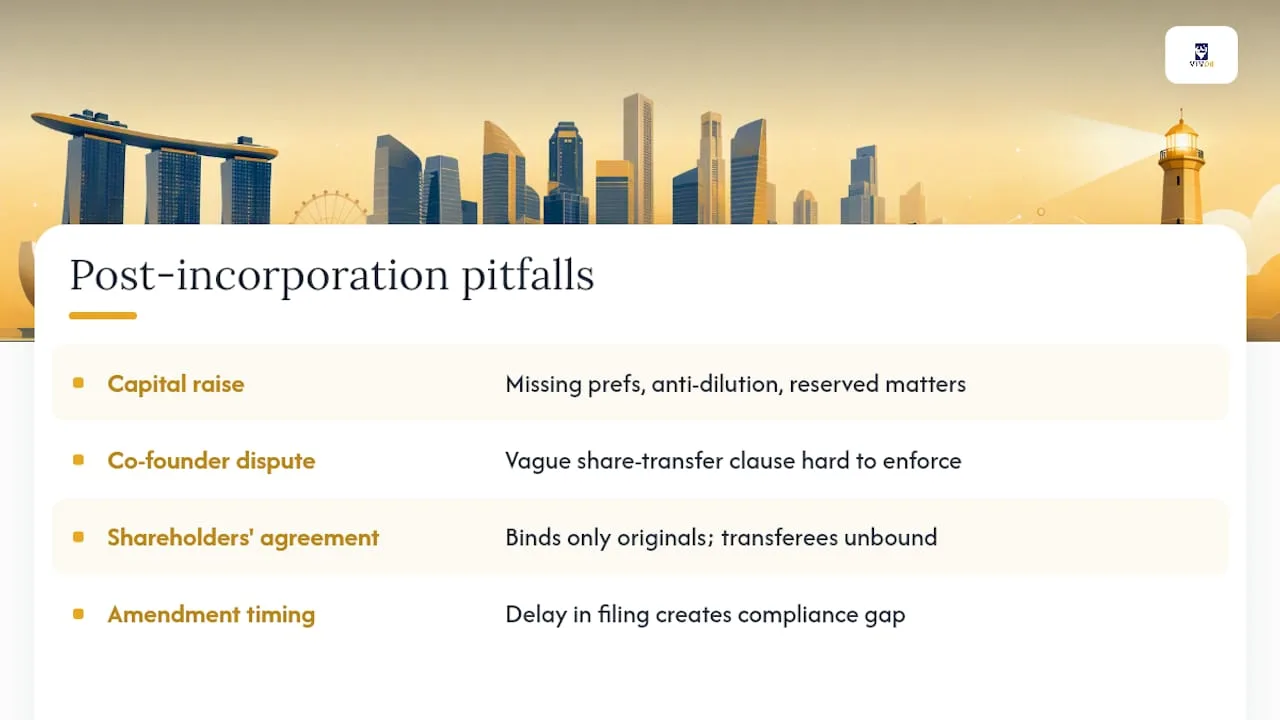
The problems arise at two predictable points. First, when a founder raises external capital and discovers the Model Constitution has no preference share provisions, no anti-dilution mechanics, and no reserved matters. Retrofitting these requires a special resolution, legal drafting fees, and an ACRA filing, all at a moment when the founder’s attention is on closing the round. Second, when a co-founder dispute surfaces and the share transfer clause is too vague to enforce cleanly.
The conventional wisdom is to keep the constitution simple and rely on a shareholders’ agreement for the complex governance terms. That approach has a structural flaw: a shareholders’ agreement binds only its original signatories. When shares transfer, the new holder is not automatically bound by the agreement. A constitutional provision, by contrast, binds every member automatically. Founders who understand this distinction draft the governance terms they actually need into the constitution from day one, rather than discovering the gap when it matters most.
The other underestimated risk is amendment timing. Directors who pass a special resolution and then delay lodging it with ACRA create a compliance gap. The amendment is valid between the parties from the date it passes, but the company is technically in breach of its filing obligation until lodgement. That gap is small, but it is the kind of detail that surfaces in due diligence and creates unnecessary friction at exactly the wrong moment.
Founders setting up in Singapore face a clear choice: spend time navigating ACRA’s requirements independently, or engage a specialist who has done it hundreds of times. Vivos offers fixed-fee company incorporation packages that include constitution drafting or Model Constitution adoption, BizFile lodgement, director consent forms, and registered office setup. For companies that need bespoke governance structures, Vivos’s corporate advisory team drafts tailored constitutions with investor-protection clauses, entrenchment provisions, and reserved matters aligned to your cap table and investor requirements. Ongoing corporate secretarial support covers amendment lodgement, statutory register maintenance, and annual compliance, so founders stay focused on the business rather than the paperwork.
Contact Vivos to request a constitution review or a full incorporation package. The engagement starts with a straightforward scoping conversation, and pricing is transparent from the first discussion.
Direct links to the statutory and regulatory resources referenced in this guide:
This article provides general information on Singapore company law and is not a substitute for professional legal or corporate advisory advice. Confirm current requirements with ACRA or a qualified corporate services provider before proceeding.
 2 January, 2025
 2 January, 2025
了解新加坡公司注册费用:官方 315 新元起、首年第三方费用可明显上升,逐项报价与合规建议帮您控预算并加速开户,含处理时效与开户风险说明。

Practical PE guide for foreign founders: IRAS and Income Tax Act authorities, a one page triggers table, and a six step decision checklist to manage...
为新加坡公司设计会计科目表时,应遵循适用准则并预留 ACRA 分类映射字段,保障 XBRL 申报验证通过与 IRAS 保存一致性。