A shareholders agreement is a private, contractually enforceable document, and every founder or investor putting money into a Singapore company should have one. It sits alongside the company constitution but stays off the public record, and it does the real work of managing control, share transfers, exit terms, and what happens when shareholders can’t agree. Skip it, and you’re relying on default statutory rules and a constitution that was never built to handle a falling out between business partners.
TL;DR:
A shareholders agreement is a private contract that manages control, transfer restrictions, and dispute resolution, supplementing the company constitution in Singapore.
Clauses on reserved matters, transfer restrictions, and deadlock resolution mechanisms are critical to prevent conflicts and costly court disputes.
Drafting a solid SHA requires accurate cap table details, tailored clauses, and an effective process for new shareholders via deeds of accession, typically taking several weeks.
Common mistakes include conflicting with the constitution, vague valuation formulas, and overbroad restrictions, which can lead to legal and operational issues later.
An SHA is optional but highly recommended for companies with multiple shareholders, and costs vary from a few hundred to several thousand dollars depending on complexity.
Vivos
Build A Stronger Singapore Company
VIVOS helps international entrepreneurs navigate Singapore incorporation, compliance, accounting, taxation, and corporate advisory needs.
A shareholders agreement, often shortened to SHA, is a private contract between a company’s shareholders. Unlike the constitution, it is not filed with ACRA and stays confidential between the parties who sign it. That single fact surprises a lot of first-time founders who assume every corporate document in Singapore ends up on a public register.
The company constitution, by contrast, is a statutory document lodged with the Accounting and Corporate Regulatory Authority and available to anyone who pulls a company profile through BizFile+. It governs the company’s relationship with the outside world and sets baseline rules on things like share issuance, directors’ powers, and general meetings. An SHA governs the private relationship between the people who own the shares.
The two documents need to work together, not against each other. If the constitution says one thing about share transfers and the SHA says another, you have a conflict that can end up in dispute. Practitioners generally resolve this one of two ways:
Amend the constitution so it mirrors the SHA’s transfer and voting mechanics, closing any gap between the public and private documents.
Keep the constitution deliberately broad and let the SHA carry the detailed commercial terms, provided the SHA never asks a shareholder to do something the constitution or the Companies Act expressly forbids.
The Companies Act matters here beyond a footnote. It sets hard limits on what shareholders can privately agree to, particularly around share capital, transfers, and rights that protect minority owners. Section 216 of the Act gives minority shareholders a statutory route to court if they’re being oppressed or unfairly disregarded, and this remedy exists whether or not an SHA is in place. A well-built SHA is designed to reduce the odds anyone ever needs to invoke it by giving shareholders contractual tools to resolve disputes before they escalate into minority oppression claims. Read the constitution guide on how the two documents interact in more detail if you’re setting up a new entity from scratch.
What Clauses Should a Singapore Shareholders Agreement Include?
The value of an SHA lives in its clauses, not its cover page. Lawyers describe this as “private ordering,” meaning the Companies Act deliberately leaves veto rights, non-compete terms, and valuation formulas for shareholders to negotiate themselves. Here’s what a solid agreement typically covers.
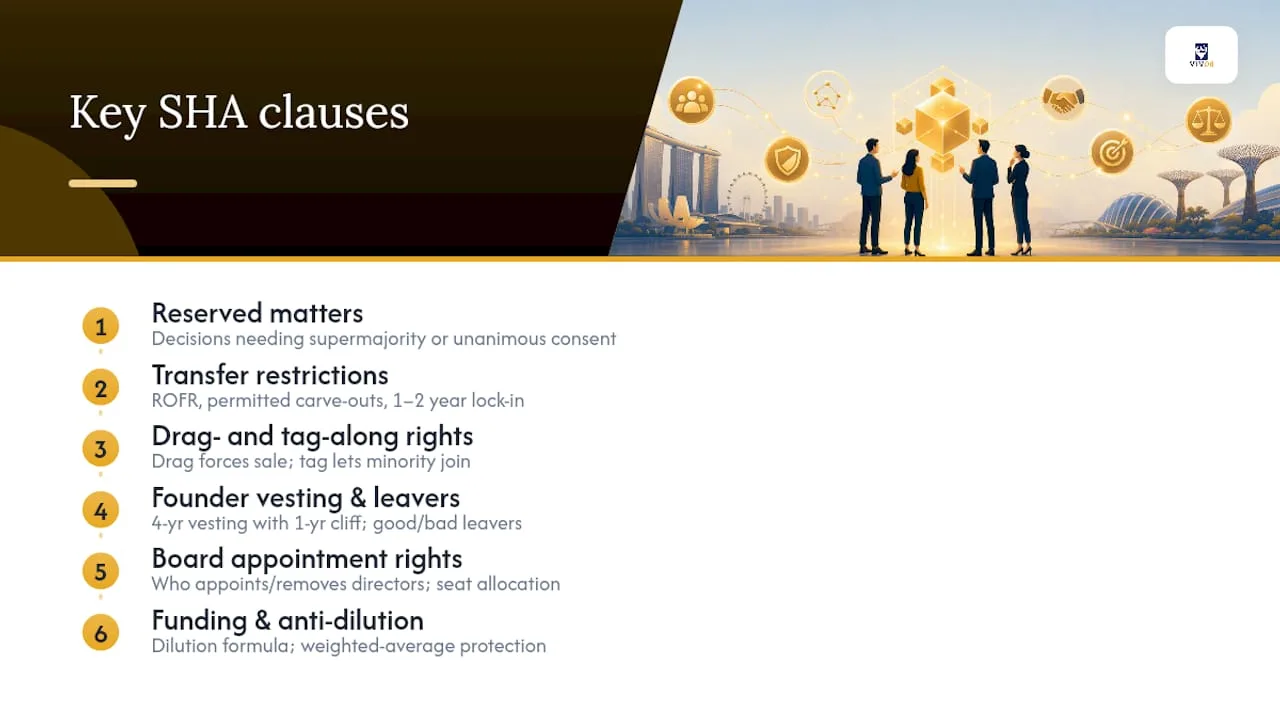
Reserved matters. These are decisions that need more than a simple majority vote, things like issuing new shares, taking on debt above a set threshold, changing the business’s core activity, or approving a sale of the company. Most Singapore SHAs list reserved matters requiring supermajority or unanimous shareholder consent, separate from the lower bar needed for routine operational decisions.
Transfer restrictions. A right of first refusal forces a selling shareholder to offer their shares to existing shareholders before anyone outside the company can buy in. Pair this with permitted transfer carve-outs (transfers to family trusts or related entities, for example) and a lock-in period that blocks any sale for the company’s first year or two.
Drag-along and tag-along rights. Drag-along lets a majority shareholder force minority holders to sell on the same terms when the majority accepts a third-party offer, which prevents a single small holder from blocking an exit. Tag-along flips that protection around, letting a minority shareholder join a sale the majority has negotiated rather than being left behind holding shares in a company under new ownership.
Founder vesting and leaver provisions. Vesting schedules, commonly four years with a one-year cliff, protect the company if a founder leaves early with a large equity stake and no further contribution. Leaver clauses need to define, in plain terms, what separates a “good leaver” (retirement, ill health, mutual agreement) from a “bad leaver” (resignation to join a competitor, termination for cause), because the two categories usually get very different repurchase prices for their shares.
Board composition and appointment rights. Spell out who can appoint and remove directors, how many board seats each shareholder class controls, and what happens to those rights if someone’s shareholding drops below a set percentage.
Funding and anti-dilution mechanics. If future funding rounds are likely, the SHA should describe how dilution gets calculated and whether early investors get any anti-dilution protection, such as a weighted-average adjustment if shares are later issued at a lower valuation.
Pro Tip:Don’t copy a reserved matters list from a template without editing it. A list built for a five-person startup with no outside investors is wrong for a company that just took its first funding round, and an overly long list can paralyze routine decisions that shouldn’t need unanimous sign-off.
How Are Shareholder Disputes Resolved in Singapore?
Most well-drafted Singapore SHAs follow a graduated escalation ladder rather than jumping straight to litigation. The sequence usually looks like this:
Direct negotiation between the shareholders involved, often with a fixed window (14 to 30 days) before either side can escalate.
Mediation through the Singapore Mediation Centre or the Singapore International Mediation Centre, both built to resolve commercial disputes without the cost and publicity of a court claim.
Arbitration through the Singapore International Arbitration Centre, which Singapore-drafted SHAs commonly nominate as the binding forum specifying Singapore law, giving parties a private, enforceable outcome.
The Singapore courts, reserved as a last resort or for remedies arbitration can’t grant, such as urgent injunctive relief.
Section 216’s oppression remedy remains available to a minority shareholder regardless of what the SHA says, because it’s a statutory right, not a contractual one. Parties build deadlock and buy-sell mechanics into the SHA precisely to make that court route unnecessary. A deadlock clause that walks through negotiation, then mediation, then a shotgun buy-sell option, then, only as a genuine last resort, winding up, is generally the most effective private alternative to a court-ordered winding up under Section 254.
When enforcement is needed, courts and arbitral tribunals can order specific performance (forcing a party to complete a share transfer as agreed), grant injunctions to block a breach in progress, or enforce a buy-sell mechanism with an independent valuer appointed to set a fair price when the parties can’t agree on one themselves.
How Do You Draft and Finalize a Shareholders Agreement?
Drafting an SHA properly is a sequence, not a single sitting. Here’s the order that keeps founders from missing something that matters later.
Confirm company and cap table details. List every shareholder, share class, and percentage holding accurately, since investors will check this against ACRA’s public records during due diligence.
Identify the parties who need to sign. Every current shareholder should be a party, and the company itself is often added as a party too, so it can be bound to register transfers correctly.
Draft the reserved matters list based on the company’s actual size and investor base, not a generic template.
Set transfer rules, including right of first refusal mechanics and any lock-in period.
Build the valuation and exit formulas, deciding upfront how shares get priced on a leaver event or deadlock trigger.
Add the deadlock ladder and dispute resolution clause, naming SIAC and Singapore law as the governing framework.
Confirm governing law and execute the agreement, with signed originals lodged with the company secretary for safekeeping.
New shareholders coming in later, through a funding round or a transfer, should sign a deed of accession, a short document that binds them to the existing SHA’s terms without renegotiating the whole agreement from scratch. Keep the executed original and every deed of accession with your corporate secretary, since investors doing due diligence will ask to see the full accession trail.
Timeline expectations vary by complexity. A straightforward SHA between two or three founders with no outside investors typically takes two to six weeks from first draft to signature. Bring in a funding round, multiple share classes, or cross-border shareholders, and negotiation can stretch to six to twelve weeks or longer. Templates are widely available and can work for simple, low-stakes arrangements, but bespoke drafting or a lawyer’s review is worth the cost once investors, complex vesting, or cross-border parties enter the picture. Cost scales with the same variables: a template adaptation might run a few hundred dollars in legal review time, while a fully negotiated agreement with valuation experts and multiple rounds of redlines can run into the thousands.
Pro Tip:Build your cap table schedule as a living document from day one, not something you reconstruct under deadline pressure during your first funding round. Investors will cross check every number against your ACRA filings, and any mismatch slows diligence down.
What Mistakes Should Founders Avoid When Negotiating an SHA?
The same handful of mistakes show up again and again in Singapore SHAs, and most are avoidable with a careful first draft.
Inconsistency with the constitution. A transfer restriction in the SHA that contradicts the constitution creates ambiguity about which document actually controls, and that ambiguity gets expensive to resolve later.
Vague valuation formulas. “Fair value as agreed between the parties” is not a formula. Use an objective mechanism, such as an independent valuer applying a stated methodology, so a leaver event doesn’t turn into its own dispute.
No deed of accession process. Without one, new shareholders can end up outside the agreement entirely, which defeats the purpose of having one.
Overbroad restraints. Non-compete clauses that run too long or cover too much geography risk being unenforceable under Singapore contract law principles.
On the negotiation side, founders do better when they keep the reserved matters list narrow enough to preserve day-to-day operational flexibility, and insist on a deadlock clause with real teeth rather than vague language about “good faith discussions.”
What Legal Framework Governs Shareholders Agreements in Singapore?
Singapore treats an SHA as a standard contract, governed by general contract law principles: offer, acceptance, consideration, and an intention to create legal relations. Courts will enforce its terms the same way they’d enforce any commercial agreement, provided the clauses don’t conflict with mandatory provisions of the Companies Act.
The Act itself is the statutory backdrop every SHA operates within. It governs how shares are issued, transferred, and reduced, and it sets out remedies, most notably the Section 216 oppression remedy, that exist independently of whatever the shareholders privately agreed. Case law on minority oppression has generally focused on whether majority shareholders acted in a way that was commercially unfair to minority interests, even where the majority’s actions were technically permitted by the constitution. That’s part of why SHAs increasingly build in explicit protections, exit rights, and valuation mechanics: they give minority shareholders a contractual remedy that’s faster and more predictable than pursuing a Section 216 claim through the courts.
Singapore’s corporate governance guidance, including material published by the Singapore Institute of Directors, reinforces the expectation that shareholders receive proper notice and engagement around major company decisions. That expectation shapes how reserved matters and communication clauses get drafted, particularly around board meetings and general meeting notice periods. None of this replaces the SHA. It shapes the boundaries within which the SHA has to operate.
How Does the Companies Act Shape Shareholders Agreements Beyond the Constitution?
The Companies Act’s influence on an SHA goes well past resolving conflicts with the constitution. It sets the statutory ceiling on what shareholders can contract around in the first place.
Provisions on share capital, for instance, govern how shares can be allotted, whether the company can buy back its own shares, and what procedures apply to a capital reduction. An SHA can add extra approval requirements on top of these processes, but it cannot override the Act’s own procedural requirements. Similarly, statutory rules on share transfers set the outer framework an SHA’s right of first refusal and lock-in clauses have to sit inside.
The Act’s remedies provisions matter just as much. Beyond Section 216, the Act also governs winding-up procedures under Section 254, which becomes relevant when a deadlock clause reaches its final stage and shareholders genuinely cannot continue together. A carefully built SHA gives parties contractual exits, buy-sell triggers, independent valuations, negotiated buyouts, that are almost always faster and cheaper than a statutory winding up.
Directors’ duties under the Act also interact with SHA terms. A director nominated by a particular shareholder still owes fiduciary duties to the company as a whole, not just to the shareholder who appointed them. Founders sometimes miss this: an SHA clause instructing a director how to vote on the board can create tension with that director’s independent statutory duties, and a well-drafted agreement should account for that friction rather than ignore it.
Are There Tax Implications for Shareholders Agreements and Share Transfers?
An SHA itself is not a taxable event. Signing the agreement creates contractual obligations between shareholders, but it doesn’t trigger any tax liability on its own. Tax exposure arises later, when the mechanisms the SHA describes actually get used, particularly when shares change hands.
Share transfers in Singapore are generally subject to stamp duty, calculated on the higher of the purchase price or the market value of the shares being transferred. Founders negotiating a right of first refusal, a drag-along sale, or a leaver buyback should factor stamp duty into the pricing discussion, since it affects the real cost to the buyer.
Where a shareholder sells shares at a gain, Singapore generally does not impose capital gains tax, since Singapore has no general capital gains tax regime. Gains from an isolated share sale by an individual investor are typically treated as capital in nature and not taxable, though gains that look more like trading income (frequent, systematic share dealing as a business activity) can be assessed differently. This distinction matters most for founders and early employees exercising vesting or leaver provisions, since how a gain is characterized affects whether it’s taxable at all.
Where an SHA includes compensation-like arrangements, such as sweat equity vesting tied to continued service, there can be income tax implications for the recipient depending on how the shares or options are structured. Get specific tax advice before finalizing a vesting mechanism if this applies to your company, since the Tax Planning and Structuring side of your SHA design deserves the same attention as the legal drafting.
Do Private Companies and Listed Companies Need Different Shareholders Agreements?
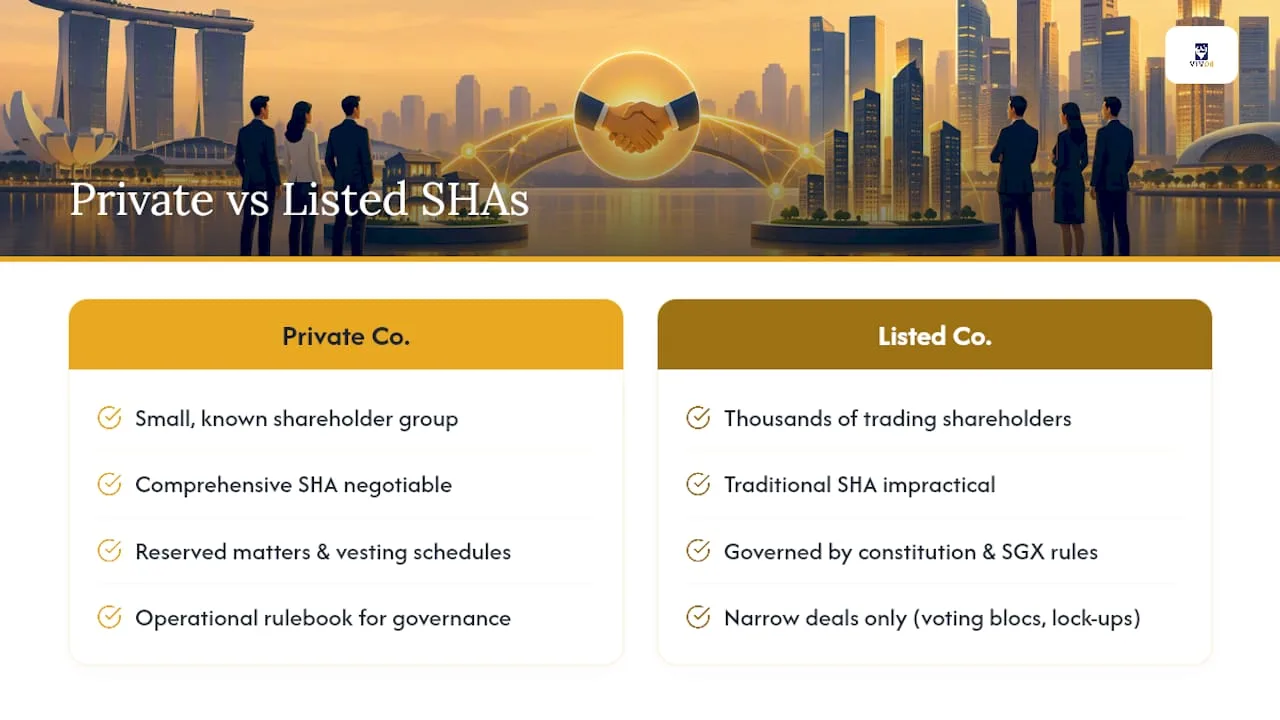
The overwhelming majority of Singapore SHAs govern private limited companies, and for good reason: private companies have a small, known group of shareholders who can realistically sit down and negotiate a private contract together. Listed companies operate under a completely different structure, and the comparison is instructive for founders thinking about where their company is headed.
A private limited company with two to ten shareholders can negotiate reserved matters, vesting schedules, and exit mechanics that are specific to the people actually in the room. The SHA becomes the operational rulebook for day-to-day governance decisions that the constitution leaves open.
A listed company, by contrast, has potentially thousands of shareholders trading shares on an exchange daily. A traditional SHA is impractical at that scale, since there is no fixed, known group to sign one. Listed companies instead rely on the company’s constitution, the Singapore Exchange listing rules, and statutory corporate governance codes to protect shareholder interests. Where private arrangements do persist among founders or major shareholders of a listed company (a controlling family, for instance) these usually take the form of narrower agreements addressing specific matters like voting blocs or lock-up periods around the IPO, rather than a comprehensive SHA covering every aspect of governance.
For founders building toward an eventual public listing, the practical lesson is to treat the SHA as a transitional tool. It’s built to serve the company through its private years, funding rounds, and early governance decisions, and it typically gets unwound or substantially rewritten as the company approaches a public offering.
Author and VIVOS Perspective: Practical Help for Singapore Founders
. Most disputes I’ve seen between shareholders trace back to an SHA that was either never written, or written once and never revisited as the company grew. A template signed at incorporation rarely still fits the company two funding rounds later, and founders often don’t notice the gap until a disagreement forces them to reread the document closely for the first time.
insert client testimonials specific to Ray’s authored content]. Vivos supports SHA drafting alongside corporate secretarial custody and [share and capital management, so the agreement, the cap table, and the statutory registers all stay consistent… Templates work fine for simple, no-investor setups. Once outside capital, multiple share classes, or cross-border shareholders enter the picture, bespoke drafting with local counsel is worth the cost.
— Ray
How Vivos Supports Your Shareholders Agreement
Vivos handles the parts of shareholder governance that founders usually don’t have time to get right themselves: keeping the executed SHA and every deed of accession properly filed, aligning your constitution with your agreement’s terms, and managing the share and capital management work that investors check first during due diligence.
A typical engagement starts with a review of your existing constitution and any draft SHA, followed by coordinated drafting input alongside your legal counsel, execution support, and ongoing custody of the signed original as your appointed corporate secretary. For foreign founders who haven’t yet incorporated, Vivos also handles the underlying company setup, including resident director and registered address requirements, so your governance structure is sound from day one rather than patched together after the fact.
If you’re preparing for a funding round or simply formalizing an agreement between existing co-founders, gather your cap table, current constitution, and any prior shareholder correspondence before reaching out. Full pricing for incorporation and secretarial packages is available, and a quick call is usually enough to scope what your company actually needs.
Sources
For readers who want to verify the law directly or find a starting template, these sources are worth bookmarking:
This article is general information, not a substitute for advice from a qualified lawyer. Consult a qualified legal professional about your own circumstances before acting on anything here.
FAQ
Is a Shareholders Agreement a Legal Requirement in Singapore?
No. Singapore law does not require a company to have a shareholders agreement, and many small companies operate without one. It’s optional but strongly recommended once a company has more than one shareholder, since without it, disputes fall back on the constitution and default statutory rules that rarely address transfer, exit, or deadlock scenarios well.
Can Founders Write Their Own Shareholders Agreement?
Founders can draft their own SHA using a practitioner template for simple arrangements with no outside investors. Once the company brings in funding, multiple share classes, or cross-border shareholders, bespoke drafting or a lawyer’s review is worth the investment to avoid vague clauses that become disputes later.
What Is the Main Purpose of a Shareholders Agreement?
An SHA exists to manage control, transfers, and exits among a company’s shareholders through a private, enforceable contract that the constitution doesn’t cover. It sets reserved matters requiring extra approval, transfer restrictions, vesting terms, and a deadlock ladder so disputes have a defined resolution path instead of ending up in court.
How Much Does a Shareholders Agreement Cost in Singapore?
Cost depends heavily on complexity: a simple template adaptation for two or three founders can cost a few hundred dollars in legal review, while a fully negotiated agreement involving investors, valuation experts, and multiple redraft rounds can run into the thousands. Vivos offers corporate secretarial services from S$800 per year to handle execution, custody, and ongoing compliance once your SHA is signed.