

Paying Your Hong Kong Sister Company from Singapore: The Withholding Tax Checklist

Ray Tay
A Singapore company paying its Hong Kong sister company must withhold 15% on interest and 10% on royalties, and file and pay that tax to…
Published: 5 August 2026 · Last reviewed: 30 September 2026 · Reviewed by Ray Tay, Co-Founder & Managing Director, VIVOS PTE. LTD. (ACRA Filing Agent FA20240323 · MOM EA Licence 24S2425)
For US businesses sending a low number of international payments per month with no distributed card program, Wise Business is the lower-cost, lower-friction choice. For growing operations that need corporate cards, payment acceptance at checkout, mass payouts, and API-driven automation, Airwallex Business delivers more capability per dollar once you account for the full operational stack.
The tipping point is operational complexity, not transfer volume alone. A solo founder paying overseas contractors twice a month has no reason to pay for Airwallex’s tiered platform. A 20-person ecommerce brand running distributed virtual cards, reconciling multi-currency payables, and collecting payments across APAC markets will find Wise’s point-solution model adds reconciliation overhead that erodes its FX-cost advantage. Accounting integrations with tools like Xero matter here: Airwallex’s built-in expense workflow reduces the manual hours that a Wise-plus-separate-card-stack setup typically requires.
One regulatory note for US decision-makers: neither Airwallex nor Wise is FDIC-insured in the way a US chartered bank is. Both hold customer funds in safeguarded accounts per their respective regulatory frameworks, but that distinction affects how you treat balances on your treasury policy.
The table below covers the dimensions US finance teams ask about most. Pricing examples use published rates; run each provider’s live calculator before committing.
| Dimension | Airwallex Business | Wise Business |
|---|---|---|
| Pricing & FX | ~0.50% markup on major currencies; ~1.00% on others; tiered monthly plans | Mid-market rate + transparent conversion fee (~0.33–0.60% on major corridors) |
| Supported currencies | 20+ local account currencies; outbound to 150+ countries | 40+ currency balances; local account details in 10+ currencies |
| Transfer speeds | Same-day to 2 business days on major rails | Same-day to 2 business days; corridor-dependent |
| Account types | Multi-currency wallet; local receiving accounts (UK, EU, HK, SG, AU) | Multi-currency balances; local account details in major currencies |
| Cards | Virtual and physical; per-card limits; receipt capture | Wise Business debit card; limited virtual card issuance |
| APIs & integrations | Full REST API; payment gateway; Xero, QuickBooks connectors | API available; Xero, QuickBooks connectors; lighter automation |
| Mass payouts | Batch payouts via API or CSV; built-in workflow | BatchTransfer via CSV; no native API mass-payout orchestration |
| KYC / onboarding | Typically 1–3 business days; additional docs for US entities | Typically 1–2 business days; straightforward for US LLCs |
| Security / compliance | Regulated in US, UK, EU, AU, HK, SG; PCI-DSS compliant | Regulated in US (FinCEN MSB), UK (FCA), EU; MAS-registered in Singapore |
| Customer support | 24/7 live chat for paid tiers; email for free tier | 24/7 chat and email; phone support in select markets |
| Accounting / reconciliation | Built-in expense management; direct accounting sync | Manual export or connector; lighter reconciliation tooling |
| Best for | Ecommerce, marketplaces, multi-card programs, APAC collection | Freelancers, small agencies, simple cross-border transfers |
| Scenario | Wise Business | Airwallex Business | Delta |
|---|---|---|---|
| $5,000 single USD→EUR transfer | 0.33–0.60% | 0.50% | Wise wins by a small margin |
| $100K monthly USD conversions | — | — | ~$90/month gap (~$1,080/year) |
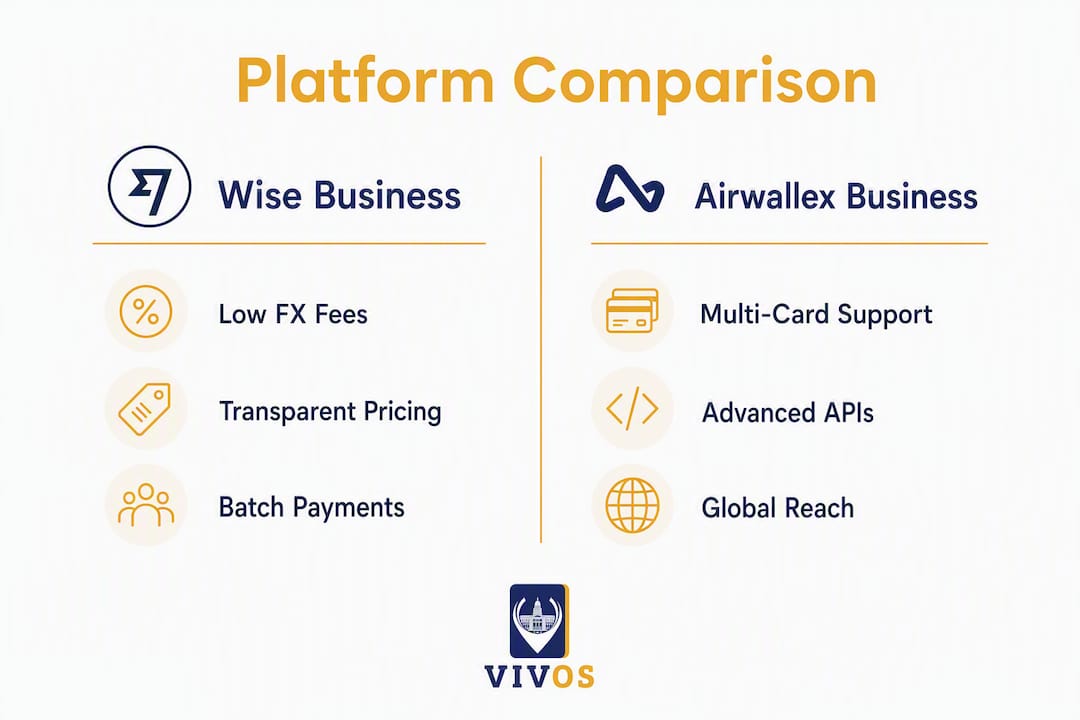
At $100K monthly conversion volume, the FX-spread delta between the two platforms is roughly $1,080 per year. That figure is meaningful but small relative to switching from a Big-4 bank to either fintech. The real decision variable is whether Airwallex’s bundled card, gateway, and reconciliation tools save enough operational hours to justify the difference.

Wise Business is a multi-currency account and transfer service built around one principle: show the mid-market exchange rate and charge a transparent, corridor-specific conversion fee on top. For US businesses, that means no hidden markup buried in the rate.
Account capabilities:
FX pricing model: Wise applies the mid-market rate and adds a conversion fee that typically runs 0.33–0.60% on major corridors such as USD→EUR and USD→GBP. The exact fee appears on-screen before the transfer is confirmed, which simplifies corridor-specific cost modeling for US finance teams.
Cards and spend: The Wise Business debit card supports multi-currency spending and draws from the account’s existing balances. Virtual card issuance is more limited than Airwallex’s offering. Teams with five or more cardholders and per-card spend controls will find the toolset thin.
Integrations and reconciliation:
Wise Business suits US companies whose primary need is low-cost, transparent international transfers with minimal setup. The accounting and reconciliation overhead grows once card programs or high-frequency payouts enter the picture.
Airwallex positions itself as a financial operations platform, not just a transfer tool. For US businesses, that distinction matters when the payment stack includes checkout, cards, and multi-entity treasury.
Account capabilities:
FX pricing model: Airwallex builds its markup into the exchange rate rather than displaying a separate fee line. Published markups run approximately 0.50% on major currencies and 1.00% on others. Tiered monthly subscription plans affect net cost: higher tiers unlock lower markups and additional features. Airwallex’s pricing tiers can become effectively fee-free for businesses that meet minimum balance thresholds, so US teams should verify current US-market thresholds directly with Airwallex before assuming a fixed monthly cost.
Cards and expense management:
APIs and batch payouts:
Pro Tip: Before signing up for a paid Airwallex tier, ask the sales team for the US-specific balance threshold that waives the monthly fee. Many businesses qualify for a fee-free tier they never request.
The core FX comparison is straightforward. Wise charges the mid-market rate plus a visible conversion fee. Airwallex builds its markup into the rate. At $5,000 per transfer, the difference is marginal. At $100K monthly, the gap is approximately $90/month, or $1,080/year, with Wise typically cheaper on pure FX cost for major corridors.
That $1,080 annual delta shrinks further when Airwallex’s subscription tier is fee-waived by a balance threshold. It also disappears entirely if the alternative to Airwallex is a Big-4 bank charging 2–3% FX markups.
Wise holds balances in 40+ currencies and provides local account details in 10+ currencies. Airwallex offers 20+ local account currencies and stronger local rail coverage across Asia-Pacific, including markets in Hong Kong, Singapore, and Australia. For US businesses collecting payments from APAC customers, Airwallex’s local collection accounts reduce the friction of cross-border receipt.
Both platforms deliver same-day to 2-business-day transfers on major corridors. Speed differences are corridor-specific rather than systematic. Neither platform consistently outperforms the other on speed for USD→EUR or USD→GBP.
This is where the platforms diverge most sharply. Airwallex supports multiple virtual cards with per-card limits, category controls, and receipt capture integrated into an expense workflow. Wise Business offers a debit card and limited virtual card issuance. For teams issuing 5–10 or more cards, Airwallex’s per-card controls and connected reconciliation workflow represent a meaningful operational advantage.

Airwallex provides a full REST API covering payment initiation, FX conversion, card issuance, and webhook-based event handling. Wise offers an API but with lighter automation depth. For engineering teams building payment flows or automating treasury operations, Airwallex’s API surface is broader.
Both platforms connect to Xero and QuickBooks. Airwallex’s built-in expense sync reduces the reconciliation steps that a Wise-plus-separate-card-stack setup requires. Understanding how currency exchange accounting integration works is useful context before evaluating either platform’s connector depth.
Wise Business supports BatchTransfer via CSV, covering most contractor payment scenarios. Airwallex supports batch payouts via both CSV and API, with a more structured workflow for high-volume disbursements. For marketplaces or platforms paying out to many recipients, Airwallex’s API-driven batch capability scales better.
Both platforms complete KYC for standard US LLCs within 1–3 business days. Wise tends to be slightly faster for straightforward entities. Complex structures (holding companies, multi-entity groups) may require additional documentation on either platform. Neither publishes hard transfer limits publicly; both negotiate limits with larger accounts.
Wise operates as a licensed Money Services Business (MSB) registered with FinCEN in the US, regulated by the FCA in the UK, and registered with MAS in Singapore. Airwallex holds equivalent licenses across its operating markets and is PCI-DSS compliant for payment acceptance. Neither is FDIC-insured; both safeguard customer funds per their regulatory obligations.
Airwallex offers 24/7 live chat for paid-tier customers and email support for the free tier. Wise provides 24/7 chat and email across tiers, with phone support available in select markets. Response quality on complex issues is not publicly benchmarked; both platforms receive mixed reviews on escalation handling.
Airwallex’s built-in expense management and direct accounting sync reduce the manual reconciliation steps that a multi-tool stack requires. Wise relies on connector-based sync or manual export. For finance teams tracking multi-currency payables and card spend, the reconciliation overhead difference is real and worth measuring during a trial.
Analysts note that focusing only on FX spread misses net cost: reconciliation labor, multiple point solutions, and switching friction frequently outweigh small FX deltas. The $90/month FX gap at $100K volume can be consumed by a single additional hour of monthly reconciliation work.
Pro Tip: During any trial, run a time-motion study on reconciliation. Log the hours your team spends matching card transactions, exporting statements, and correcting FX entries. That number, multiplied by your team’s hourly cost, is the hidden cost that pure FX comparisons never show.
Work through these questions before committing to either platform:
Match your operational profile to the recommended platform:
The operational tipping point is roughly 15–20 outbound international payments per month or 5–10 active company cards. Below that threshold, Wise’s simplicity and FX transparency are hard to beat. Above it, Airwallex’s integrated stack starts to pay for itself in reduced operational overhead.
The framing that matters most is simplicity versus capability, not Wise versus Airwallex. Analysts consistently find that businesses choosing a platform based solely on FX spread often underestimate the operational cost of stitching together multiple point solutions.
Assume a US ecommerce company converting $100K/month, running 10 virtual cards, and using a separate expense management tool:
| Cost item | Wise Business + separate card tool | Airwallex Business (paid tier) |
|---|---|---|
| Monthly FX cost | Wise is about $90 less per month than Airwallex | About $90 more per month than Wise |
| Card/expense tool subscription | ~$50–$150 | Included |
| Reconciliation labor (est. 3 hrs/month at $50/hr) | ~$150 | ~$50 (integrated workflow) |
At this profile, the platforms are cost-equivalent or Airwallex is marginally cheaper once the full stack is priced. The FX-only comparison would have suggested Wise was cheaper by $90/month.
Pro Tip: Pilot both platforms simultaneously for 30–60 days using representative corridors and real transaction volumes. Measure reconciliation time, exception rates, and support response quality. A live pilot reveals the operational costs that published pricing pages never show.
Methodology note:
Airwallex wins on operational capability for growing US businesses; Wise wins on FX transparency and simplicity for low-volume, transfer-focused teams, with the tipping point at roughly 15–20 monthly international payments or 5–10 active cards.
| Point | Details |
|---|---|
| FX cost delta is small | At $100K monthly conversions, Wise costs about $90/month less than Airwallex, a gap of ~$1,080/year. |
| Operational tipping point | At 15–20 outbound payments/month or 5–10 active cards, Airwallex’s integrated stack typically offsets its FX premium. |
| Hidden costs matter | Reconciliation labor and point-solution subscriptions frequently exceed the FX delta; measure both during a trial. |
| Geographic reach | Airwallex offers stronger local collection accounts across APAC; Wise covers major corridors with superior FX transparency. |
| Vivos for APAC expansion | US businesses expanding into Singapore, Hong Kong, Malaysia, or UAE benefit from Vivos’s banking support and corporate advisory alongside their fintech selection. |
The conventional wisdom on the Airwallex vs. Wise decision frames it as a price comparison. That framing is incomplete and, for growing businesses, actively misleading.
Finance teams that optimize for the lowest FX spread at the point of decision frequently discover 12 months later that they are paying more in total. The mechanism is predictable: a low-cost transfer tool gets supplemented with a separate card tool, then a separate expense management tool, then a manual reconciliation process that consumes staff hours. Each addition is individually justified. The aggregate cost is never calculated.
The more useful frame is operational maturity. A business at the stage where Wise is the right answer is a business that has not yet built the operational complexity that makes Airwallex’s bundled platform valuable. That is not a criticism of Wise. It is a description of a growth stage. The mistake is staying on Wise past the tipping point because switching feels disruptive, or moving to Airwallex before reaching the volume where its features justify the cost.
The pilot approach matters more than the pricing comparison. Thirty days of parallel operation, with reconciliation time logged, reveals the true cost of each platform for your specific transaction mix. Published FX rates are inputs to that calculation, not the conclusion.
One practical note: the APAC dimension is underweighted in most US-centric comparisons. For US businesses with any operations or collections in Hong Kong, Singapore, or Australia, Airwallex’s local account infrastructure is a material advantage that does not show up in a USD→EUR FX comparison.

Choosing between Airwallex and Wise solves the payment operations question. For US businesses expanding into Singapore, Hong Kong, Malaysia, or UAE, the adjacent challenge is the corporate and compliance layer: local incorporation, corporate secretarial obligations, banking relationship setup, and cross-border tax structuring.
Vivos provides corporate secretarial services, banking and financing support, accounting, payroll, and financial and business advisory for international businesses establishing operations across APAC. For companies evaluating Airwallex or Wise in the context of an APAC expansion, Vivos helps navigate the local banking relationships, PSP onboarding requirements, and compliance obligations that fintech platforms do not cover.
Request an assessment from Vivos to clarify the corporate structure and banking setup your APAC expansion requires before committing to a payment platform.
The sources below were used to build the pricing examples, feature comparisons, and methodology in this article. Re-check each provider’s live calculator for current corridor-specific fees before making a final decision.
Run live pricing checks on each provider’s calculator for your specific corridors and volumes. Published markups and subscription tiers are subject to change.

 2 January, 2025
 2 January, 2025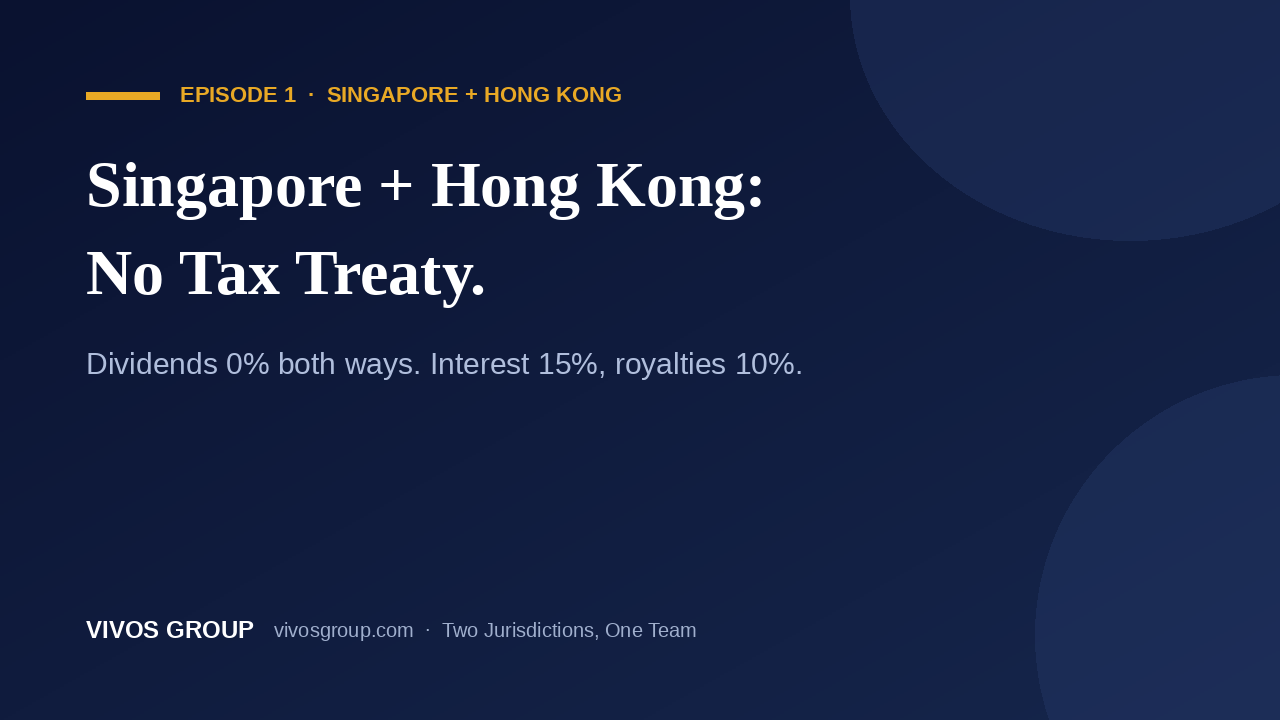
A Singapore company paying its Hong Kong sister company must withhold 15% on interest and 10% on royalties, and file and pay that tax to…


Practitioner checklist for founders transferring shares in Singapore: compute 0.2% stamp duty, meet the 14 or 30 day deadlines, secure board approval, and...