

新加坡公司注册费用:2026年官方收费与实务预算全解析

Ray Tay
了解新加坡公司注册费用:官方 315 新元起、首年第三方费用可明显上升,逐项报价与合规建议帮您控预算并加速开户,含处理时效与开户风险说明。
Published: 3 August 2026 · Last reviewed: 30 September 2026 · Reviewed by Ray Tay, Co-Founder & Managing Director, VIVOS PTE. LTD. (ACRA Filing Agent FA20240323 · MOM EA Licence 24S2425)
Pick Pulley for pre-seed through Series A founder-led teams. Pick Carta once institutional investors, fund administration, or secondary transactions enter the picture. That stage-based rule covers the majority of decisions.
The fastest way to make this decision: Ask your lead investor which platform their fund uses for LP reporting. That single answer often settles the Carta vs Pulley question before you open a pricing page.
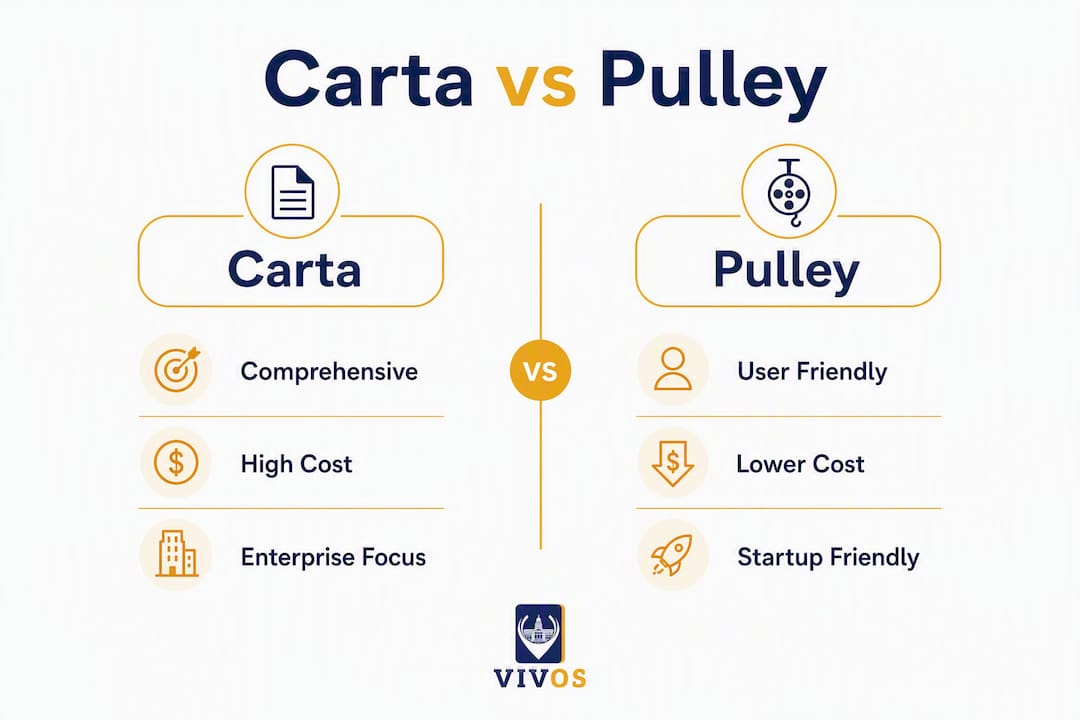
The table below maps both platforms across the dimensions that matter most to founders preparing for fundraising or managing an active option pool.
| Dimension | Carta | Pulley |
|---|---|---|
| Best for / stage fit | Series B+, fund managers, CFO-led teams | Pre-seed through Series A, founder-led |
| Pricing model | Sales-led quotes; scales with stakeholder count | Public pricing tiers; Startup and Growth levels |
| 409A inclusion | Separate add-on or third-party | Bundled in paid tiers; rapid turnaround |
| Cap table & options | Full-featured; broad international stock-plan coverage | Strong for US plans; limited international plan support |
| Fund admin / secondaries | Fund admin, K-1, CartaX secondary rails | Limited fund admin; no secondary marketplace |
| Audit support | ASC compliance, LP reporting, K-1 processing | Standard reporting; lighter audit tooling |
| VC / investor ecosystem | 7,000+ VC funds; institutional default | Growing adoption; founder-community preferred |
| UX / scenario modeling | Capable but complex for non-CFO users | Cleaner dilution and waterfall tools; faster for founders |
| Migration effort | Four weeks minimum; longer for complex tables | Similar inbound migration timeline |
| Free entry tier | Launch tier available (pre-seed, SAFE tracking) | No free tier |
| Security / compliance | SOC 2; broad international plan support | SOC 2; US-plan focus |
Carta strengths at a glance:
Pulley strengths at a glance:
Pro Tip: If a secondary transaction or tender offer above $50M is likely within 24 months, starting on Carta earlier may cost less than migrating under deal pressure. Migration administrative friction and verification effort can outweigh short-term UX or cost savings when timing is tight.
Pulley is the stronger default for early-stage founders; Carta becomes the practical requirement once institutional investors, fund administration, or secondary transactions enter the scope.
| Point | Details |
|---|---|
| Stage-based default | Choose Pulley pre-seed through Series A; switch to Carta when institutional investors or fund admin enter scope. |
| 409A true cost | Pulley bundles 409A in paid tiers, lowering effective annual cost versus unbundled third-party valuations. |
| Migration risk | Plan 2–6 weeks and up to 40–60 hours for reconciliation, legal re-papering, and investor sign-offs. |
| Investor preference | Confirm your lead investor’s platform before committing; many institutional funds default to Carta for LP reporting. |
| Vivos advisory | Vivos supports international founders with cap-table advisory, corporate secretarial, and migration coordination across Singapore, Malaysia, Hong Kong, and UAE. |
Migration checklist reminder: Before switching platforms, confirm stakeholder count, pending secondaries, international equity plan requirements, 409A cadence, and lead investor preference. Skipping any one of these steps adds weeks to the process.
When Vivos works with an international founder preparing for fundraising in Singapore, Malaysia, Hong Kong, or the UAE, the platform question typically surfaces during incorporation or the first option-pool setup. A common scenario: a founder incorporated in Singapore with US-based investors requests cap-table software guidance before issuing the first employee stock option plan. The decision path follows a structured checklist rather than a vendor preference.
Checklist Vivos uses with clients:
What to prepare for migration:
Recommended timeline: Budget four weeks minimum. Week one: data audit and reconciliation. Weeks two and three: platform import, legal review, and re-papering. Week four: investor and accountant sign-off. Complex tables with international stakeholders or prior secondary activity should budget six weeks and a dedicated advisor.
Schedule a meeting with your lead investor and legal counsel before initiating any migration. Their input on fund-raising preparation and data-room requirements will shape both platform choice and migration sequencing.

International founders choosing between Carta and Pulley often face a parallel set of corporate housekeeping tasks: re-papering equity instruments, updating share registers, coordinating 409A timing with accountants, and preparing data rooms for investor diligence.
Vivos handles the corporate layer that sits alongside cap-table software. Corporate secretarial services cover share and capital management, board resolution updates, and document re-papering required during a platform migration. Corporate advisory aligns migration timing with fundraising milestones and local compliance requirements across Singapore, Malaysia, Hong Kong, and the UAE. Banking introductions, accounting coordination, and tax filing support are available as part of the same engagement.
Founders who engage Vivos before initiating a migration typically reduce re-papering delays and avoid the compliance gaps that surface during investor diligence. Contact Vivos to confirm which services apply to your current company stage and jurisdiction.
 2 January, 2025
 2 January, 2025
了解新加坡公司注册费用:官方 315 新元起、首年第三方费用可明显上升,逐项报价与合规建议帮您控预算并加速开户,含处理时效与开户风险说明。

Practical PE guide for foreign founders: IRAS and Income Tax Act authorities, a one page triggers table, and a six step decision checklist to manage...

为新加坡公司设计会计科目表时,应遵循适用准则并预留 ACRA 分类映射字段,保障 XBRL 申报验证通过与 IRAS 保存一致性。