
新加坡虚拟地址合规指南:创业者必须知道的规定

Ray Tay
在新加坡使用虚拟地址,须登记境内实体地址、避开邮政信箱,并在变更后14天内申报。掌握2026年文件查阅新规、选址核验与违规风险,创业合规少走弯路。
Published: 10 October 2026 · Reviewed by Ray Tay, Co-Founder & Managing Director, VIVOS PTE. LTD. (ACRA Filing Agent FA20240323 · MOM EA Licence 24S2425)
A company is a Singapore tax resident when its control and management is exercised in Singapore, in practice where the board meets and strategic decisions are taken, which makes the company eligible for a Certificate of Residence to access DTA benefits (IRAS, as of 2026). This guide is built for founders who run a Singapore company from overseas and need to know exactly what to put in place.
TL;DR:
- IRAS assesses residency separately for each Year of Assessment, so moving board meetings or decision making offshore can jeopardize that year’s claim.
- A Certificate of Residence application must identify the calendar year and foreign income, provide company details, and confirm Singapore management throughout that year.
- Substantive minutes from Singapore board meetings can outweigh founder visits; a resident director who only signs documents weakens the claim and still has legal duties.
- Foreign company branches need to show control exercised in Singapore and valid reasons for not incorporating locally, supported by minutes, employment contracts, and CPF records.
Living outside Singapore does not disqualify a company from tax residency. What matters is where control and management of the business is exercised, not where the founder or shareholders happen to live. IRAS defines this as the location where strategic decisions, such as those on company policy and overall direction, are made.
Incorporation in Singapore is not the test. A company registered with ACRA can still fail the residency test if the people actually steering it never set foot in Singapore and every major decision is made elsewhere. IRAS looks past the registration certificate and asks where the thinking happened.
In practice, IRAS weighs several factors together:
Residency is not a one-time label. IRAS assesses it for each Year of Assessment, so a company that qualified last year must keep meeting the same standard this year. A founder who moves board meetings offshore partway through the year risks breaking residency for that period, even if the company was clearly Singapore-managed before.
A Certificate of Residence (COR) is the document IRAS issues to confirm a company’s Singapore tax residency so it can claim benefits under a Double Taxation Agreement (DTA). Foreign tax authorities typically ask for a COR before granting reduced withholding tax rates on cross-border payments such as dividends, interest, or royalties.
The IRAS application process asks for specifics rather than a general declaration. An application needs to cover:
A user guide published by IRAS walks through the form fields for companies and Variable Capital Companies (VCCs) separately, since VCCs have their own sub-fund considerations. Non-Singapore incorporated companies and branches of foreign companies are generally not eligible for a COR unless they can demonstrate that control and management was genuinely exercised in Singapore and show valid reasons for not incorporating locally. IRAS treats these as exceptions rather than the norm, so a branch structure needs stronger documentary support than a locally incorporated subsidiary.
Meeting the residency test is mostly a matter of discipline: put the right people and paperwork in place, then keep records consistent year after year. Foreign founders running operations remotely tend to get this wrong by treating Singapore as a mailing address rather than a decision-making base.
Pro Tip: Align your board meeting calendar with the calendar year IRAS will ask about on your COR application, not your company’s financial year, to avoid gaps in your evidence.
For founders building a Singapore-based team, local professional development resources covering business Mandarin can also help when hiring or liaising with local staff and partners.
IRAS does not score residency on a single document. It builds a picture from several pieces of evidence, and the strength of that picture determines how confidently a company can claim residency or request a COR.
| Residency signal | What it shows | Red flag equivalent |
|---|---|---|
| Board meetings held in Singapore | Strategic decisions recorded as made locally | No board meetings held in Singapore |
| At least one executive director based in Singapore | Real decision-making presence, not nominee-only | All directors and decision-makers based offshore |
| Key employees or operations managed from Singapore | Day-to-day strategy executed locally | Management functions run entirely from abroad |
| CPF contributions for local employees | Local workforce tied to the business | No local payroll or CPF records |
| Detailed, dated board minutes | Clear documentary trail for IRAS review | Missing or generic minutes with no substance |
A company claiming tax residency in another jurisdiction at the same time, without a clear tie-breaker analysis, adds further risk. Each positive signal above is best supported by the underlying document itself, minutes, CPF statements, or employment contracts, attached to the COR application rather than summarized after the fact.
Most foreign founders overestimate how much is needed and underestimate how consistent it has to be. A single well-documented board meeting a year, with minutes showing genuine strategic discussion, often does more for a residency claim than a founder who visits Singapore frequently but leaves no paper trail.
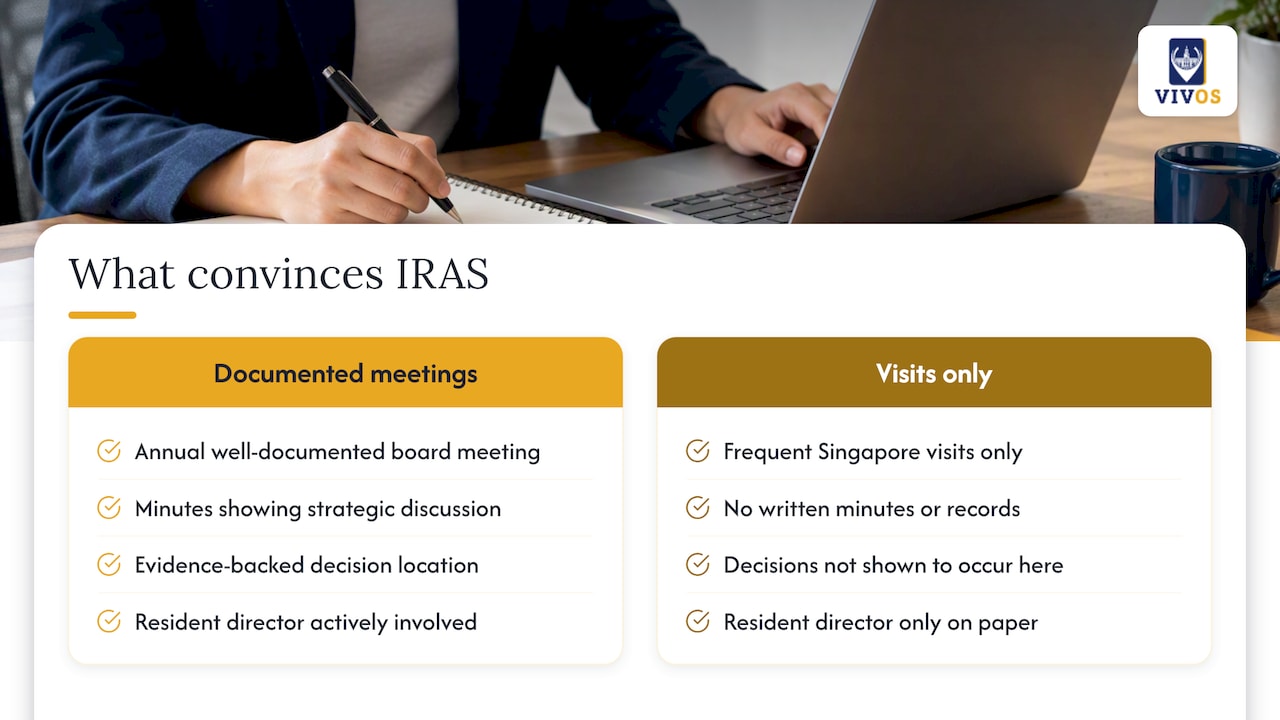
The recurring gap we see is governance that exists on paper but not in substance: a resident director appointed purely to satisfy the Companies Act requirement, with no real involvement in decisions. ACRA’s director duties framework does not distinguish between nominee and operating directors when it comes to statutory responsibility, so treating the role as a formality carries its own legal risk, separate from the tax question entirely.
As Ray Tay, Managing Director of VIVOS, puts it: “Founders often assume a Singapore address is enough. IRAS wants to see where decisions actually happen, and that has to be backed by minutes, not memory.”
— Ray
We handle the parts of this process that are easiest to get wrong from overseas. We provide services including nominee resident director arrangements, a registered address, corporate secretary services, and tax residency support, and extend similar support into multiple jurisdictions.

Our team maps directly onto the checklist above:
If you are setting up a Singapore company from abroad or need to tighten your residency documentation before filing, check our pricing and services to find the right starting point.
The standard corporate income tax rate applies to companies tax resident in Singapore, with rebates and exemption schemes available depending on the company’s profile. Some rebate schemes require that the company has made CPF contributions to at least one local employee during the relevant year.
Proof typically combines board meeting minutes showing strategic decisions made in Singapore, evidence that at least one director is genuinely based and active in Singapore, and records such as CPF contributions for local staff. This documentation supports a Certificate of Residence application rather than relying on incorporation status alone.
Under Singapore’s single-tier system, tax paid by a company on its profits is final, and dividends distributed to shareholders are not taxed again in the shareholders’ hands. This applies regardless of whether the shareholder is an individual or another company, and it is separate from the control and management test used for corporate tax residency.
No. IRAS assesses residency based on where control and management is exercised, not where the company is incorporated. A company incorporated in Singapore but managed entirely from abroad can still fail the residency test for a given Year of Assessment.

 2 January, 2025
 2 January, 2025
在新加坡使用虚拟地址,须登记境内实体地址、避开邮政信箱,并在变更后14天内申报。掌握2026年文件查阅新规、选址核验与违规风险,创业合规少走弯路。


Singapore compilation report explained for foreign founders. Includes an 8 item preparation checklist, filing timeline, S$10M small‑company test, costs,...