
新加坡公司注册费用:2026年官方收费与实务预算全解析

Ray Tay
了解新加坡公司注册费用:官方 315 新元起、首年第三方费用可明显上升,逐项报价与合规建议帮您控预算并加速开户,含处理时效与开户风险说明。
Published: 5 October 2026 · Reviewed by Ray Tay, Co-Founder & Managing Director, VIVOS PTE. LTD. (ACRA Filing Agent FA20240323 · MOM EA Licence 24S2425)
A permanent establishment (PE) in Singapore is a fixed place of business or dependent agent through which a foreign enterprise carries on operations. Where one exists, profits attributable to it become taxable in Singapore under the Income Tax Act 1947 and applicable tax treaties, as confirmed by IRAS as of 2026. A subsidiary, by contrast, is a separately incorporated taxable person in its own right.
TL;DR:
- A PE in Singapore usually involves a fixed location used regularly or a dependent agent habitually signing contracts on behalf of the foreign business.
- Activities like storage, display, or short-term projects generally do not create a PE unless they extend beyond specific duration thresholds or evolve into core operations.
- Hiring staff or engaging contractors in Singapore does not automatically establish a PE, but their role and authority in contract negotiations are crucial factors.
- Choosing between a remote setup, branch, or subsidiary depends on control, management location, and treaty benefits, with subsidiaries offering better DTA access.
- Maintaining detailed records of site usage, contract authority, and decision-making is essential to defend PE status during IRAS audits.
Singapore’s domestic tax framework and its double tax agreements (DTAs) both rely on the concept of a PE to decide which country gets first claim on business profits. The statutory foundation sits in the Income Tax Act 1947, which sets out when a foreign enterprise is treated as operating in Singapore for tax purposes. Where a DTA applies, its specific PE article usually governs, and IRAS administers both frameworks.
Two tests decide whether a PE exists:
Certain preparatory or auxiliary activities, such as storage, display, or information-gathering, are generally exempt from triggering a PE on their own. During the COVID-19 period, IRAS also issued temporary guidance recognizing that staff stranded in Singapore due to travel restrictions would not automatically create a PE for their overseas employer, provided specific conditions were met and documented, as set out in IRAS guidance on tax residence and permanent establishment.
Professional summaries of Singapore’s regime, including PwC’s Worldwide Tax Summaries, note that PE mainly matters for treaty purposes since Singapore’s own system is built around tax residence. Even so, a local PE still triggers Singapore filing obligations on the profits it generates. Foreign founders weighing remote sales against setting up a local entity should treat PE status as the first question, not an afterthought, because it decides whether Singapore has taxing rights at all.
Legal tests translate into everyday business facts. Reviewing your Singapore footprint against the following indicators gives a reasonably accurate read on your exposure.
Borderline cases deserve particular attention: a short consulting assignment that quietly extends past its original timeline, a warehouse that evolves from storage into a fulfillment hub, or a local hire whose job description drifts from support into deal-closing. Each of these shifts can convert a low-risk arrangement into a taxable presence, often without anyone deciding it on purpose. Keeping dated records of project scope, staff duties, and site usage is the clearest way to show which side of the line your operations fall on if IRAS asks.
Not every Singapore touchpoint creates a PE, and the line often depends on duration, authority, and exclusivity rather than appearance alone.
| Setup | Outcome | Condition that changes it |
|---|---|---|
| Office or warehouse used for core business | Trigger | Storage or display used only for preparatory purposes may fall outside PE scope |
| In-market sales staff negotiating and closing deals | Trigger | Staff limited to marketing support with no contracting authority lowers risk |
| Dependent agent habitually concluding contracts | Trigger | Agent acting occasionally, with principal approval required for every deal, weakens the case |
| Independent agent serving multiple unrelated clients | Not trigger | Exclusivity to one foreign principal can convert the agent into a dependent one |
| Short-term project under the applicable treaty threshold | Not trigger | Extension past the treaty’s time limit converts it into a trigger |
| Product demonstrations or trade show appearances | Not trigger | Repeated, long-running demonstrations that function as a sales outlet shift this toward a trigger |
| Online sales with no physical presence or local agent | Not trigger | Appointing a local fulfillment team with contracting power changes the analysis |
These categories follow the fixed place and dependent agent tests under the Income Tax Act 1947 and the PE articles found in Singapore’s DTAs. Where a scenario does not fit neatly into one row, the safest approach is to document the facts and seek a position before activity expands.
Hiring staff or engaging contractors in Singapore does not automatically create a PE, but the nature of their work decides the outcome. Employees who regularly negotiate, sign, or materially influence contracts on your behalf can constitute a dependent agent PE even if they never touch a lease agreement.
Pro Tip: Draft agent and employment contracts so that final approval of pricing and contract terms sits outside Singapore until you have decided on your long-term structure.
Choosing between selling remotely, registering a branch, or incorporating a subsidiary in Singapore comes down to tax residency, treaty access, and how much compliance you are willing to carry; understanding Singapore gift tax rules forms part of this broader tax consideration.
A subsidiary is a Singapore-incorporated company and a separate taxable person from its foreign parent. It can become eligible for a Certificate of Residence, which unlocks DTA benefits, but eligibility depends on where control and management genuinely sit, not merely where the company is registered. A branch, by comparison, is legally an extension of the foreign head office. IRAS and guidance on company tax residency make clear that non-Singapore incorporated entities and branches are generally not eligible for a COR unless they can demonstrate that control and management occur locally, which limits their treaty position.
Remote selling, with no fixed place of business and no dependent agent in Singapore, carries the lowest PE risk of the three paths, but it also means forfeiting any local tax residency status and the commercial credibility a Singapore entity can bring.
A closer comparison of these structures, including compliance and banking trade-offs, is covered in our branch vs subsidiary breakdown.
Once a PE exists, the foreign enterprise must file a Singapore corporate tax return covering the profits attributable to that PE, even though the parent itself remains a foreign entity. Attribution follows the profits that would have arisen had the PE operated as a separate, independent business dealing with its head office at arm’s length.
Professional tax summaries confirm that PE in Singapore functions mainly as a treaty concept, while a local PE still creates domestic filing duties for the profits it generates. That distinction often surprises founders who assume PE only matters when claiming treaty relief; in practice, it decides whether you file in Singapore at all. Readers who want a quick sense of what a Singapore PE might owe can run figures through our corporate tax calculator, and a fuller walk-through of filing timelines sits in our corporate income tax guide.
Reducing PE exposure is less about avoiding Singapore altogether and more about matching your structure to how deep your operations actually run.
Pro Tip: Revisit your PE position every time you add Singapore headcount or renew a local lease, not just once at setup.
A detailed walk-through of what incorporation actually involves for non-residents is covered in our guide to Singapore company incorporation for foreigners.
IRAS inquiries into PE status turn on facts and paperwork, not assertions. The documents that matter most show where decisions are genuinely made and what authority local staff or agents actually hold.
The most common mistake we see among foreign founders is treating incorporation as a formality rather than a substance question. A company registered in Singapore but run entirely from overseas, with no local decision-making and poorly drafted agent contracts, rarely achieves the tax residency status founders assume they have secured.
We provide Singapore company incorporation for foreign founders, including nominee resident director, registered address, corporate secretary, and tax filing support, and we extend the same services to founders setting up in Malaysia, Hong Kong, and UAE.
Founders often underestimate how much weight IRAS places on where decisions are actually made, not just where the company is registered. Getting the governance structure right from day one avoids a much harder conversation later.
Deciding between remote selling, a branch, or a full subsidiary gets easier once you know exactly what local substance and compliance will cost you. We offer foreign-founder incorporation paired with nominee resident director, registered address, and corporate secretarial support that together help establish the substance IRAS looks for when assessing control and management in Singapore.
Our accounting services cover the bookkeeping and filing work that follows once a PE or subsidiary is in place, while our taxation support handles structuring questions specific to cross-border operations. We provide Singapore company incorporation for foreign founders, nominee resident director, registered address, corporate secretary, and tax filing, and we support setup processes in Malaysia, Hong Kong, and UAE for founders expanding across more than one market.
If you are weighing remote sales against registering locally, a direct conversation about your specific activities is the fastest way to get a clear answer. Review our pricing and service packages or reach out to discuss which structure fits your Singapore plans.
This article is general information, not a substitute for advice from a qualified financial advisor. Consult a qualified financial professional about your own circumstances before acting on anything here.
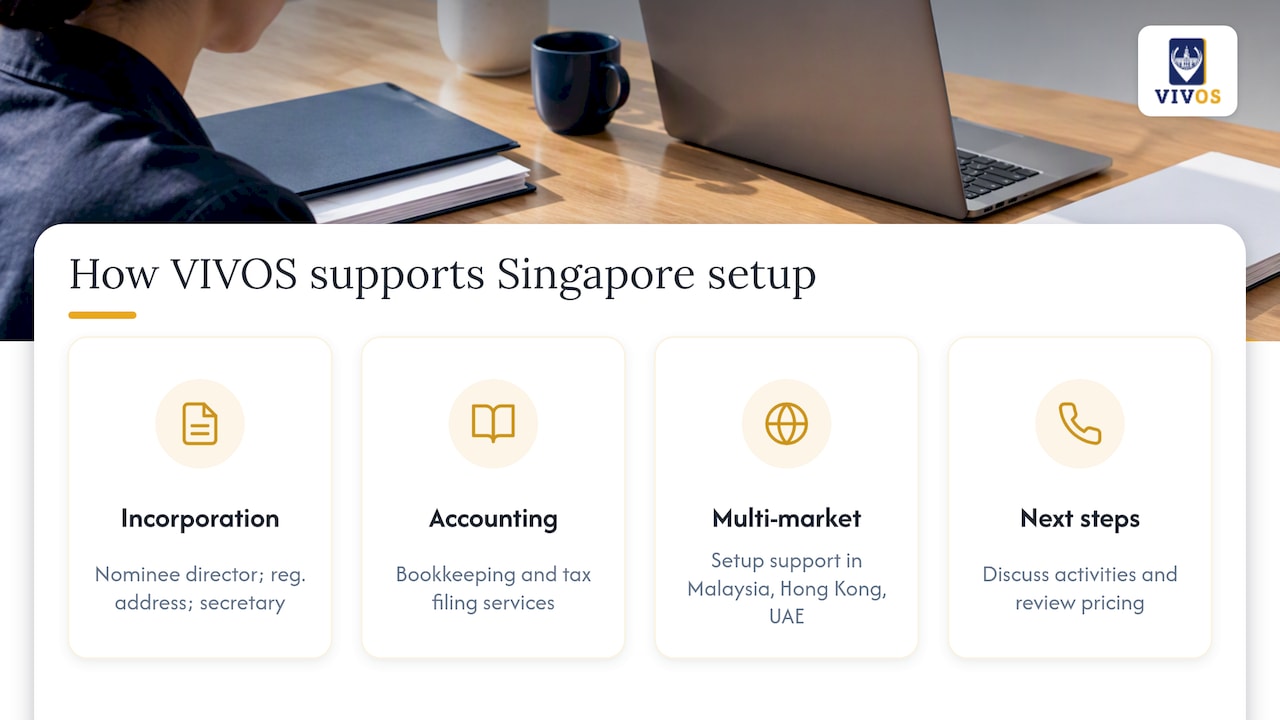
A PE commonly arises through a fixed place of business, such as an office, branch, or workshop, or through a dependent agent who habitually concludes contracts on behalf of the foreign enterprise. A separate category covers installation or construction projects, which can create a PE once they run past the duration threshold set in the applicable treaty, as outlined under the Income Tax Act 1947.
Stamp duty in Singapore applies to specific documents, most commonly property and share transfers, and permanent resident status itself does not create or remove that obligation. This question falls outside PE and corporate tax rules, so anyone with a specific stamp duty scenario should check the relevant transaction guidance directly with IRAS.
Personal income tax in Singapore is calculated on progressive resident or non-resident rates depending on your tax residency status for the year, and the exact amount depends on reliefs, deductions, and your specific residency position. This article focuses on corporate PE and tax filing obligations rather than personal income tax, so a precise figure requires checking current IRAS individual tax rate tables for your exact situation.
Singapore permanent residents are taxed on income earned in Singapore under the same resident tax rates that apply to citizens, based on their tax residency status for the year. Specific thresholds, reliefs, and exemptions depend on individual circumstances, which sit outside the corporate PE framework covered in this guide.
 2 January, 2025
 2 January, 2025
了解新加坡公司注册费用:官方 315 新元起、首年第三方费用可明显上升,逐项报价与合规建议帮您控预算并加速开户,含处理时效与开户风险说明。
为新加坡公司设计会计科目表时,应遵循适用准则并预留 ACRA 分类映射字段,保障 XBRL 申报验证通过与 IRAS 保存一致性。

Practical founder checklist to build a VC Ready three statement model with monthly forecasts for the first 18–24 months, three scenarios, cap table, and...