

4 Cross Border Tax Tools for Singapore Firms and Foreign Founders

Cross border tax checklist for foreign founders in Singapore: four planning tools, IRAS 30 day requests, transfer pricing files and APAs.
Published: 22 September 2026
Under MAS Notice 626 (as of 2026), Singapore banks require verified identity of directors and shareholders, disclosure of beneficial owners, source-of-funds evidence, and proof of business substance before opening a business account. Requirements scale with risk. Foreign founders, lacking local Myinfo verification, typically face enhanced checks. Vivos assists foreign founders through this exact process, from incorporation to bank introductions.
TL;DR:
- For foreign founders, obtaining certified true copies of foreign documents and demonstrating genuine Singapore operations can significantly speed up the onboarding process.
- Beneficial ownership structures must be clearly mapped and supported by registry extracts and control diagrams, especially when layers involve multiple entities.
- Enhanced due diligence becomes mandatory for PEPs, complex ownership, or foreign jurisdictions on watchlists, often requiring senior management approval and longer processing times.
- Digital ID verification tools like Myinfo and Singpass simplify resident onboarding but are unavailable to non-residents, leading to longer, document-heavy procedures.
- Ongoing monitoring and record-keeping remain critical, with transaction patterns and ownership changes triggering additional reviews and potential compliance issues.
Banks split their document demands into two buckets: proof of who the individuals are, and proof of what the company is. For individuals, that means a passport (or NRIC for citizens and permanent residents) and a recent proof of address, usually a utility bill or bank statement dated within three months. For the company, banks want the ACRA BizFile extract, the Certificate of Incorporation, and the constitution (formerly the memorandum and articles of association).
Foreign documents create friction. A passport copy notarized in Jakarta or a corporate registry extract from Dubai cannot always be checked against a live government database, so MAS circulars on non-face-to-face verification push banks toward certified true copies (CTCs) or notarization as compensating controls. A document in Mandarin, Bahasa, or Arabic generally needs a certified English translation attached to the original, not a substitute for it.
| Document Type | Purpose | Who Provides It |
|---|---|---|
| Passport / NRIC | Verifies director/shareholder identity | Individual applicant |
| Proof of address | Confirms residential address | Individual applicant |
| ACRA BizFile extract | Confirms company registration and officers | Company (via corporate secretary) |
| Certificate of Incorporation | Confirms legal existence of the entity | Company (via corporate secretary) |
| Company constitution | Defines shareholding and governance structure | Company (via corporate secretary) |
| Certified true copy of foreign ID/registry documents | Compensates for non-face-to-face verification gaps | Notary or authorized certifier in home jurisdiction |
| Source-of-funds evidence | Demonstrates legitimate origin of capital | Individual or corporate applicant |
Banks rarely accept a photocopy of a foreign passport on its own. Budget time for CTC processing before you book an account-opening appointment.
MAS Notice 626 requires banks to identify any individual who owns or controls a significant portion of a company’s shares or voting rights, and to verify that person’s identity the same way they would a named director. Where no single individual crosses that threshold, banks must look through the structure to find whoever exercises ultimate control, whether through indirect shareholding, a voting agreement, or another arrangement.
The Notice’s beneficial ownership provisions exist because shell layers are the most common laundering technique regulators encounter. Banks typically expect:
For founders with layered structures, an ownership chart that traces every intermediate entity up to the ultimate individual owner does more to speed approval than any single document. Compliance officers read structure diagrams faster than they read footnoted shareholder agreements, and a chain of registry extracts without a narrative connecting them almost always draws a follow-up query.
Business substance is evidence that a company actually operates, not just that it exists on paper. A registered address and a certificate of incorporation alone rarely satisfy a bank’s compliance team, because both can be arranged in an afternoon with no real activity behind them.
Banks look for markers that a company generates or intends to generate genuine economic activity in Singapore:
Pro Tip: If your company is pre-revenue, sign even one small local services contract, issue one invoice to a Singapore client, and put one part-time hire on payroll before you apply. A thin but real operating history beats an empty shell with a prestigious address every time.
MAS Notice 626 sets three tiers of scrutiny, and which one applies to you determines how much paperwork you’ll need.
For foreign founders, the practical takeaway is blunt: assume EDD unless proven otherwise. Multi-jurisdiction shareholding, a founder who is a PEP in their home country, or incorporation through a jurisdiction on any watchlist will trigger the higher tier, and the bank will ask more before it asks less.
MAS has formally recognized Myinfo and Myinfo Business, accessed through Singpass, as reliable independent sources for verifying personal and corporate data. For a Singapore citizen or permanent resident opening a personal or business account, this can replace a stack of physical documents entirely, with the bank pulling verified data straight from government systems once the applicant consents.
Foreign founders don’t have that shortcut.
Expect the foreign-founder pathway to run longer than the resident pathway, simply because no digital shortcut exists.
A disorganized submission is the single fastest way to add weeks to an account opening. Work through this sequence before you book a bank appointment:
Pro Tip: When ownership runs through more than one entity, attach a single-page chart at the front of your file rather than making the reviewer reconstruct it from separate registry extracts. Compliance officers approve what they can understand in one read.
Vivos assembles this exact file for foreign founders as part of its Singapore company incorporation service, pairing it with a bank account introduction once the paperwork is ready.
Banks don’t stop checking once your account opens. MAS Notice 626 requires records to be kept for several years after a relationship ends, and banks must run ongoing transaction monitoring that can trigger a Suspicious Transaction Report (STR) to Singapore’s Suspicious Transaction Reporting Office at any point, not just at onboarding.
Practitioner guides note that beneficial ownership documentation gaps rank among the most common findings in MAS compliance reviews, which explains why incomplete UBO paperwork is the single most frequent cause of multi-week delays for foreign-owned entities.
Most rejected applications share the same three gaps, according to Ray Tay, Managing Director of Vivos.
Vivos handles the parts foreign founders are least equipped to manage alone: Singapore company incorporation for foreign founders, a nominee resident director, a registered address, corporate secretary support, and direct bank account introductions once the file is ready. The same model runs across Malaysia, Hong Kong, and the UAE, with bilingual English-Mandarin support for founders more comfortable working in Mandarin.
A practical remediation checklist Vivos uses with clients who’ve already faced one rejection:
MAS’s October 2024 revision to the Guidelines to Notice 626 sharpened expectations around enterprise-wide risk assessment and how banks document connected-party relationships, and banks have carried those interpretive standards into 2026 onboarding practice. The direction is toward more granular documentation of control, not less.
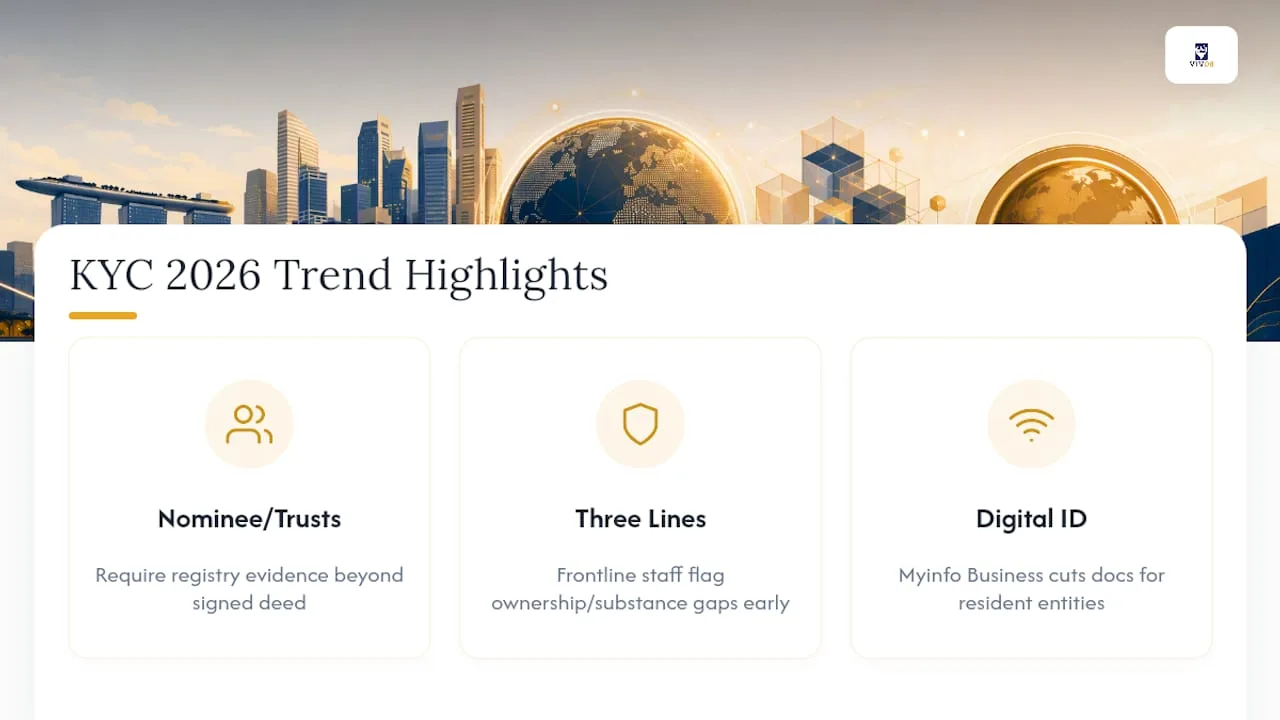
Two trends stand out for foreign founders specifically. First, banks are applying more consistent scrutiny to nominee and trust arrangements, since MAS’s own guidance places the burden of proving ultimate control squarely on the bank, not the customer’s say-so. A trust deed or nominee agreement that used to satisfy a reviewer with a signature now often needs supporting registry evidence behind it.
Second, MAS’s Guidelines explicitly reference the Three Lines of Defence model, pushing banks to build compliance checks into frontline account-opening staff rather than leaving everything to a back-office compliance team. In practice, that means the relationship manager taking your application is now trained to flag substance and ownership gaps immediately, rather than passing an incomplete file up the chain and letting compliance discover the gaps weeks later. Expect more questions at the first meeting, not fewer.
Digital verification is also expanding. Myinfo Business coverage has grown, meaning more resident-owned entities can skip physical document submission entirely, even as the non-resident pathway stays document-heavy for the reasons already covered above.
For customers, the immediate consequence of an incomplete or misleading KYC file is a rejected application, but the downstream consequences run further. A rejection at one bank is frequently visible, informally, to others in a small banking market, and a pattern of rejections across multiple institutions can make every subsequent application harder, not easier. Providing false or misleading information during KYC can also expose an individual to liability under Singapore’s anti-money-laundering statutes, separate from any banking relationship at all.
For banks, the stakes run in the opposite direction but land just as hard. MAS holds a bank’s board and senior management personally accountable for AML/CFT failures under Notice 626, and supervisory action against a bank for weak CDD can include financial penalties, restrictions on new customer onboarding, and, in serious cases, reputational damage that outlasts any single fine. That accountability structure is precisely why frontline staff push back on incomplete files rather than waving them through. No relationship manager wants to be the reason a board-level finding lands on their branch.
The practical result for founders is a system with very little tolerance for shortcuts. A bank would rather decline a legitimate but poorly documented application than accept one it later has to explain to a regulator.
KYC doesn’t end when your account opens. It’s the starting point for ongoing transaction monitoring, which runs for as long as the account stays active. Banks use automated systems to flag activity that deviates from the profile established at onboarding, whether that’s transaction volume, counterparty geography, or the nature of payments moving through the account.
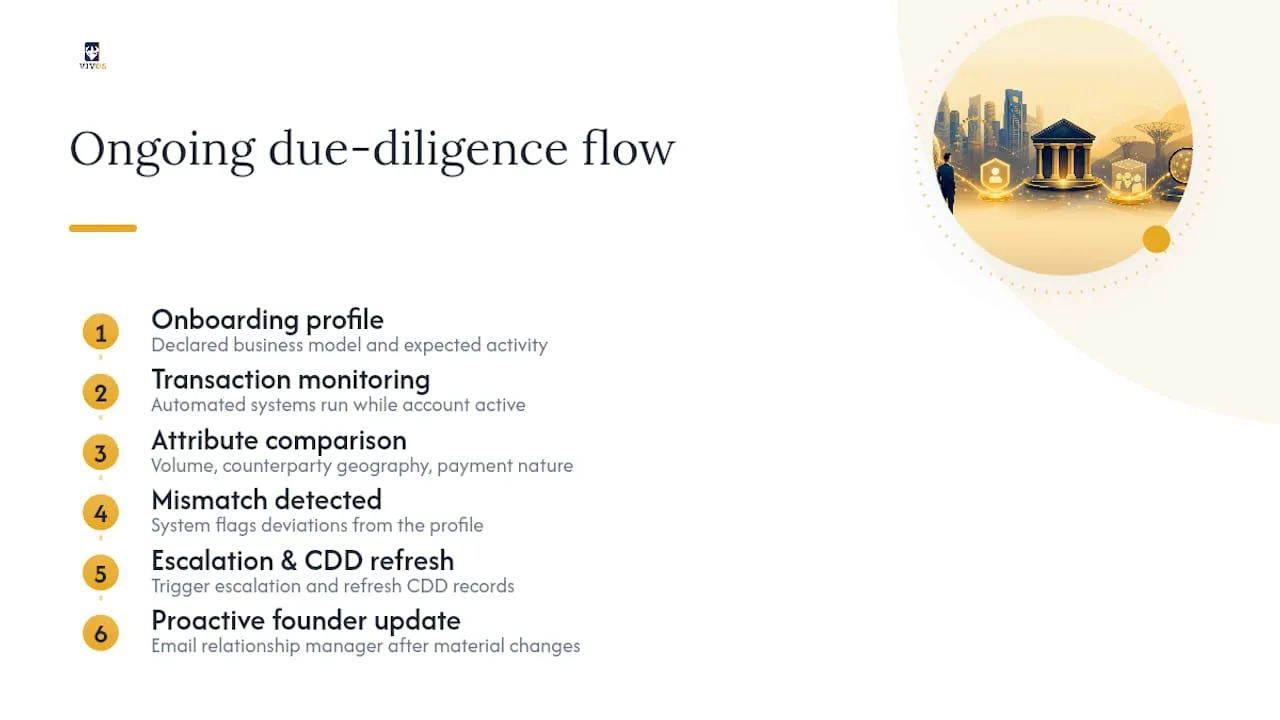
A founder who told the bank at onboarding that the company would process modest local service payments, then suddenly runs large international wire transfers through the same account, should expect a call. That’s not the bank being obstructive. It’s the system doing exactly what MAS Notice 626 requires: matching real activity against the declared business model and escalating the mismatch when it doesn’t line up.
This is also where the earlier insight about ongoing KYC becomes practical. Monitoring systems periodically trigger a refresh of CDD records, particularly when a business changes its registered activities, brings on new shareholders, or crosses a size threshold that shifts it into a higher risk category. Founders who update their bank proactively, rather than letting the bank discover a change through monitoring, tend to avoid the account freezes that follow an unexplained anomaly. A short email to your relationship manager after a material business change costs nothing and heads off a much longer compliance conversation later.
Banks apply conservative, sometimes frustrating scrutiny because MAS places ultimate AML/CFT accountability on the board, not on the frontline staff reviewing your file. That structure protects Singapore’s reputation as a financial center, and by extension, it protects every legitimate business that opens an account here. A clean KYC file isn’t paperwork for its own sake. It’s the price of banking in a jurisdiction international counterparties still trust. Vivos supports founders through this process across Singapore, Malaysia, Hong Kong, and the UAE, with bilingual English-Mandarin service for clients who need it.
— Ray
Vivos is the direct route for foreign founders who want incorporation and bank onboarding handled as one connected process rather than two separate headaches. Where a founder working alone has to coordinate a corporate secretary, a resident director, a registered address, and a bank relationship manager separately, Vivos runs all four under one engagement.

That includes Singapore company incorporation for foreign founders, a nominee resident director where required, a registered address, ongoing corporate secretarial support, and direct bank account introductions once your KYC file is complete. Foreign-founder incorporation starts from S$4,600 one-off, with corporate secretary support from S$800 per year for the ongoing compliance work that follows. The same team also supports founders setting up in Malaysia, Hong Kong, and the UAE, with bilingual English-Mandarin service throughout.
If you’re preparing to open a corporate account and want the ownership chart, source-of-funds package, and substance evidence assembled before you ever sit down with a bank, get a quote through the Vivos pricing page or explore the full incorporation and banking support service to start the process now.
Banks must verify the identity of directors, shareholders, and beneficial owners, understand the source of funds, and confirm the business has genuine operational substance, under MAS Notice 626. The exact documents required depend on whether standard CDD or enhanced due diligence applies to your file.
Senior management approval is required before onboarding any enhanced due diligence case.
Common red flags include an ownership structure with no clear beneficial owner, source-of-funds documentation that doesn’t match the stated business activity, and a company with no verifiable operations beyond a registered address. Foreign shareholders connected to high-risk jurisdictions or politically exposed persons also trigger closer review.
There’s no fixed annual requirement, but KYC is an ongoing obligation rather than a one-time check. Banks refresh customer due diligence records periodically and whenever a material change, such as new shareholders or a shift in business activity, warrants a fresh look.
 2 January, 2025
 2 January, 2025
Cross border tax checklist for foreign founders in Singapore: four planning tools, IRAS 30 day requests, transfer pricing files and APAs.

Compare the GIP's three routes and thresholds (≈S$10M, ≈S$25M, S$200M). Learn timelines, REP renewal rules, tax implications, common risks, and advisor...

Singapore’s Corporate Service Providers Act 2024 (CSP Act) took effect on 9 June 2025, and the grace period for previously-unregistered providers ended 9 December 2025…