7 Steps to Multi Entity Consolidation for SG, MY, HK and UAE Groups

Ray Tay
Checklist for founders and finance leaders in SG, MY, HK and UAE: control tests, FX translation, intercompany eliminations and a 7 step close.

Published: 27 September 2026 · Reviewed by Ray Tay, Co-Founder & Managing Director, VIVOS PTE. LTD. (ACRA Filing Agent FA20240323 · MOM EA Licence 24S2425)
A registered filing agent is an ACRA-authorized firm or individual that files incorporation and compliance transactions on BizFile+ for clients who cannot file themselves. Foreign founders without Singpass fall into this category by default. As of 2026, ACRA requires anyone offering these services commercially to register as a corporate service provider under the CSP Act 2024.
TL;DR:
- Foreign founders and shareholders without Singpass must hire a registered filing agent to incorporate or amend a Singapore company.
- All providers must have an active CSP registration, a current RQI, and offer transparency on included services and fees before engagement.
- Many providers bundle corporate secretarial support with filing services, but firms that only file transactions do not handle ongoing governance or deadline tracking.
- Clarify nominee director renewal terms, fee structures, and document what is included in quotes to avoid hidden costs and delays.
- Choosing a reputable provider with clear credentials and responsive communication reduces the risk of compliance lapses and costly delays later.
Singapore citizens, permanent residents and Employment Pass holders with Singpass can file company transactions themselves through BizFile. Foreign founders cannot. Without a local Singpass account, self-registration on BizFile is not possible, which makes a filing agent a practical requirement rather than an optional convenience.
Local directors technically have the option to file directly. Many still engage a corporate service provider (CSP) because the filing steps intersect with governance duties that carry real deadlines and real penalties.
A filing agent’s job is transactional: submitting incorporation applications, updating company particulars, and lodging annual returns on BizFile+. A corporate secretary’s job is broader and ongoing, covering governance obligations that exist between filings.
The distinction matters mostly at the point of hiring. A provider that only files transactions without a secretarial mandate will not track your AGM deadline or update your registers between events.
Before signing anything, confirm the provider’s credentials against ACRA’s own records rather than taking a website claim at face value.
A provider that hesitates to share its CSP number or RQI details is worth treating with caution.
Engagement starts with paperwork and ends with an operating bank account. The sequence is fairly consistent across providers, though timing depends on how quickly documents come in.
The most common pitfall is treating nominee director terms as an afterthought. Clarify renewal fees and resignation notice periods before signing.
Quoted packages vary widely between providers, and what counts as “included” in one bundle is often billed separately in another.
| Service | Included or extra | Typical 2026 fee range |
|---|---|---|
| Incorporation filing | Included in incorporation packages | Set from $615 for local incorporation (VIVOS pricing) |
| Foreign-founder incorporation | Included in dedicated foreign-founder packages | Set from $4,600 (VIVOS pricing) |
| Corporate secretary (annual) | Often bundled, sometimes billed separately | Set from $800 per year (VIVOS pricing) |
| Nominee director renewal | Usually billed as a separate annual line item | Set from $3,000 per year (VIVOS pricing) |
| Monthly accounting | Rarely included, typically a recurring add-on | Set from $250 per month (VIVOS pricing) |
| Registered address | Often bundled with corporate secretary plans | Price on request from most providers |
| XBRL preparation | Usually billed separately per filing | Price on request from most providers |
Ask any provider for a written breakdown before comparing quotes, since headline prices rarely tell the full story.
Selecting a filing agent comes down to verification first, then fit. The strongest candidates make both easy to check.
Pro Tip: Ask for the provider’s CSP number and RQI name in writing before paying a deposit. A registered firm will produce both without hesitation.
Red flags include vague scope documents, ongoing fees that only appear after signing, and any reluctance to explain how RQI endorsement is tracked internally.
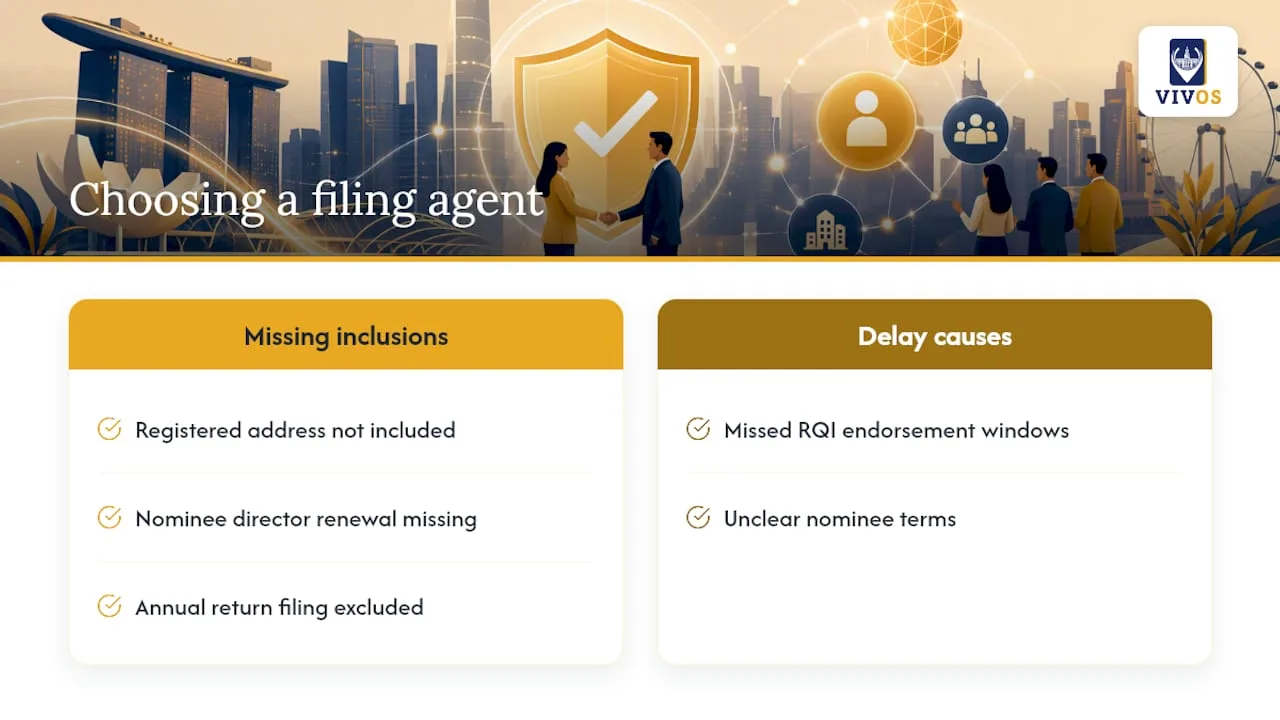
The gap between a cheap incorporation quote and a properly compliant one usually shows up months later, not at signing. Founders who choose on price alone often discover that registered address, nominee director renewal, and annual return filing were never actually included.
Ray Tay, Managing Director of VIVOS, points to missed RQI endorsement windows and unclear nominee terms as the two most common causes of delay among founders switching providers mid-year.
— Ray
One registered filing agent provides Singapore company incorporation for foreign founders, covering nominee resident director appointment, registered address, corporate secretary services, and bank account opening support. Some providers also serve founders setting up in other countries such as Malaysia, Hong Kong, and the UAE, offering support in multiple languages including English and Mandarin.

For founders comparing bundled packages against itemized ones, VIVOS publishes its core fees rather than quoting only on request.
Any firm or individual who files BizFile transactions for clients on a commercial basis must register as a corporate service provider under the CSP Act 2024. This applies whether the work is incorporation, annual returns, or other statutory changes filed on a client’s behalf.
No. ACRA is the Accounting and Corporate Regulatory Authority, the regulator overseeing company registration in Singapore. The Unique Entity Number, or UEN, is the identification number ACRA issues to a company once incorporation is approved.
A registered qualified individual, or RQI, must be named by a CSP and complete the AML/CFT training required under the Filing Agents and Qualified Individuals Regulations. ACRA then issues a professional number confirming the individual’s authorization to file on the firm’s behalf.
Only a registered corporate service provider or a named registered qualified individual can file BizFile transactions on behalf of a client. Directors with Singpass can file for their own company directly, but foreign founders without Singpass depend on a registered filing agent such as VIVOS to complete the same transactions.

 2 January, 2025
 2 January, 2025
Checklist for founders and finance leaders in SG, MY, HK and UAE: control tests, FX translation, intercompany eliminations and a 7 step close.

Singapore guide for founders on shareholders agreements: key clauses, Companies Act limits, drafting steps and realistic timelines of 2–6 weeks.

Compare NetSuite and Xero for Singapore SMEs. Learn S$45 to S$150 pricing, InvoiceNow readiness, upgrade signals, and a practical migration checklist.


Incorporated in Singapore under the Companies Act 1967 UEN 202416468C | ACRA Registered Filing Agent FA20240323 | MOM Employment Agency Licence 24S2425
Malaysia – VIVOS (M) Sdn. Bhd. | Registration Number:
People’s Republic of China, Hong Kong – VIVOS CORPORATE SERVICES (HK) LTD. | Business Registration Number: 80545137
United Arab Emirates, Dubai – VIVOS CORPORATE SERVICES L.L.C. | Commercial Licence Number: 1638200