
在新加坡注册公司到底有多快?ACRA比客户的午餐还快(2026年真实案例)

Ray Tay
ACRA大多在付款后即批准注册(名称15新元+注册300新元,通常当天完成)。真正拖慢创始人的是未决定的事项:财年、股权、注册地址、银行KYC文件。
Published: 20 August 2026 · Last reviewed: 30 September 2026 · Reviewed by Ray Tay, Co-Founder & Managing Director, VIVOS PTE. LTD. (ACRA Filing Agent FA20240323 · MOM EA Licence 24S2425)
Yes, an eligible foreign company can redomicile to Singapore, transferring its registration while keeping its corporate identity intact. The first step: reserve a company name and file an Application for Transfer of Registration through the Accounting and Corporate Regulatory Authority’s Bizfile portal.
Before you start, know the numbers with which ACRA works:
Redomiciliation lets an eligible foreign company transfer its registration to Singapore while keeping its original corporate identity, contracts, and history intact.
| Point | Details |
|---|---|
| Confirm home-jurisdiction permission | Some countries, including the UK and Hong Kong, do not permit outward redomiciliation, so check this before filing. |
| Budget for the ACRA fee and timeline | Expect a $985 non-refundable fee and roughly 40 working days for processing. |
| Use entity-level financials | ACRA requires entity-level audited statements, not consolidated group figures, a common rejection cause. |
| Track post-approval deadlines | Deregister at home within 60 days and register pre-existing charges within 30 days of approval. |
| Get professional filing support | Vivos prepares documents, lodges the Bizfile application, and manages post-approval compliance tasks. |
Start with the ACRA page above to confirm your entity qualifies before touching Bizfile.
Redomiciliation transfers a company’s place of registration without creating a new legal entity. The same corporate person that existed abroad becomes a Singapore company limited by shares, or a Variable Capital Company if it’s a fund vehicle. Nothing about the company’s history resets.
What changes:
This is fundamentally different from opening a branch or forming a subsidiary, both of which create a new legal relationship rather than moving the original one.
Pro Tip: A branch or subsidiary gives you a second legal person tied to the parent. Redomiciliation gives you one legal person that simply changes its home address. If preserving deal history, credit ratings, or litigation continuity matters to your business, that distinction decides everything.
Once approved, most entities land in one of two forms:
From that point forward, the entity answers to the Companies Act for governance, filing, and reporting.
Fund managers weighing redomiciliation should check the VCC route early. A VCC structure carries its own capital and reporting rules distinct from a standard Pte Ltd, and choosing the wrong form after transfer means unwinding decisions that are expensive to reverse.
ACRA will not process an application unless the entity clears several statutory tests. Miss one, and the filing stalls.
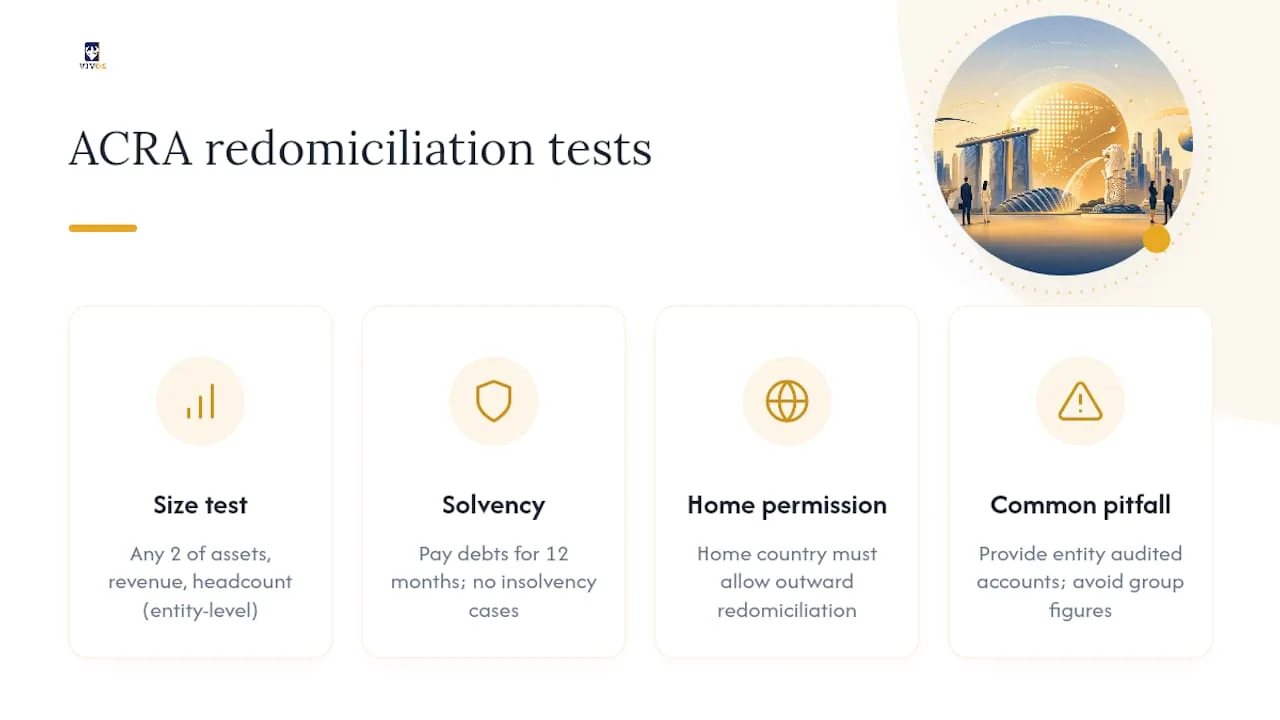
Size test. The company must meet any two of three thresholds: total assets, annual revenue, or employee headcount, measured at the entity level, according to ACRA’s requirements.
Solvency test. The company must be able to pay its debts as they fall due for at least the next 12 months, with no pending insolvency proceedings, and it cannot be under judicial management or liquidation.
Home-jurisdiction permission. Your current country of registration must legally allow outward redomiciliation. Some jurisdictions permit it readily; others, including the UK and Hong Kong, generally do not authorize an outward transfer at all, according to Duane Morris LLP. Check this before spending time on anything else.
Pro Tip: The most common rejection trap isn’t a failed solvency test; it’s submitting group-level consolidated figures when ACRA wants entity-level audited financials. If your business operates as part of a larger group, isolate your entity’s own numbers before you file.
Prepare these before you touch Bizfile:
Certification timing matters more than most applicants expect. Supporting documents generally need to be certified within a defined window, and ACRA’s own guidance recommends certifying documents at least four months before you apply, unless you’ve secured prior approval for an exception, per the transfer of registration manual. Submissions go in as PDFs, so scan everything cleanly and check page orientation before uploading.
Pro Tip: Start pulling together audited financial statements the moment you decide to pursue redomiciliation, not after you’ve picked a target filing date. If your entity typically works from unaudited management accounts in a parent-subsidiary setup, confirm with ACRA or your corporate secretary whether that will pass muster, because it often won’t.
The application runs through a predictable sequence, though each stage has its own timing risk.
Once approved, the clock doesn’t stop:
Run banking updates, contract notifications, and employment paperwork in parallel with the application rather than after approval. Waiting sequentially adds months you don’t need to lose.
A redomiciled company becomes a Singapore tax resident subject to local corporate tax rules from the point of transfer. Your home jurisdiction may impose exit taxes or stamp duties on the way out, and Singapore’s ability to offer tax credits against those costs depends on treaty terms and case-by-case approval. Singapore’s absence of capital gains tax is a genuine draw for companies relocating headquarters, a point highlighted in tax-planning research, though it doesn’t erase exit-side liabilities elsewhere.
Once transferred, the company takes on full Companies Act obligations: annual general meetings, financial reporting, XBRL filing, and statutory register maintenance, all on Singapore’s compliance calendar.
Employment contracts, payroll arrangements, social security registrations, and intellectual property filings all need review, since none of these transfer automatically just because the corporate registration has moved.
Pro Tip: Engage a cross-border tax specialist before you file, not after approval lands. Modeling exit-tax exposure against Singapore’s tax position takes time, and doing it retroactively usually means discovering a liability you can no longer plan around.
Redomiciliation isn’t always the right tool. Consider alternatives when:
The common alternatives: incorporate a new Singapore Pte Ltd and transfer operations across, register a branch if full legal continuity isn’t essential, or set up a subsidiary.
Pro Tip: For smaller or early-stage operations, fresh incorporation plus an asset transfer is usually faster and cheaper than redomiciliation. Save the redomiciliation route for established businesses with real corporate history worth preserving.
An experienced Singapore provider typically handles:
Working with a team that has processed these applications before generally shortens the overall calendar, since it catches the entity-level financials trap and certification timing errors before ACRA does.
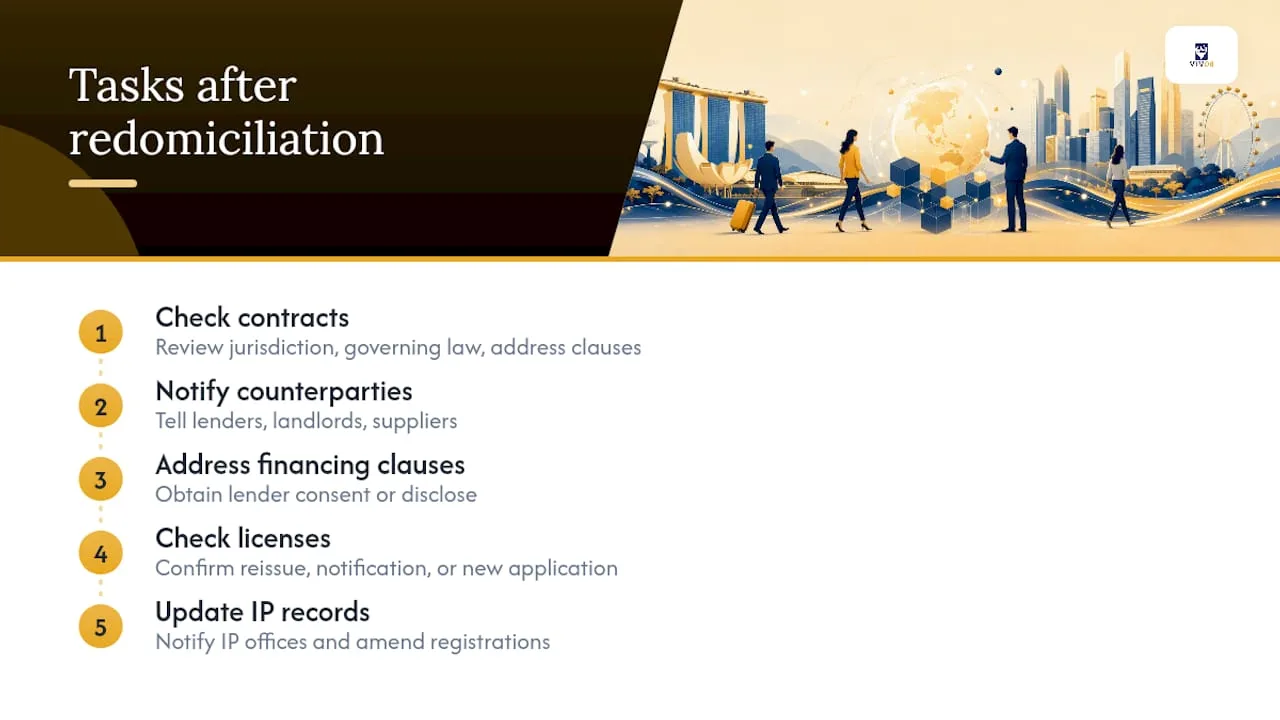
Because redomiciliation preserves the same corporate person, existing contracts generally remain valid without requiring wholesale renegotiation. The company that signed the agreement is still the company on the other side of it. That said, contracts often contain clauses tied to the company’s jurisdiction of incorporation, governing law, or registered address, and those clauses need review even when the underlying obligation survives.
Notify key counterparties, particularly lenders, landlords, and long-term suppliers, once your transfer is approved. Some financing agreements include change-of-domicile triggers that require lender consent or disclosure, and missing that step can create a technical default even though nothing commercially has changed.
Licenses issued by Singapore authorities or foreign regulators deserve separate attention. A license tied to your old jurisdiction’s registration number doesn’t automatically follow the company to Singapore. Check with each licensing body whether redomiciliation requires a formal notification, a license reissue, or a fresh application under Singapore rules.
Intellectual property is its own workstream. Trademarks, patents, and domain registrations tied to your company’s old legal name or registration number often need updating with the relevant IP office once the transfer completes. This isn’t automatic, and delays here can create gaps in enforceability if a dispute arises before the records catch up. Build IP record updates into your post-approval task list alongside share certificate issuance and charge registration, rather than treating it as an afterthought.
Because the company itself doesn’t change identity, existing employment contracts generally continue without requiring new agreements, unlike a sale of business where employees transfer to a different legal employer. That’s one of redomiciliation’s underappreciated advantages: your workforce doesn’t experience a legal employer change on paper.
That said, practical employment matters shift the moment the company becomes Singapore-registered. Payroll, statutory contributions, and work pass arrangements for any staff physically located in Singapore fall under Singapore’s employment framework going forward. Staff still based in the home jurisdiction may remain under that country’s labor law and social security system, creating a split compliance picture that needs careful documentation.
Review employment contracts for clauses referencing the company’s jurisdiction of incorporation or governing law, since these sometimes need amendment even when the employment relationship itself is uninterrupted. Notify employees of the change proactively. A registration transfer that happens without warning tends to generate anxious questions about job security and benefits continuity, questions that a short internal memo can head off entirely.
Coordinate with a payroll and HR compliance specialist to confirm Central Provident Fund obligations begin correctly for any Singapore-based hires and that any foreign social security wind-down happens on the right schedule. Getting this sequencing wrong is a common source of post-transfer compliance headaches.
Double-check entity-level financials before submission, certify documents within the acceptable window, and have letters ready for banks and counterparties before approval lands. The single biggest avoidable delay Vivos sees: companies that don’t coordinate home-jurisdiction deregistration early enough, risking forced cancellation if the 60-day window closes first.
Vivos prepares and lodges redomiciliation applications for foreign companies moving to Singapore, then manages the post-approval compliance work that follows. That combination matters: a filing that gets approved but mishandles the 30-day charge registration or 60-day deregistration deadline creates its own new problems.

Vivos’s redomiciliation support covers two areas most owners underestimate. First, corporate secretarial preparation, including certifying your documents correctly the first time so ACRA doesn’t send the application back. Second, accounting and financial advisory work to model your exit-tax exposure before you commit to a one-way transfer.
If you’re weighing whether redomiciliation or fresh incorporation fits your business, contact the Vivos team for a direct assessment of your entity’s eligibility.
No. Your entity must pass ACRA’s size and solvency tests, and your home jurisdiction must legally permit outward redomiciliation. Some countries, such as the UK and Hong Kong, generally don’t allow it.
ACRA charges a non-refundable fee of $985 for the Application for Transfer of Registration, regardless of whether the application is approved.
Processing typically takes about 40 working days from a complete submission, though document certification and home-jurisdiction approvals can add time before you even file.
No. Singapore does not currently permit outward redomiciliation, so transferring in is a long-term legal commitment.
They generally remain valid, since redomiciliation preserves the same corporate entity rather than creating a new one. Some contracts may still require notice to counterparties or lenders under change-of-domicile clauses.
It depends on your priorities. Redomiciliation preserves corporate history and existing contracts, while fresh incorporation is usually faster and simpler for smaller or early-stage operations.
This article is general information, not a substitute for advice from a qualified lawyer. Consult a qualified legal professional about your own circumstances before acting on anything here.

 2 January, 2025
 2 January, 2025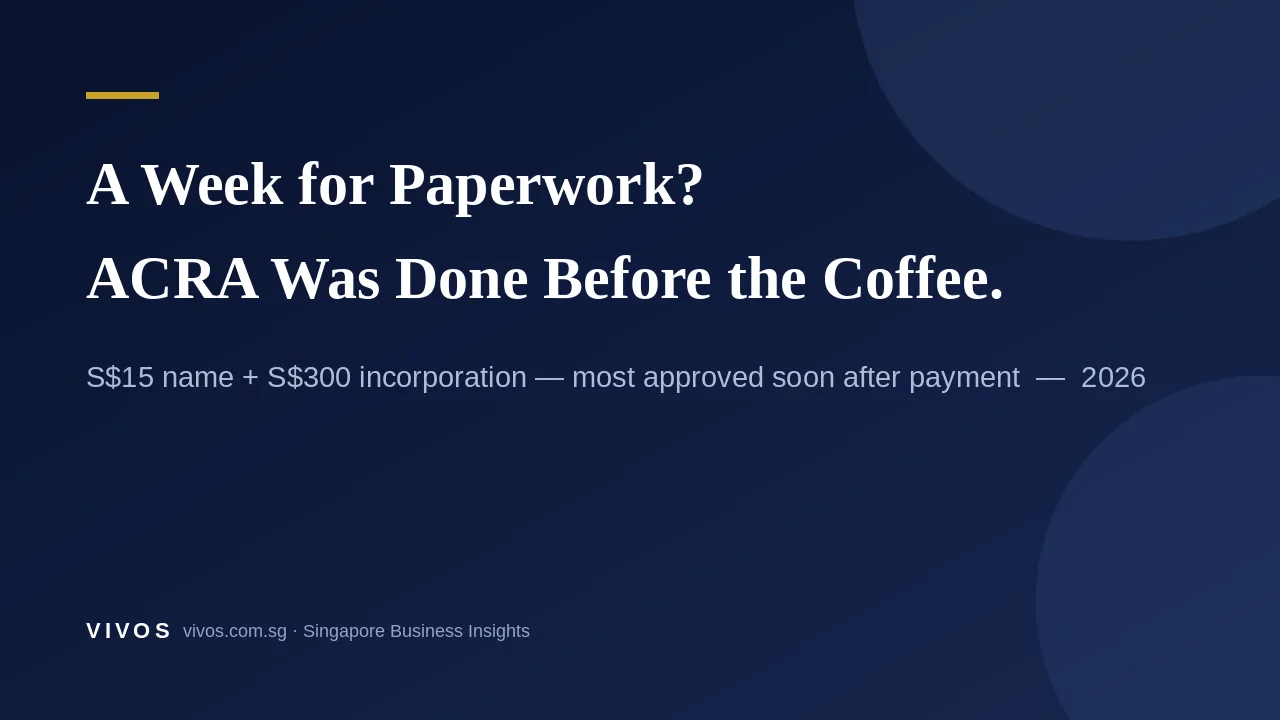
ACRA大多在付款后即批准注册(名称15新元+注册300新元,通常当天完成)。真正拖慢创始人的是未决定的事项:财年、股权、注册地址、银行KYC文件。
ACRA approves most Singapore incorporations soon after payment (S$15 name + S$300). A true client story on what really slows founders down — and the…

了解新加坡公司注册费用:官方 315 新元起、首年第三方费用可明显上升,逐项报价与合规建议帮您控预算并加速开户,含处理时效与开户风险说明。