

新加坡公司注册费用:2026年官方收费与实务预算全解析

Ray Tay
了解新加坡公司注册费用:官方 315 新元起、首年第三方费用可明显上升,逐项报价与合规建议帮您控预算并加速开户,含处理时效与开户风险说明。
Published: 4 October 2026 · Reviewed by Ray Tay, Co-Founder & Managing Director, VIVOS PTE. LTD. (ACRA Filing Agent FA20240323 · MOM EA Licence 24S2425)
A startup financial model is a linked three-statement projection, income statement, balance sheet, and cash flow, driven by assumptions about revenue, hiring, burn, and runway. Investors expect one from the seed round onward, and most founders also use it internally for hiring decisions, budget control, and board reporting. Done well, it becomes the single reference document for the business.
TL;DR:
- A seed-stage financial model must include a fully linked three-statement projection with monthly detail for at least the first 18 months, covering revenue, COGS, headcount, and working capital.
- Assumptions should be built bottom-up, clearly documented, and separated into dedicated tabs, with scenario planning (base, upside, downside) to test business robustness.
- Regular monthly updates using actuals, variance reconciliation, and rolling forecasts are vital to keep the model relevant and prevent cash shortages.
- Incorporate jurisdiction-specific inputs like tax rates, GST thresholds, employer CPF, and incorporation timing, especially for Singapore startups.
- A clear cap table linked to fundraising scenarios and dilution projections helps assess ownership impacts, while validation against actuals maintains model credibility.
A seed-stage model needs all three financial statements linked together, not just a revenue spreadsheet with a growth curve attached. Each statement answers a different question, and investors read them as a set because each one checks the others.
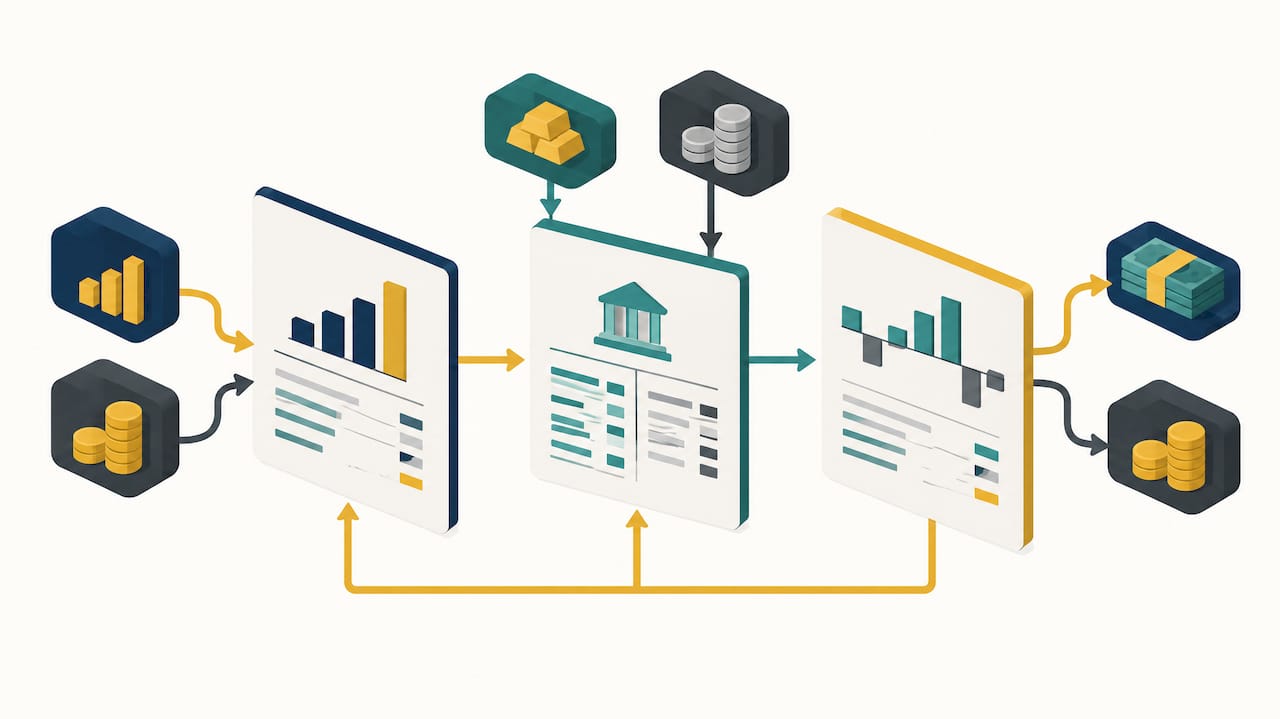
The income statement, or P&L, shows revenue and expenses over time and answers whether the business model works at all. It is driven by the same assumptions that drive the rest of the model: pricing, unit volumes, headcount costs, and operating expenses. The balance sheet shows what the company owns and owes at a point in time, including cash, receivables, equipment, and any debt. It is the reconciliation layer: if the balance sheet does not balance, an assumption elsewhere is wrong.
The cash flow statement tracks the actual movement of money in and out of the bank account, and for an early-stage company it is the most consequential of the three. A company can show a profit on paper and still run out of cash because customers pay late or because a large capital purchase hits the bank account before revenue catches up. Investors commonly ask for a three-to-five year forecast with monthly granularity for at least the first 18 to 24 months, tapering to quarterly detail further out.
A model built to this standard typically includes:
Investors weigh the defensibility of a founder’s assumptions more heavily than the precision of a five-year revenue number, because nobody, including the founder, can forecast year four with real accuracy. What they are testing is whether the founder understands the levers of the business well enough to run it under pressure.
Every number in the model traces back to an assumption, and the quality of the model is really the quality of its assumptions. Vague inputs produce a vague model, no matter how polished the formatting looks.
Pro Tip: Keep every assumption in one visible cell with a label next to it: an investor who cannot find the input behind a number will assume you cannot either.
Building the model in the right order prevents the rework that comes from discovering a missing input halfway through. Each tab should feed the next, so sequence matters as much as content.
Keep the whole build at monthly granularity for at least the first two years. Quarterly models hide the month a company actually runs out of cash, which defeats the purpose of building one. Run a parity check every month: does the balance sheet balance, and does the ending cash balance on the cash flow statement match the cash line on the balance sheet. If it does not, an assumption somewhere is double-counted or missing.
Common pitfalls to avoid:
For investor review, document every assumption in plain language next to the number it drives, and be ready to explain why the churn rate or the sales cycle length is what it is. A widely used modelling checklist recommends exactly this structure: bottom-up drivers, a separate assumptions tab, monthly forecasts, and at least three named scenarios, because that combination is what lets an outsider follow the logic without a walkthrough call.
A consistent tab structure makes the model usable by anyone who opens it, including a future finance hire or a due diligence team. The exact order matters less than having every tab present and clearly labeled.
| Tab | Purpose | Key assumption |
|---|---|---|
| Assumptions | Central list of every driver used elsewhere in the model | Growth rate, pricing, churn, tax rate |
| Revenue model | Bottom-up build of monthly revenue by channel | Units, conversion rate, average revenue per user |
| Headcount | Hire dates and fully loaded cost by role | Salary, statutory contributions, start month |
| OpEx | Fixed and variable operating costs | Rent, software, marketing spend |
| Capex and balance sheet | Equipment, deposits, financing | Purchase timing, depreciation schedule |
| P&L | Monthly income statement | Linked from revenue, COGS, headcount, OpEx |
| Cash flow | Monthly cash movement and ending balance | Working capital, timing of collections |
| Cap table | Ownership by shareholder and round | Share count, option pool size |
| Dashboard | Summary view for quick reading | Runway, burn rate, gross margin |
Google Sheets works well for most seed-stage founders because collaboration with co-founders and investors is simpler and version history is automatic. Excel remains preferable for more complex models with heavy scenario toggles or when an investor’s finance team expects a specific file format. Whichever tool you choose, keep one master version, name file copies by date, and avoid emailing spreadsheet attachments back and forth, since conflicting versions are one of the more common sources of investor confusion during diligence.
A single-scenario model tells an investor nothing about how the business behaves under stress, which is exactly the condition most startups eventually face. Three scenarios, base, upside, and downside, give a far more honest picture.
The base case reflects your most likely assumptions for growth, churn, and hiring pace. The upside case tests what happens if a channel outperforms or an enterprise deal closes early. The downside case is the one investors read most carefully, and it should include specific, named stress tests rather than a vague “slower growth” toggle:
Under each scenario, the numbers investors check first are runway, the burn multiple (net burn divided by net new revenue), and the month the business reaches break-even or its next milestone. A downside case that still leaves 12 months of runway is one of the more reassuring things a founder can show a term sheet negotiation. That single number often carries more weight than a strong base-case growth curve, because it demonstrates the business survives a miss rather than just performing well when everything goes right.
Present sensitivity with a small toggle on the dashboard tab that switches the whole model between scenarios, rather than three separate files. This lets an investor flip between cases live on a call and ask “what if churn is two points higher” without waiting for a follow-up email. Keep the toggle simple: a single dropdown or input cell that feeds every downstream tab is enough, and it signals that the model is built to be interrogated, not just presented once and filed away.
A financial model that is built once for a fundraise and never opened again stops being useful within a quarter, because assumptions drift and actuals diverge from plan almost immediately. Treating the model as a living document is what keeps it relevant.
A rolling 12-month forecast updated on a monthly cadence materially reduces the risk of an unexpected cash shortfall, because problems surface as a trend across two or three months rather than as a crisis in the fourth. Founders who skip this step tend to notice cash problems only when the bank balance itself looks low, which is usually too late to fix without an emergency raise.
Foreign founders setting up a new Singapore company need several jurisdiction-specific figures in the assumptions tab, since getting these wrong distorts both the tax line and the cash flow timing. IRAS sets the prevailing corporate tax rate at 17%, and qualifying new start-up companies can access a partial tax exemption on the first chunk of chargeable income, which lowers the effective rate in the early years. As of 2026, CIT rebates announced in recent budgets may further reduce the cash tax payable, so the model’s tax line should reference the current exemption and rebate schedule rather than a flat 17% applied from year one.
GST registration becomes mandatory once taxable turnover crosses the current threshold, assessed on either a retrospective or prospective basis, and IRAS is the authority to check for the current threshold and assessment method. A model should flag the month projected turnover approaches that figure so GST collection and remittance can be built into cash flow before registration becomes due, not after.
Other inputs that belong in the assumptions tab:
An ACRA-registered filing agent provides Singapore company incorporation for foreign founders, including nominee resident director, registered address, and corporate secretary services, with accounting support that feeds these figures directly into the model; similar services are also offered in Malaysia, Hong Kong, and the UAE, in English and Mandarin.
Founders raising into a Singapore entity often underestimate how much incorporation timing affects their first six months of cash flow. Getting the entity, the bank account, and the accounting set up correctly from day one means the model’s early assumptions hold up instead of needing a rebuild once the real invoices start arriving.
Ray Tay, Managing Director, VIVOS
This section is informational, not legal or tax advice. Confirm current rates and thresholds directly with IRAS or CPF, or with a qualified advisor, before finalizing the model.
Every funding round changes who owns what percentage of the company, and a model that ignores this gives founders a misleading view of their own long-term stake. Dilution modelling sits alongside the cash flow forecast, not inside it, but the two inform each other directly.
Each time new shares are issued, whether to investors, to an option pool, or to new co-founders, existing shareholders own a smaller percentage of the same company, even though the value of that smaller percentage may grow. A simple dilution table should show, for each planned round, the pre-money valuation, the amount raised, the resulting post-money valuation, and the ownership percentage of every shareholder class before and after.
Option pools deserve particular attention because they are often created or expanded at the same time as a priced round, and investors typically want the pool sized before the new money comes in, which dilutes existing shareholders more than it dilutes the incoming investor. Founders who model this in advance can negotiate pool size and timing instead of discovering the dilution after the term sheet is signed. Keep the dilution table on its own section of the cap table tab so it updates automatically as round assumptions change, rather than being recalculated by hand each time a scenario shifts.

The cap table and the financial model should be linked, because the amount raised in each round directly determines the runway extension the model shows afterward. A fundraising rounds forecast lets founders test how much to raise, at what valuation, and how long that capital lasts before the next round is needed.
Build the cap table tab to list every shareholder, their share count, and their percentage ownership, updating automatically as each new round is added as a line item with its own raise amount and valuation. Link the raise amount from each planned round directly into the cash flow statement as a financing inflow in the month the round is expected to close, so the runway calculation reflects the actual timing rather than treating all future capital as already in the bank.
This matters most when testing how early or late to raise the next round. A model that shows runway dropping to three months before the next round is projected to close is a planning failure the founder can catch and fix, either by extending the current round, cutting burn, or moving the fundraising timeline forward. Keeping the cap table and the cash flow statement on separate tabs but linked by formula, rather than updated independently, is what prevents the two from drifting apart as rounds get renegotiated.
A model built entirely from assumptions, with no connection to actual performance, is a forecast in name only. Validating it against historical data and outside benchmarks is what turns a spreadsheet into a planning tool investors can trust.
Once the company has a few months of actual revenue and expense data, compare it line by line against the original forecast. A consistent gap in one direction, rather than random noise, usually means an assumption was wrong rather than the business underperforming, and the fix belongs in the assumptions tab, not in a one-off adjustment to a single month’s output. Early-stage companies with no revenue history yet can still sanity-check assumptions against public benchmarks for comparable business models, such as typical SaaS gross margins or typical conversion rates for a given channel, flagging any assumption that sits far outside the normal range for further justification.
Re-run the validation every time a new quarter of actuals becomes available, since a model validated once at the seed stage will drift as the business matures and its unit economics shift. Treat each validation pass as an opportunity to tighten the assumptions tab rather than as a one-time exercise done only before a fundraise.
The most common mistake is not technical. Founders build an impressively detailed model and then stop checking it against reality, because once the fundraising deck is finished, the model feels like it has served its purpose. The opposite is true: the model earns its value after the round closes, when it becomes the tool for deciding whether to make the next hire or cut the next cost.
The second mistake is modelling headcount optimistically and burn conservatively, which is backwards. Hires almost always start later than planned, recruiting takes longer, and onboarding adds a ramp period before a new salesperson or engineer contributes fully. Modelling hire dates a month later than the plan, and modelling new hires at zero productivity for their first month or two, produces a far more honest burn number than assuming every hire starts exactly on schedule and is productive immediately.
A rolling 12-month forecast, updated monthly against actuals, has changed more than one founder’s hiring decision by showing a burn trend three months before the cash account itself would have shown a problem. That lead time is the entire point of building the model in the first place.
— Ray
A financial model is only as reliable as the inputs behind it, and several of those inputs depend on how and where the company is incorporated. An ACRA-registered filing agent handles Singapore company incorporation for foreign founders, including nominee resident director, registered address, and corporate secretary services, so the entity, banking, and compliance timeline that feed the model’s early assumptions are set up correctly from the start.

Services that map directly onto model inputs include consulting an App developer Singapore for SMEs for accurate project delivery timelines and cost inputs.
Similar services are offered in Malaysia, Hong Kong, and the UAE, with support in English and Mandarin, for founders structuring operations across more than one jurisdiction. Founders who prefer to build and maintain the model themselves can still use these services selectively, for incorporation or accounting alone, while keeping the forecasting work in house. For current service details and pricing, visit the VIVOS pricing page.
A startup financial model is a linked three-statement projection, income statement, balance sheet, and cash flow, built from assumptions about revenue, hiring, burn, and runway. Investors typically expect one with monthly detail for at least the first two years as part of fundraising due diligence.
ChatGPT and similar tools can help draft formulas, structure tabs, or explain modelling concepts, but they cannot generate the assumptions that make a model credible, since those depend on the founder’s own knowledge of their market, pricing, and cost structure. Treat AI tools as drafting assistance, not as a substitute for building and defending the assumptions yourself.
Definitions vary across sources, but a common version lists pre-seed, seed, early stage (Series A), growth stage (Series B and C), expansion, maturity, and exit. A financial model evolves at each stage, moving from rough assumptions at pre-seed to a fully actuals-reconciled forecast by the growth stage.
AI tools are increasingly used to speed up formula building and scenario testing, but the core judgment behind a startup model, choosing which assumptions matter and defending them to investors, remains a founder-level task. The model’s value comes from the reasoning behind the numbers, which AI can support but not originate.

 2 January, 2025
 2 January, 2025
了解新加坡公司注册费用:官方 315 新元起、首年第三方费用可明显上升,逐项报价与合规建议帮您控预算并加速开户,含处理时效与开户风险说明。

Practical PE guide for foreign founders: IRAS and Income Tax Act authorities, a one page triggers table, and a six step decision checklist to manage...

为新加坡公司设计会计科目表时,应遵循适用准则并预留 ACRA 分类映射字段,保障 XBRL 申报验证通过与 IRAS 保存一致性。