
Singapore Founders: Get a Shareholders Agreement in 2–6 Weeks

Ray Tay
Singapore guide for founders on shareholders agreements: key clauses, Companies Act limits, drafting steps and realistic timelines of 2–6 weeks.
Published: 26 September 2026 · Reviewed by Ray Tay, Co-Founder & Managing Director, VIVOS PTE. LTD. (ACRA Filing Agent FA20240323 · MOM EA Licence 24S2425)
Multi-entity consolidation combines the financial results of a parent company and its subsidiaries into one set of accounts, stripping out intercompany transactions and translating foreign-currency figures into a single reporting currency. Singapore’s Companies Act requires many parent companies to lay consolidated financial statements at the annual general meeting, subject to specific exemptions. This article walks through the accounting logic, the statutory triggers, and the closing process itself.
TL;DR:
- Control of an entity, often with more than 50% ownership or board rights, triggers consolidation regardless of geographic location or legal form.
- Currency rate fluctuations between local entities can shift consolidated revenue by several percentage points, emphasizing the need for documented rate policies.
- Intercompany transactions must be meticulously matched and eliminated, with differences in timing and FX revaluation being the main reconciliation challenges.
- Consolidation software should automate currency translation, intercompany eliminations, NCI modeling, and provide a full audit trail to streamline the process.
- Maintaining consistent bookkeeping across jurisdictions, including chart-of-accounts mapping and rate sources, significantly reduces consolidation errors and audit complications.
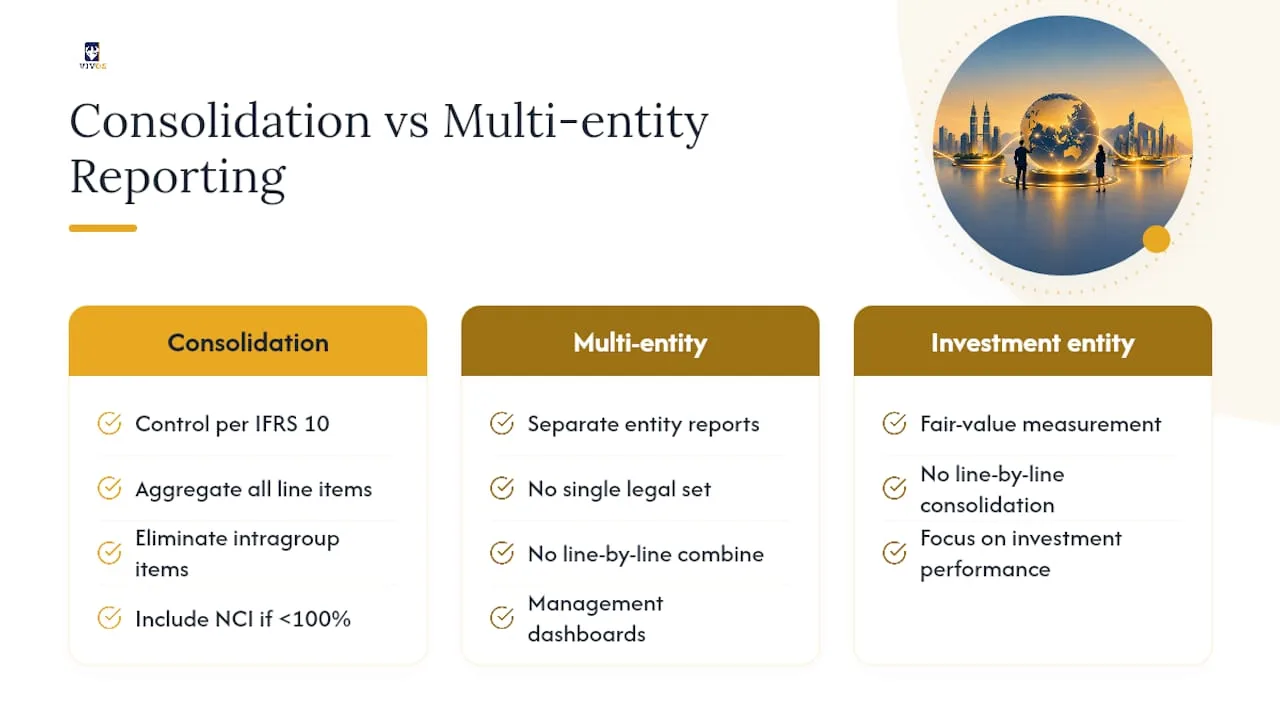
Consolidation starts with a single question: who controls whom? Under IFRS 10, control (not just ownership percentage) determines whether an entity belongs inside the consolidated group. A parent typically controls a subsidiary when it has power over relevant activities, exposure to variable returns, and the ability to use that power to affect those returns. Ownership of more than 50% of voting shares usually signals control, but not always. A 40% stake paired with board majority rights can still trigger consolidation.
Once the group perimeter is defined, the mechanics follow: every line item on the income statement and balance sheet, from revenue to fixed assets, gets aggregated across entities. Intragroup sales, loans, and dividends are then eliminated so the group doesn’t double count money moving between its own subsidiaries. This is where multi-entity reporting differs from simple consolidation. Multi-entity reporting can mean producing separate management dashboards for each subsidiary without ever combining them into one legal set of accounts. Consolidation is the specific accounting exercise of producing one unified statement.
Two other pieces matter. Non-controlling interest (NCI) captures the portion of a subsidiary’s equity and profit that belongs to outside shareholders when the parent owns less than 100%. And IFRS 10 carves out an investment-entity exception: certain investment vehicles measure subsidiaries at fair value through profit or loss rather than consolidating them line by line, because line-by-line combination would obscure rather than clarify their investment performance.
Singapore’s Companies Act requires a parent company to lay consolidated financial statements, along with its own balance sheet, before the AGM. This is a statutory obligation, not a discretionary reporting choice, and it sits alongside SFRS(I) accounting standards that mirror IFRS 10s control-based framework.
In practice, the trigger is the same control test described above. If a Singapore holding company owns or controls one or more subsidiaries anywhere (Malaysia, Hong Kong, the UAE, or elsewhere), that control relationship generally pulls those entities into the consolidated group accounts, regardless of where they are incorporated.
Exemptions exist. Smaller groups may qualify for audit exemption under the small company or small group criteria, and some wholly owned subsidiaries of a Singapore parent don’t need to prepare their own consolidated accounts if they’re already captured further up the chain. But exemption criteria change, and thresholds get revisited. Confirming eligibility with a qualified accountant before assuming an exemption applies is worth the hour it takes.
None of this replaces local filing. A Malaysian subsidiary still files its own statutory accounts in Malaysia; a Hong Kong entity still meets its own filing calendar. Consolidation sits as a reporting layer above those entity-level obligations, not a substitute for them.
Four problems show up in almost every cross-border close.
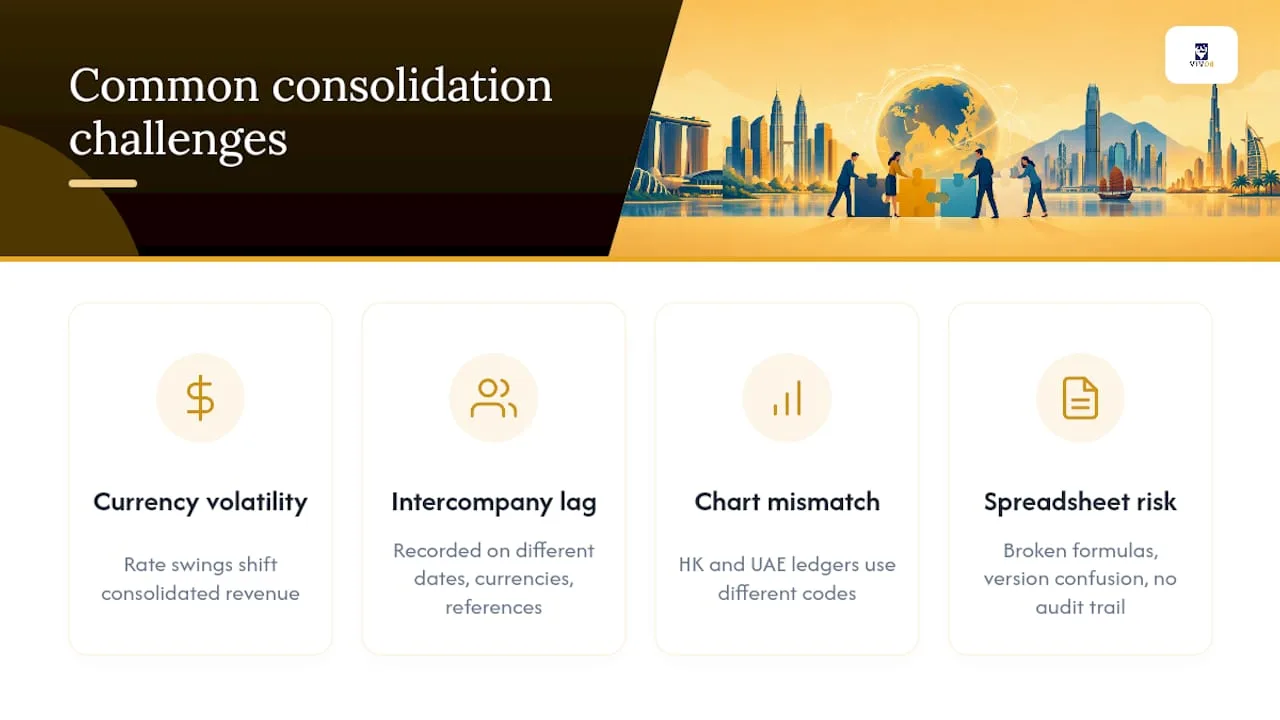
Currency volatility tops the list. A Singapore parent consolidating a Malaysian ringgit subsidiary and a UAE dirham entity faces rate swings that can shift consolidated revenue by several percentage points between one close and the next, especially without a documented rate policy.
Intercompany reconciliation runs a close second. Two entities record the same transaction on different dates, in different currencies, sometimes with different reference numbers, and the mismatch surfaces only during consolidation, forcing a scramble to trace it back.
Disparate charts of accounts compound both problems. A Hong Kong entity’s ledger structure rarely matches a UAE free zone entity’s structure, so line items that should map cleanly into one consolidated category get scattered across mismatched codes.
Manual spreadsheets tie it all together, badly. Groups running four or five entities through linked spreadsheets accumulate broken formulas, version confusion, and no audit trail. That’s usually the point where finance leaders start pricing consolidation software.
A repeatable close follows roughly the same sequence every period, regardless of how many entities sit in the group.
Confirm the group perimeter and control conclusions. Document a control memo for each entity, stating why it is or isn’t consolidated under IFRS 10 principles. This memo matters as much as the numbers themselves during an audit, since control judgment is the foundation the entire consolidation rests on.
Align fiscal year-ends, chart-of-accounts mapping, and accounting policies. Entities acquired at different times often carry different year-ends and different depreciation or revenue-recognition policies. Platforms like Microsoft Dynamics 365 support consolidation across multiple fiscal calendars, but the underlying mapping work (deciding which local account rolls into which group category) has to happen regardless of the tool.
Complete each entity’s close and produce trial balances. Every subsidiary closes its own books first, with supporting schedules for fixed assets, accruals, and provisions ready to hand off.
Translate foreign-currency trial balances. Apply the closing rate to balance sheet items and an average rate to income statement items, using a documented, consistently applied rate source.
Match and eliminate intercompany balances. Sales, cost of goods, loans, dividends, and unrealized profit between entities all get identified and removed so the group isn’t reporting revenue it earned from itself.
Compute non-controlling interests and acquisition adjustments. Where ownership is below 100%, calculate the NCI share of equity and profit, then post any fair-value adjustments from the original acquisition date through top-side journal entries.
Aggregate, validate, and prepare disclosures. Combine the balance sheet, profit and loss, and cash flow statement, run variance checks against the prior period, and prepare the notes required under SFRS(I) or IFRS.
Translation method choice isn’t optional detail. Balance sheet items translate at the closing rate; income statement items typically translate at the average rate for the period. The gap between those two rates creates a cumulative translation adjustment (CTA), which posts to a separate line in equity rather than flowing through profit or loss. That’s a deliberate design choice in the standards. It keeps currency movement from distorting operating performance.
Set up a rate registry (one documented source, applied consistently) and map which entities’ transactions flow through which rates. Reconcile the CTA balance every period, and keep the rate source documentation on file. Auditors ask for it every year.
Match intercompany transactions on invoice or reference ID, amount, and date, not just amount alone. Amount-only matching misses cases where two similar invoices post in the same period, which creates false matches and hides real breaks.
Differences generally fall into two buckets: timing (one entity books a transaction a few days before the other) and FX revaluation (the same transaction valued at different rates on each side). Each needs a different fix, so tag the difference type before trying to clear it.
Unrealized profit on intercompany inventory sales and intercompany financing arrangements both need specific elimination entries; a subsidiary selling inventory to another at a markup can’t recognize that profit at the group level until the inventory sells to an outside party. Elimination reports and exception lists, ranked by dollar size, help prioritize which discrepancies get attention first. Require documented approval and supporting evidence on every elimination entry (this discipline, more than any software feature, is what makes an audit go smoothly). Groups with heavy intercompany financing or property transactions, a pattern common in developer and holding structures, tend to need the tightest reconciliation controls of all.
Three categories of tools handle this work. ERP-native consolidation modules build the function into the same system running day-to-day accounting, which reduces data transfer but ties you to that ERP’s ecosystem. Standalone consolidation engines sit above whatever ERPs the group already runs and specialize purely in the consolidation math. Reporting layers sit even further out, pulling consolidated numbers into dashboards for management use without owning the underlying eliminations.
Regardless of category, the feature list to check is the same: multi-currency translation with configurable rate sources, automated intercompany elimination and matching, ownership and NCI modeling, chart-of-accounts mapping, and a full audit trail. Sage Intacct’s consolidation capabilities, for instance, automate eliminations, currency conversion, and CTA handling to cut close time.
Integration matters more than most buyers expect. A tool that can’t pull feeds from local ledgers, banking platforms, and payroll systems in each jurisdiction ends up needing the same manual data entry you were trying to eliminate. Automation delivers its fastest return on the intercompany matching and currency translation steps, since those are the most repetitive, rule-based parts of the close.
| Common Pitfall | Practical Fix |
|---|---|
| Mismatched FX rates across entities | Adopt a single source-of-rate policy and maintain a rate registry for every currency in the group |
| Undocumented control conclusions | Prepare a standard control memo template for every entity, reviewed at each acquisition and each period-end |
| Intercompany timing differences | Standardize cut-off rules across entities and use automated matching keyed to invoice ID, amount, and date |
| Multiple local charts of accounts | Introduce a group reporting chart of accounts with a mapping layer from each local chart |
Foreign founders running parent structures in Singapore, with operating subsidiaries in Malaysia, Hong Kong, or the UAE, hit the same wall repeatedly: local books stay separate by law, but the group still needs one consolidated picture for investors, banks, and statutory filing. Consolidation is the layer built on top of, not instead of, each entity’s own statutory accounts.
Vivos provides Singapore company incorporation for foreign founders and accounting services across Singapore, Malaysia, Hong Kong, and the UAE, including nominee resident director appointments, registered address services, corporate secretarial support, and consolidation-ready bookkeeping delivered in English and Mandarin.
“Founders running multi-jurisdiction structures usually underestimate how much of the consolidation headache traces back to inconsistent bookkeeping at the entity level, long before anyone opens a consolidation tool,” says Ray Tay, Managing Director of VIVOS.
One recurring pattern among groups Vivos has supported: a founder incorporates in Singapore, adds an operating entity in Malaysia within a year, and only then realizes the two sets of books use incompatible account structures. Fixing that mapping before the next audit cycle, rather than during it, saves weeks at close.
Consolidated numbers deserve more attention from leadership than they usually get. Treat that combined view as a decision tool, not a year-end obligation. Centralize the mechanical work (rate management, elimination logic) but keep local accounting expertise close to each entity, since local tax and regulatory nuance rarely survives full centralization intact. Match your operating model, process design, and technology choice to each other, not in isolation.
— Ray
Vivos is the alternative to piecing together consolidation from disconnected local bookkeepers across four jurisdictions. Where a founder running Singapore, Malaysia, Hong Kong, and UAE entities separately typically juggles four different accountants, four different chart-of-accounts formats, and no single point of accountability, Vivos runs the entity-level bookkeeping consistently across all four markets so consolidation starts from clean, comparable inputs rather than a scramble to reconcile mismatched ledgers.
Services relevant to a consolidation-ready structure include foreign-founder incorporation starting from S$4,600, ongoing corporate secretarial support, and bookkeeping and compliance services starting from S$250 per month that keep entity books structured for a faster group close. Vivos also handles tax planning and structuring across the region, which matters once consolidated results start feeding group-level tax decisions.
If your group is adding a second or third jurisdiction and the books already feel disconnected, get in touch through the pricing and services page to scope out a consolidation readiness review.
A parent company consolidates a subsidiary when it controls that subsidiary under IFRS 10, meaning it has power over key decisions and exposure to variable returns. Singapore’s Companies Act requires most parent companies to lay consolidated statements at the AGM, subject to exemptions for smaller groups.
Multi-entity means a business operates through more than one separate legal entity, often across different countries, each keeping its own statutory books. Multi-entity reporting can refer to combined dashboards across those entities, while consolidation specifically means legally combining their financial statements into one set of accounts.
The three common approaches are full consolidation (line-by-line combination for controlled subsidiaries), the equity method (used for associates and joint ventures where influence exists but not control, recording a single line for the investment’s share of profit), and proportionate consolidation (combining only the group’s ownership share of a jointly controlled entity’s line items, used in limited circumstances). Full consolidation applies whenever the control test under IFRS 10 is met.
A consolidated entity is any subsidiary whose financial results get combined into the parent company’s group accounts because the parent controls it. This includes wholly owned subsidiaries and majority owned subsidiaries, with non-controlling interest recorded separately for the portion outside shareholders own. Vivos’s accounting services help structure entity-level books so they’re ready to feed into that consolidated view from the start.
 2 January, 2025
 2 January, 2025
Singapore guide for founders on shareholders agreements: key clauses, Companies Act limits, drafting steps and realistic timelines of 2–6 weeks.

Compare NetSuite and Xero for Singapore SMEs. Learn S$45 to S$150 pricing, InvoiceNow readiness, upgrade signals, and a practical migration checklist.

Cross border tax checklist for foreign founders in Singapore: four planning tools, IRAS 30 day requests, transfer pricing files and APAs.