
Changing Transfer Pricing Adviser in Singapore: 2026 Handover Checklist

VIVOS Editorial Team
What to collect from your current transfer pricing adviser, the S$10 million documentation test, and how to meet the 30 November 2026 deadline.
Published: 28 August 2026 · Reviewed by Ray Tay, Co-Founder & Director, VIVOS PTE. LTD. (ACRA Filing Agent FA20240323 · MOM EA Licence 24S2425)
Quick answer: Choose Singapore for credibility with banks and investors, Asia-wide operations and the strongest treaty and legal infrastructure; Hong Kong for China-facing trade and the lowest simple profits tax on modest earnings (8.25% on the first HK$2 million); Dubai for Gulf-region revenue, 0% personal income tax and the lightest cost of living taxes for relocating founders. Many founders end up with two of the three – typically a Singapore holding company plus an operating entity where their customers are.
Video update, 11 November 2026: Singapore's Corporate Tax Is 17%. New Companies Pay About 3%. (VIVOS Short, 83 s)
A qualifying new Singapore company with S$200,000 of chargeable income pays roughly S$6,400 in YA 2026, an effective rate near 3%, not 17%. Two reliefs do it: the IRAS Start-Up Tax Exemption (75% of the first S$100,000 exempt, 50% of the next S$100,000, for your first three Years of Assessment) and Budget 2026's enhanced 50% Corporate Income Tax rebate for YA 2026, capped at S$40,000.
What corporate tax will your new Singapore company actually pay in twenty twenty-six? Far less than the seventeen percent headline, for many new companies closer to three percent. I'm Ray Tay, co-founder of VIVOS. Here are the real numbers, straight from IRAS. First, the Start-Up Tax Exemption. For your first three years of assessment, seventy-five percent of your first one hundred thousand dollars of chargeable income is exempt, and fifty percent of the next one hundred thousand. Then Budget twenty twenty-six added more: an enhanced fifty percent corporate income tax rebate for Year of Assessment twenty twenty-six, capped at forty thousand dollars. Put together: a new company earning two hundred thousand dollars pays roughly six thousand four hundred, an effective rate near three percent. And Singapore has no capital gains tax, and dividends aren't taxed again in your hands. The conditions: incorporated and tax-resident in Singapore, no more than twenty shareholders, with at least one individual holding ten percent; investment-holding and property-development companies don't qualify. VIVOS handles incorporation, accounting and every IRAS filing, so you actually capture these exemptions.
▶ Watch on YouTube: Singapore's Corporate Tax Is 17%. New Companies Pay About 3%..
Reviewed by Ray Tay, VIVOS. General information, not legal or tax advice.
| Singapore | Hong Kong | Dubai / UAE | |
|---|---|---|---|
| Headline corporate tax | 17%, cut sharply by start-up exemption (75% off first S$100k for 3 years) and partial exemption | Two-tier: 8.25% on first HK$2M profits, 16.5% above | 9% above AED 375,000 profit; 0% below; 0% on qualifying free zone income |
| Personal income tax | 0-24% progressive | Capped ~15-17% (salaries tax) | 0% |
| Capital gains / dividends | No CGT; one-tier dividends tax-free | No CGT; dividends tax-free | No personal CGT or dividend tax |
| GST / VAT | 9% GST (register at S$1M turnover) | None | 5% VAT (register at AED 375k) |
| Foreign ownership | 100% | 100% | 100% (free zone and most mainland activities) |
| Minimum local officer | 1 resident director + company secretary | 1 director (any nationality) + local company secretary + designated representative | None equivalent; local licence and registered agent per zone |
| Incorporation speed | 1-3 days | ~1 business day (often under an hour by e-filing) | 1-2 weeks (free zone) |
| Founder work visa route | Employment Pass via own company (COMPASS framework), EntrePass, ONE Pass | Investment as Entrepreneurs visa; Top Talent Pass | Company-sponsored residence visa; 10-year Golden Visa at AED 2M property |
| Banking | Deepest in Asia; strict onboarding | Good, China corridor strength | Improved but slowest onboarding (2-6 weeks) |
| Best for | HQ, fundraising, ASEAN + global | Greater China trade | GCC revenue, founder relocation |
Watch on YouTube: Singapore vs Hong Kong vs Malaysia vs UAE: Lowest Tax to Incorporate? · 2 min 2 sec.
What the governments actually charge to register a company, and the officers and capital each jurisdiction requires. These are official fees only; the real first-year cost also depends on services such as a company secretary, registered address, nominee director, licence or office.
| Singapore | Hong Kong | Dubai / UAE | |
|---|---|---|---|
| Official set-up fee | S$315 (name S$15 + incorporation S$300) ≈ US$235 | HK$3,895 (Companies Registry HK$1,545 + 1-year Business Registration HK$2,350) ≈ US$500 | Licence-based; all-in typically AED 15,000–35,000 ≈ US$4,000–9,500 |
| Company secretary | Required within 6 months (must be resident) | Required (HK resident or licensed TCSP) | Not required |
| Minimum paid-up capital | S$1 | HK$1 (nominal) | Often none (varies by free zone) |
Currency conversions are approximate (July 2026). Sources: ACRA (BizFile+) and IRAS; Hong Kong Companies Registry and Inland Revenue Department; UAE Federal Tax Authority and Dubai Department of Economy & Tourism.
On the first tranche of profits the three systems converge more than founders expect. A new Singapore company earning S$200,000 pays roughly 6-8% effective after the start-up exemption. A Hong Kong company on the same profits sits at 8.25%. A UAE mainland company pays 0% on the first AED 375,000 (about S$135,000) and 9% beyond. The divergence appears at scale: at S$2-3 million of annual profit Singapore’s effective rate climbs toward 15-17% against Hong Kong’s 16.5% and the UAE’s 9% – but by then withholding taxes, treaty access and where your team actually sits matter more than the headline. Singapore’s ~100 double tax agreements remain the widest net; Hong Kong’s network is strong for China; the UAE’s is growing but younger. For how foreign income flows back into a Singapore holding company, see our guide to foreign-sourced income rules.
Venture investors, MNC procurement teams and banks still price Singapore entities at a premium: predictable courts, ACRA transparency, and the default seat for ASEAN headquarters. Hong Kong carries equivalent weight in Greater China supply chains. A UAE free zone entity is respected for Gulf business but is not yet the vehicle global VCs prefer to invest into – which is why the SG-holdco-plus-Dubai-opco pattern dominates among our clients. We covered the setup mechanics in how to set up a Dubai company from Singapore.
Singapore lets a founder sponsor their own Employment Pass through the new company, subject to the qualifying salary (S$5,600 for new applications, higher with age, rising to S$6,000 from 1 January 2027) and the COMPASS points framework – full details in our EP-for-business-owners guide. EntrePass and the ONE Pass serve funded founders and top earners. Hong Kong uses the Investment as Entrepreneurs stream with a business plan test. Dubai is the most mechanical: the company sponsors your residence visa almost automatically, and AED 2 million of property buys a 10-year Golden Visa with no minimum stay. If personal tax residency is the goal, Dubai wins; if permanent residence and citizenship optionality matter, Singapore’s PR pathways (including the Global Investor Programme) are the deeper prize.
Singapore: corporate secretary, registered address, annual return, ECI and Form C-S filings – audit exempt for most small companies; expect S$2,000-5,000 per year all-in at the light end. Hong Kong: annual audit is mandatory for every company regardless of size, which adds cost; the Business Registration fee and designated representative rules apply. Dubai: licence renewal is the big line item (AED 12,000-30,000 in most free zones), corporate tax filing is now mandatory, and PRO services add up. None of the three is meaningfully cheaper than the others once you operate honestly; they differ in where the cost sits.
SaaS or services selling globally: Singapore alone until Gulf revenue justifies a Dubai entity.
Trading with mainland China: Hong Kong operating company, often with a Singapore holding layer for treaty and fundraising access.
Relocating founder optimizing personal tax: Dubai residence plus a UAE entity; keep or add Singapore for Asian clients and banking depth.
Family wealth and funds: Singapore’s 13O/13U incentives and VCC regime are the regional standard – compare in our 13O vs 13U guide.
Hong Kong and Singapore incorporations both cost a few hundred dollars in government fees and are comparable at the professional-services level. Dubai’s government licence fees are structurally higher (thousands of dollars per year). Total first-year cost is usually lowest in Singapore or Hong Kong.
Legally yes – any of the three can invoice worldwide. Practically, withholding taxes, customer procurement rules and banking mean most groups add a local entity once revenue in another region becomes material.
Hong Kong remains a functioning common-law jurisdiction with no exchange controls, and its two-tier profits tax is genuinely low. Most concerns we hear are reputational and China-exposure judgments, not tax or legal mechanics; many groups now hold Hong Kong operating companies under a Singapore parent to get both.
Yes, narrowly: qualifying free zone income can still be taxed at 0% if QFZP conditions (substance, qualifying activities, filing) are met. General mainland profits above AED 375,000 pay 9%.
VIVOS operates entities in Singapore, Malaysia, Hong Kong and Dubai, and runs incorporation, corporate secretarial, accounting and founder-immigration work as one engagement – Singapore EP and PR strategy included.
Written by the VIVOS team. VIVOS PTE. LTD. is an ACRA Registered Filing Agent (FA20240323) and holds MOM Employment Agency Licence 24S2425. General information, not tax or legal advice; figures current as of August 2026.
 2 January, 2025
 2 January, 2025

What to collect from your current transfer pricing adviser, the S$10 million documentation test, and how to meet the 30 November 2026 deadline.
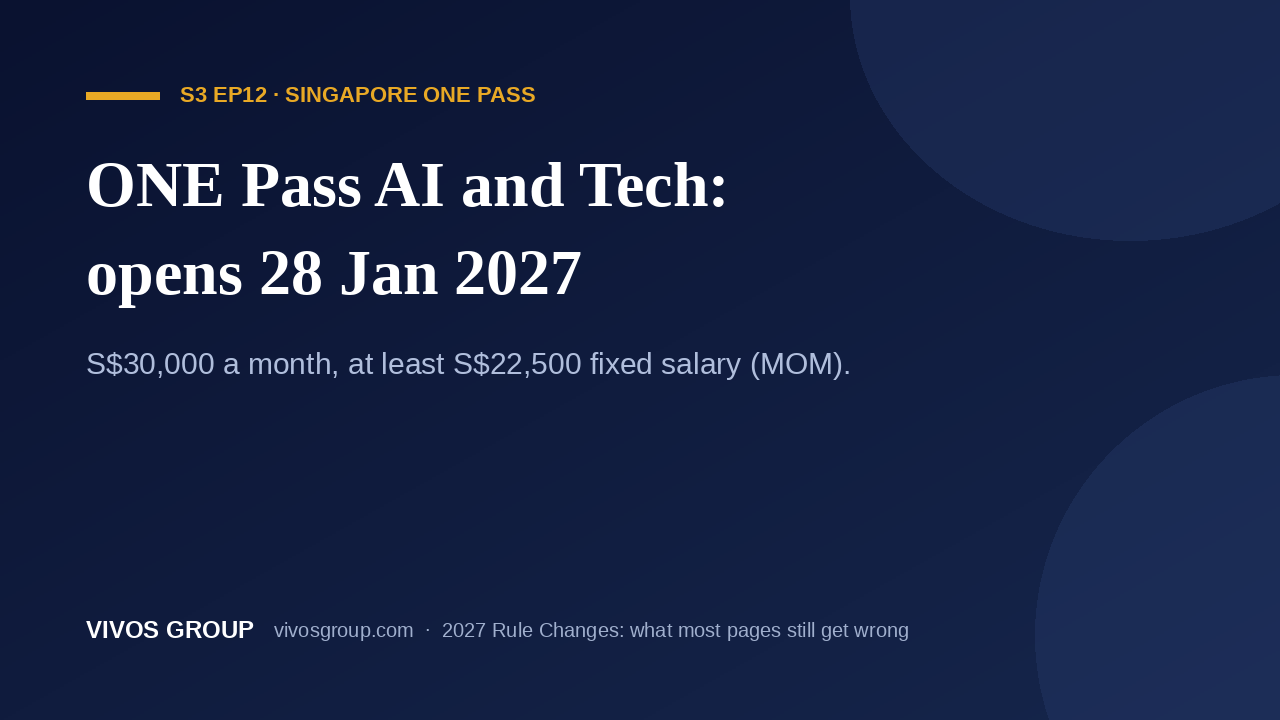
ONE Pass AI and Tech track: from 28 January 2027, MOM's ONE Pass (AI and Tech) track opens for applicants who earned at least S$30,000…
Malaysians face the same Employment Pass salary and COMPASS test as every other nationality. This guide covers what changes when a Malaysian founder sets up…